MagSafe is the kind of feature people discover by accident. A friend gets a new iPhone, slaps a wallet on the back, and suddenly realizes the thing they have been plugging in for years has been quietly redesigned. The magnets are not a gimmick, but they are also not magic. They are a set of precisely arranged components with a specific pull force, and that force degrades, shifts, and sometimes simply was never there in the first place. Checking the magnet before buying a phone, case, or accessory is a five-minute task that saves a lot of returned merchandise.
The core of the system is a ring of 18 magnets arranged around a central alignment magnet, all tucked inside the back of the phone. Apple specifies the layout, and accessory makers build to that spec. But here is the friction point: the phone's magnet is only half the equation. The case, the charger, the wallet, the battery pack, each one carries its own magnets or its own ferrous plate, and each one can be slightly off. A case that is 0.5 mm too thick can separate the charger from the phone enough to drop the connection entirely.
What the Spec Sheet Does Not Tell You
Every MagSafe accessory claims compatibility. Every case with a "magnetic" tag promises a secure fit. The printed specs usually list a pull force or a wattage rating, but those numbers come from a lab bench with a clean, bare phone. Real life involves silicone, plastic, metal, and the occasional dust bunny. A case rated for 15W charging might deliver 7.5W through a thick bumper, and a wallet rated for "strong hold" might slide off in a coat pocket.
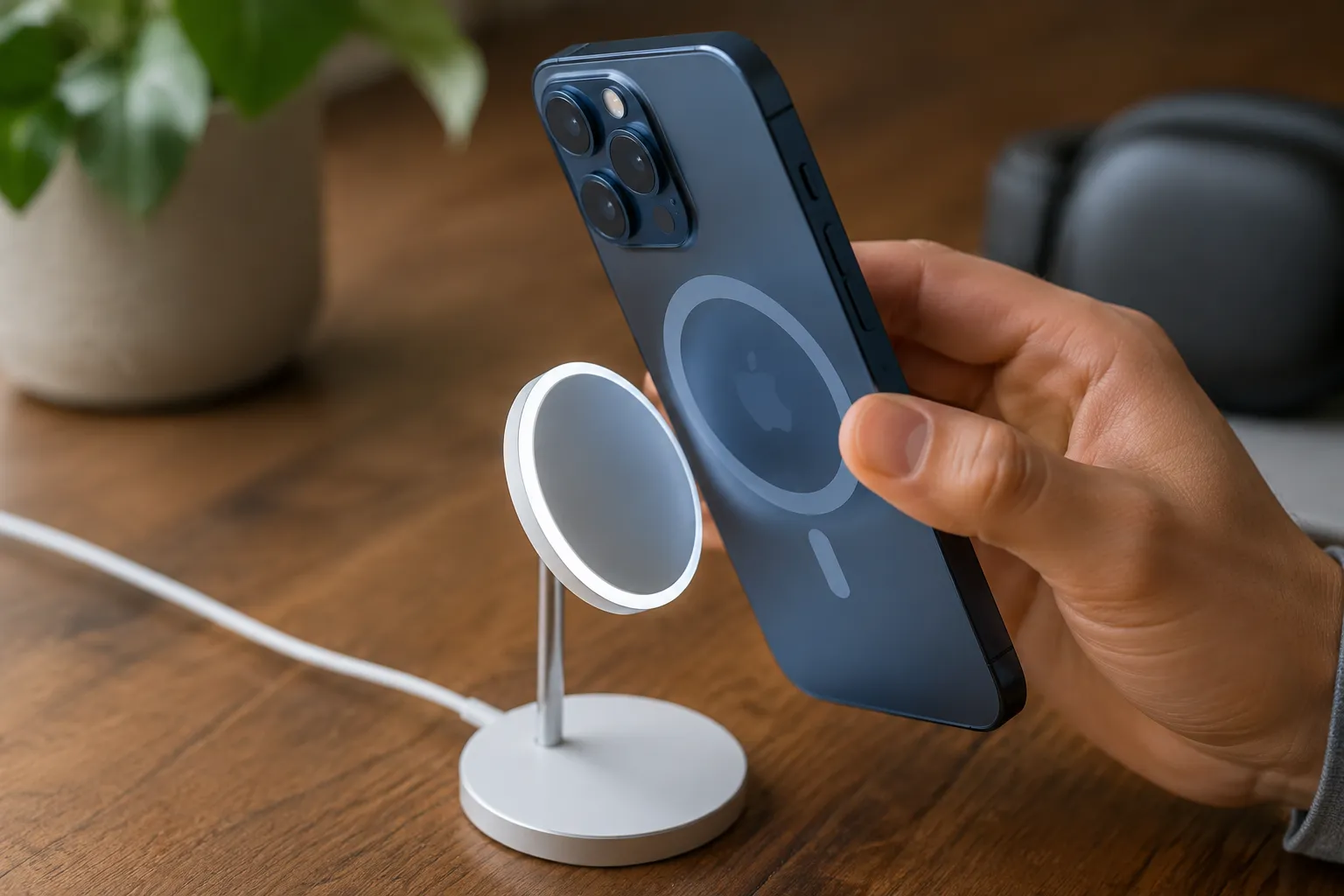
The practical check starts with a bare phone. Most Apple stores and carrier shops have display units, and a person can walk in, ask to test a charger, and feel the snap. The bare phone should click onto a MagSafe puck with a satisfying thud, and it should hold its position even when tilted vertically. If the phone slides or wobbles on the bare glass, the charger is either off-spec or counterfeit.
Then comes the case test. This is where most of the variance lives. A good MagSafe case has the magnet ring embedded close to the surface, usually with a thin layer of material between the phone and the accessory. A poor one uses a metal plate glued to the inside, which adds weight and messes with the alignment. The store test is simple: put the case on the phone, hold the charger against the back, and shake gently. No slide, no wobble, no dead spot when the charger moves around the center.
A person should also test the edge of the case, not just the center. Some cases have the magnet ring shifted slightly toward the camera bump, which means a charger placed dead center will not activate at all. Moving the charger a few millimeters should find the sweet spot, but the sweet spot should be in the middle, not off to one side.
The Wallet Problem and the Drop Test
MagSafe wallets are the accessory most likely to fail in daily use. They sit on the back of the phone, they hold cards, and they rely entirely on magnet strength to stay attached. The official Apple wallet holds well, but it is slim and holds only two or three cards. Third-party wallets often bulk up the capacity to five or six cards, and that is where the physics start to betray people.
Adding cards increases weight, and weight changes the leverage. A wallet loaded with five cards will pull away from the phone more easily when the phone is in a bag or a tight pocket. The standard pull force for a MagSafe wallet is around 0.8 to 1.2 kg of force, which sounds substantial until a pair of jeans applies lateral pressure. A person can do a simple home test: load the wallet to capacity, attach it to the phone, and shake the phone over a soft surface. If the wallet shifts at all, it will eventually come off in daily use.
The other geometry issue is the camera bump. On larger Pro models, the camera module sticks out enough that a wallet can rock slightly around it. A well-designed wallet has a cutout or a raised lip to stabilize against the bump. A cheap one just has a flat back, and it will feel loose even with strong magnets. The check is to press on the corners of the wallet after it is attached. Any rocking motion means the fit is poor, regardless of the magnet strength.
Counterfeit Pucks and the Heat Problem
Wireless charging generates heat, and heat is the enemy of both battery health and magnet performance. A genuine MagSafe puck has a specific thermal profile, with the coils and magnets arranged so that heat dissipates through the aluminum back. A counterfeit puck often skips the thermal management entirely, running hotter and potentially softening the adhesive that holds the magnet ring in place inside the phone.
Detecting a counterfeit without opening it is tricky, but two signs are reliable. First, the pull force. A fake puck often uses weaker, fewer magnets, and the phone will not snap into place with the same authority. Second, the alignment. Hold the phone upside down, a few centimeters above the charger, and let it drop. A genuine puck will catch the phone cleanly and hold it in perfect alignment. A fake one will let the phone slide to one side before settling.
The heat question matters more than most people realize. When a phone charges wirelessly at full speed, the battery warms up, and the magnetic components warm up with it. Over months of daily charging, that heat cycles can weaken the adhesive holding the magnet array to the phone's internal frame. Apple designs for this, using high-temperature adhesives, but the phone is still a consumer device with a finite lifespan. A person who uses cheap, hot chargers is shortening the magnet's effective life without knowing it.
Alignment Marks: What They Mean and Where They Lie
Many third-party accessories print a small alignment ring or dot on their surface, claiming it marks the exact center of the magnetic array. These marks are often wrong. A charger with a printed center circle might actually have its magnets offset by a few millimeters, either due to sloppy manufacturing or a deliberate design choice to accommodate a different phone model.
The real check is behavioral, not visual. Place the phone on the charger and start a charging session. Then try to nudge the phone slightly in each direction without lifting it. On a properly aligned charger, the phone will settle back to the same spot every time. On a misaligned one, the phone might hold a slightly different position and still charge, but at a lower wattage. The phone's battery settings screen shows the charging status, but it does not show the wattage. A person can use a USB power meter between the charger and the wall plug to see the actual draw. A genuine MagSafe charger at full speed draws around 18 to 20W from the wall. A misaligned or weak connection often draws half that.
That power meter is the most honest tool in the entire checking process. It does not care about marketing claims. It shows exactly how much energy is moving. A person who tests a handful of chargers with a meter will quickly see that the $10 puck and the $39 puck often deliver identical results, and that some expensive multi-device stands are surprisingly weak.
The Stand Test Nobody Runs
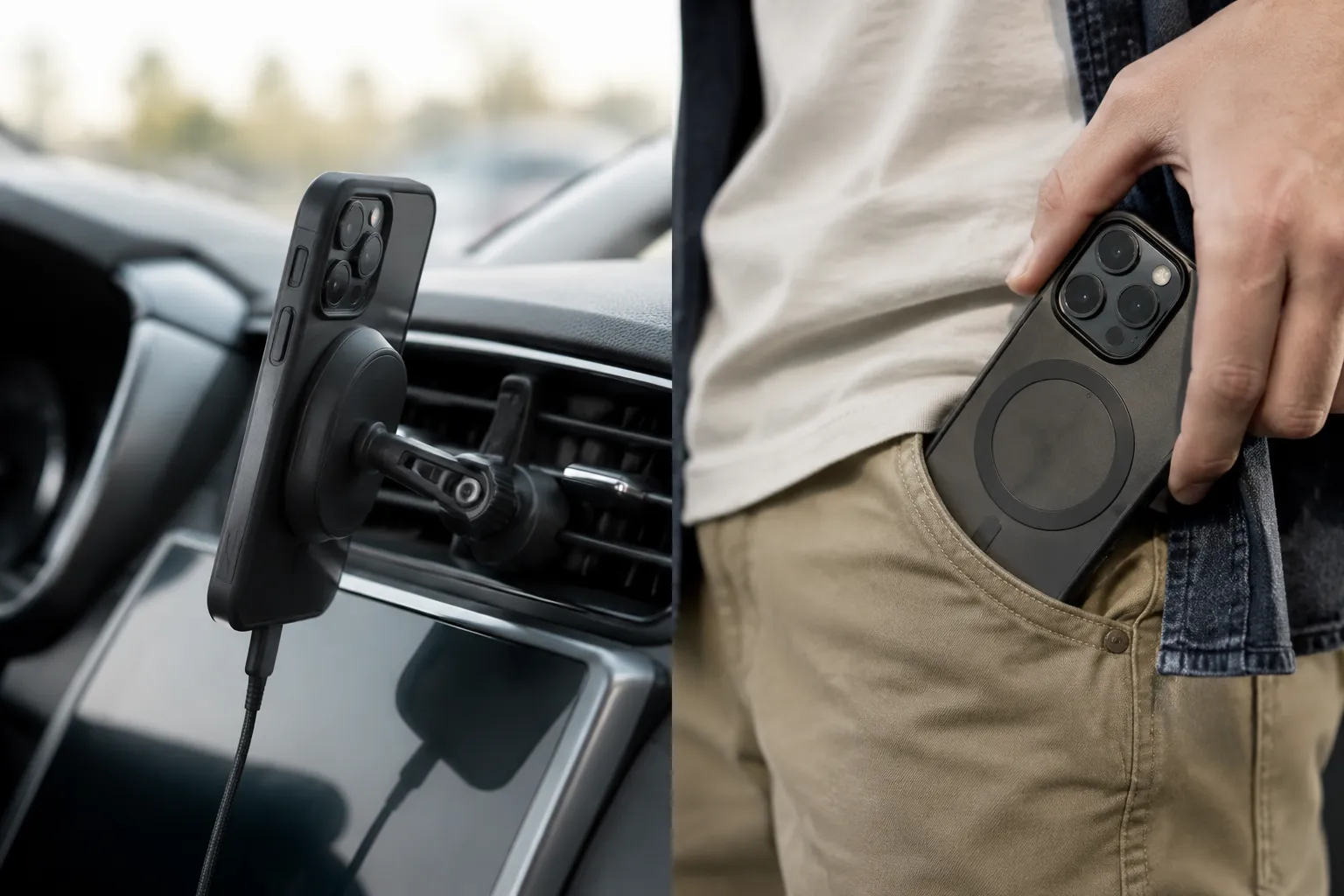
Desktop stands and car mounts introduce a third variable that flat chargers do not have: angle. A flat puck holds the phone horizontally, with gravity helping the magnets stay in contact. A stand holds the phone at an angle, often 60 to 75 degrees, which means the phone's weight pulls perpendicular to the magnet axis. This is a much harder test for the magnet array.
A person should test a stand with the phone in its case, because the angle changes the effective force. A stand that holds a bare phone perfectly might let a cased phone slide down slowly, especially if the case has a smooth, slick back. The test is to mount the phone, set it down, and give it a gentle tap on the top edge. On a good stand, the phone stays put. On a marginal one, it slides down a few millimeters and stops, which means it will gradually creep out of position over a long drive or a full workday.
The magnetic alignment in a stand is also more forgiving in some ways and less in others. A stand can have a larger magnet array in its base, which makes it easier to hit the phone's sweet spot. But many car mounts use a flat plate with a single strong magnet rather than a MagSafe-compatible ring. These mounts hold the phone fine, but they do not trigger the charging function, and they can interfere with the phone's internal compass if placed near the top of the device.
Case Materials Change the Math
The material of a case is not cosmetic. It is functional. Silicone cases have a high friction surface that grips the charger, which helps hold alignment. Leather cases are slicker, and the phone can slide on the charger even when the magnets are aligned. Polycarbonate cases are the middle ground, with moderate grip and moderate thickness.
Thickness is the real variable. Apple's own cases are 1.5 to 2 mm thick at the back, and the magnet ring sits nearly flush against the case's inner surface. Third-party cases often run 3 to 4 mm thick, especially rugged ones, and that extra distance weakens the magnetic coupling. The inverse square law governs magnet strength, which means doubling the distance between the phone and the charger roughly quarters the pull force. A 3 mm thick case can cut the effective magnet strength in half compared to a 1 mm case.
A person can check thickness without calipers by placing a bare phone on the charger, noting how strongly it snaps, then placing the cased phone on the same charger. If the snap is noticeably weaker, the case is too thick. If the phone charges but slides around, the case is too slick. If the phone does not charge at all, the case is both too thick and possibly has a metal plate that is interfering with the coil alignment.
Battery Packs and the Alignment Lottery
Portable MagSafe battery packs are the hardest accessory to evaluate because they are thick, heavy, and top-heavy. A battery pack can weigh 150 grams or more, which is heavier than most phones. The magnet has to hold that weight against gravity while the pack is also charging. Most packs have larger magnet arrays than a standard puck, but the extra weight still makes them prone to sliding.
The test for a battery pack is to attach it, hold the phone upright, and shake it with moderate force. If the pack stays put, it passes. If it shifts even slightly, it will come off in a bag or a pocket. Another test is to put the phone and pack in a jacket pocket and walk around for a few minutes. The lateral pressure from the fabric will find any weakness.
Some battery packs use a mechanical latch or a fold-out kickstand to supplement the magnets, which is a sign that the manufacturer knows the magnets alone are not sufficient. These designs are often more reliable, not because the magnets are stronger, but because the mechanical grip takes over when the magnetic force reaches its limit.
The Return Policy Test
The most practical check happens after purchase, not before. A person should buy from a retailer with a relaxed return policy and test the accessory for a full day, not just a few minutes in a store. Magnets behave differently over time. A pack that holds well when cold might weaken when warm from charging. A case that grips fine on a dry day might slide on a humid one. A wallet that stays put on a desk might fall off when the phone is pulled out of a tight pocket fifty times a day.
This extended testing period is the only way to catch the failure modes that are invisible in a store. The magnet check is not a single moment. It is a process of using the accessory in the real conditions where it will live. If the accessory survives a week of daily use without sliding off, dropping, or losing alignment, it is likely a good unit. If it fails once, it will fail again, and returning it is the right move.
The best way to verify MagSafe is ultimately not any of these individual tests in isolation. It is the combination of a bare-phone snap test, a cased-phone runtime test, a weight and angle check, and a full day of honest use. That combination filters out the counterfeit pucks, the too-thick cases, the slippery wallets, and the underpowered stands. It takes about an hour of total effort, and it separates the accessories that work from the ones that merely claim to work.