Drop protection has become a spec-sheet arms race, and the numbers have lost all meaning. A phone case claims 3-meter protection. Another cites MIL-STD-810G. A third says 6.6 feet, which sounds both precise and arbitrary. Consumers are left comparing figures that were never meant to be compared, from tests that were never meant to be marketed.
The dirty secret of the consumer electronics industry is that most drop ratings exist to win a bullet point on an Amazon listing, not to describe how a device survives a real fall. Understanding what these numbers actually measure, and more importantly what they fail to measure, requires a look at where the standards came from and how manufacturers bend them.
The MIL-STD myth: a military test that never tests drops
MIL-STD-810 is a real document, maintained by the United States Department of Defense, and it covers a lot of ground. It details how equipment should be tested for altitude, humidity, salt fog, sand and dust, vibration, and temperature extremes. When a rugged phone or a protective case claims compliance with MIL-STD-810G or the newer 810H, that certification can refer to any of dozens of individual test methods within the standard.
Here is the catch that marketing departments rarely explain: the standard does not dictate pass or fail criteria. It describes test procedures, not performance requirements. A manufacturer can run a test, watch the device shatter, and still claim the product was tested to MIL-STD-810G. The claim is technically accurate. The product simply failed, and that failure gets filed away.
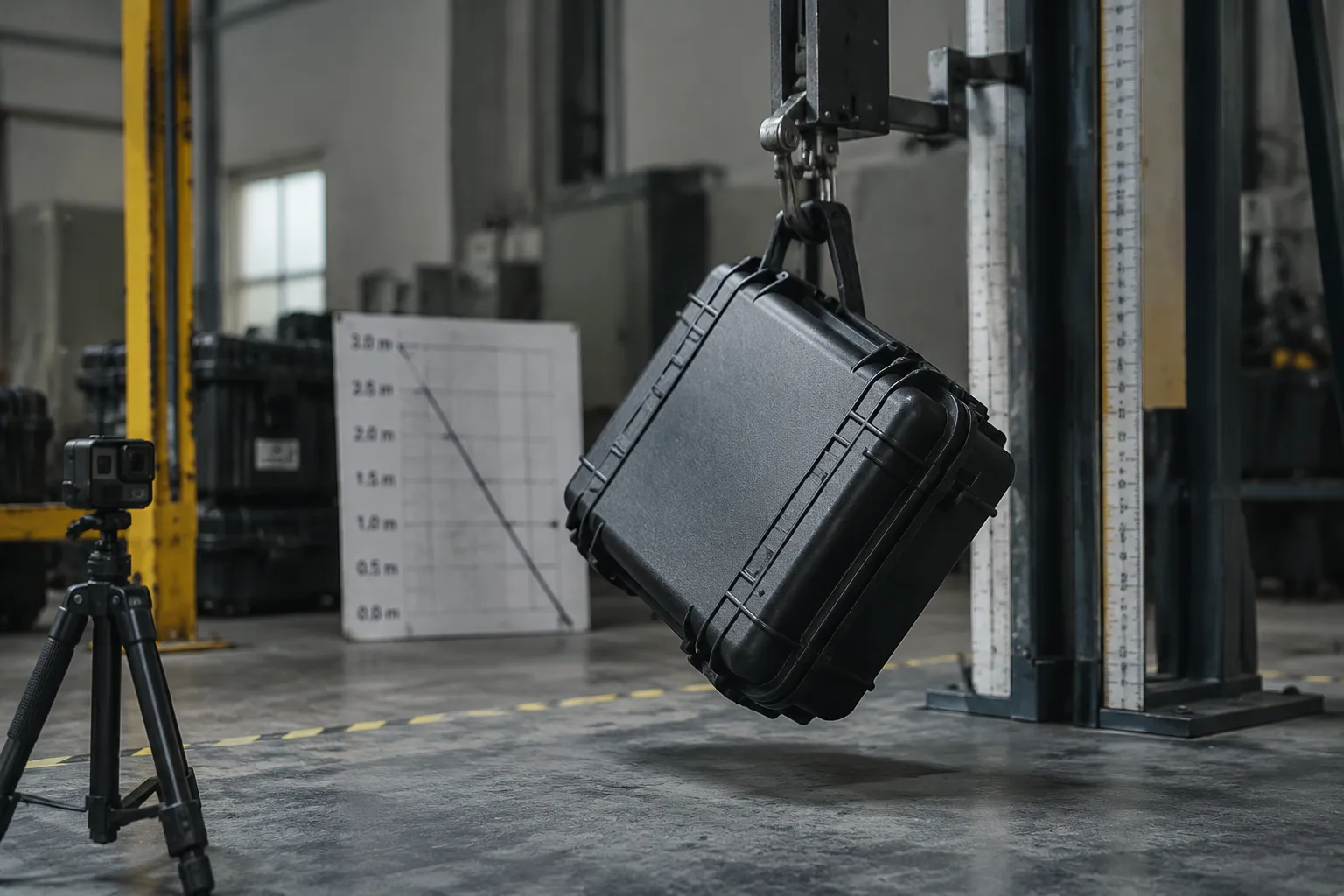
Drop testing exists in this standard under Method 516, and it specifies a height of 4 feet for most equipment. But the test is designed for military gear like radios and targeting devices, not consumer phones. The surface is typically plywood over concrete, which is forgiving compared to the asphalt and tile that phones actually meet. And the test drops each face of the device once, from a controlled orientation, with no tumble.
No case manufacturer subjects a product to 26 drops from 4 feet onto concrete and watches it survive. That kind of torture test would destroy most cases. Instead, the engineering team runs a few drops, photographs the results that look acceptable, and writes a press release.
What the meter count actually represents
The meter rating on a consumer case is entirely self-reported. No independent body verifies it. No standard methodology exists for claiming 3-meter protection versus 2-meter protection. Each company develops its own test protocol, which makes cross-brand comparisons meaningless.
A 3-meter rating from one manufacturer might mean a single drop onto carpeted plywood. Another brand's 3-meter rating could mean six drops onto granite from different angles. Both print the same number on the box. The consumer has no way to know which test produced the claim, because the test details live in internal documents, not on the packaging.
The height itself is misleading. A fall from a pocket is somewhere around 3 feet. A fall from a hand while walking is 4 to 5 feet. A fall from a face-time call on a second-floor balcony approaches 12 feet. The realistic range for most phone damage is 3 to 6 feet. Claiming 3-meter protection, roughly 10 feet, sounds impressive, but the physics of a 10-foot drop are dramatically different from a 4-foot drop. Impact velocity scales with the square root of height, so 10 feet produces about 60 percent more impact speed than 4 feet. Kinetic energy scales linearly with height, so the 10-foot drop hits with two and a half times the energy.
Most 3-meter claims deserve skepticism because the materials that make cases slim and attractive, polycarbonate, TPU, and aluminum, reach their structural limits well before 10 feet. A case can survive one 10-foot drop by distributing the impact across a wide surface area, but the second drop onto a corner will likely crack the frame or tear the bumper. The rating describes a single event, not a lifespan.
The corner drop problem
Ask any phone repair technician what kills screens, and the answer is consistent: corner impacts. A flat drop onto the face or back distributes force across a broad area. A corner drop concentrates every joule of energy into a single point, often the weakest structural area of both the phone and the case.
Case designers know this, which is why most protective cases feature reinforced corners. The thickest, stiffest material sits at each corner, sometimes with an air gap or a raised lip to keep the screen off the ground. This design approach works reasonably well for drops up to 6 feet, which is why so many cases claim that range. Beyond that, no amount of corner reinforcement saves a phone, because the frame itself bends.
The marketing problem is that corner drops are also the hardest to test consistently. A phone that lands perfectly on its corner at 10 feet might experience a different outcome than one that lands slightly off-axis, skidding across the pavement before stopping. The angle of incidence, the texture of the surface, and the phone's rotation at impact all matter more than the height alone.
Reputable manufacturers test from multiple angles at their claimed height and report the worst result. Less scrupulous ones drop the device on its back, which is the easiest orientation to survive, and let the number speak for itself. A 3-meter rating with no mention of drop orientation is a red flag.
Military tests versus everyday realities
The gap between MIL-STD testing and real-world drops is not just about height. Military drop tests assume equipment strapped to a soldier's vest or mounted to a vehicle. The drops are typically from a workbench or during handling, not from a running person's hand. The equipment is usually protected by a hard shell or a shock-absorbing mount, not a thin consumer case.
Real phone drops involve concrete, asphalt, and tile, surfaces with little give. They involve gravity combined with horizontal momentum, a phone slipping from a hand while walking or falling off a bike mount at speed. The impact angle changes constantly as the phone tumbles. Military drop tests drop a device flat onto a rigid surface from a controlled height. The two scenarios share almost nothing besides the word "drop."
Even the temperature tests in MIL-STD-810 matter more than consumers realize. The standard tests equipment from -40 to 160 degrees Fahrenheit, and consumer phones handle this range poorly. A phone left in a hot car on a summer day exceeds the operating range of its lithium-ion battery, and the frame materials become more pliable. A drop at 100 degrees Fahrenheit performs differently than a drop at 70 degrees, but no case manufacturer tests at these extremes, and no consumer expects them to.
Material thickness is the real spec
Strip away the marketing language and the actual protection comes down to a few engineering decisions. The first is the durometer of the TPU bumper, measured on the Shore A scale. A softer compound, around 60 to 70 Shore A, absorbs more impact but feels flimsy and attracts lint. A harder compound, around 90 Shore A, resists deformation but transfers more shock to the phone. The best cases use a dual-layer approach, a stiff polycarbonate shell for structure and a softer TPU inner layer for shock absorption.
The second decision is the screen lip. A case with a 2-millimeter raised edge protects the screen from flat drops. A case with a 1-millimeter lip, or no lip at all, leaves the glass vulnerable. The camera bump needs similar protection, a raised ring around the lens that keeps the glass from touching any surface.
The third decision is the air gap. Some cases use a honeycomb pattern or a series of small air pockets inside the back panel. These pockets compress on impact, absorbing energy before it reaches the phone's glass back. The concept is sound, but the air gap only works if the case maintains structural integrity. A thin case with an air gap is just a thin case.
A case that measures 2.5 millimeters thick with a 2-millimeter lip and a Shore A 70 bumper will protect a phone from most drops under 6 feet. A case that measures 1.5 millimeters thick with a flush lip will not, regardless of its MIL-STD claim. The physical dimensions tell the truth. The marketing copy does not.
Why the test numbers keep climbing
The escalation from 1-meter ratings to 2-meter to 3-meter and beyond follows a simple competitive logic. When every case in a price bracket claims 3 meters, the manufacturer claiming 4 meters gains a visible advantage, even if no consumer needs 4-meter protection. The numbers become a proxy for quality that consumers can compare at a glance, never mind that the underlying tests are incomparable.
This dynamic pushes manufacturers to design cases for the test rather than for real use. A case optimized for a 12-foot drop needs to be thick, heavy, and rigid, exactly the qualities that make cases unpleasant to carry. The rugged case category, brands like OtterBox and UAG, embrace this tradeoff. Slim cases cannot compete on drop height, so they compete on aesthetics and feel, often dropping their claims to a modest 6 to 8 feet.
The result is a market segmented by honesty. Rugged cases genuinely survive higher drops, and their claims reflect real engineering. Slim cases with 3-meter ratings are either lying about their test protocol or have designed a case that performs well in one narrow test scenario and poorly everywhere else. A consumer choosing between a 3-meter slim case and a 6-foot rugged case is comparing a guess against a warranty.
Reading between the listed numbers
The practical way to evaluate drop protection is to ignore the headline number and look for three things. The first is a published test protocol. A manufacturer that describes its drop procedure, including surface type, number of drops, and drop orientation, has done actual engineering work. A manufacturer that just prints a height has not.
The second is the corner design. The case should have visible reinforcement at all four corners, whether a thicker bumper segment, a raised internal rib, or a separate molded piece. Flat, uniform cases hide their weakness until the first corner impact.
The third is the warranty. Companies that back their drop claims with a damage warranty, even a limited one, have skin in the game. Companies that offer only a 30-day return policy are betting against the case ever meeting its rated height.
Real drop protection has not changed much in a decade. The materials are the same. The physics are the same. What changed is the marketing vocabulary, and it has made honest comparison nearly impossible. The next time a case claims MIL-STD-810G compliance or 3-meter protection, the right question is not whether the number is true. The right question is what test produced it, and whether that test resembles the floor in a parking garage. In most cases, it does not.