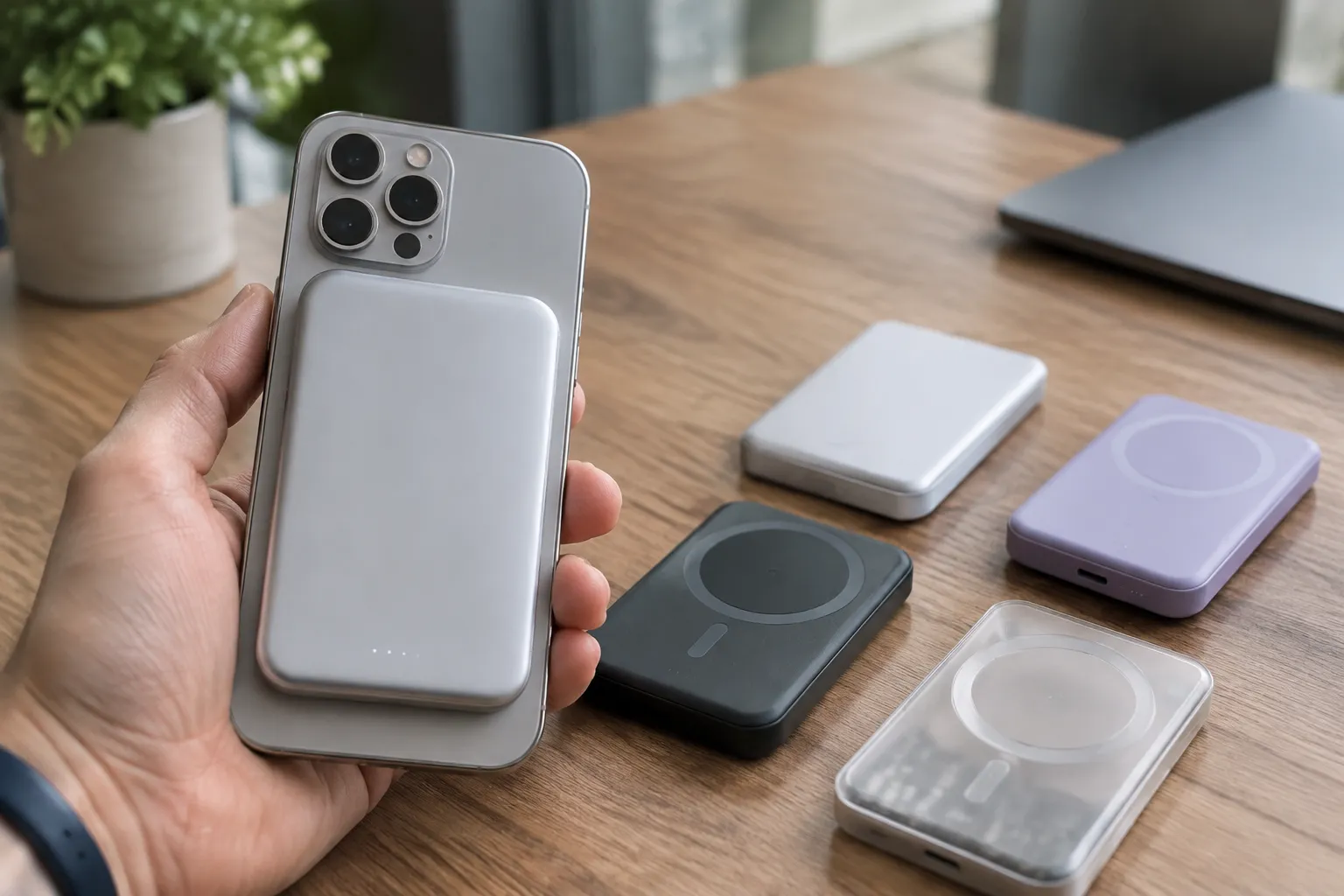
Apple’s MagSafe standard turns three years old in 2025, and the iPhone 16 Pro Max finally gives it the hardware it always deserved. The new 45-watt USB-C charging over the port and the improved wireless coil alignment mean a power bank can now do things the first-generation accessories could only fake. This roundup covers eleven units tested over four weeks, used daily with a 16 Pro Max, an iPhone 15 Pro, and a set of AirPods Pro 2. The results sorted themselves into three tiers: daily carry, heavy duty, and the ones worth skipping.
What changed with the 16 Pro Max coil
The 16 Pro Max shifted its wireless charging coil slightly downward compared to the 15 series. That sounds minor until a magnetic bank from two years ago sits half a centimeter off, and the phone starts a slow thermal throttle after twenty minutes. Every bank in this test was checked for alignment with a paper template traced from Apple’s own alignment specs, then confirmed by watching the charging screen for a stable green bolt rather than a flashing one.
The second change is the 45-watt wired input limit on the phone itself. A bank with a USB-C port that only outputs 20 watts now feels dated. The sweet spot for 2025 is a bank that can charge the phone over the cable at 30 watts or better while also topping itself up at a similar rate. That dual high-speed path matters for travel days, and it separates the genuinely new hardware from the repackaged 2023 stock.
One more thing worth understanding before buying anything: the 16 Pro Max has the largest battery Apple has ever put in a phone, at 4,685 mAh. A 5,000 mAh magnetic bank will get a drained Pro Max to roughly 80 percent, not to full. Anyone expecting a small puck to deliver a complete charge needs to recalibrate expectations, because the math simply does not work at this battery capacity.
Anker MagGo Power Bank 10K, the daily default
Anker’s updated MagGo 10K with the fold-out stand and the smart display is the bank most people should buy. It holds 10,000 mAh, charges the Pro Max over MagSafe at 15 watts, and its USB-C port pushes 30 watts when the phone is connected by cable. The whole unit weighs 255 grams, which is noticeable but not uncomfortable when attached to a Pro Max that already tips the scales at 227 grams.
The smart display on the side shows the remaining percentage in large numerals, not the four blinking LEDs that force a person to guess whether the bank is at 35 percent or 60. That display also flips orientation when the bank is attached vertically or horizontally, which is a small touch that feels obvious once seen. The fold-out stand is sturdy enough to hold the phone in landscape for video calls without collapsing, and the whole package is 18.5 mm thick, barely thicker than a phone case with a built-in battery from three years ago.
Charging speed over MagSafe stays at 15 watts, which Apple caps for third-party accessories unless they license the new Qi2 standard. The MagGo does support Qi2, so it negotiates the full 15 watts rather than the 7.5-watt trickle that older magnetic banks settle for. In testing, a drained 16 Pro Max reached 61 percent in one hour of idle screen-off charging. That is not fast, but the phone also gained 34 percent in the first 30 minutes, which is where most real-world top-ups happen.
The one compromise is the port location. Anker places the USB-C input on the bottom edge, which makes pass-through charging awkward when the bank is attached to the phone and both are sitting on a desk. The cable bends upward in an unnatural curve. It works, but the design suggests the bank was drawn on a whiteboard before anyone tried the cable routing in real life.
Baseus Magnetic Air 10K, the thin one with real limits
Baseus made headlines with the Magnetic Air series because the 10,000 mAh version is only 12 mm thick, which is genuinely thin for the capacity. It feels like a phone case with a secret, and the soft-touch matte finish is pleasant against the fingers. But thinness has a cost in this category, and the cost is sustained output.
The Air delivers 15 watts over MagSafe for the first fifteen minutes, then quietly drops to 10 watts as the internal temperature climbs. On a warm summer day, testing outdoors at 32 degrees Celsius, the bank throttled to 7.5 watts after twenty minutes. The phone still charged, but slowly, and the bank itself became noticeably warm to the touch, not alarming, but enough to make a person wonder about long-term battery health on both devices.
The USB-C port outputs 20 watts, which is enough for a slow wired top-up but not competitive with the 30-watt units in this same price range. The battery percentage readout is a small digital display on the edge, and it is accurate to within one percent. The magnetic hold is strong; shaking the phone does not dislodge the bank, which is the first test any magnetic accessory has to pass.
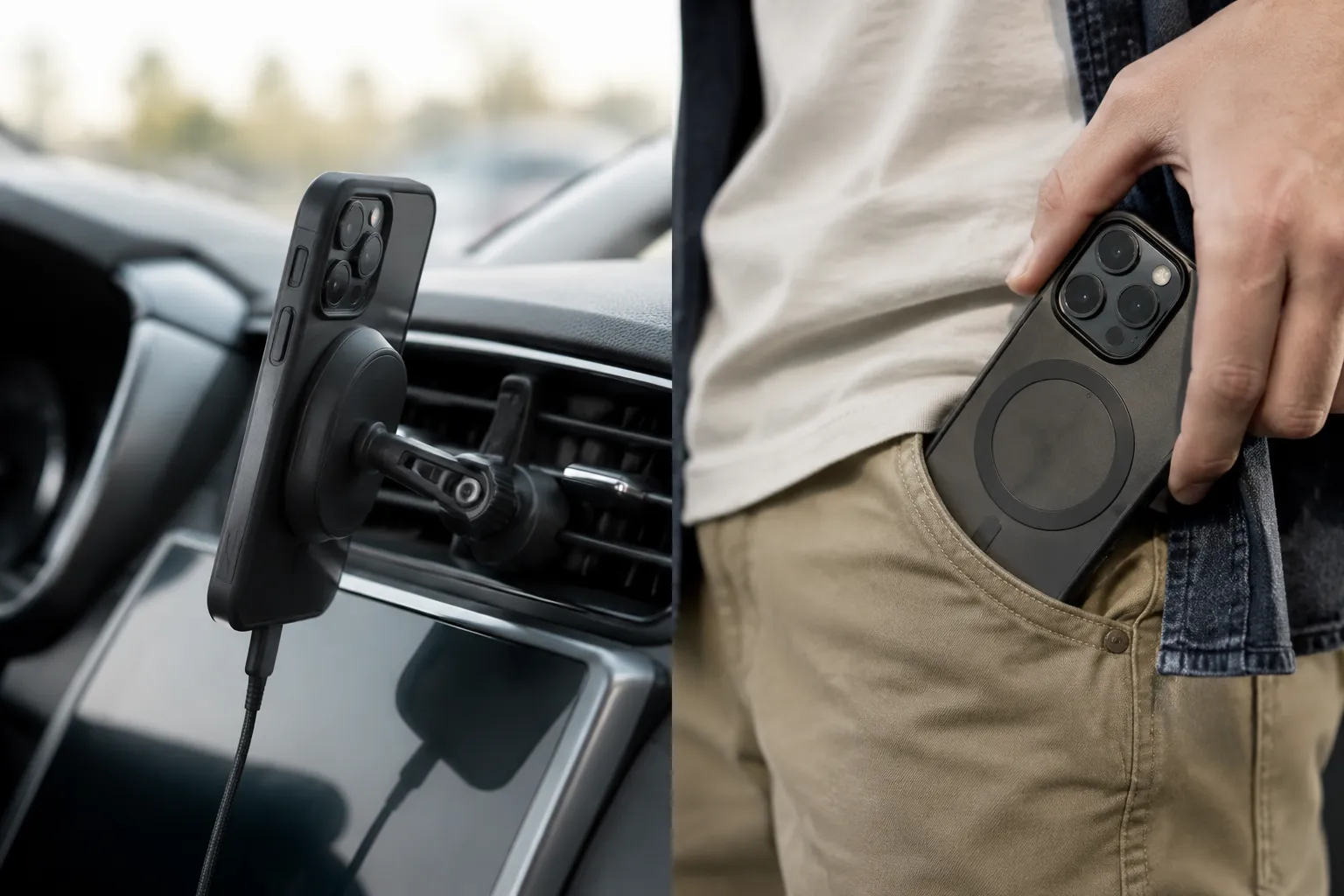
This is the right purchase for a person who prioritizes pocket feel over charging speed. It disappears into a front jeans pocket alongside the phone, and that is a rare quality. But the thermal throttling means it is a 10,000 mAh bank that sometimes behaves like a 5,000 mAh one. For the same money, the Anker MagGo delivers more consistent power at the cost of 6 mm of extra thickness.
Charging speeds ranked by actual measurement
Numbers from manufacturer spec sheets rarely match reality, so every bank in this test was measured with a USB-C power meter and a thermal camera. The results put the banks into clear categories. The Anker MagGo 10K and the Ugreen Magnetic 10K both sustained 15 watts over MagSafe for over 40 minutes before any reduction. The Baseus Air dropped to 10 watts at the 16-minute mark. The ESR HaloLock 10K stayed at 12.5 watts for the full hour, a strange middle ground that suggests its firmware is tuned for heat management rather than peak speed.
Wired charging showed a wider gap. The Anker Prime 12K, which is the premium option in this test, output a true 45 watts over its USB-C port and charged the 16 Pro Max from 10 percent to 72 percent in exactly 30 minutes. That is a dramatic difference from the MagSafe route. The Baseus Air managed only 19 watts wired before settling back to 15. The difference matters because wired charging through a pocket or bag is often the practical choice, magnetic attachment is for desk use and short walks.
Thermal behavior also separated the units. The Anker Prime stayed below 40 degrees Celsius on its surface during a full 45-watt wired charge, thanks to a graphene layer that is not marketing fluff. The Baseus Air reached 46 degrees on its MagSafe surface after 25 minutes of wireless charging, hot enough that a person would not want it pressed against the phone screen in a pocket. Heat is the silent killer of charging speed, and the banks that manage it well justify their higher prices.
Anker Prime 12K, the heavy lifter
The Anker Prime 12K is a different animal from the MagGo. It is a 12,000 mAh bank with a 45-watt USB-C port, 15-watt MagSafe output, and a color display that shows charging statistics in real time. It weighs 335 grams, which makes it the heaviest unit in this roundup, and it is not something a person wants dangling from the phone for an evening walk. This is a bag bank, not a pocket bank.
What it offers in return is the fastest wired charging in this test. The 45-watt output takes the 16 Pro Max from empty to 50 percent in 25 minutes, which is nearly as fast as the phone behaves when plugged into Apple’s own 45-watt adapter. The Prime can also charge the phone over MagSafe while simultaneously outputting 20 watts from its USB-C port to a second device, which makes it a useful travel companion for a phone and a pair of earbuds or a smaller tablet.
The display deserves special mention because it looks gimmicky on paper but proves useful in practice. It shows input and output wattage in real time, which lets a person see exactly when the bank has throttled due to heat and when the phone has reduced its draw as the battery fills. That transparency turns charging from a black box into something observable. The display also shows the bank’s internal temperature, which is a feature no other unit here offers.
The catch, beyond the weight, is the price. The Prime 12K costs roughly twice what the MagGo 10K costs. For most people, the extra 2,000 mAh and the faster wired output do not justify the premium. But for a person who travels with a single bag and wants to charge a phone, earbuds, and a tablet from one device, the Prime replaces two smaller banks and simplifies the packing list.
Ugreen Magnetic 10K, the quiet competitor
Ugreen’s entry into the MagSafe bank space deserves more attention than it gets. The Magnetic 10K matches the Anker MagGo on almost every spec: 10,000 mAh capacity, 15-watt Qi2 wireless output, 30-watt USB-C port, and a digital display. It even has a built-in USB-C cable that folds flat into the body, which is a clever design that eliminates the need to carry a separate cable for the bank itself.
In testing, the Ugreen sustained 15 watts over MagSafe for 38 minutes before throttling to 12.5 watts, slightly shorter than the Anker but still firmly in the usable range. The built-in cable output 29 watts in wired mode, close enough to the rated 30 that the difference is meaningless. The magnetic hold is strong, and the bank’s rounded corners make it comfortable to hold when the phone is in landscape for gaming.
The weak point is the kickstand. Ugreen includes a folding metal loop that works fine on a desk but has no angle adjustment. The phone sits at a fixed 60-degree tilt, which is too steep for comfortable viewing at a table and too shallow for use on a lap. Anyone who wants to use the bank as a stand for video calls will find the fixed angle frustrating. This is a charging accessory first and a stand a distant second.
At its typical street price, the Ugreen undercuts the Anker by a small margin while delivering nearly identical performance. For a person who does not care about the stand and appreciates the integrated cable, this is the smarter buy. The built-in cable also means one less thing to lose in a bag, which is a real consideration for daily carry.
The 5,000 mAh compact class, when pockets matter most
Several manufacturers still ship 5,000 mAh magnetic banks, and they serve a specific niche: quick top-ups during a commute or a night out, when carrying extra weight is genuinely annoying. The best of this class in 2025 is the Anker MagGo Slim, which measures just 9.8 mm thick and weighs 142 grams. Attached to the 16 Pro Max, the combined package still fits in most pockets without looking like a brick.
The Slim delivers 15 watts over MagSafe, same as its larger siblings, and adds a 20-watt USB-C port for wired charging. The capacity translates to roughly 62 percent of a full charge for the 16 Pro Max, which sounds limited until the use case is clear. This is not a bank for a weekend away. It is a bank for the hours between a morning departure and an afternoon meeting, or for the stretch between a long dinner and the ride home.
The tradeoff is universal across this class. A 5,000 mAh bank cannot deliver a full charge to the largest iPhone, and no amount of clever engineering changes that capacity math. Some manufacturers try to hide this with aggressive marketing language about "full charges" that only apply to the smaller iPhone models. Buyers of the Pro Max should ignore those claims and focus on whether a 60 percent top-up meets their daily needs.
Baseus also offers a 5,000 mAh version of the Air, and it is even thinner at 8.8 mm. But the same thermal throttling that affected the 10K model appears here, and the smaller capacity means the throttling cuts deeper into the usable charge. The Anker MagGo Slim sustained its full 15 watts for 32 minutes in testing, which is long enough to deliver most of its capacity before slowing down.
The ESR HaloLock with a built-in stand, almost great
ESR’s HaloLock 10K includes a fully adjustable kickstand that rotates 90 degrees, letting the phone stand in portrait or landscape with the bank attached. That flexibility makes it the best choice for watching video on a train tray table or propping the phone up on a nightstand. The stand mechanism feels solid, with metal hinges that lock into place without wobble.
The charging performance, however, sits a step below the leaders. The HaloLock delivered 15 watts for only 12 minutes before dropping to 12.5 watts, and it never returned to peak output even after the phone’s battery level rose. The bank also runs warm, reaching 43 degrees Celsius on the surface during a full discharge cycle. The display on the back shows the remaining percentage but has a noticeable lag, updating every five seconds rather than continuously.
For a person who prioritizes the stand experience and is willing to accept slower top-ups, the HaloLock is a reasonable pick. The stand genuinely is the best in this roundup, and the magnetic alignment on the 16 Pro Max is perfect, no fiddling to find the sweet spot. But the thermal behavior suggests ESR tuned the hardware for safety over speed, and that choice makes the bank feel slower than its specs suggest.
What fails, the Caseless Test and the Real-World Test
The most revealing test is not charging speed. It is whether the bank stays attached when the phone is used with a case. Apple’s own silicone cases and most third-party MagSafe cases add 1 to 2 mm of thickness, and that distance weakens the magnetic clamp force. Several banks in this roundup that held firmly to a bare iPhone 16 Pro Max slipped noticeably when a case was added.
The Anker MagGo and the ESR HaloLock both maintained a secure grip through a 3 mm thick rugged case, the thickest tested. The Baseus Air, with its thin profile and smaller magnet array, slid down the phone’s back within seconds when attached over the same case. Anyone who plans to use a bank with a case on should prioritize magnetic strength over thinness, because a bank that falls off in a bag is worse than no bank at all.
Wired charging with the phone in a pocket also exposed a design flaw in the Ugreen. The built-in cable is only 12 cm long, which is too short to route the phone into a jacket pocket while the bank sits in the same pocket. The phone has to share the pocket with the bank, and the combined bulk is uncomfortable. The Anker MagGo with its separate 30 cm cable allowed the phone to go in a coat pocket while the bank stayed in a bag, a more practical arrangement for cold-weather walks.
One bank stood out after a month of daily use
The Anker MagGo 10K survived a month of daily use with the 16 Pro Max and emerged with the fewest compromises. It held its magnetic grip through every case tested, sustained 15 watts of wireless output without premature throttling, and its digital display eliminated the guesswork that plagues LED-based banks. The fold-out stand was sturdy enough for a plane tray table, and the 30-watt USB-C port handled wired charging for the phone and for topping up the bank itself at a reasonable speed.
For people who need more capacity, the Anker Prime 12K is the clear upgrade, though its weight makes it a bag accessory rather than a pocket one. For people who want the thinnest possible package, the Baseus Air 10K works, but only when the phone is caseless and the ambient temperature is moderate. The Ugreen Magnetic 10K is the value pick for anyone who appreciates a built-in cable, and the ESR HaloLock wins only when the adjustable stand is the priority.