The smartphone case market split in two somewhere around 2015. One branch went thin, slick, and disposable, plastic shells that yellowed in six months and got tossed into a drawer. The other branch went bulky and tactical, slabs of rubberized polymer that looked like they belonged on a set of power tools. Leather and magnets occupy the narrow ground between those two failures. It is a strange combination, one organic and one industrial, but together they solve the real problem with premium cases: not protection, but the slow erosion of desire.
Most people buy a case the way they buy a band-aid. It is a necessary evil, a layer of ugliness that preserves the phone underneath. The case gets swapped when it gets gross, or when the phone itself is replaced, and nobody mourns the thing. A leather case with magnets does not work that way. It changes the relationship. The case becomes the object, and the phone becomes the component inside it. That reversal is the entire point, and it is worth understanding how the materials pull it off.
The Case for Patina Over Perfection
Synthetic materials fail by accumulation. A polycarbonate shell gets scratched, and each scratch is a small death. The surface is the product, and once the surface is marred, the product is ruined. There is no recovery, no narrative, just a slow slide into looking like garbage. This is why most cases feel disposable even when they cost seventy dollars. They are engineered to be perfect for a day and then decline forever.
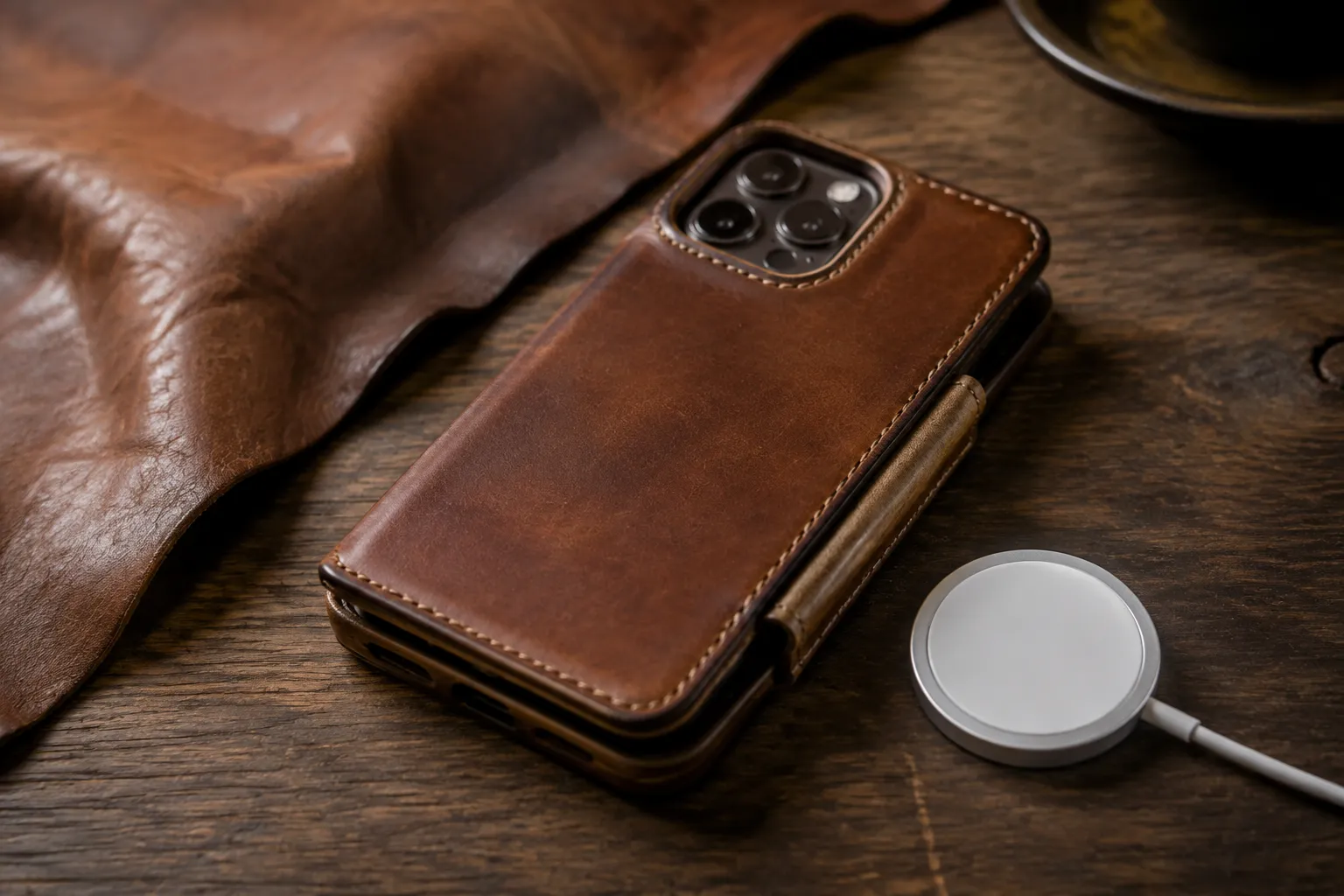
Leather runs the opposite direction. Full-grain leather, specifically, the kind that still has its natural surface intact, does not decline. It transforms. A scratch lands on the surface and becomes part of the record. The color deepens where hands grip it daily. The edges darken with oils from pockets and palms. A well-worn leather case tells a story that a plastic one cannot, because it was never trying to stay the same.
This is not a metaphor. The chemistry is real. Leather is hide, and hide is a matrix of collagen fibers that absorb oils and moisture. Every time a hand wraps around the case, a little sebum transfers to the surface. That oil darkens the dye and softens the fibers. The case literally molds to the way a person holds it. A left-handed person will wear a different pattern than a right-handed person. Nobody designs that. It just happens.
The catch is that this only works with real leather. Bonded leather, the stuff made from ground-up scraps glued together, does not patina. It peels. It is a plastic product with a leather flavor. A person shopping for a case that ages well needs to check the material description the way a person checks an ingredient label, because the word "leather" alone guarantees nothing.
Why Magnets Are Not a Gimmick
Magnetic closures on cases are older than smartphones. Flip cases used them for years, a little disc of metal in the flap that clicked against a magnet in the back shell. That was a functional necessity, keeping the cover shut in a bag. Modern cases use magnets for something else entirely, and the shift is worth appreciating.
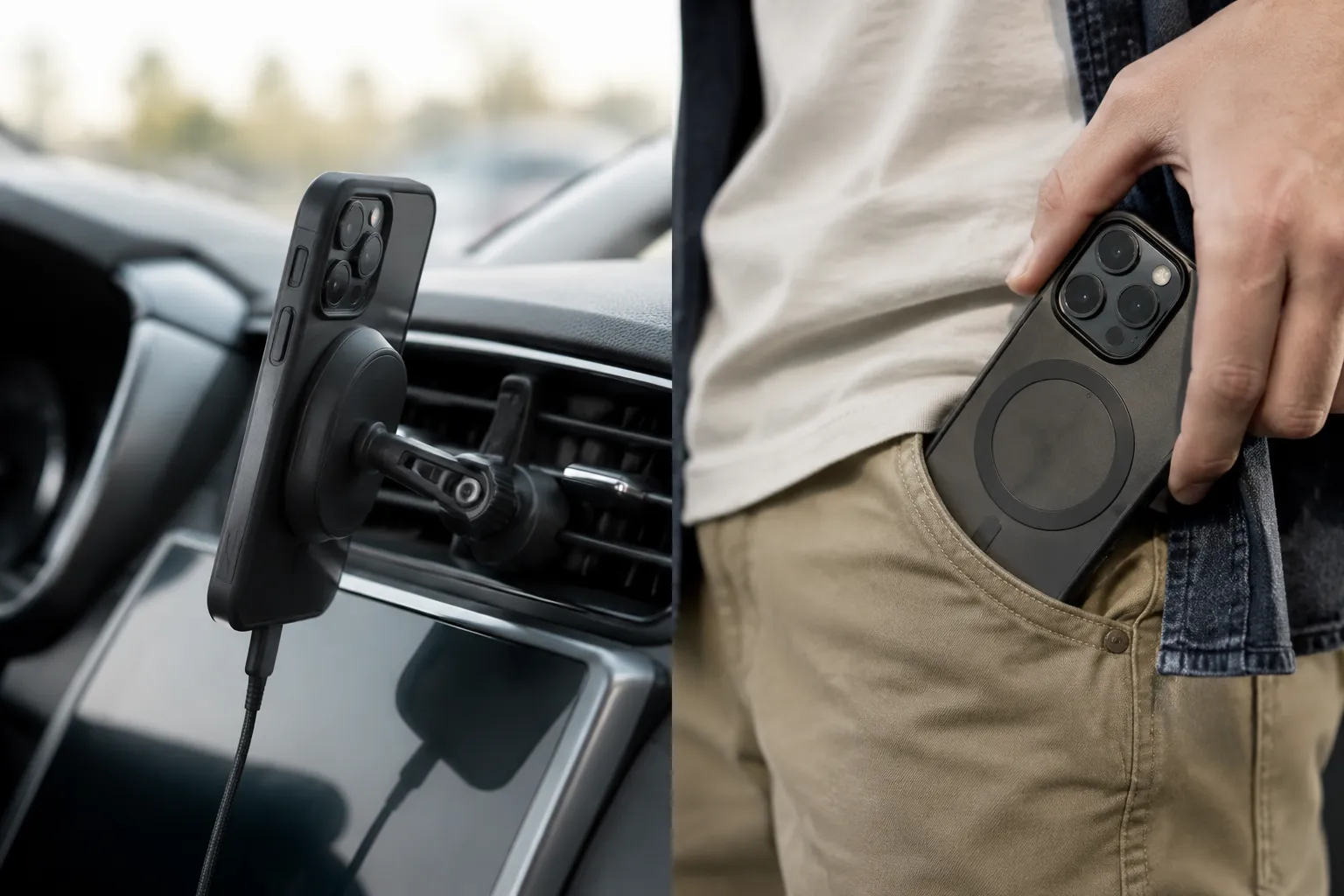
The modern ecosystem revolves around the MagSafe standard, a ring of magnets embedded in the back of recent iPhones. Android manufacturers have been slower to adopt the standard, but the accessory market has filled the gap with adhesive magnetic rings. The result is that a case now serves as an interface. It is not just armor. It is the mounting point for a wallet, a battery pack, a car vent holder, a desk stand.
A leather case with a built-in magnetic ring becomes the rare accessory that improves with age while remaining functionally current. The leather develops character. The magnets stay strong, because rare-earth magnets do not wear out in any practical sense. They lose a fraction of their pull over decades, not months. The combination offers something almost contradictory: an old, worn exterior and a perfectly precise mechanical core.
The alignment matters more than most people expect. A cheap case with a loosely toleranced magnet ring will wobble on a charger or slide off a mount at the worst moment. The good cases use a machined ring or a precisely placed array that snaps into place with an audible click. That click is not a luxury detail. It is the difference between a case that works with the phone and a case that fights it.
The Weight of a Good Cover
Nobody talks about the weight of a case, which is strange, because it is the first thing a person notices. A naked phone has a certain heft, a dense slab of glass and aluminum. Slap a cheap case on it, and the balance shifts. The phone becomes top-heavy or bottom-heavy. It feels like a brick in the pocket. Premium cases obsess over this balance, and leather offers a distinct advantage.
Leather is light. A full-grain leather back panel adds a fraction of the weight of a polycarbonate shell with a rubber bumper. A leather case with a metal frame and magnetic ring will still weigh less than a cheap dual-layer case from the hardware store. This is not a minor convenience. The difference between 40 grams and 70 grams is the difference between remembering the phone is in a pocket and constantly checking for it.
The texture also changes the grip equation. A bare phone is slippery. A plastic case is slippery in a different way, often glossy and prone to sliding off a sloped surface. Leather has natural friction. The surface grips the hand without requiring a death grip. It also grips fabric, which means the case is less likely to slide out of a jacket pocket or off a car seat. This is the quiet utility of the material, the thing that sells itself the first time a person tries to pick the phone up one-handed.
There is a downside, and it deserves honesty. Leather is not as protective as thick polymer on impact. A leather back panel will not absorb a drop from head height as well as a honeycomb-structured plastic shell. The trade is real. A person who drops a phone daily should buy a rugged case and accept the aesthetic compromise. A person who wants a case that feels good in the hand every day for three years should consider leather, and learn to hold the phone.
The Magnet and the Wallet Problem
The magnetic wallet is the most popular accessory in this ecosystem, and it exposes a design tension. A leather case with a magnetic back can hold a leather wallet on the outside, which makes the whole assembly a leather sandwich. This looks great for about a week. Then the wallet develops its own patina, and the case develops its own, and they do not age at the same rate. The color mismatch becomes permanent.
Some users embrace this. The two pieces become distinct, the case darkening from hand contact while the wallet darkens from being pressed against the case. Other users find it unbearable. They want the whole surface to age as one unit. The market has responded with products that fuse the two functions, a case with an integrated card slot on the back. These work, but they remove the modularity. A person cannot swap a card holder for a battery pack without changing the whole case.
The better solution, and the one that ages most gracefully, is to use the magnet for what it does best: temporary attachment. A wallet that clicks on when leaving the house and clicks off when the phone goes on a wireless charger. The repeated clicking is the point. Each cycle wears the leather slightly, darkens the corners, and builds a history. The wear is not damage. It is the system working as intended.
The Case That Outlives the Phone
Most cases die with their phones. The plastic degrades, the buttons fall off, or the color becomes so unpleasant that the case gets retired early. Leather cases have a different trajectory. A good one will outlast the phone it was built for. The leather will still be fine after two years. The magnets will still hold. The question becomes whether the case can fit a new phone, and that depends on the manufacturer.
Apple's MagSafe standard has remained stable across several generations, so a leather case from an older iPhone model often fits a newer one if the dimensions stayed close. Third-party manufacturers have started building cases to the same standard, and the good ones publish compatibility charts. A person who buys a leather case from a brand that commits to the standard can sometimes carry the same case across two or even three phones. That is a strange and wonderful thing in an industry built on planned obsolescence.
The patina becomes a record of the phones it has protected. The scuffs from the first phone remain. The color from the second phone's era is slightly different. The case becomes an artifact, a timeline of ownership that no plastic shell could ever produce. This is the real argument for the category. It is not about protection or grip or even aesthetics. It is about buying something once and watching it become personal.
A person who buys a cheap case every six months will never understand this. The case is a utility, replaced when it fails. A person who buys a leather case with a magnet ring makes a different bet. The bet is that the daily object, the thing touched hundreds of times a day, deserves to be an object of small pleasure. The bet is that a case can be more than a band-aid.
The leather will darken. The edges will soften. The magnets will click. And one day, the phone inside will be obsolete, and the case will go into a drawer, and it will still look better than the day it came out of the box. That is the whole trick. Everything else is just marketing.