There is a strange gravitational pull toward the thinnest possible phone case, as if a millimeter of polycarbonate somehow makes the thousand-dollar computer in a pocket feel less like a liability. The iPhone 16 generation has quietly shifted that equation. The built-in kickstand, once a feature relegated to rugged bricks and budget afterthoughts, has gone mainstream, and Apple's MagSafe magnet array has made the accessory ecosystem sticky in a way that feels deliberate. The cases that matter now are the ones that admit the phone will be propped up, leaned against something, and watched for two hours without a hand cramping. The best of them do this without turning the device into a clumsy slab.
The tension is real. A kickstand adds bulk, and bulk is the enemy of the pocket. MagSafe adds a ring of magnets that can interfere with the stand's hinge mechanism if the engineering is lazy. Yet several manufacturers have figured out how to make both features coexist, and the results are surprisingly specific in their personalities. Some stands are stiff and require two hands. Some snap open with a satisfying click. Some rotate, some do not. Some cases feel like furniture, others feel like fabric. The differences matter more than the spec sheets suggest.
The Stand That Disappears Into the Case
The most elegant solution on the market comes from a company called Smartish, which has been quietly making wallet cases for years. Their iPhone 16 offering, the Gripster, hides the kickstand inside the back panel, flush with the surface, so the case feels like a normal case until a finger finds the tiny lip and pulls. The stand is a full loop that swings out from the bottom third of the case, and it locks into place with a firm detent that does not loosen over months of use. The whole thing rotates 360 degrees, which matters more than people expect. Landscape is obvious, but portrait mode with the phone propped at a slight angle for FaceTime or a scrolling session changes the ergonomics completely.
The tradeoff is that the Gripster is not a thin case. It has a rubberized texture that feels closer to a tire than to glass, and the corners are reinforced to a degree that makes the phone look armored. That texture is the point. The grippy sides mean the phone does not slide off a thigh or a car seat, and the kickstand loop doubles as a finger hook for people who hold the phone one-handed in bed. It is a case designed for actual use, not for looking pretty on a desk. The MagSafe ring is embedded cleanly and holds a wallet attachment without wobble, though the thickness of the case means the magnet pull is slightly weaker than on a bare phone. Charging works through it, which is the only metric that truly counts.
Smartish also offers a slimmer option, the Kraft, which uses a built-in stand that folds flat into a recessed cutout. That one trades the full loop for a single aluminum tab that props the phone at one fixed angle. It is less versatile but noticeably thinner in the hand. The choice between the two comes down to whether the rotation matters. For video calls and recipe reading, the fixed angle is fine. For anything involving a charger cable while watching, the full loop wins.
The Heavyweight That Earns Its Bulk
OtterBox has spent years selling the Defender series as the default answer to clumsy hands, and the iPhone 16 version finally includes a built-in stand without making the case feel like a brick from 2012. The stand is a thick plastic strip that slides out from the lower back and clicks into place with a very audible snap. It is stiff, deliberately so, and it holds the phone at a steep angle that works well on a desk but poorly on a soft surface like a bed or a couch cushion. The stiffness is the tradeoff. A loose stand flops, and an OtterBox stand does not flop.
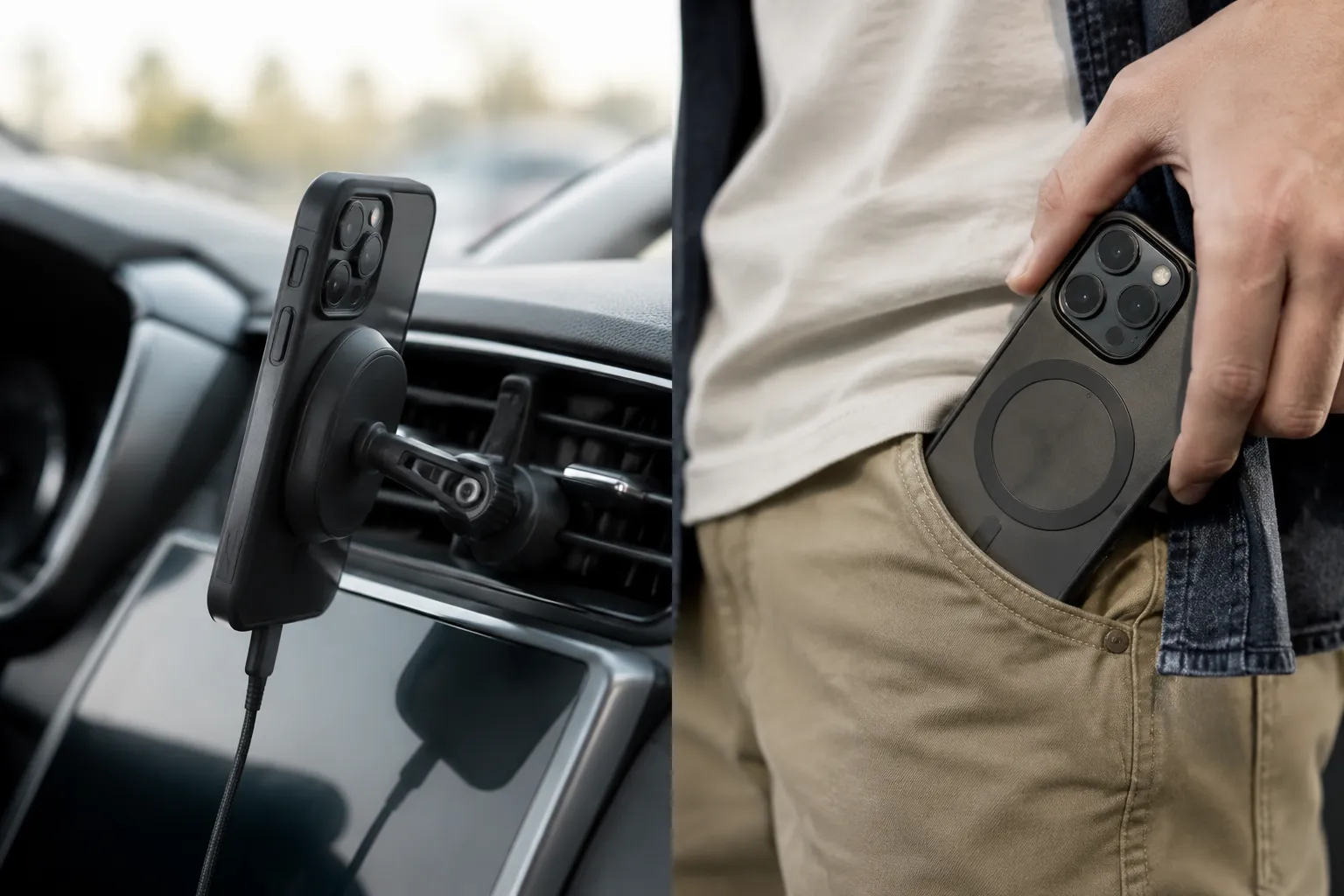
The MagSafe implementation here is a port in the back plate, a recessed circle of exposed magnets rather than a smooth embedded ring. That means the back of the case has a visible circular depression, which looks odd at first but functions flawlessly. Accessories snap on with an audible click, and the magnetic hold is strong enough to support the weight of the phone dangling from a magnetic car mount. The case also has a belt clip holster in the box, a relic that some will ignore and others will find indispensable. The kickstand angle is fixed, no rotation, which feels like a missed opportunity given the size of the device. But for people who drop phones weekly, the Defender is the only case on this list that survives a two-story fall onto concrete without drama.
The real surprise with the Defender is the new texture. The rubberized back has a soft-touch coating that resists fingerprints, and the edges are contoured enough that the case does not feel like holding a brick. It is heavy, no question, but the weight distribution is balanced so the phone does not tip over when propped in the stand. That balance is harder to achieve than it sounds. Several competitors with lighter cases tip backward the moment the phone vibrates with a notification.
The Slim Case That Refuses to Compromise
The thinnest credible option comes from Torras, a brand that has carved a niche in the slim-case market with a stand that folds flush and uses a hinge made of a hardened steel alloy. The case itself is barely thicker than a standard silicone sleeve, and the stand is a circular disc that rotates and locks at any angle. The engineering is genuinely impressive. The disc sits in a recessed ring on the back, and a fingernail pries it out of a tiny notch. Once out, the disc rotates freely and holds its position through friction rather than detents, which means the phone can be set at virtually any angle between 15 and 90 degrees.
The catch is that the stand is small, about the diameter of a quarter, so the phone rests on a single point of contact. On a hard desk, this is stable. On a textured surface or a lap, it slides. The small footprint also means the phone wobbles slightly when typing on the screen while propped. The Torras case exists for people who prioritize pocket feel above everything else and want a stand for occasional use, not for marathon viewing sessions. The MagSafe ring is strong, and the case comes in matte finishes that resist the greasy fingerprints that plague glossy cases.
Torras also sells a version with a folding metal tab instead of the rotating disc. That version is slightly thicker but offers a more stable two-point contact when propped in landscape. The rotating disc is the more interesting product, though, because it enables a trick no other case on this list manages: propping the phone in portrait at a low angle so it leans against a coffee mug or a stack of books, creating a makeshift standing dock for reading. It is a niche use case, but once discovered, it becomes a habit.
The Folding Ring That Doubles as a Grip
ESR has bet heavily on the halo-lock ring design, a circular metal ring that folds flat into the back of the case and swings out to become either a finger grip or a kickstand. The iPhone 16 version of their MagSafe case is the most polished iteration yet. The ring is wide enough to slide two fingers through comfortably, and it locks into place at 90 degrees for a landscape stand or at a lower angle for portrait viewing. The hinge is the weak point on most ring designs, but ESR has reinforced it with a detent mechanism that clicks audibly at the key positions.
The ring approach has one clear advantage over a fold-out tab: it provides a grip point that changes how the phone feels in the hand. A person can hold the phone by the ring with one finger, which makes one-handed use dramatically easier on the larger Pro Max models. The ring also allows the phone to be hung from a hook or a rod, useful in a kitchen or a workshop. The disadvantage is that the ring protrudes slightly even when folded flat, which creates a tiny bump on the back that some people can feel when the phone sits in a pocket.
The MagSafe alignment on the ESR case is excellent, with a magnet array that mirrors the phone's internal layout closely enough that accessories snap on with satisfying precision. The case itself is a hard polycarbonate back with soft TPU edges, a combination that offers drop protection without the bulk of a dual-layer design. The camera bump is protected by a raised lip that clears the lenses by a safe margin. This is the case to buy for someone who wants one accessory to serve as both grip and stand, and who does not mind the slight protrusion on the back.
The Leather Option for People Who Refuse Plastic
Apple's own lineup of cases has a gap. The Clear Case with MagSafe does not include a stand, and the Silicone Case with MagSafe added a built-in stand this year, but it is a flimsy tab that props the phone at one fixed, awkward angle. The third-party leather options are sparse because leather and moving parts do not mix well. One company, Mujjo, has solved this with a leather case that hides a metal kickstand under a flap of full-grain leather. The stand is a single aluminum plate that folds out from the bottom edge and locks at two angles, roughly 55 and 70 degrees.
The leather develops a patina over months of use, which means the case looks better in June than it does in September. The kickstand mechanism is hidden so well that the case looks like a standard leather folio from the outside, with no visible seam or cutout betraying the hardware underneath. The MagSafe ring is embedded under the leather, and the magnetic hold is strong enough for wallet attachments but not quite strong enough for a magnetic car mount with a heavy phone. The leather also adds grip, which offsets the slipperiness of the bare iPhone back.
This is a niche product for a specific buyer: someone who wants the warmth and texture of leather, refuses to use a plastic case, and still wants the functionality of a kickstand. The tradeoffs are real. The leather adds thickness, the stand has only two angles, and the case does not offer the drop protection of a dual-layer design. But for desk work and travel, it is the most refined option available. The leather smells like leather, which sounds like a throwaway detail until a person has spent a year with a plastic case and forgotten what natural materials feel like.
The Stand That Rotates Without a Lock
Spigen has re-entered the kickstand conversation with a case called the Ultra Hybrid S, which uses a rotating ring that spins freely without detents. The ring is a full circle, not a half-moon, and it rotates 360 degrees with a smooth, damped motion. The lack of locking positions means the ring can be set at any angle and stays where it is put, but it also means the ring has a tendency to drift over time as vibrations from notifications slowly rotate it. The ring folds flat when not in use, and the case is transparent, showing off the iPhone 16's color.
The free-spinning ring is a personal preference question. Some people hate it because the phone never sits at the exact same angle twice. Others love it because it allows micro-adjustments that locked stands cannot match. The ring also functions as a finger grip, though it is less comfortable than the ESR ring because it is thinner and narrower. The clear polycarbonate back is scratch-resistant but not scratch-proof, and it will yellow over a year of UV exposure. Spigen ships two clear back panels in the box, acknowledging that the first one will eventually discolor.
The MagSafe implementation is solid, with a visible circular magnet array embedded in the clear back. The case is a two-piece design, a TPU bumper that snaps around the phone and a polycarbonate back plate that clips onto the bumper. The process of installing and removing the case is more fiddly than a one-piece design, but the payoff is a case that feels more rigid and protective than a single-piece flexible shell. For people who want to see the phone's color and still have a functional stand, this is the best option.
The Decision Comes Down to Angles
Every case on this list solves the same problem differently, and the differences are not cosmetic. The Smartish Gripster offers the most versatile stand with its rotating loop, at the cost of bulk and a rubberized texture that not everyone will like. The OtterBox Defender offers the most rugged protection and a rock-solid stand, but it is heavy and its fixed angle limits its usefulness. The Torras slim case disappears into a pocket but sacrifices stability when propped. The ESR ring case adds a grip that changes how the phone feels in the hand. The Mujjo leather case brings a material warmth that plastic cannot match. The Spigen Ultra Hybrid S shows off the phone's color while offering an adjustable ring that drifts lazily.
The iPhone 16 generation has made the built-in kickstand a default expectation rather than a specialty feature, and the market has responded with a range of engineering solutions that vary widely in quality. The cases that fail are the ones that treat the kickstand as an afterthought, a flimsy plastic tab that snaps off after a month or props the phone at an angle that makes the screen unwatchable. The cases that succeed treat the stand as a primary feature, designing the hinge, the detent, and the footprint with the same care as the drop protection and the MagSafe alignment. A case with a badly designed stand is worse than no case at all, because it lulls a person into propping the phone in a situation where it will inevitably tip over.
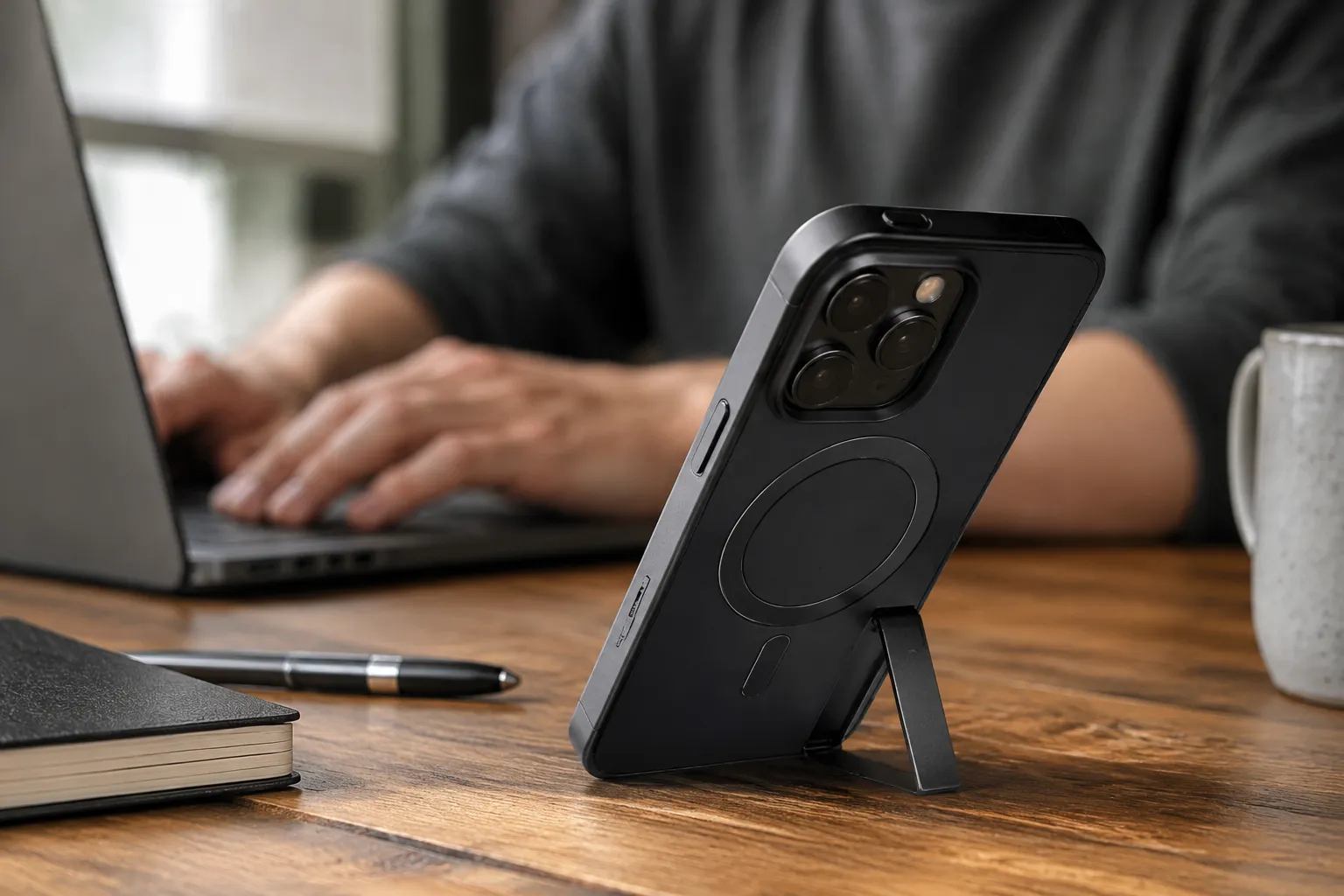
The concrete test for any of these cases is simple. Set the phone propped in landscape on a kitchen counter, then walk across the room and look at it from a distance. If the angle is too low, the screen washes out. If it is too high, the phone is unstable. The best cases hit a sweet spot around 60 degrees, where the screen is visible from across a room and the center of gravity stays safely within the footprint of the stand. The Smartish and the Mujjo hit this angle best. The OtterBox sits slightly steeper, which works for a desk but fails on a coffee table. The Torras requires a hard, flat surface to feel secure. The ESR ring holds steady at whatever angle the user sets.
There is no single best case, only the right tradeoff for a particular set of habits. A person who watches video during lunch at a desk needs a different case than a person who props the phone on a nightstand to fall asleep to a podcast. The good news is that the market has matured to the point where the choice is no longer between a flimsy stand and a thick case. The choice is about which compromises are acceptable, and those compromises are now specific enough that a buyer can match a case to a lifestyle with real precision. The build quality across these six options is uniformly high, which means the decision comes down to the small things: the feel of the texture, the sound of the detent, the way the phone settles into a pocket. Those small things are exactly what a case is for.