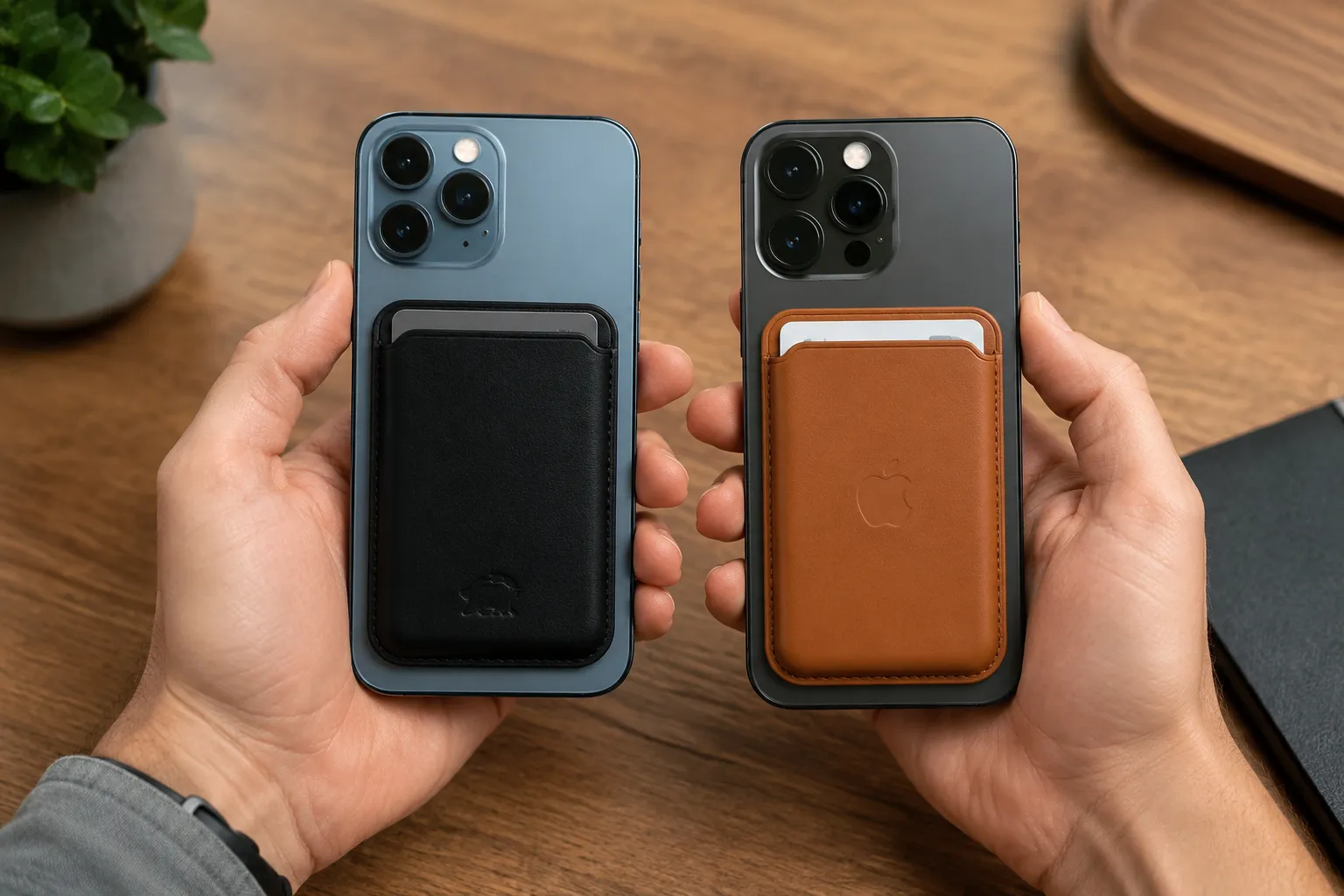
The magnet tug-of-war between Apple's own MagSafe wallet and the third-party competition has been settled in parking lots, on subway cars, and against the brick walls of coffee shops since 2020. After years of testing both, the honest answer is that Apple's leather sleeve holds tighter than almost everything else on the market, but that single advantage does not make it the better product. The trade-offs run deeper than a pull test.
Apple's wallet, officially called the iPhone MagSafe Wallet, uses an array of magnets arranged in a specific pattern that aligns with the magnets buried inside every iPhone 12 and later model. Third-party wallets from companies like PopSocket, Spigen, Moft, and Bellroy have to work with the same magnetic footprint, but they do not all use the same magnet strength or the same arrangement. Some of them cheat by adding a thicker magnet array or by relying on a friction lip that wraps around the phone's edge. The result is a market where "MagSafe compatible" means very little on its own.
The first real test is the shake test. A person grabs the phone, snaps the wallet on, and then shakes the device like a cocktail shaker. Apple's wallet stays put. The PopSocket wallet with the built-in grip also stays put, but only because the grip itself gives a hand something to hold, which changes the physics of the shake. The Moft Snap and Go, which doubles as a stand, slides off after about eight good shakes. The Spigen magnetic wallet, which costs half as much as Apple's, slides off after four.
Those numbers come from a person who has tossed phones onto couches, dropped them into bags, and accidentally sat on them. The real world does not shake phones deliberately, but it does subject them to sudden jolts. A wallet that survives a vigorous shake will survive a car door. A wallet that slides off after four shakes will eventually slide off in a coat pocket.
The Magnet Spec That Actually Matters
Apple does not publish the pull force of its wallet magnets, but independent tests and teardowns consistently show the wallet uses a ring of magnets with an advertised holding force around 4.5 newtons on the phone's back. That sounds technical until a person realizes that a typical iPhone weighs about 2.5 newtons. The wallet can technically hold more than the phone itself, which is why Apple's wallet will cling to the back of a phone even when the phone is dangling upside down.
Third-party wallets rarely match that figure. The good ones, like Bellroy's MagSafe wallet and the Moft Snap and Go, hover around 3 to 3.5 newtons. The cheaper ones dip below 2 newtons, which means they can hold the weight of a few cards but not the weight of a phone swinging at the end of a wrist strap. The magnet strength is not a marketing detail. It is the entire product.
There is also the question of the magnet array's diameter. Apple's wallet uses a circular magnet arrangement that matches the phone's internal magnet ring with near-perfect alignment. Third-party wallets that use a smaller or larger ring create a weaker hold even when the total magnet count looks similar on paper. The gap between the wallet's magnets and the phone's magnets is the difference between a firm click and a vague wobble.
What Apple's Own Wallet Gets Right
Apple's wallet has one trick that no third-party wallet has replicated successfully: the Find My integration. The wallet contains a chip that lets the iPhone show the wallet's last known location in the Find My app. When the wallet detaches from the phone, the phone sends a notification. This has saved countless wallets from restaurant booths and taxi back seats. The chip lives inside the wallet's body and does not require a battery. It draws power from the phone when the two are in contact.
The leather on Apple's wallet is also genuinely good. The current version uses a specially tanned leather that develops a patina over time. A person who buys the saddle brown color will watch it darken and scuff in ways that look intentional. The wallet's stitching is clean, with no loose threads even after a year of daily use. The card slot is tight enough that cards do not slip out on their own but loose enough that a thumb can push them out without a fight.
Apple's wallet holds three cards max. That is not a marketing constraint; it is a physical one. The magnet needs to pull against the phone's back through the leather and the cards, and every additional card weakens the hold noticeably. Two cards feel nearly identical to an empty wallet. Three cards feel slightly looser. Four cards will not fit, and forcing them in stretches the leather permanently.
The Third-Party Advantage: Features Apple Refuses to Build
Apple's wallet does one thing: it holds cards. The third-party market has decided that one thing is not enough. PopSocket's MagSafe wallet includes a collapsible grip that turns the phone into something a person can hold securely with one hand. The grip folds flat when not in use, and the whole thing is rated for wireless charging, which means a person can leave it attached and still charge the phone on a MagSafe puck.
Moft's Snap and Go wallet doubles as a kickstand with two viewing angles. It props the phone up for FaceTime calls or video watching, and the stand mechanism uses a folded leather design that snaps open and shut. The wallet holds three cards, same as Apple's, but it adds about three millimeters of thickness when folded flat. The trade-off is that the kickstand is the first thing to wear out. After six months of daily opening and closing, the hinge gets loose, and the phone starts to sag during video calls.
Spigen's wallet, the cheapest of the group at around thirty dollars, skips the leather and uses a synthetic material that feels like rubberized plastic. It has no special features, no Find My chip, and no stand. What it has is a wider magnet array that grips the phone with surprising force for the price. The material does not scuff, does not stain, and wipes clean with a wet finger. It is the wallet a person buys when they want something that works and does not care about aesthetics.
Bellroy's MagSafe wallet sits in a strange middle ground. It costs nearly as much as Apple's wallet, uses premium leather that feels better than Apple's, and includes a card slot that can hold up to three cards plus a folded bill. The extra bill space is the standout feature. Apple's wallet cannot hold cash, which is a genuine limitation for people who still carry the occasional paper bill. Bellroy's wallet adds a thin pocket behind the card slot that hides a folded twenty without adding noticeable bulk.
The Daily Grind: Pockets, Desks, and Car Mounts
The real test of a MagSafe wallet is not the shake test or the magnet spec sheet. It is the daily routine of taking the wallet off and putting it back on. Apple's wallet comes off with a clean sideways slide. The leather edges are rounded, so a thumb can grip the side and push. The third-party wallets with square edges or rubberized coatings require a different motion: a pry from the bottom edge, which feels awkward and risks bending a card.
Every person who uses a MagSafe wallet has to deal with the moment when they want to charge the phone wirelessly in the car. Apple's wallet comes off and slides into a pocket. The Moft wallet with its folded stand comes off but is bulkier in a pocket. The PopSocket wallet, with its collapsible grip, takes up an entire pocket by itself. The Spigen wallet slips into a pocket easily but slides out just as easily, and more than one person has lost it to a shallow pocket while reaching for keys.
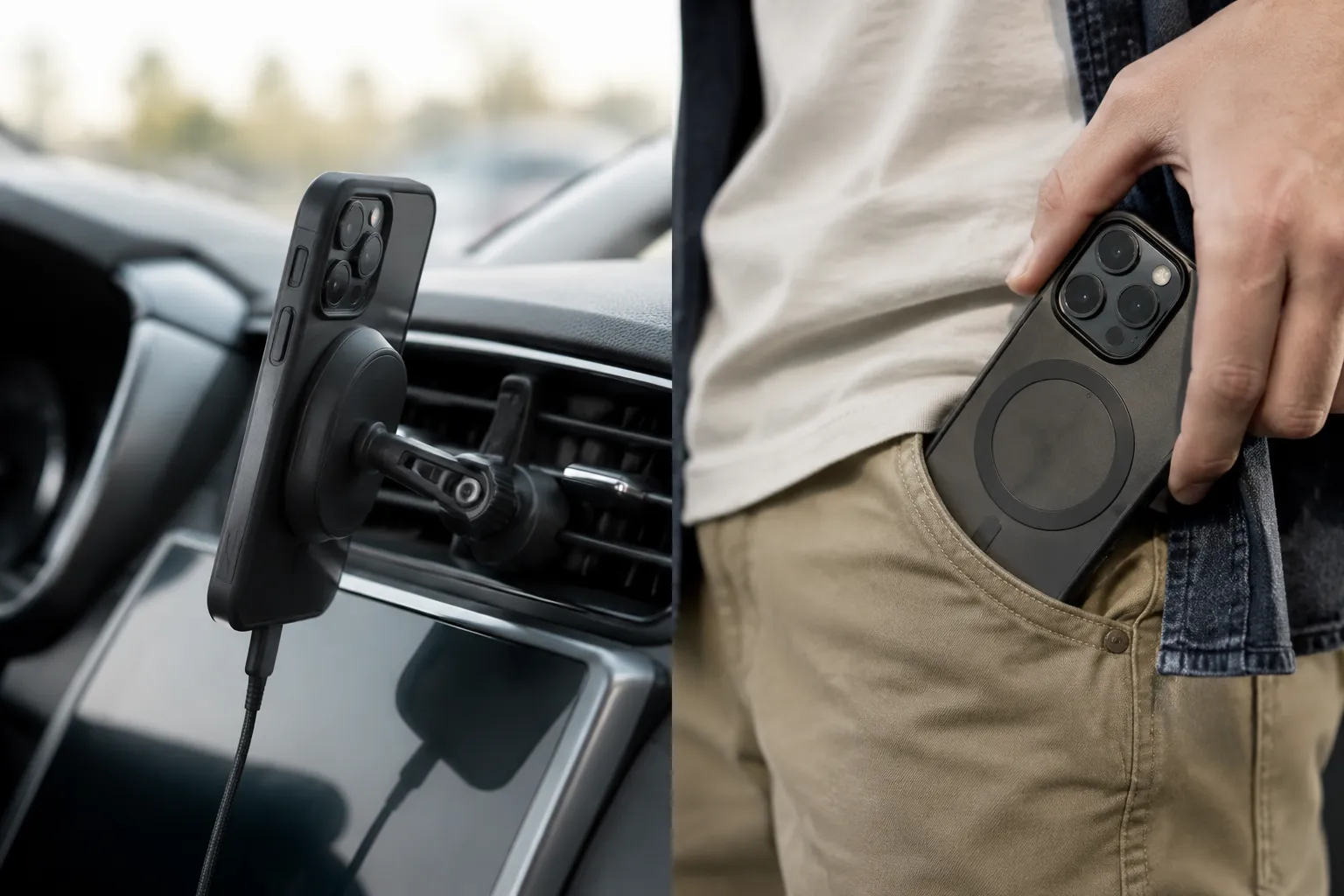
Car mounts add another layer of complexity. A phone with a wallet attached cannot sit flat on most magnetic car mounts, because the wallet pushes the phone's center of gravity away from the mount. The standard move is to remove the wallet before mounting, which means the wallet needs to go somewhere. Apple's wallet fits in a cup holder. The Moft wallet fits too, barely. The PopSocket wallet does not fit in most cup holders, which forces a person to toss it onto the passenger seat where it slides around every turn.
When the Wallet Falls Off, and What Gets Lost
The failure mode matters more than the holding force. Apple's wallet, when it eventually detaches, tends to fall straight down because its magnets release all at once. The wallet lands flat on the ground, cards stay inside, and the leather absorbs the impact. A person picks it up, snaps it back on, and continues. Third-party wallets with weaker magnets tend to peel off from one edge first. The wallet pivots on one corner, the cards slide out slightly, and the whole thing lands at an angle that scatters cards across the pavement.
This is not a hypothetical. It happens to people who wear their phones in back pockets and slide into a car seat. The wallet catches on the seat's edge and peels off. Apple's wallet survives this scenario because the leather has a slight friction grip, which works with the magnets to keep the wallet from twisting. The synthetic wallets from Spigen and Moft lack that friction. Their smoother surfaces slide against denim, which means the peel starts sooner.
The worst-case scenario is losing the wallet entirely. Apple's Find My integration has a range limit. The phone tracks the wallet's last known location when they separated, which is usually the spot where the wallet fell. That helps a person retrace steps. The third-party wallets have no such safety net. A lost PopSocket or Moft wallet is gone forever, and the cards inside require cancellation and reissue. For a person who carries a driver's license, two credit cards, and a transit pass, the replacement cost runs well over a hundred dollars and several hours of phone calls.
The Fine Print: Wireless Charging and Apple Pay
Wireless charging through a MagSafe wallet is a feature that works perfectly on paper and awkwardly in practice. Apple's wallet is thin enough that the phone charges through it, but the charging speed drops noticeably. A phone that charges at 15 watts with a bare back charges at around 7.5 watts with the wallet attached. The slower speed matters less at night than during a quick top-up before leaving the house. Third-party wallets with thicker bodies, especially the Moft and PopSocket models, block charging almost entirely. The phone will not charge through them, which means the wallet has to come off for every wireless charge.
Apple Pay works fine with any MagSafe wallet attached. The wallet sits on the back of the phone, not over the screen, so a person can double-click the side button and tap the phone against a reader with the wallet still in place. The only annoyance comes from thicker wallets that change the phone's balance. The PopSocket wallet, when the grip is collapsed, makes the phone feel noticeably heavier on one side. Holding it to a payment terminal feels clumsy.
MagSafe charging pucks have a separate quirk. A phone with a wallet attached will snap onto the puck, but the wallet creates a gap that reduces the magnetic alignment. The phone slides off the puck more easily, and a person has to position it carefully to get the charging animation to appear. This is less a flaw in the wallets and more a reality of stacking magnets on top of magnets. Every wallet on the market has this issue. The thinner ones simply have less of it.
The Price Question: Thirty Dollars Versus Sixty Dollars
Apple's wallet retails for sixty dollars. The third-party competition spans from thirty dollars for the Spigen up to fifty-five dollars for the Bellroy. The price difference looks small until a person considers that the third-party wallets, with the exception of Bellroy, are not made to last more than a year or two. The synthetic materials degrade, the hinges loosen, and the magnets weaken with repeated thermal cycles. Apple's leather wallet, with moderate care, lasts three years or more before the leather wears through at the corners.
The value calculation shifts when a person considers what they actually need. A rider who uses a phone for navigation and wants a wallet that also props the phone up for directions will get more daily use from the Moft than from Apple's plain sleeve. A person who wants the grip to prevent phone drops benefits more from the PopSocket. A minimalist who carries two cards and wants the thinnest possible attachment will choose Apple's wallet and ignore everything else.
The magnet strength difference between Apple and the third-party field is real but rarely the deciding factor in real life. The deciding factor is how the wallet fits a person's routine. A wallet that holds tighter but requires removal for every car mount and wireless charge is not actually more convenient. A wallet that holds slightly looser but stays on through a commute because a person never has to take it off might be the better tool.
Choosing the Right Failure Point
The final consideration is how much loss a person can tolerate. Apple's wallet costs more, but it has a tracking chip and a predictable failure mode. A person who loses it can find it again. The third-party wallets are cheaper, but they are untrackable and their failure modes are more chaotic. A person who loses a Spigen wallet will not be able to retrace steps with an app. They will be canceling cards and hoping a kind stranger turns the wallet in.
The tightest grip in the market belongs to Apple's wallet, and that grip matters most during the first month of ownership when the leather is stiff and the magnets are fresh. After a year, the leather softens, the cards loosen the slot slightly, and the magnet strength fades by a small but measurable degree. The Apple wallet still holds tighter than the Spigen on day one, but the gap narrows. Meanwhile, the PopSocket's grip mechanism has worn in and the Moft's stand has loosened, and both wallets are starting to show their age in ways that Apple's leather does not.
The third-party market has won on features, price, and variety. Apple has won on the fundamentals: magnet strength, build durability, and the security of knowing where a lost wallet ended up. A person who wants the single most reliable attachment should buy Apple's wallet and accept its limitations. A person who wants their wallet to do more than hold cards should buy a third-party model and accept the higher risk of loss. The market has made the trade-offs clear. The choice depends on which failure a person can live with, a peeled wallet on the pavement or a wallet that never falls off but also never does anything else.