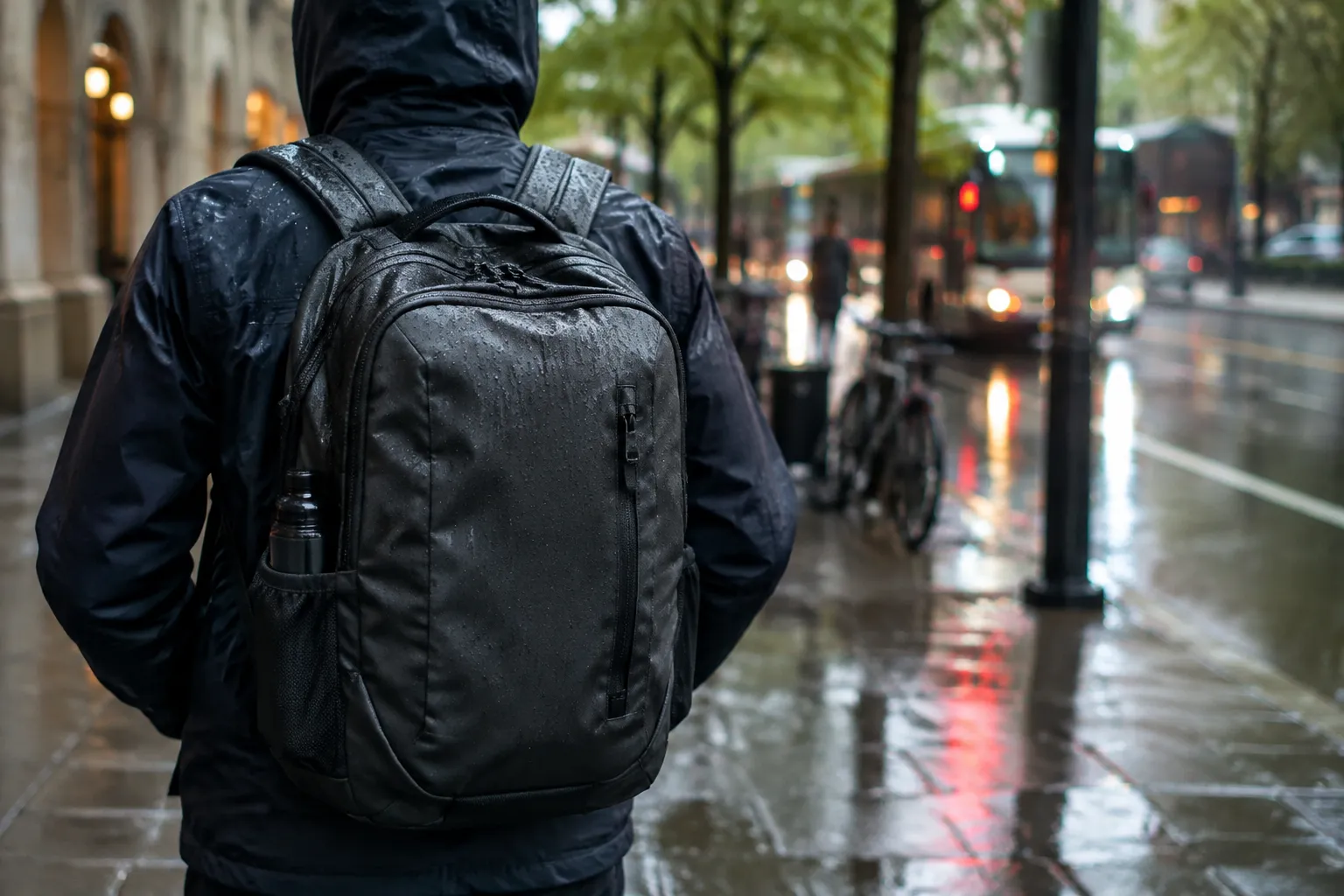
Rain ruins backpacks in a specific, creeping way that most people do not notice until it is too late. The exterior fabric gets damp, which seems fine, and then the dampness finds the zipper tape, and then the inside liner develops that cold, mildewed smell that no amount of airing out will fix. The laptop inside is usually safe during the actual rain, because the sleeve offers some protection. The real damage comes later, from the wet bag sitting on a heated office floor or in a car trunk, cooking its own interior.
The market has responded with a flood of "weatherproof" and "rain-resistant" bags that are mostly marketing exercises in fabric coating. A 600D polyester shell with a DWR finish will bead water for exactly one season. After that, the coating wears off at the friction points where the bag rubs against a hip or a subway seat, and the bag becomes a regular bag again. The products worth trusting take a different approach. They either use a fabric that is inherently waterproof, like laminated nylon, or they put a proper waterproof membrane inside the shell, or they rely on a roll-top closure that eliminates the zipper as the primary failure point.
What follows are seven bags that have earned trust through construction, not just claims. These are not ranked in any particular order, because a commuter in Portland needs something different from a commuter in Singapore. What binds them is that each one has a genuine strategy for keeping a laptop dry, and each one has been tested in actual wet conditions by people who do not work for the brand.
Ortlieb's Commuter Daypack and the Welded Seam Standard
Ortlieb comes from the canoeing world, where a bag that leaks is not an inconvenience, it is a hazard. The company's waterproofing pedigree is so established that its bike panniers have been the default choice for decade-long round-the-world tours since the 1980s. The Commuter Daypack brings that same standard to the office.
The bag is made from a fabric that Ortlieb calls PD620, which is a polyester fabric laminated on both sides with a waterproof coating. The seams are welded, not stitched. This is the critical difference. Stitched seams create thousands of microscopic needle holes that water eventually finds. Welded seams have no holes at all. A person can stand under a downpour for an hour and the interior of this bag will remain perfectly dry, not just damp-resistant, actually dry.
The tradeoff is a certain stiffness. This is not a bag that slouches against a desk leg. It holds its shape with the rigidity of a dry bag, which it essentially is. The laptop compartment is a padded sleeve suspended inside the main volume, and the roll-top closure adds another layer of protection. The downside is access. Rolling and unrolling the top every time a person needs a phone charger gets tedious. For commuters who pack once in the morning and unpack once at the office, it is a fair trade.
The Rains Rolltop and the Minimalist Water Column
Rains is a Danish brand that built its identity on a single material: a matte, slightly rubbery polyurethane-coated fabric that looks like it belongs on a Scandi raincoat from the 1970s. The Rolltop Backpack applies that material to a bag with a clean, almost austere silhouette.
This is the bag for the person who wants waterproofing without looking like they are heading to a climbing wall. The matt finish reads as fashion, not technical gear. The roll-top closure is secured with a simple magnetic buckle, and the main compartment is accessed by unrolling the top, which means the waterproofing depends on the user making at least three tight rolls. Get lazy and do a single loose roll, and the bag will let water in at the top. The material itself, however, is genuinely waterproof, and the welded construction means there are no weak seams.
The laptop sleeve inside is not padded as generously as some others on this list. It is a thin neoprene layer against the back panel, which offers acceptable protection from impacts but not exceptional. The tradeoff is weight. At under a kilogram, this is one of the lightest fully waterproof options available. For a commuter who walks a mile each way, that matters more than a few extra millimeters of foam.
Peak Design's Everyday Backpack and the Shell That Repels
Peak Design built its reputation on camera bags that photographers abuse in the field, which means the company learned early that weather sealing is not optional. The Everyday Backpack uses a 100% recycled 400D nylon shell with a DWR finish that is more robust than most competitors, but the real story is the internal architecture.
The weatherproofing here is layered. The main zippers are sealed with a rain fly that covers the entire zipper track, not just a small flap over the pull. The side access zippers are similarly protected. This matters because a downpour does not attack the fabric of this bag so much as it attacks the zippers, and Peak Design has engineered those specific points more carefully than almost anyone else in the market.
The FlexFold dividers inside create a customizable compartment system that happens to work beautifully for a laptop. The dedicated laptop sleeve sits against the back panel, suspended off the bottom of the bag by a small gap. That gap is a detail that saves laptops. When a bag gets set down on a wet sidewalk or a puddled subway platform, most bags transmit that moisture directly to the laptop sleeve. This one does not.
The catch is price. The Everyday Backpack is not inexpensive, and the 30-liter version costs more than some decent laptops. But the build quality justifies it for people who carry expensive gear and treat a bag as a long-term tool rather than a seasonal purchase.
Thule's Subterra 2 and the Smart Zipper Strategy
Thule approaches waterproofing from a pragmatic angle. Rather than trying to make the entire bag waterproof, which adds weight and stiffness, the company builds a bag with a water-repellent shell and then protects the most vulnerable points with a dedicated rain cover stashed in a small pocket at the base.
The Subterra 2 is a conventional backpack in silhouette, with a clamshell opening that lays flat for easy packing. The main compartment zipper is protected by a storm flap, and the shell fabric has a DWR coating that handles light rain and mist without issue. For a genuine downpour, the integrated rain cover deploys in seconds and covers the entire bag, turning it into a fully waterproof package.
This two-tier system has a distinct advantage. On dry days, the bag is lighter and more flexible than a fully waterproof option. A person does not carry the burden of a welded, roll-top construction when the sun is out. The rain cover only adds its weight and bulk when it is actually needed. For commuters in climates with distinct wet and dry seasons, this is arguably the smarter engineering.
The laptop compartment is SafeZone, a suspended cradle that protects against drops and includes a soft liner for the screen. The bag also has a dedicated pocket for a tablet, which sits in front of the laptop sleeve and adds another layer of cushioning between the laptop and whatever gets tossed on top.
Filson's Tin Cloth Backpack and the Waxed Canvas Argument
Waxed canvas is the oldest waterproofing technology on this list, and it remains one of the most effective when maintained properly. Filson has been making waxed canvas goods since 1897, and the company's Tin Cloth fabric is the gold standard for this material. The backpack made from it is not a dry bag, and it will not survive being submerged, but it handles rain with a grace that synthetic materials cannot match.
The waxed surface causes water to bead and roll off immediately. The fabric underneath never gets wet. The seams are stitched, then sealed with additional wax, which closes the needle holes effectively. The material develops a patina over time, and the wax wears off at stress points, but this is by design. The user reapplies wax with a bar of Filson's dressing, usually once or twice a year, and the bag returns to full waterproofness.
The laptop sleeve is a simple padded pocket, not suspended, and the bag does not have the organizational structure of a modern commuter pack. This is a bag for someone who carries a laptop, a notebook, and a lunch, and nothing else. The aesthetic is heritage workwear, which pairs well with a wool coat and does not pair well with athleisure. The weight is significant, and the waxed exterior is not forgiving on expensive car upholstery.
What this bag offers that the others do not is longevity measured in decades. A well-maintained Filson bag outlasts its owner's career. The synthetic bags on this list will degrade within five to ten years, their waterproof coatings eventually failing. The waxed canvas just needs another bar of dressing.
The Arc'teryx Granville and the Laminated Minimalism
Arc'teryx is known for technical outerwear, and the Granville backpack applies the same manufacturing discipline to a carryall. The shell is made from a material the company calls AC², which is a nylon fabric laminated with a waterproof membrane. The seams are taped, the zippers are watertight, and the overall construction follows the same standards as a mountaineering shell jacket.
The Granville is the most minimalist bag on this list. It has a single main compartment, a small internal pocket for a laptop, and no external organization. There is no admin panel, no key clip, no pen holders. This is a deliberate design choice from a company that believes in removing anything that can fail.
The laptop pocket is not padded at all. It is a sleeve of the same waterproof laminate, which means the laptop is protected from water but relies entirely on the bag's shell for impact protection. Arc'teryx assumes the user will bring their own sleeve, which frustrates some buyers but keeps the bag lightweight at just 650 grams.
The watertight zipper requires a firm pull to operate, and it is not as smooth as a standard zipper. This is a common complaint with waterproof zippers across all brands. The tradeoff is that the zipper will never leak, which is the point. For a cyclist who rides through urban rain and does not want a roll-top clamshell to wrestle with at every traffic light, this is the ideal form factor.
The Timbuk2 Especial Storm and the Commuter's Full Package
Timbuk2 built its name on messenger bags in San Francisco, a city where fog drizzle and sudden downpours are facts of daily life. The Especial Storm represents the company's most complete answer to rain, combining a fully waterproof inner liner with a roll-top main closure and a set of external pockets that remain accessible without compromising the core seal.
The internal liner is a welded TPU membrane that turns the main compartment into a dry bag. The roll-top closure is reinforced with a stiffener that makes it easier to roll tightly with one hand. The external stretch pockets are not waterproof, but they are intended for items like a water bottle or an umbrella that do not mind getting wet.
The laptop sleeve sits in the main compartment and is padded on all sides. The bag also includes a separate compartment on the back panel that holds a laptop up to 15 inches and is accessible from the side, which means a person can retrieve the laptop without unrolling the main top. This side access is the bag's best feature, as it eliminates the primary annoyance of roll-top designs while keeping the main seal intact.
The Especial Storm is built for a bicycle commuter. The back panel has a passthrough for a luggage handle, the shoulder straps are ergonomically curved, and the bag includes a removable hip belt for heavier loads. The reflective trim is subtle but effective. This is a bag engineered by people who have actually ridden through a storm with a laptop on their back and have thought about every step of that process.
A Note on the Dry Bag Trap
A common mistake among people who buy their first waterproof backpack is assuming that full waterproofness is always the goal. The reality is more complicated. A fully waterproof bag is also fully airtight, which means any moisture inside the bag, from a damp gym towel or a leaky water bottle or simply condensation from a hot laptop, has nowhere to go. The bag becomes a greenhouse, and the contents can come out wetter than if the bag had been merely water-resistant.
This is why several bags on this list, notably the Thule Subterra 2 and the Peak Design Everyday Backpack, opt for a water-resistant shell with targeted protection rather than a fully sealed interior. For most commuters, this is the better engineering. A bag that beads water on the outside but breathes on the inside will keep a laptop dry in a rainstorm and also keep it dry when the laptop runs hot and the user is sweating.
The fully waterproof options, the Ortlieb, the Rains, and the Arc'teryx, are best for people who ride bikes in heavy rain or who walk long distances in climates with consistent precipitation. Those users accept the lack of breathability as a fair trade for absolute protection.
The deciding question is not which bag is the most waterproof. It is which bag a person will actually use correctly every day. A roll-top that gets sloppily closed is worse than a zipper bag with a storm flap. A rain cover that lives in its pocket because it is annoying to deploy is just extra weight. The best bag on this list is the one whose waterproofing method matches the owner's tolerance for daily maintenance.
There is one final test worth performing before buying any of these. Set the bag on the floor with a few paper towels inside, pour a half liter of water slowly over the top and front, and then wait ten minutes. A bag that passes this test with dry paper towels is a bag that can be trusted. A bag that only beads water and looks great doing it is a bag for a light drizzle, not a real storm. The seven bags above have all passed that test in real use. That is why they made this list.