Airline overhead bins have become a Darwinian arena, and the creature best adapted to survive is no longer the person with the biggest bag, but the one whose bag opens with the least fuss. The difference between a smooth security line and a fumbling, apologetic one often comes down to a single decision made at home, hours before the curb. That decision is the order of operations: the sleeve goes in first, and the bag is built around it.
The standard advice about carry-on packing is obsessed with the bag itself. People argue over hard vs. soft shells, spinner vs. two-wheel, 35 liters vs. 40. This misses the point. The bag is just a container. The real project is the load inside it, and that load has a spine: the laptop sleeve, or whatever rigid, protective case holds the most fragile and most-used item. Everything else is packing material.
Why the Laptop Dictates the Whole Bag
A laptop is the one item that cannot be replaced at a destination pharmacy. It carries the presentation, the tickets, the work product, the photos from the trip so far. It is also the item most likely to be damaged by the very bag designed to carry it, crushed against the bottom by a water bottle or squeezed against the seatback in front. The solution is to treat the laptop as the structural center of the cargo, not as an afterthought shoved into a padded pocket that sits wherever it sits.
The sleeve, whether it is a neoprene slip or a hard-shell clamshell, should be packed first and packed flush against the back panel of the bag, the side that will rest against the person's back when worn. This puts the most delicate item against the most protected surface. It also keeps the laptop's weight close to the spine, which matters on a long walk through a terminal where the bag starts to feel like a sack of concrete.
Many bags advertise a dedicated laptop compartment, and those are fine for a quick commuter trip. For a real journey, the dedicated compartment is often too thin to hold a sleeved laptop, so travelers slide the bare machine in, trusting a quarter-inch of foam to absorb the impact of the bag being thrown into an overhead bin. A sleeve adds meaningful shock absorption, and it is the only way to make the laptop's position negotiable within the bag's main cavity.
The Physics of the Load Order
Once the sleeved laptop is placed against the back panel, the rule is simple: heavy items go toward the back and the bottom, light items fill the front. This is not a stylistic preference. A bag packed with the heavy items on the outside, toward the front zipper, will want to fall away from the body when worn. It will also be more likely to tip over when set on the floor. The center of gravity needs to sit somewhere between the shoulder blades, not at the small of the back.
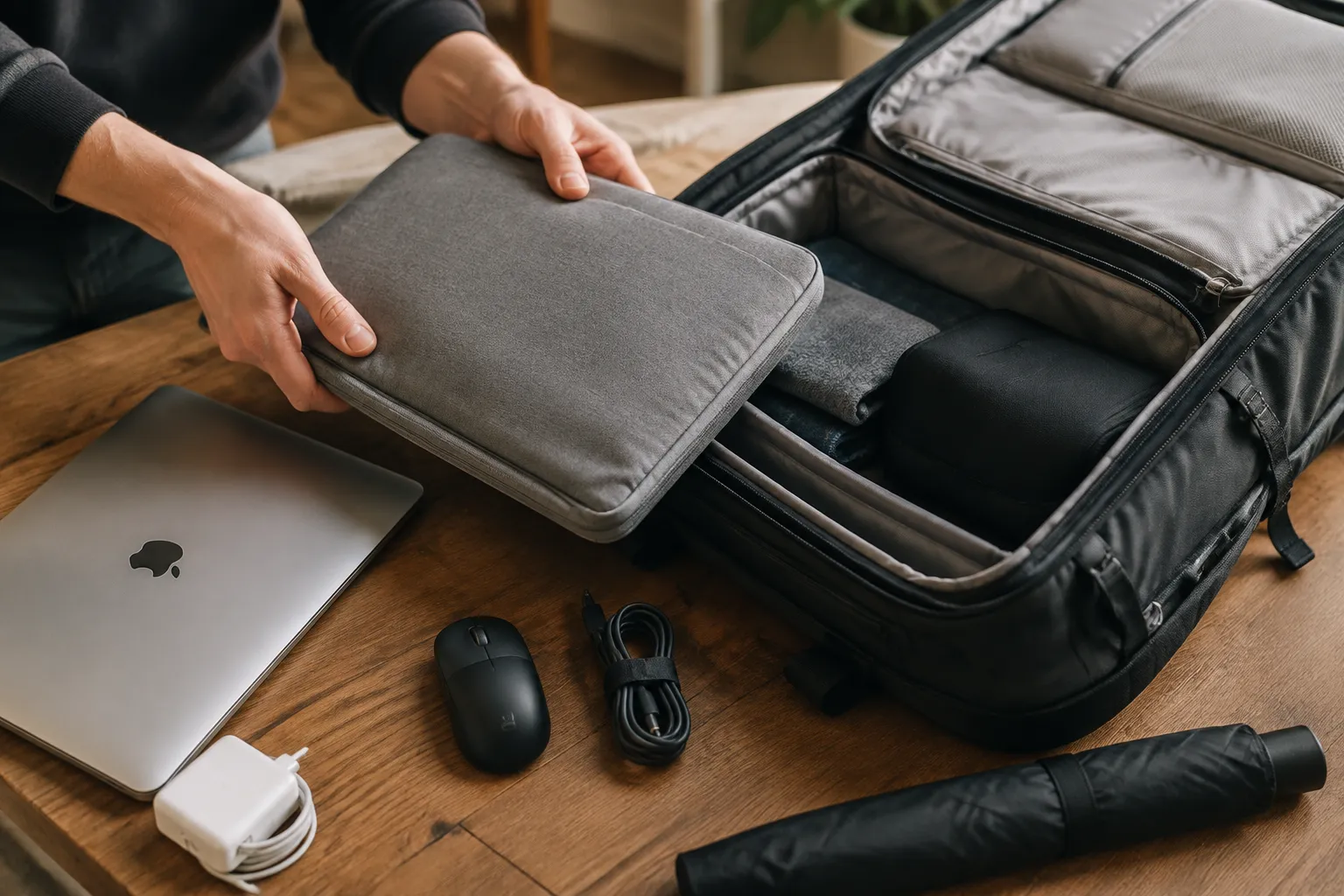
The order goes like this. Sleeve first. Then the tech pouch, which holds the charger, cables, dongles, and a portable battery. This pouch should be the second item in because it is dense and should sit against the laptop sleeve, sharing the protected back zone. Then the toiletries kit, assuming it is not the quart-size liquid bag, which goes in an outer pocket for security. Then clothing, rolled tight, filling the remaining volume. Finally, a folded jacket or a soft item goes on top, creating a cushion between the rigid items and the zipper.
This order matters for a practical reason beyond balance. When security asks for the laptop to come out, the sleeve is what comes out. A person who can unzip the bag, grab the sleeved laptop by its handle, and slide it onto the bin without unpacking anything else is moving through the line at a pace that feels almost illegal.
The Sleeve Itself: A Case for the Hard Shell
Neoprene sleeves have their place, which is a padded envelope for a machine that stays mostly on a desk. For travel, the soft sleeve offers a false sense of security. It protects against scratches and light bumps, but it does nothing against the single most common travel threat: the pressure of other items pressing into the screen from above. A hard-shell sleeve, often marketed as a shockproof case, distributes that pressure across its surface.
The trade-off is bulk. A hard shell adds roughly a centimeter on each side, and that centimeter is real volume lost in a carry-on. But the alternative has a specific failure mode that is worth respecting. A bag packed tight, with a soft-sleeved laptop at the bottom, will transfer the force of every heavy object placed on top directly through the foam into the screen. LCD panels do not fail gracefully; they bloom into dark patches or crack along hairline fractures that only show up when the screen is lit.
For anyone who travels weekly, the hard shell pays for itself in anxiety reduction alone. There is a particular silence in a terminal when a bag drops from an overhead bin onto the aisle floor, and that silence is followed by a personal calculation about what was in the bag. With a hard shell, the calculation is already done.
What the Tech Pouch Actually Needs to Hold
The tech pouch is where most packing systems go to die, because people pack for hypothetical scenarios instead of actual ones. The pouch should hold the items that were used on the last trip, not the items that might be used on a trip someday. A 65-watt USB-C charger, two cables (one USB-C to USB-C, one USB-C to Lightning or whatever the secondary device takes), a small battery under 10,000 mAh, and a single adapter for foreign outlets. That is the core kit.
Everything else is negotiable. A mouse, an external drive, a card reader, spare earbuds: these are all items that sound essential at home and become dead weight by day two. The pouch itself should be a flat, rectangular organizer with a few internal dividers, not a boxy case that eats volume. It sits flush against the laptop sleeve, and it should not be so thick that it creates a bulge on the back panel.
The battery is worth a special mention. Many airlines restrict batteries over 100 watt-hours, and while enforcement varies, the rule is not worth testing. A 10,000 mAh battery is roughly 37 watt-hours, which clears every limit comfortably. It also charges a modern phone about twice, which is enough for a full travel day. Anything larger belongs in checked luggage, if it belongs anywhere.
Rolling vs. Folding: A Truce With a Winner
The rolling vs. folding debate is a distraction from the real function of clothing in a carry-on, which is to fill space, not to save it. Rolling works better for dense fabrics like denim and cotton, and it produces uniform cylinders that stack like logs. Folding works better for dress shirts and anything that wrinkles. The hybrid approach is the only sensible one: roll everything that does not wrinkle, fold the few items that do, and place the folded items on top of the rolled ones.
The more important point is that clothing should be the filler, not the focus. A bag packed with carefully rolled shirts and then a laptop shoved on top is a bag that has its priorities inverted. The shirt does not break if the water bottle presses against it. The laptop does. So the clothing goes in after the rigid items, and it goes in loosely enough to conform to whatever gaps remain.
This is where the sleeve-first system reveals its elegance. A person who packs the laptop and tech pouch first knows exactly how much volume remains for clothing. A person who packs clothing first is guessing. The guesses are almost always wrong, leading to a bag that is either underfilled and rattling, or overfilled and impossible to close.
The Outer Pockets: Only Two Things Belong There
Outer pockets are the graveyard of travel organization. They invite a specific kind of chaos: loose pens, boarding passes from previous flights, crumpled receipts, a half-eaten granola bar. The discipline of the sleeve-first system extends to the outer pockets, which should hold exactly two categories of items: things needed during the flight, and things needed for security.
The quart-size liquid bag goes in the outer pocket, along with the boarding pass and a phone. That is it. The pocket should be nearly empty when the bag is packed, because every item in an outer pocket shifts the bag's center of gravity forward and makes it pull on the shoulders. A water bottle has its own place, which is a side pocket or a carabiner, not the main compartment and not the outer organizer.
Some bags have a dedicated passport pocket on the back panel, and that is a fine use of space. But the rule stands: if an item will not be touched during the flight or during security, it belongs in the main compartment, packed after the tech pouch. The outer pockets are for access, not for storage.
The Compression Dilemma and When to Skip It
Compression straps and packing cubes with compression zippers are popular because they promise more volume. They deliver on that promise, but they create a specific problem: a compressed bag is a rigid bag, and a rigid bag is harder to fit into a full overhead bin. The compression that works at home, where the straps are pulled tight and the cubes are smashed flat, becomes a liability in the aisle of a full flight where the bag needs to flex into the remaining space.
The sleeve-first system works best with a bag that is packed to about 80 percent of its capacity. That remaining 20 percent is the flex zone, the give that allows the bag to squish into a tight bin or under a seat. Overpacking, even with the best compression gear, turns a bag into a brick, and bricks do not fit anywhere gracefully.
This is the counterintuitive core of the whole method. Most packing advice focuses on fitting more into the bag. The sleeve-first method focuses on fitting the right things in the right order, and accepting that the bag should be slightly underfull. The empty space is not wasted; it is the buffer that makes the system work in the real world, where bins are full and seats are small and the person in front of the traveler reclines without warning.
A Note on Bags That Make This Easier
Not every bag is built for the sleeve-first method. Clamshell bags that open flat, like a suitcase, are ideal because they allow the back panel to be loaded without fighting gravity. Top-loading bags, like a traditional backpack, require the user to pack the back panel first and then stack forward, which is awkward for the laptop. The best bag is a clamshell with a main cavity that opens completely, allowing the sleeve to be laid flat against the back panel and the rest of the load stacked on top.
Bags with a separate laptop compartment are workable, but they require the laptop to be sleeved or unsleeved at the security line. The separate compartment also places the laptop on the outside of the bag's structure, where it is more exposed to a drop. The sleeve-first method works best with a bag that has no dedicated laptop slot, forcing the traveler to place the sleeved machine in the main cavity where it belongs, protected by the bag's full structure.
This is a matter of personal preference, but the travelers who have moved to this system usually report the same discovery: the bag feels lighter, not because it weighs less, but because the weight is distributed correctly. The load sits high and close to the back. The bag does not swing when walking. The laptop is never forgotten, because it is the first thing packed and the first thing unpacked.
The Security Line Test and the Final Unpack
The true test of any packing system is the security line at 6 a.m., when the traveler is tired, the line is long, and the person behind is breathing down a neck. The sleeve-first system shines in exactly this moment. The bag opens, the sleeve comes out by its handle, the sleeve goes into the bin, and the bag closes. Total time from zipper to zipper: under ten seconds.
Compare that to the traveler who packed the laptop in the dedicated compartment, which requires turning the bag around, finding the zipper on the back panel, and wrestling the machine out of a tight slot. Or the traveler who packed the laptop at the bottom of the main cavity, under three rolled shirts and a toiletry kit, forced to unpack half the bag on the conveyor belt.
The system also survives the arrival. At the hotel, the sleeve comes out first, the laptop goes on the desk, and the bag empties in reverse order. The tech pouch is unpacked onto the desk. The clothing goes into the drawers or stays in the bag. The empty bag stands in the corner, ready for the return trip, when the same order repeats in reverse. The sleeve goes in last on the way home, because it goes in first on the way out, and the rhythm of the whole trip settles into a pattern that requires no thought, which is the point of a good system.
The sleeve-first method is not about the sleeve. It is about making a decision once and never revisiting it. The laptop goes against the back, the heavy items sit near it, the clothing fills the gaps, and the bag closes. Every time. The travelers who pack this way are the ones who walk through security with their shoes still on, their belts still buckled, and their laptop already out, moving at a pace that looks calm because the chaos has been designed out of the process.