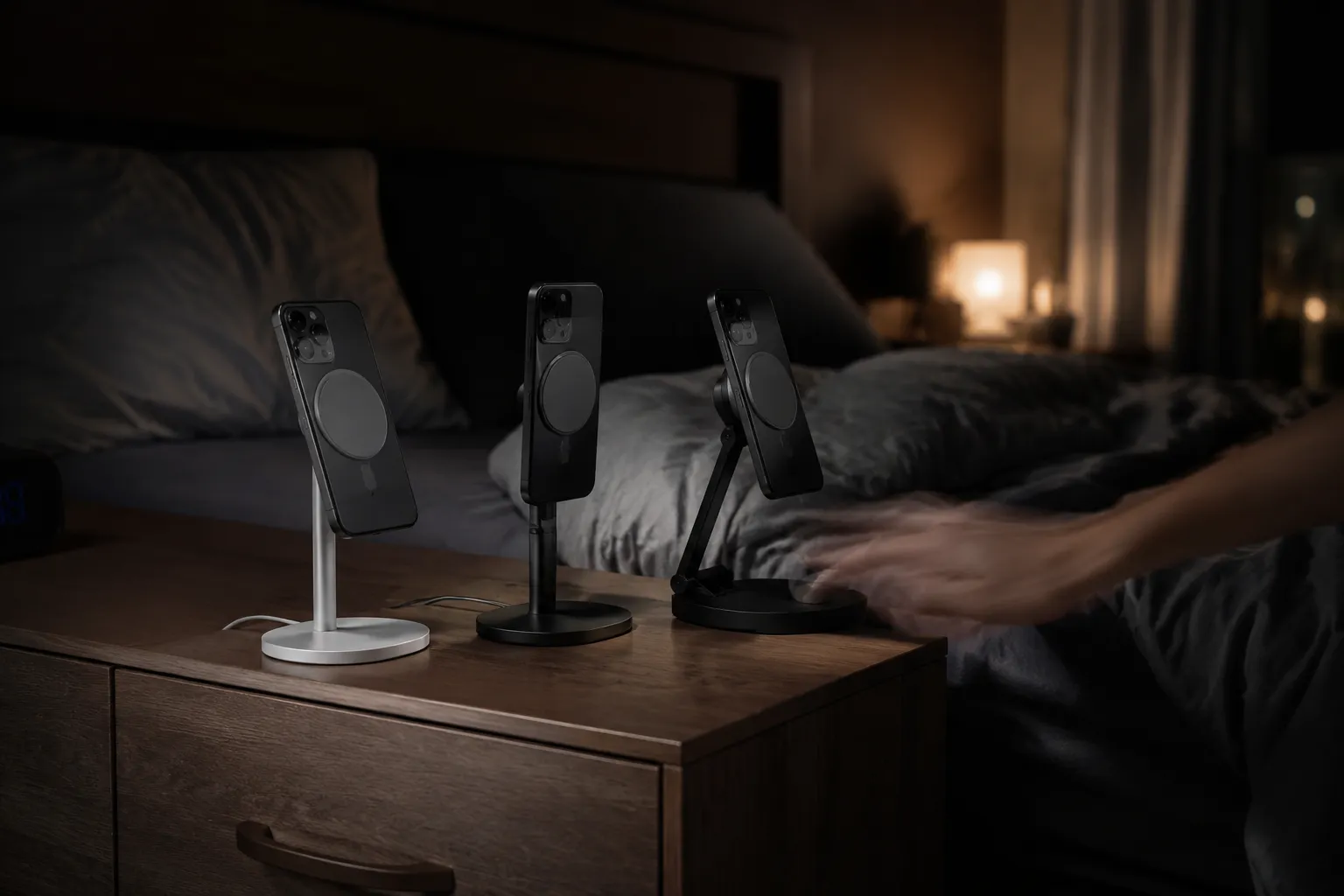
At 3:17 in the morning, a phone is not a phone. It is a glowing rectangle balanced on a nightstand, and the only question a half-asleep person cares about is whether that rectangle will still be there when the alarm goes off. The MagSafe bedside stand has become the default answer to that question, a category that exploded once Apple’s magnetic charging puck made docking feel inevitable. But the market is crowded with products that look nearly identical in product photography and behave very differently on an actual piece of furniture. Three stands have emerged as the usual suspects: the Belkin BOOST↑CHARGE Pro, the Anker 313 Magnetic Wireless Charger, and the Twelve South HiRise 3 Deluxe. Each one promises stability. Each one wobbles in its own particular way.
What follows is not a lab test. It is a field test conducted on a pine nightstand with a slightly uneven floor, a ceiling fan that runs on medium, and a person who rolls over roughly twice per hour. The phone used throughout was an iPhone 15 Pro Max, which is the heaviest common test subject and therefore the most honest one. A lightweight phone will make almost any stand feel solid. The 15 Pro Max exposes the structural truth.
The Belkin and the Heavy Base Trick
The Belkin BOOST↑CHARGE Pro is the heaviest of the three by a significant margin. It arrives with a weighted circular base that feels like a paperweight designed by someone who was tired of losing arguments. That weight is the entire strategy, and it works. When the phone is docked in landscape mode, the Belkin does not move. A person can bump the nightstand, drag a blanket across it, or knock an elbow into the base while reaching for water, and the stand absorbs the impact.
But there is a tradeoff hidden in that heft. The Belkin’s charging puck sits at the end of a hinge mechanism that allows the viewing angle to adjust, and that hinge is the weak point. At its most upright position, the phone’s center of gravity shifts forward just enough to make the whole assembly feel like it is leaning into the job rather than standing up to it. The base stays planted. The top half develops a micro-wobble, a barely perceptible oscillation that only shows up when the phone is being tapped or swiped with any force.
In practice, this means the Belkin is excellent for the 99 percent of the night when the phone is sitting still, and mildly frustrating for the 1 percent when a person is half-asleep and trying to hit the snooze button with an uncoordinated thumb. The phone does not fall. It does not even shift position. It just trembles, and that trembling is enough to register as instability in a brain that was not fully awake in the first place.
The base also collects dust in a way that seems almost intentional. The weighted bottom has a rubber ring around its perimeter, and that ring catches every stray fiber and pet hair within reach. After two weeks on a nightstand, the Belkin looks like it has been through a lint trap. It is a cosmetic issue, not a functional one, but it is worth knowing before committing to a stand that will sit in the open.
The Anker and the Physics of the Thin Stem
The Anker 313 takes the opposite approach. It is light, almost startlingly so, and it achieves its stability not through mass but through geometry. The base is a flat disc with a silicone pad underneath, and the stem rises at a steep angle before curving forward to hold the charging puck. That curve is the whole game. It positions the phone’s weight directly over the center of the base rather than behind it, which means the stand does not need to be heavy to stay put.
The result is a stand that feels almost too easy. It does not wobble in normal use. A person can pick the whole thing up with one hand while the phone is still attached, which is either a feature or a warning depending on how much trust they place in magnets. The iPhone 15 Pro Max stays firmly locked to the puck, and the stand stays firmly locked to the nightstand, and the whole assembly behaves like a single solid object.
The weakness appears only when the angle of the phone changes. The Anker’s charging puck is fixed at a single tilt, and that tilt is optimized for viewing the screen while sitting up in bed. For a person lying flat on their back, the angle is slightly too steep, which forces the phone to be adjusted by rotating the entire stand. That rotation is where the wobble lives. Because the base is light, any twisting force applied to the stem translates directly to the silicone pad, and the pad can only grip so much. On a smooth surface, the Anker twists easily. On a textured surface, it holds. On a nightstand with even a thin layer of dust, it slides.
This is not a failure of design. It is a tradeoff between portability and rigidity, and the Anker comes down firmly on the side of portability. The stand weighs less than a coffee mug and can be thrown into a duffel bag without a second thought. For a person who travels even occasionally, that portability might be worth more than the absolute rock-solid feel of a heavier competitor.
The charging speed is also worth noting. The Anker 313 maxes out at 7.5 watts for iPhones, half the speed of the other two stands tested here. Over the course of a normal night, that difference is irrelevant. A phone that goes on the charger at 11 PM and comes off at 7 AM will be full regardless. But for a person who plugs in for a quick top-up before heading out, the slower charging becomes a real constraint. The stand is stable, but it is also slow, and stability cannot compensate for a phone that is not ready when it needs to be.
The Twelve South and the Adjustable Conundrum
The Twelve South HiRise 3 Deluxe is the most ambitious of the three, and ambition creates complications. It uses a weighted base similar to the Belkin’s, though lighter, and it adds a height-adjustable arm that slides up and down on a central column. That adjustability is the selling point. A person can set the phone at exactly the right height for their pillow, their nightstand, and their sleeping position. In theory, this makes the HiRise 3 the most personal of the three stands.
In practice, the sliding arm introduces play. The mechanism that holds the arm in place relies on friction, and friction requires a tolerance that works against the design. When the phone is docked and the stand is set to its full height, the arm has a slight front-to-back give that the Belkin and Anker do not have. It is not a wobble in the traditional sense. It is more of a springiness, a sense that the phone is mounted on a suspension system rather than a rigid frame.
For some people, this will not matter. The give is small, perhaps two or three millimeters of travel, and it does not affect the phone’s charging connection or its visibility. But for a person who has ever been annoyed by a wobbly table at a restaurant, the HiRise 3’s flex will be noticeable on the very first night. It is the kind of detail that a person either forgets about after a week or fixates on for the entire duration of ownership.
The HiRise 3 also has the most distinctive visual presence of the three. It is taller than the others, with a clean, architectural silhouette that looks like it was designed by someone who cares about how a nightstand appears during the day, not just how it functions at night. The Belkin looks like a gadget. The Anker looks like a tool. The Twelve South looks like furniture, and for a person who keeps their bedside area visible, that distinction matters.
But the adjustable arm has a second consequence that is less obvious. Because the arm is designed to move, the cable management built into the base has to accommodate that movement, which means there is slack in the system. The cable loops internally but still manages to escape through a small opening at the back, and that loop can catch on a stray finger during a midnight fumble. It is a minor annoyance, but it is an annoyance that the fixed-height stands simply do not have.
The Landscape Mode Question
All three stands advertise landscape mode, which is the preferred orientation for anyone using their phone as a clock, a calendar, or a mini TV while falling asleep. The Belkin handles this orientation best because its face-down charging surface does not rely on a lip or a ledge to keep the phone in place. The phone just snaps to the puck and stays there, regardless of whether it is portrait or landscape.
The Anker is nearly as good, though its fixed angle means the landscape view is slightly low for a person sitting up in bed. The phone ends up pointing at the chest rather than the face, which requires a slouch or a reach to correct. The Twelve South is the most frustrating in this mode. Its charging puck has a small lip at the bottom to help hold the phone, and that lip works in portrait but becomes a minor obstruction in landscape. The phone sits on the lip rather than flush against the puck, which leaves a visible gap and a faint sense that the magnets are not fully engaged.
None of these issues are dealbreakers. They are the kinds of quirks that emerge only with extended use, the small compromises that separate a product that was tested in a lab from a product that was lived with.
The Nightstand Test Results
After a month of rotating the three stands on the same nightstand, a clear hierarchy emerged. The Belkin is the most stable when it matters most, but its hinge wobble and its dust-collecting base keep it from being perfect. The Anker is the most portable and the most predictable, but its slow charging and its tendency to twist on smooth surfaces are real limitations. The Twelve South is the most elegant and the most adjustable, but its mechanical play and its landscape mode quirk make it the least settled of the three.
For a person who wants to set a phone down and forget about it, the Belkin is the choice, provided they can tolerate its weight and its appetite for lint. For a person who travels with their charger or who values a clean, minimal footprint, the Anker is the better fit, provided they are patient with 7.5 watts. For a person who wants their nightstand to look like a designed space and who does not mind a little flex, the Twelve South is the one.
The honest answer is that no MagSafe stand is perfectly stable at 3 AM, because 3 AM is not a stable time. A person who is half-asleep, slightly dehydrated, and operating on reflex will find fault with any product. The goal is not to eliminate the wobble entirely. The goal is to reduce it enough that it does not become the thing a person remembers in the morning.
The Belkin wobbles at the hinge when touched. The Anker twists on a dusty surface. The Twelve South flexes at the arm and fumbles in landscape. Pick the flaw that annoys the least, and the rest of the night takes care of itself.