Apple sells two accessories that solve the same problem in opposite ways. The MagSafe Battery Pack clips to the back of an iPhone and refills it wirelessly. The MagSafe Charging Case replaces the iPhone's own back panel with one that contains a battery and a charging coil. Both promise a full day of use. Both cost more than a person wants to spend. And both force a quiet compromise that most buyers discover only after weeks of daily carry: one of them changes how the phone feels in the hand, and the other changes how the phone behaves in the pocket.
The choice comes down to a single question about a person's daily routine, and it has nothing to do with battery capacity numbers or charging speeds. The question is whether the phone ever needs to leave the pocket or the bag while it is charging.
The Battery Pack Is a Temporary Passenger
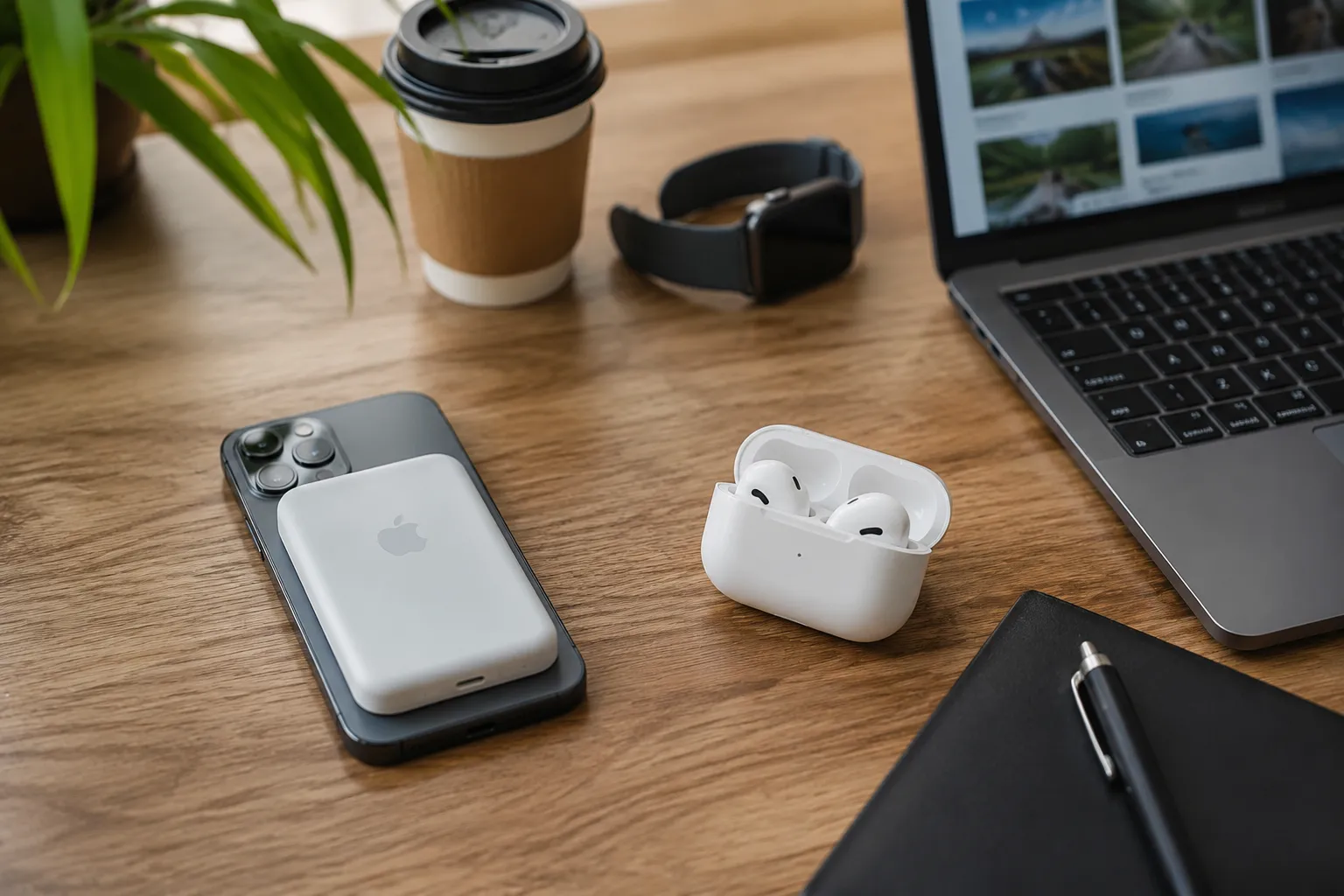
The MagSafe Battery Pack is a small, rounded rectangle of metal and rubber that snaps onto the back of a compatible iPhone. It is roughly the size of a pack of cards, slightly thicker, with a smooth white exterior that collects fingerprints the way a new car's dashboard does. Attached, it adds about 120 grams of weight and a noticeable bulge to the phone's profile. The phone no longer lies flat on a table. It rocks slightly when a finger taps the screen near the top edge.
That physical awkwardness is the trade for a specific kind of freedom. The pack is not a permanent modification. It goes on when the battery drops below 40 percent and comes off when the phone reaches full charge, or when a person simply wants the slim phone back. It lives in a pocket, a bag, a desk drawer. It serves one purpose and then gets out of the way.
This makes the pack the right tool for a person whose phone use comes in bursts. A commute, a long afternoon of navigation, a day of heavy camera use, a flight with no seatback outlet. The phone drains, the pack goes on, the phone refills while still being usable, and at the destination the pack comes off and the phone returns to its normal shape.
There is a genuine elegance to this rhythm. The pack is a tool, not a wardrobe change.
The Charging Case Changes the Phone Itself
The MagSafe Charging Case is a different animal. It is a full replacement back panel, sold by Apple as a separate accessory for select iPhone models, that sandwiches a battery between the phone's internal components and the external surface. The phone becomes thicker by several millimeters and heavier by a similar margin to the external pack. The camera bump sits inside a raised bezel. The whole device takes on the proportions of a small brick.
The critical difference is that this bulk is permanent. The case is not designed to come off mid-day. It is installed once and left in place, and the phone lives out its entire life with the extra weight and thickness. A person who buys this case has effectively chosen a different phone. The iPhone inside is the same, but the object in the pocket is not.
In exchange, the case offers something the external pack cannot: the phone is always topped up, with zero thought required. There is no moment where a person looks at the battery percentage and decides to act. The case quietly extends the phone's endurance by roughly 50 to 70 percent, depending on the model and usage pattern. A phone that died at 6 p.m. now lasts until midnight. A phone that died at noon now survives the workday.
For a person who chronically forgets to charge overnight, or who spends full days away from any outlet, this always-on buffer is transformative. The phone simply does not die during waking hours anymore.
The Handling Difference Nobody Mentions
Reviewers talk about capacity and heat. They rarely talk about how each option changes the physical relationship between a person and the phone, which is the detail that actually decides long-term satisfaction.
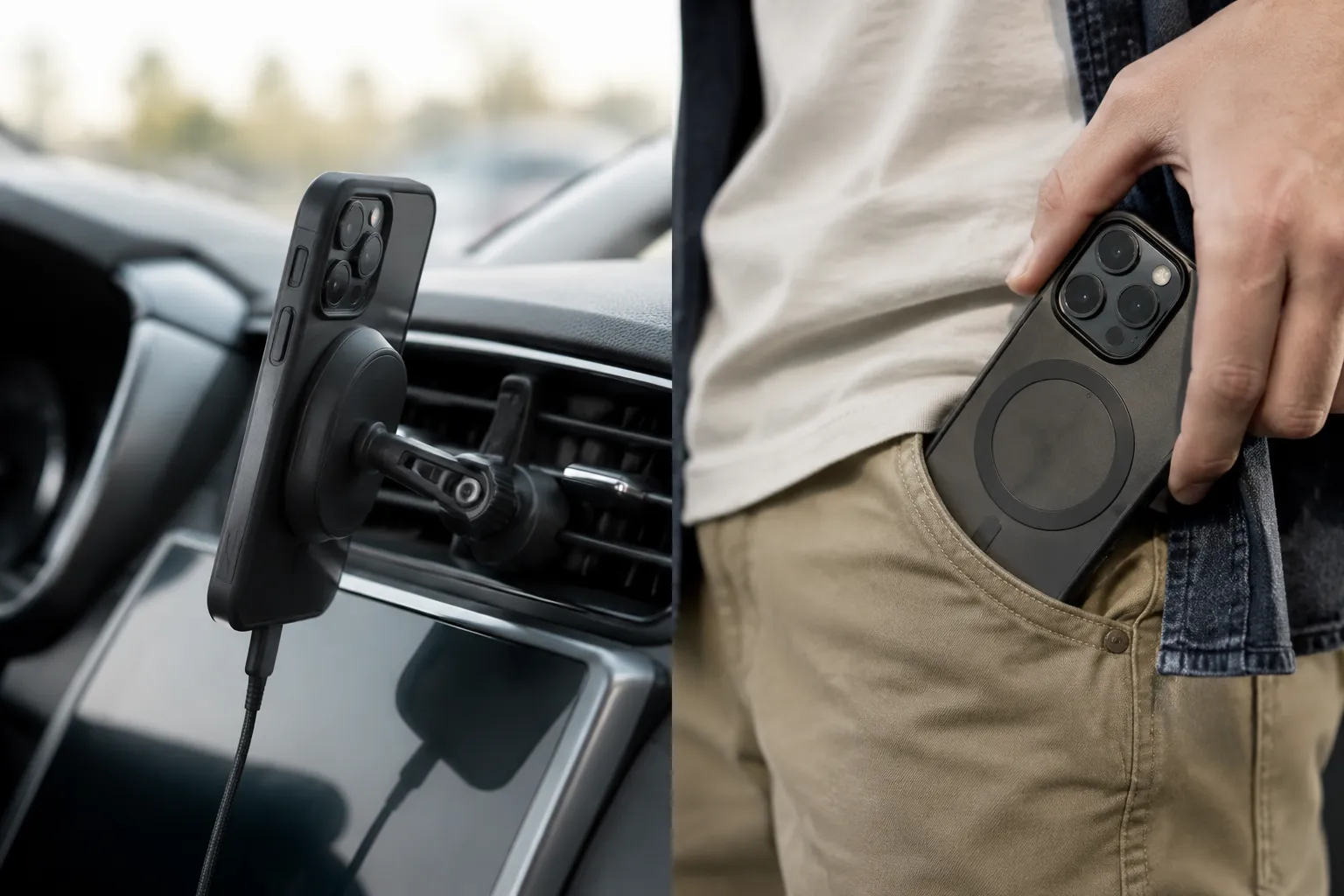
The external pack makes the phone unbalanced. The weight sits behind the lower half of the device, which shifts the center of gravity downward and backward. One-handed use becomes a small forearm workout. Typing with the phone resting on a pinky finger turns the contact point into a pressure sore after about twenty minutes. The pack also blocks MagSafe accessories while attached; a person cannot slap the phone onto a magnetic car mount or a wallet with the pack in place.
The charging case, by contrast, is balanced. The weight is distributed across the entire back surface, and the phone handles almost exactly like a larger, heavier version of itself. The thickness is uniform, so the phone never rocks on a table. The extra weight is noticeable for the first three days and then becomes completely invisible, the way a person stops feeling a watch on the wrist.
But the case has its own hidden cost. Because it is always attached, it always adds heat. Wireless charging generates warmth, and the case traps that warmth against the phone's aluminum chassis. During intensive tasks like navigation or video calls, the phone gets noticeably warm to the touch, and in hot weather the phone may throttle performance or halt charging temporarily to protect the battery. The external pack also generates heat, but it can be removed when the phone reaches full charge. The case never stops insulating.
A Commute Test: Which One Survives the Day
Consider a concrete routine. A person leaves home at 8 a.m. with the phone at 100 percent. The morning involves thirty minutes of podcast streaming over Bluetooth, a handful of Slack messages, and a navigation session through city traffic. By noon the phone sits around 65 percent. The afternoon adds another navigation stint, some photo taking, and constant email checking. By 5 p.m. the phone reads 30 percent and the evening has not started.
The external pack user attaches the pack at 5 p.m., rides home with the phone refilling to 80 percent, and then detaches the pack at the front door. The phone feels normal for the evening. The pack goes on a shelf.
The charging case user never touches the pack. The phone left home at 100 percent, but the case added another 50 percent of buffer, so the phone actually started the day with the equivalent of 150 percent. By 5 p.m. the phone reads 65 percent. The evening proceeds without a thought. The phone goes on the nightstand at 75 percent and charges overnight while the case does its silent work.
Both users end the day with a working phone. But the experience of getting there is entirely different. The pack user performed a small ritual. The case user performed none.
The Case Wears the Phone Down
There is a longer-term consideration that most buyers skip, and it tilts the decision for people who keep a phone for more than two years. The charging case is a sealed unit. When its internal battery degrades, the entire case must be replaced. Apple's own battery service does not refurbish the case separately; a person buys a new one. The external pack has the same limitation, but replacing a pack is cheaper than replacing a case, and a pack that degrades can simply be retired while the phone continues with its original battery.
More importantly, the case accelerates wear on the phone's own battery. A phone that is constantly kept above 80 percent through case-assisted top-ups cycles through fewer deep discharges, which is good. But the additional heat from the case, especially during charging, is a known stressor on lithium-ion cells. Phones with charging cases tend to show higher battery health degradation over eighteen months than phones that charge normally. Apple's battery health screen will eventually tell the story in the Settings app.
The external pack avoids this because it is not present during overnight charging. The phone charges alone, cool, on a normal MagSafe puck or cable. The pack only engages during the day, when the phone is already warm from use and the added heat is less of a shock to the system.
Who Should Not Buy Either
A person who spends most of the day within reach of an outlet, or who drives a car with CarPlay and a charging cable, does not need either accessory. The MagSafe Battery Pack is a solution for a problem that only exists during travel, long outdoor days, or heavy media consumption. The charging case is a solution for a problem that only exists when a person consistently forgets to charge overnight or works in a field with no power access.
There is also the matter of cost. The external pack retails around 99 dollars. The charging case runs closer to 130 to 150 dollars depending on the iPhone model. Both are premium accessories for a premium phone, and both are strictly optional. Apple sells them because the margins are excellent and because a person who buys one tends to keep it for years.
For a person who already owns a standard MagSafe charger at home and at work, the external pack is the only one that makes sense. It complements an existing charging setup instead of replacing it. The case, by contrast, demands to be the primary charging method, because the phone lives inside it permanently and charging the case is the only way to charge the phone.
The Verdict Is a Routine, Not a Spec Sheet
The decision resolves cleanly when a person looks at the shape of an average day. The external pack suits the person whose phone drains unpredictably but who wants the phone to feel normal most of the time. The charging case suits the person whose phone drains predictably and who wants to stop thinking about battery life entirely.
There is no wrong answer, but there is a mismatched one. A heavy user who buys the external pack will find it annoying to attach and detach several times a day. A light user who buys the charging case will carry unnecessary bulk for a buffer that is never tapped. The pack punishes frequent use with friction. The case punishes infrequent use with permanent heft.
The honest recommendation is to try the pack first, because it is removable. A week with the pack reveals exactly how often the battery actually dips into the danger zone. If the answer is every single day, the case earns its place. If the answer is once or twice a week, the pack is enough, and the phone stays slim the rest of the time. The pack tests the hypothesis without committing to a permanent change. The case commits before the hypothesis is ever tested.
That is the whole argument in a single image: the pack slips off and the phone returns to its original shape, while the case stays on until the day the phone is traded in. A person should know which ending they want before spending the money.