The magnetic ring on the back of an iPhone is a trapdoor. Once a person buys one MagSafe accessory, the rational case for stopping collapses. The charger that snaps on feels inevitable, then the battery pack, then the car mount, and before long the whole ecosystem has colonized a nightstand, a desk, a dashboard, and a wallet. The convenience is real, but so is the creeping realization that Apple designed this system to be frictionless in a way that has nothing to do with charging speed. It is frictionless for the wallet.
Costing out a full MagSafe setup requires deciding what "full" means. The ecosystem spans chargers, batteries, mounts, wallets, and cases, and each category has a budget lane and a premium lane. The gap between those lanes is not cosmetic. It is the difference between a setup that works reliably for years and one that gets tossed in a drawer by spring.
The baseline charger is not optional
Every MagSafe setup starts with the same piece: the charger that gives the system its name. Apple sells the MagSafe Charger for $39, a puck that delivers up to 15W to recent iPhones. Third-party versions from Anker, Belkin, and Spigen run $15 to $30 and often match that 15W output, provided the phone runs a recent version of iOS that allows the faster charging profile.
The cheap knockoffs on Amazon are a false economy. A $12 no-name puck frequently caps out at 7.5W, which is the old Qi standard, and some of them drop to 5W when the alignment magnets are weak. Charging overnight at 5W versus 15W does not matter much. Topping off before heading out the door does. A person wakes up with 30 percent, plugs in, and watches the percentage crawl while making coffee.
The Apple puck costs more because it includes the alignment magnets that make the snap satisfying and the 15W profile that makes the charging useful. Anyone building a budget setup should still buy the genuine puck for the bedside charger. It is the one piece where the Apple tax buys actual performance rather than branding.
A second charger for the desk or office adds another $39, or a person can pick up a MagSafe-compatible stand for $25 to $35 that holds the phone upright while charging. The stand version earns its space because it turns the phone into a glanceable clock and notification hub, which changes how often a person actually uses the charger beyond the nightly ritual.
The battery pack price of convenience
The MagSafe battery pack is where the ecosystem's pricing gets strange. Apple's official version, when it was still in production, retailed for $99 and delivered a modest 1,460 mAh of actual charge capacity. That is roughly enough to add 60 to 70 percent to an iPhone 15's depleted battery, not the full recharge a person expects from a power bank.
Apple discontinued the pack in late 2023, which pushed the aftermarket price up to $120 or more for new units. That price for a battery that cannot fully charge a modern Pro Max makes no sense, yet the form factor remains the best reason the ecosystem exists. A battery that attaches to the back of the phone instead of dangling from a cable changes how a person moves through a long day. No pocket bulge, no cable snag, no awkward holding the phone while a cord tethers it to a bag.
Third-party alternatives from Anker and Baseus fill the gap at $40 to $60. The tradeoffs are real. The Anker 633 charges at 10W instead of Apple's 15W pass-through, and its magnetic grip is slightly weaker, which matters when the phone is in a case. But it carries 5,000 mAh, nearly triple the usable capacity of Apple's pack, and it costs half as much. For a day at the airport or a festival, the Anker is the better buy. The Apple pack was a beautifully designed object with inadequate range.
The ecosystem's real cost shows up here, in the difference between what the system promises and what it delivers. A person buys a MagSafe battery pack expecting the same seamlessness as the charger, and then discovers that the battery adds noticeable thickness, gets warm during use, and still might not get through a heavy day without a cable backup.
Car mounts split by one decision
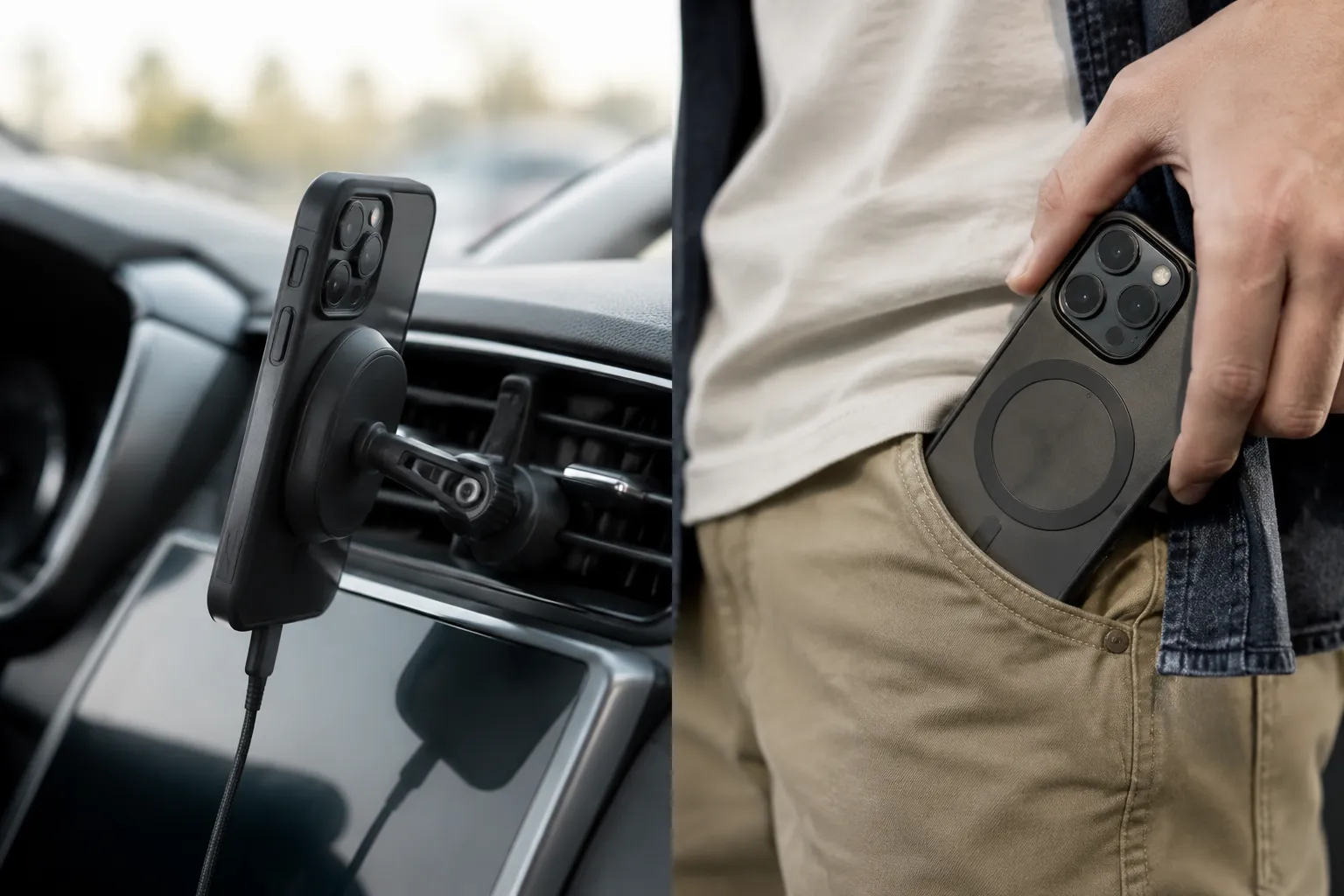
The car mount category has exactly one meaningful fork: vent mount versus dashboard mount. Vent mounts start around $20 and require the phone to hang from the air conditioning slats. They work fine in most cars, but the weight of a Pro Max on a vent mount causes the slats to droop over time, and the phone blocks the vent's airflow when it is hot outside. The charger cable matters more than the mount itself, since most affordable vent mounts are friction-fit rather than MagSafe-aligned, which means a person must plug in a cable anyway.
Real MagSafe car chargers with magnetic alignment and 15W charging run $35 to $60. The Belkin and iOttie models that snap the phone into place and hold it securely over rough pavement are the ones that justify the price. They also charge the phone while navigating, which a plain vent mount does not do without a separate cable running across the cabin.
The dashboard mount version, at $50 to $80, solves a problem most drivers do not know they have until they try it. Vent mounts put the phone low and to the left or right, forcing a glance away from the road. A dashboard mount sits at eye level, near the windshield, where the glance is shorter and the navigation is visible without moving the head. That ergonomic win is worth the extra $30, especially for people who commute in unfamiliar areas.
A person can skip the MagSafe car charger entirely and use a $5 vent clip with a short USB cable. That works. It also keeps the phone at 7.5W or less, which means navigation plus screen brightness can drain the battery faster than it charges on long trips. The MagSafe car charger earns its price by actually adding charge while the phone runs maps at full brightness.
Wallets and the accessories that hide an annual fee
The MagSafe wallet is the accessory that looks cheap and turns out to be a subscription. Apple's version costs $59, holds two or three cards, and attaches with the same satisfying snap. The Find My integration, which lets a person locate a lost wallet through the iPhone's network, sounds like a gimmick until the wallet slips between car seats at a gas station.
The catch is that the wallet's useful life is tied to the phone's. MagSafe wallets attach magnetically and rely on Apple's evolving magnet array. A wallet bought for an iPhone 13 still attaches to an iPhone 15, but the alignment has shifted slightly and the attachment feels weaker. Third-party wallets with stronger magnets solve this for $20 to $30, though they lack the Find My integration.
Then there is the case. A MagSafe case is effectively a requirement, because the magnetic grip on a bare iPhone is strong but not strong enough for car mounts and battery packs jostling over time. A case with the magnet ring built in costs $40 to $60 from Apple or $20 to $35 from Spigen and Torras. The cheap case problem is real: a case that holds the phone but has weak magnets makes every MagSafe accessory feel broken. The phone slides off the charger, the battery pack shifts, the car mount drops the phone on a pothole.
The wallet plus case combo reveals the ecosystem's hidden math. Apple's wallet at $59 plus a case at $49 is $108 for two pieces of plastic and leather. The Spigen equivalent costs $45 total and works 90 percent as well. The missing 10 percent is the Find My integration, which is the only feature that genuinely justifies the Apple premium in this category.
Standing docks multiply the cost quietly
The most expensive corner of the ecosystem is the multi-device charging stand. These docks promise to charge a phone, watch, and AirPods from one clean base, and they sell for $100 to $150 from Apple and Belkin, or $40 to $70 from Anker and other third parties. The price difference tracks closely with materials and stability. The cheap stands wobble when a phone is removed, and the watch charger sometimes uses a weaker alignment coil that charges slower than Apple's official puck.
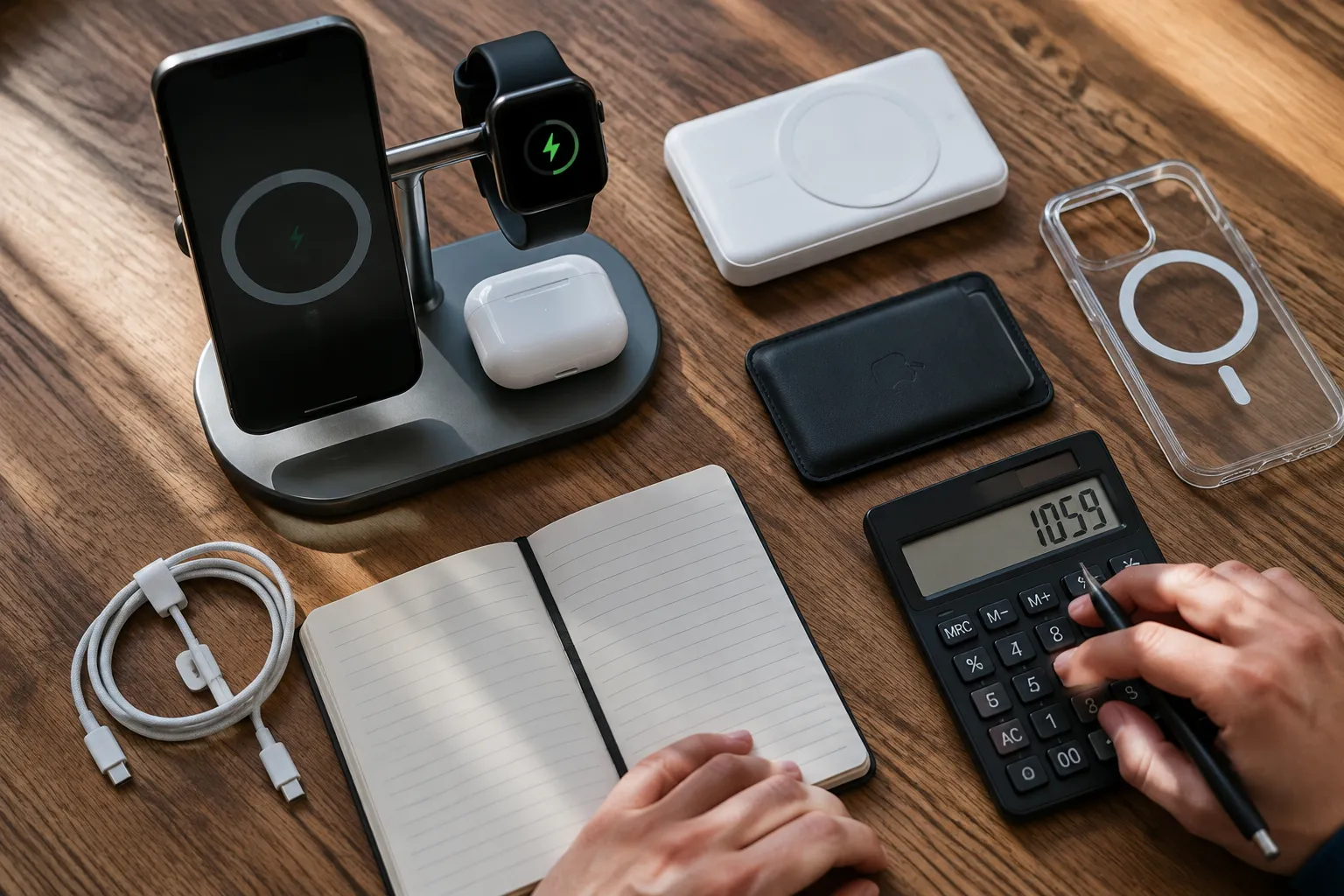
A person can assemble a standing dock from separate pieces: a MagSafe puck at $39, a watch charger at $29, and a Qi pad for AirPods at $15. That totals $83 and covers two nightstands awkwardly. The integrated dock costs more because it consolidates three cables and three bricks into one. For a person with a partner who also owns an iPhone, the single-dock solution runs $150 to $250 because one dock cannot charge two phones at full speed. That is the moment the ecosystem's total cost becomes visible.
Two bedside setups, with a phone charger, watch charger, and AirPods pad each, cost roughly $200 in accessories. That is before the car mount, the battery pack, and the travel charger. A full personal ecosystem, phone to car to nightstand to bag, lands between $500 and $700 depending on how many Apple-branded pieces a person chooses.
The travel kit is where the budget breaks
Travel accessories expose the pricing strategy from a different angle. The MagSafe charger is small and portable, which makes it an easy travel companion, but a person needs a wall adapter with enough wattage to run it at full speed. Apple's 20W adapter is $19. Third-party GaN chargers with multiple USB-C ports run $30 to $50 and handle a phone, laptop, and battery pack from one wall outlet.
Apple sells a MagSafe Duo charger at $129 that folds into a compact package and charges a phone and watch simultaneously. It charges the watch at only 3W, which means a watch with low battery takes noticeably longer to top up than on the standard puck. The Duo is the most expensive travel accessory in the lineup and it cuts the charging speed on the very devices it is meant to serve. Third-party travel stands at $30 to $50 charge faster but fold less elegantly and add bulk to a carry-on.
A person traveling light can pack the $39 MagSafe puck plus a $19 wall adapter and charge the phone and, with a USB-C to Lightning or USB-C cable, also charge AirPods and a battery pack. That setup covers most needs but loses the watch charger entirely. Adding a third-party watch charger at $15 plus the cable required to use it brings the travel kit to around $80, still less than the Duo and with better charging speeds.
What the real budget totals look like
Three tiers of commitment emerge from the pricing. The entry level, with a genuine Apple MagSafe puck, a $25 stand, a $30 car mount, and a $25 third-party battery, runs $120. That buys the ecosystem's core experience: snap-on charging at home, navigation power in the car, and a day of extra battery on the go. It is a functional setup with no Apple logo beyond the puck itself.
The middle tier adds a third-party case, a proper dashboard mount, a higher-capacity battery pack, and a two-device nightstand dock. That totals $300 to $350 and covers every scenario a person faces in a normal week. The accessories are from Anker, Spigen, and Belkin, and they perform within a few percent of Apple's versions while costing half as much.
The full Apple tier, everything branded, everything matched, runs $550 to $650. That buys the integration features that matter, Find My in the wallet and the case, plus the aesthetic coherence of a drawer full of white boxes. It also buys slower charging in the battery pack, lower capacity in the wallet, and a Duo charger that underpowers the watch. The premium does not consistently purchase better performance. It purchases the system working as one designed thing rather than as a collection of compatible parts.
The one accessory that changes the calculation
Apple's MagSafe charger shares its connector standard with every iPhone since the iPhone 12, but the ecosystem's future is not guaranteed. The iPhone 15's switch to USB-C made most existing MagSafe accessories work unchanged, which signals that the magnetic standard is stable across connector changes. The same cannot be said for the watch charger, which Apple has already changed once with the watch's magnetic fast-charging profile.
A person buying into this ecosystem in 2025 should treat the chargers as the durable investment and the batteries and wallets as consumables. The puck and the car mount will outlast two or three phone upgrades. The battery pack will degrade in two years. The wallet will wear out or lose its magnetic grip in eighteen months. The replacement cycle for the cheap pieces is what pads Apple's revenue, and it is the line item most budget breakdowns omit.
The realistic long-term cost is not the initial $300 or $600. It is the $80 to $150 per year spent replacing the worn battery pack, the scuffed wallet, the case that no longer fits the new phone's camera bump. MagSafe is a system of small, replaceable objects, and Apple designed it that way deliberately. The parts are cheap enough to feel disposable and expensive enough to add up, and the magnetic snap keeps pulling the next purchase into place.