The wireless charging industry has spent a decade selling convenience and quietly ignoring physics. The result is a market where two standards that look nearly identical on paper, MagSafe and Qi2, deliver meaningfully different real-world charging speeds, and almost nobody shopping for a charger knows why. The gap has nothing to do with the wattage printed on the box and everything to do with how each standard manages heat, magnets, and power delivery. Understanding the difference starts with discarding the assumption that a 15W logo means the same thing on both.
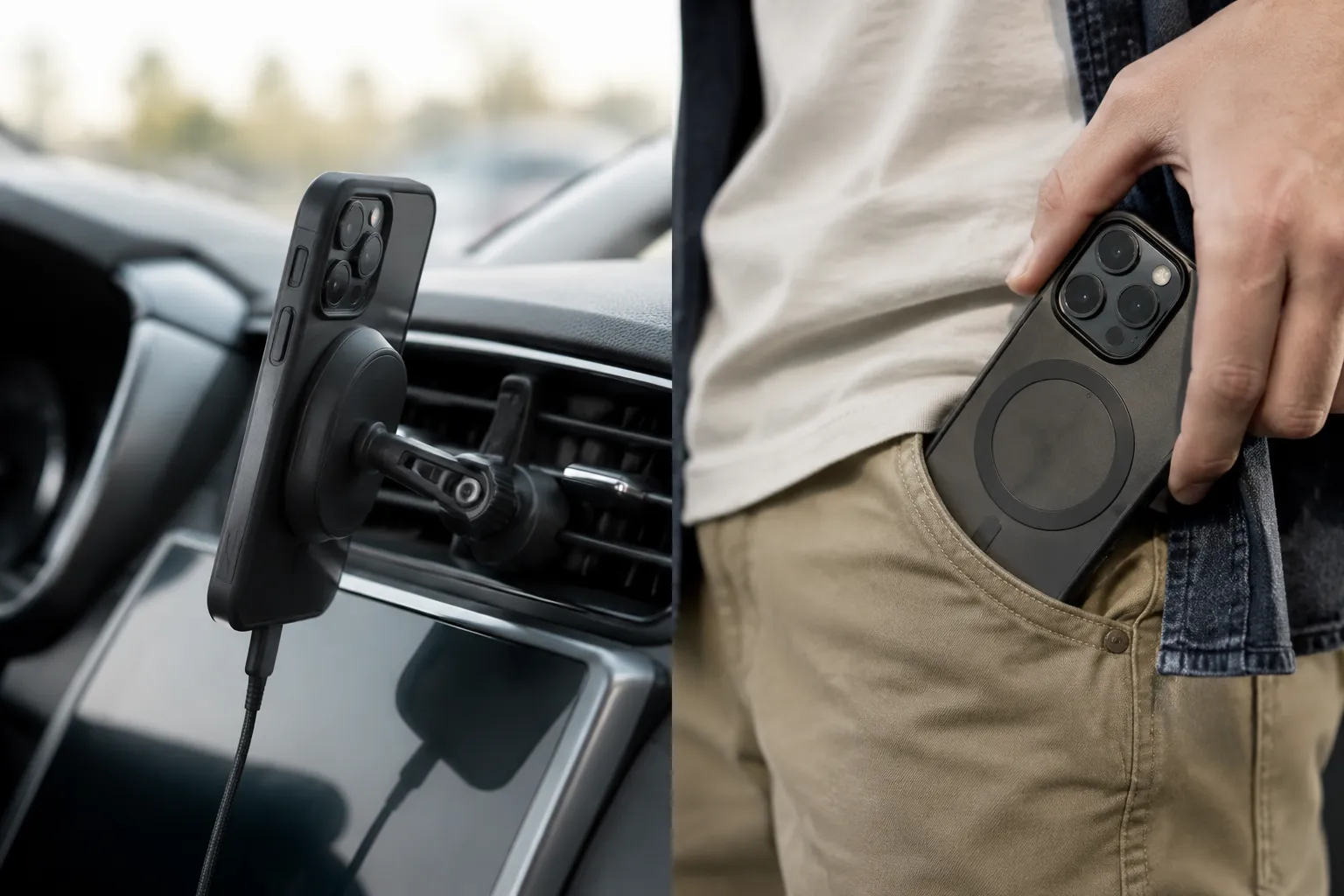
Apple introduced MagSafe in 2020 with a ring of magnets around a wireless charging coil, a design that solved a problem most people did not know they had. Qi chargers before MagSafe were positional nightmares. A phone sitting a few millimeters off center would charge slowly or not at all, and the user would find a dead device in the morning. The magnet array on the iPhone 12 and later models guarantees alignment between the coil in the phone and the coil in the puck. That alignment makes charging reliable, and it also allows the phone to negotiate for higher power without cooking itself.
The Qi2 standard, finalized in 2023, borrows the magnet ring concept and generalizes it. The Wireless Power Consortium took Apple's geometry, made it an open specification, and called the result the Magnetic Power Profile. Any phone maker can now build a device that snaps onto the same pattern of magnets. Any charger maker can build a puck that works with both iPhone and Android devices that support the profile. On the surface, this looks like a victory for standardization. The magnets align, the coil centers, and the phone should charge at the same speed.
That expectation collapses under the first real-world test with a thermal camera and a watt meter. A MagSafe-certified charger pulling the full 15W from an iPhone will heat the phone's back glass to around 36 to 38 degrees Celsius after twenty minutes. A Qi2 charger doing the same job on the same iPhone will run hotter, often crossing 40 degrees, because the Qi2 spec has a different thermal budget and different power negotiation thresholds. The phone notices. Its firmware throttles power to protect the battery, and the effective charging speed drops.
The 15W number is a ceiling, not a promise
Both standards publish 15W as their maximum wireless output. The confusion starts when shoppers interpret that as a sustained rate. A phone does not pull 15W from the wall for the entire charging session. It draws the maximum only during a narrow window when the battery is between roughly 20 and 60 percent capacity and the temperature is within a comfortable range. Outside that window, the phone steps power down in increments of 2.5W or 5W to manage heat and battery stress.
The difference between MagSafe and Qi2 is how quickly and how aggressively that stepping happens. Apple controls the entire MagSafe ecosystem, from the charger hardware to the iPhone firmware. The phone trusts a MagSafe-certified puck more than it trusts a generic Qi2 pad, and it runs closer to the 15W ceiling for longer. The phone cannot extend the same trust to a Qi2 charger because the Qi2 spec allows considerable variance in coil design, magnet strength, and thermal management. The phone plays it safe.
Charging a fully drained iPhone 15 with an Apple MagSafe puck takes about two hours to reach 100 percent. The same phone on a quality Qi2 charger takes closer to two hours and twenty minutes. The difference sounds small until the phone is doing something active during the charge, such as playing audio or navigating. Then the gap widens substantially, because the Qi2 charger has less thermal headroom to begin with, and any added heat from the phone's own components forces an earlier power cutback.
Android phones complicate the comparison further. Many Qi2-certified Android devices, like the HMD Skyline, do not actually pull 15W. Their manufacturers implemented the Magnetic Power Profile but set their own power limits, often landing between 7.5W and 10W. The Qi2 logo on a charger does not guarantee that any given phone will use the full negotiated wattage. The logo only guarantees that the magnets align and that the phone will attempt to talk to the charger. The outcome of that conversation varies by device.
Where the heat actually goes
The thermal story is the story that matters, and it explains why two chargers with identical output ratings behave differently. Wireless charging is inefficient by design. Energy moves from the charger's coil to the phone's coil through an electromagnetic field, and a meaningful portion of that energy never makes the jump. It becomes heat in both coils and in the phone's metal and glass. At 15W, a typical wireless setup wastes about 20 to 30 percent of the input power as heat. That waste is the limiting factor, not the charger's maximum output.
MagSafe chargers benefit from a tighter coil alignment tolerance. The magnet ring in an Apple puck is strong enough to pull the phone into place with a satisfying snap, and that mechanical lock keeps the coils within a millimeter of perfect alignment. Qi2 chargers use the same magnet pattern, but the spec allows weaker magnets and looser tolerances. A Qi2 puck with weaker magnets can shift slightly during a bump or a vibration, and even a small misalignment increases heat generation by a measurable margin.
The charger's own construction matters just as much. A good MagSafe puck contains the receiving coil, the magnet ring, and a metal or ceramic backplate that acts as a heatsink. The heat spreads across the backplate and dissipates into the air. Many Qi2 chargers, especially the cheap ones flooding online marketplaces, use thin plastic housings with no thermal mass. The heat stays concentrated in one spot, directly under the phone's coil, and the phone's internal temperature sensor reads a hotter surface than it would on a better-built charger.
Anker, Belkin, and Spigen all make Qi2 chargers with adequate thermal design, and those units perform close to MagSafe in controlled tests. The problem is that Qi2 certification does not require a minimum thermal performance. The standard only checks that the charger communicates correctly and maintains alignment. A charger that passes certification can still run hot enough to throttle the phone within minutes. The consumer has no way to tell the difference from the packaging.
Standby mode exposes the real gap
The most honest comparison between MagSafe and Qi2 happens at 2AM on a nightstand, not during a daytime speed test. Both standards support a standby mode that turns the phone into a clock, a photo frame, or a calendar display while it charges. This is where the standards diverge in a way that has nothing to do with wattage and everything to do with how the phone decides to behave.
An iPhone in StandBy mode on a MagSafe charger runs a special interface that rotates through clock faces and widgets. The phone knows it is on a MagSafe charger because the charger identifies itself over the communication channel, and the phone adjusts its power draw to keep the display running without overheating. The phone also uses the magnet alignment to precisely position the UI elements relative to the physical charger, a level of integration that Qi2 cannot replicate.
On a Qi2 charger, the same iPhone enters StandBy mode too, because Qi2 chargers support the same standby trigger. But the phone treats the Qi2 charger with less confidence. It runs the display at a lower brightness ceiling and steps down its power draw earlier, because it cannot fully verify the thermal characteristics of the connected device. The standby screen looks identical, but the charging rate underneath is slower. Over an eight-hour overnight session, the phone on a Qi2 charger might gain 5 to 8 percent less charge than the same phone on a MagSafe puck.
This gap matters most for people who skip the overnight charge and rely on a short top-up before leaving the house. A thirty-minute morning routine with the phone on a MagSafe charger adds roughly 25 percent to a depleted iPhone. The same thirty minutes on a Qi2 charger adds closer to 18 percent. Neither number will cause a problem for someone who charges overnight. Both numbers matter for the person who forgot to plug in before bed.
The Android side has a different problem
Android adoption of Qi2 has been slow and inconsistent, and the phones that do support it bring their own charging logic to the table. Samsung's Galaxy series, the largest Android lineup in many markets, does not support Qi2 at all as of early 2025. Samsung phones use the older Qi standard for wireless charging, capped at 15W on some models and 10W on others, with no magnet alignment. Google's Pixel lineup supports Qi2 on the Pixel 12 and later models, but Google has not published clear expectations for Qi2 charging speeds on its devices.
The fragmentation creates a market where Qi2 chargers are sold primarily to iPhone users, because those users get the most consistent benefit from the magnetic alignment. An iPhone user with a Qi2 charger gets a reliable attachment and a charging speed close to, but not equal to, MagSafe. An Android user with a Qi2 charger gets the same magnetic attachment but a charging speed that depends entirely on the phone maker's implementation. The Qi2 standard solved the alignment problem that plagued old Qi charging. It did not solve the speed problem.
The economics of the two standards reinforce the confusion. Apple's MagSafe certification program charges manufacturers a licensing fee, and certified components cost more to produce. A MagSafe-certified puck typically retails between 30 and 40 dollars. Qi2 certification is cheaper, and the components are less tightly specified, so Qi2 chargers commonly sell for 15 to 25 dollars. The price gap leads shoppers to assume they are getting the same thing for less. They are getting a similar shape with different internals.
The cable and the wall adapter change everything
Charging speed depends on more than the wireless standard. The wall adapter feeding the charger must supply enough power, and the cable between them must carry it without loss. A MagSafe puck paired with a 20W Apple adapter delivers the full 15W. The same puck paired with a 5W adapter from an old iPhone box delivers less than 5W, and no amount of magnetic alignment will fix that bottleneck.
Qi2 chargers have the same dependency, with an additional complication. Many Qi2 chargers on the market are sold without a wall adapter, and the packaging specifies a minimum adapter wattage that users frequently ignore. A Qi2 charger rated for 15W output needs a 20W or 25W adapter to reach that figure. Plugged into a 12W adapter, the charger negotiates down to a lower power level and the phone charges at a crawl. The charger itself cannot compensate for an underpowered source.
Cable quality matters too, though less than most people think. A standard USB-C to USB-C cable with adequate gauge wire will carry 20W without issue. The problem arises with very long cables, over two meters, which suffer voltage drop that reduces the power reaching the charging puck. A three-meter cable can cost 15 to 20 percent of the charger's output, turning a 15W charge into a 12W one. The charger and the phone both report their negotiation correctly, and the user never sees the power that was lost in the wire.
Testing the claimed 15W on a real phone
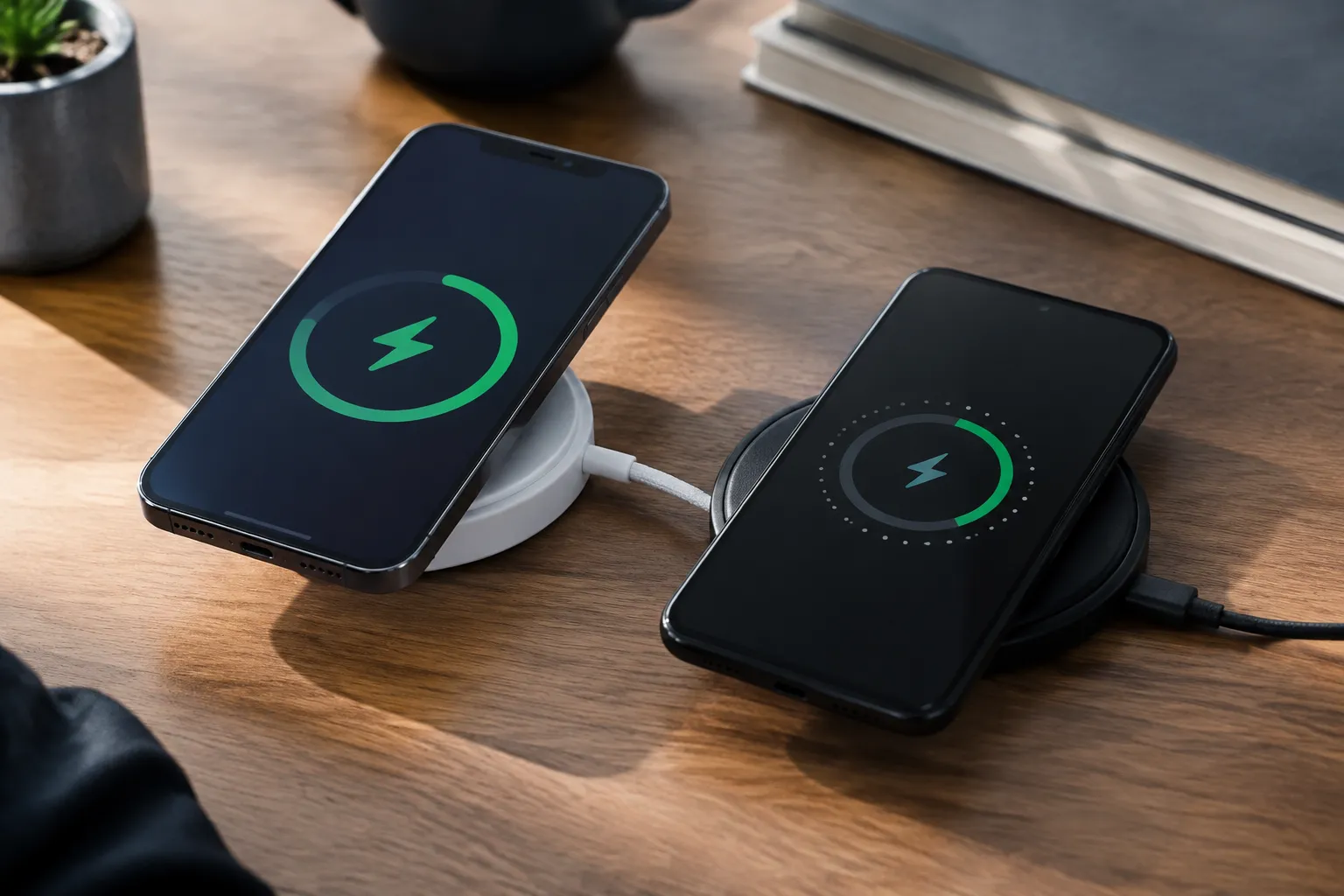
A practical test of an iPhone 15 Pro Max, measured with a USB power meter between the wall adapter and the charging puck, reveals the truth about sustained output. The MagSafe charger draws about 18W from the wall, converts it to 15W at the phone's coil, and sustains that rate for roughly 25 minutes before stepping down. The Qi2 charger draws the same 18W initially, but the phone's firmware cuts the negotiated power to 10W after about 15 minutes, because the thermal sensor on the phone's back reads a higher temperature.
That single firmware decision explains the entire real-world speed difference. The phone does not care which standard the charger claims to support. It cares about the temperature reading inside the device, and it protects the battery by reducing power when that reading climbs. The MagSafe charger keeps the phone cooler, so the phone allows more power for longer. The Qi2 charger, even a well-built one, runs slightly hotter, so the phone protects itself sooner.
The gap narrows in cooler environments. In a room at 18 degrees Celsius, the Qi2 charger can sustain 15W for nearly as long as MagSafe, because the ambient air removes enough heat to keep the phone below its throttle threshold. In a warm room at 28 degrees, the Qi2 charger throttles much earlier, and the speed difference can exceed 30 percent. The same two chargers that performed almost identically in a cool testing lab diverge sharply in a summer bedroom without air conditioning.
Choosing by use case instead of logo
The decision between MagSafe and Qi2 comes down to what the user actually does with a charger, and the answer changes the recommendation. The person who charges overnight and takes the phone off the puck in the morning will not notice the speed difference. The magnetic alignment alone justifies buying the cheaper Qi2 charger, since the phone will reach full charge long before the alarm rings. The money saved on a 15 dollar Qi2 puck versus a 35 dollar MagSafe puck buys nothing in charging performance for this user, because the charging session has eight hours to complete.
The person who charges in short bursts throughout the day, such as between meetings or while driving, will notice the difference. A ten-minute top-up on MagSafe adds roughly 8 percent to a depleted phone. The same ten minutes on a Qi2 charger adds closer to 5 or 6 percent. Over a full day of intermittent charging, that gap compounds, and the phone ends the day with 15 to 20 percent less charge than it would have had with MagSafe. For this user, the premium for Apple's standard is worth paying.
Androids with Qi2 support complicate the recommendation further. Since Android phone makers have not standardized their power negotiation for Qi2, the charger brand and model matters more than the standard it supports. A user with an Android phone should look for charger reviews specific to their phone model, not trust a Qi2 logo. The same charger that charges a Pixel at 15W might charge a different Qi2 Android device at 7.5W, with no visible indication of the difference.
The market is moving toward a convergence that will eventually erase these distinctions. Apple has hinted at supporting the Qi2 standard directly in future iPhone models, which would make MagSafe and Qi2 interchangeable for new devices. The next revision of the Qi spec promises better thermal management requirements and stricter coil tolerances. When those changes arrive, the speed gap will close, and the choice between standards will become purely about price and brand preference. Until then, the 15W number on the box is an aspiration, and the temperature sensor inside the phone is the only referee that matters.