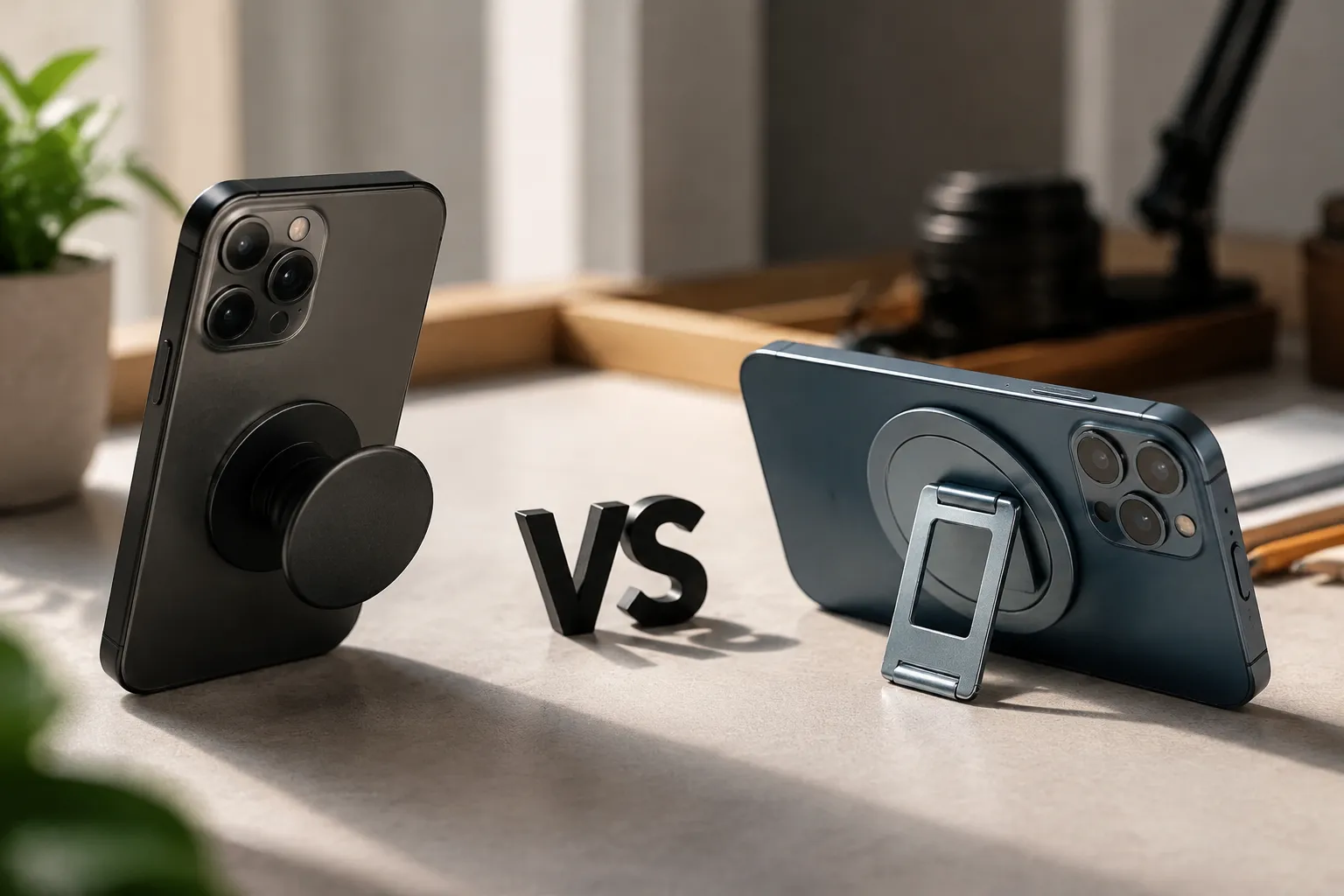
The accessory landscape behind a modern smartphone has become a crowded shelf of plastic discs, metal rings, and sticky adhesive pads. Among the most popular are the MagSafe PopSocket and the magnetic grip stand, two products that look similar at a glance but serve surprisingly different daily functions. Both attach to the back of a phone via magnets, both add something to grip, and both promise to make a large phone easier to handle. The practical differences, though, show up in specific moments: a crowded train, a kitchen counter, a car dashboard, a bedside table at 2 a.m.
The question of which one is more useful depends entirely on what a person actually does with a phone throughout the day. For someone who watches a lot of video, the grip stand wins without much contest. For someone who texts constantly and rarely watches anything longer than a clip, the PopSocket has a clear edge. But the real answer involves more than just use cases. It involves how each accessory changes the physical feel of the phone, how it behaves when not in use, and how it survives the small accidents of ordinary life.
The PopSocket Grip Is a Finger Anchor, Not a Stand
The original PopSocket, before the MagSafe version existed, was a humble plastic circle that collapsed flat and expanded into a accordion-like grip. Users hooked a finger through the collapsed folds to secure the phone against dropping. The design solved a genuine problem: phones got bigger, hands did not, and the pinky-shelf grip that people used to support a phone's bottom edge became a common source of discomfort. The PopSocket moved the support to the middle of the back, distributing weight more naturally across the hand.
The MagSafe version keeps that core function but swaps the adhesive base for a magnetic one. This means it attaches to the built-in magnet array inside newer iPhones, and it can be removed and reattached without leaving a sticky residue. The grip itself is identical in feel to the original. A finger slides between the folded accordion and the back of the phone, and the phone becomes noticeably more secure in the hand. The thumb gains freedom to reach across the screen without the rest of the hand scrambling to hold on.
That finger anchor matters most during one-handed use. Walking down a street with a coffee in one hand and a phone in the other, the PopSocket allows the phone to rest securely against the fingers while the thumb scrolls, taps, and types. Without it, the same task requires a careful balancing act, a death grip, or a two-handed pause. The PopSocket effectively makes a large phone behave like a smaller one in the hand, which is its primary and most valuable trick.
As a stand, the PopSocket is mediocre. It can prop the phone up at a slight angle for casual viewing on a table, but the angle is shallow and the stability depends on the surface. On a soft bed or a couch cushion, it falls over. On a hard desk, it works only if the phone rests against something else for additional support. The PopSocket was never designed to be a serious viewing stand, and using it that way feels like an afterthought.
The Grip Stand Is a Furniture Piece for the Phone
Magnetic grip stands, sometimes sold under brand names like ESR or Anker, take a different approach. They feature a flat metal or plastic base with a collapsible ring or a folding kickstand on the back. The ring typically rotates 360 degrees, and the whole assembly folds flat against the phone when not in use. These accessories are thicker than a PopSocket when collapsed, but they offer a fundamentally different kind of utility: they turn the phone into a self-supporting object.
With the ring flipped out, the phone stands upright on a table like a tiny picture frame. This makes video calls, recipe following, and movie watching genuinely comfortable. The viewing angle is adjustable, and the phone stays put without any additional props. On a kitchen counter, a grip stand holds the phone at eye level while a person chops vegetables or stirs a pot. On a nightstand, it props the phone up so the screen faces the room, serving as a small clock or a notification display.
The ring also works as a grip, but it does not feel as secure as a PopSocket. A finger hooks through the ring, and that keeps the phone from slipping, but the phone can still rotate around the ring's pivot point. The grip stand requires a slightly firmer hold, and it does not distribute the phone's weight as evenly across the hand. For quick one-handed typing sessions, the grip stand works fine. For extended use, the hand fatigues faster than it does with a PopSocket.
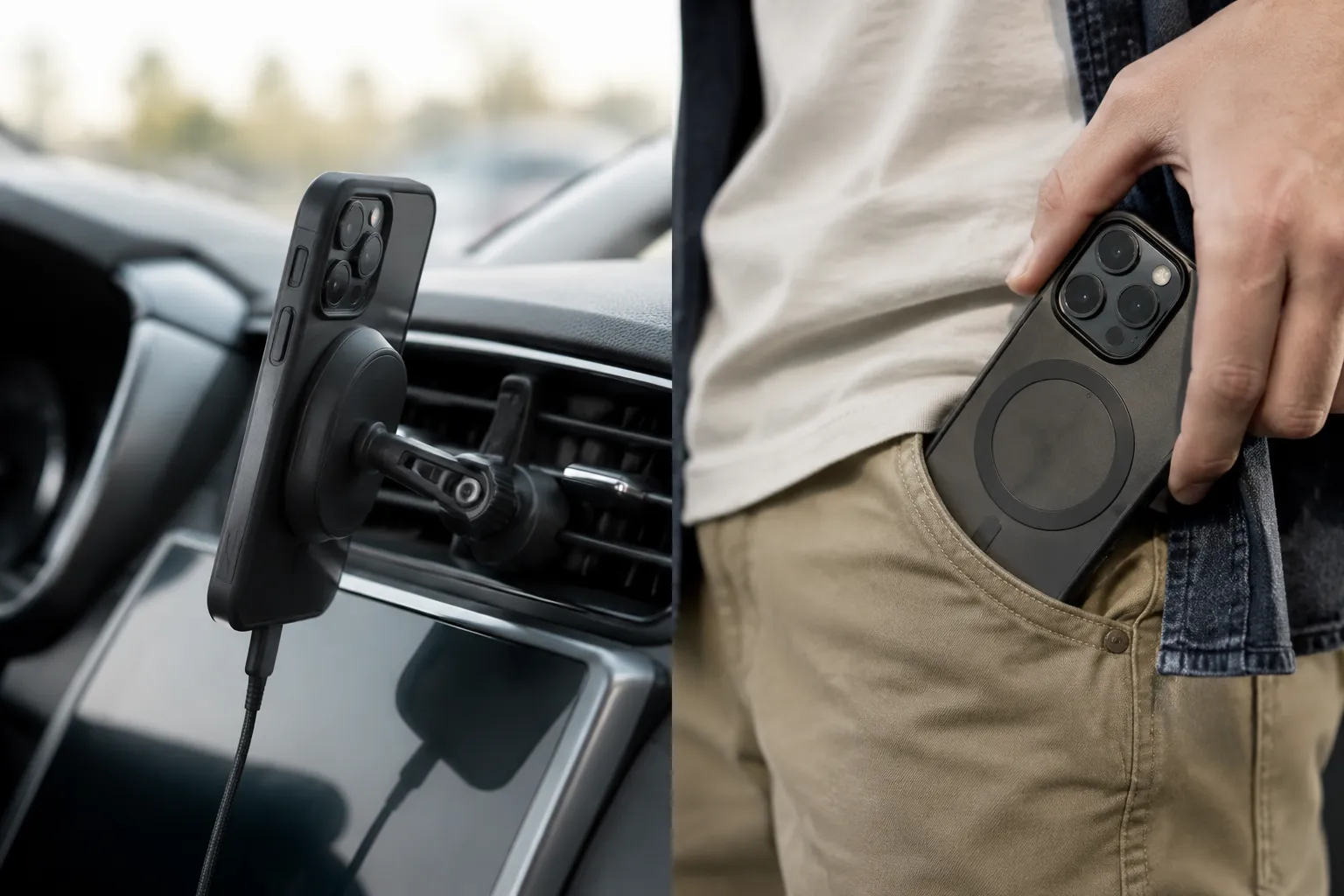
Where the grip stand truly shines is in the car. Many magnetic grip stands are compatible with MagSafe car mounts, meaning the accessory can stay attached to the phone while the phone snaps onto a dashboard mount. The PopSocket, by contrast, often interferes with car mounts because its bulk prevents the phone from seating properly against the mount's magnetic surface. This single difference changes the calculus for people who use their phone for navigation on a daily commute.
Wireless Charging Behavior Differs Between the Two
Both accessories sit directly over the phone's internal charging coil, which creates a clearance problem for wireless charging pads. A MagSafe PopSocket, when collapsed, is thick enough that it prevents the phone from lying flat against a standard Qi charging pad. The phone rocks on the PopSocket's bulk, and the charging coil loses contact. Some users solve this by removing the PopSocket before charging, which defeats the purpose of a magnetic attachment.
Magnetic grip stands generally handle wireless charging better, but only in specific configurations. Many ring-style stands fold completely flat, and their thin profile allows the phone to sit flush on a charging pad. Others include a detachable ring that removes entirely when charging is needed. The best designs use a recessed magnet arrangement that keeps the ring's thickness under the threshold that breaks the charging connection.
MagSafe chargers themselves are a different story. The Apple MagSafe charger uses its own magnet array to align with the phone, and it can charge through either accessory as long as the accessory does not lift the phone too far from the charger's surface. A thin grip stand usually passes this test. A PopSocket, even collapsed, often does not. This creates an annoying ritual for PopSocket users: attach the accessory for grip, remove it for charging, reattach it when leaving. The friction of that ritual wears thin over months of daily use.
The charging difference alone pushes many users toward the grip stand, especially those who charge wirelessly every night. A phone with a grip stand can drop onto a MagSafe puck without any fiddling. A phone with a PopSocket requires a deliberate removal step, and that step gets skipped sometimes, leading to a dead battery in the morning.
Pocket Fit and Everyday Bulk Determine Long-Term Satisfaction
Both accessories add bulk to the phone, but they add it in different ways. A PopSocket, when collapsed, sits flush against the phone's back and adds a raised disc roughly the diameter of a half dollar. In a pants pocket, that disc creates a noticeable bump, but the phone slides in and out fairly easily because the disc is smooth and rounded. The PopSocket does not catch on fabric seams as often as one might expect.
A grip stand with a ring, when folded, adds a flatter but wider footprint. The ring mechanism often has small gaps and edges where fabric can catch. Pulling the phone out of a tight jeans pocket can flip the ring open accidentally, and the phone emerges with the ring sticking out at an awkward angle. Over time, this gets irritating. The grip stand also makes the phone thicker overall, which some users notice when sliding the phone into a car's center console or a small bag pocket.
MagSafe PopSockets have an additional advantage: they are removable and swappable. Since they attach magnetically, a user can pop one off and replace it with a different color or design whenever the mood strikes. The grip stand is equally removable, but its design is more utilitarian, and swapping it feels less like a personal expression and more like a hardware change.
Durability is another dividing line. PopSockets are known for their longevity. The accordion mechanism can survive thousands of expansions and collapses, and the magnetic version holds its grip strength well over time. Grip stands vary more widely in quality. Cheap ones develop loose hinges after a few months, and the ring can start to wobble or fail to stay in its detents. A well-made grip stand from a reputable brand holds up fine, but the market is full of flimsy options that feel solid for a week and then degrade quickly.
The PopSocket Fails on the Desk and in the Kitchen
The most common place a phone rests during the day is not in a hand. It is on a desk, a counter, or a table. In those settings, the PopSocket's weakness becomes obvious. A phone with a PopSocket lies flat on its back, and to use it, a person must either pick it up or tilt it against something. The PopSocket's collapsed profile does not provide any meaningful viewing angle. Checking a notification requires lifting the phone or bending the neck to look down at it from above.
A grip stand transforms that same phone into a hands-free device. Flip the ring out, set the phone down, and the screen faces the user at a comfortable angle. Watching a YouTube tutorial while cooking, following a recipe from a screen propped against the backsplash, or joining a video meeting without holding the phone becomes possible. These are not edge cases. They are daily activities for millions of people, and the grip stand handles all of them gracefully.
This is where the grip stand establishes its strongest claim to usefulness. It does not merely improve how a person holds a phone. It changes what the phone can do when the hands are otherwise occupied. The PopSocket improves the holding experience but adds almost nothing to the resting experience. A person who uses a phone primarily as a communication device will prefer the PopSocket. A person who uses a phone as a small screen for content, calls, and information will find the grip stand indispensable.
One-Handed Reach Still Belongs to the PopSocket
For all the grip stand's talents on flat surfaces, it cannot match the PopSocket for pure one-handed security. Consider a person standing in a crowded subway car, holding a pole with one hand and a phone with the other. The PopSocket allows that person to text, scroll, and swipe with the thumb while the fingers lock through the grip. The phone feels nearly immovable. A grip stand in the same situation provides a hook for one finger, but the phone shifts and pivots more, and the user must compensate with a tighter overall grip.
This difference extends to walking, to taking photos, to holding the phone up for a video call, and to any situation where the phone is in motion along with the body. The PopSocket's design, with its wide base and deep finger channel, creates a stable connection between hand and device. The grip stand's ring, by contrast, offers a single point of contact that allows rotation and wobble.
There is also the matter of how each accessory feels during long reading sessions. Holding a phone for twenty minutes of article reading or social media scrolling requires constant micro-adjustments of grip. The PopSocket lets the fingers relax and hold the phone loosely, because the grip bears the weight. The grip stand requires a more active hold, and the hand tires sooner. For heavy one-handed users, this ergonomic difference becomes the deciding factor.
A Car Mount Settles the Argument for Commuters
Drivers who rely on their phones for GPS navigation face a specific compatibility matrix. A MagSafe car mount holds the phone with a strong magnet array, and the phone needs to sit flush against the mount's surface for the connection to hold. A PopSocket, even collapsed, lifts the phone away from the mount and weakens the magnetic connection. The phone may slide down or fall off entirely on bumpy roads. Some drivers solve this by mounting the PopSocket below the phone's magnet array, but that placement defeats the purpose of using a MagSafe-compatible accessory.
A grip stand with a thin ring folds flat enough that the phone seats properly on most MagSafe car mounts. The phone stays firmly attached, and the driver gets full navigation functionality. For daily commuters, this is not a minor consideration. It is the difference between an accessory that works with the car setup and one that requires constant readjustment.
Even for drivers who use vent mounts or dashboard mounts with a clamping mechanism, the grip stand tends to work better. The phone's flat back, with the ring folded, fits into most clamps without issue. The PopSocket's protruding disc often gets caught on the clamp's edges, and the phone sits crooked or refuses to seat properly.
The car test is a practical filter. People who drive frequently and use their phones for directions will find that the grip stand integrates seamlessly into their routine. The PopSocket creates friction at the exact moment when the driver wants to get in the car and go.
The Case Compatibility Question Changes the Answer
Both accessories attach magnetically, which means they need a phone or a case with a built-in magnet array. Most modern iPhones have this built in. Many Android phones do not, and users of those phones must buy a magnetic adapter or a magnetic case to use either accessory. The adapter approach adds another layer of bulk and another potential point of failure.
For iPhone users, the choice comes down to case style. A thin, minimal case works fine with both accessories. A rugged case with raised edges can interfere with the PopSocket's collapsed profile, making it harder to grip. A grip stand's ring, being thinner, often clears the case's edge more easily. Users who switch cases frequently will find that grip stands are slightly more forgiving across different case designs.
The MagSafe PopSocket also requires a specific placement on the back of the phone. It needs to center over the magnet array, which sits in the upper-middle area of the iPhone's back. For most users, that placement is natural and comfortable. But for people with smaller hands, the PopSocket's optimal position for grip may not align with the magnet array's location. The grip stand has the same constraint, but its ring is large enough that the hand can adjust slightly without losing the magnetic connection.
The Verdict Depends on the Dominant Hand Position
Every person holds a phone in one of two dominant states: in the hand, actively being used, or resting on a surface, waiting for the next interaction. The PopSocket optimizes for the first state. The grip stand optimizes for the second. A phone that spends most of its waking hours in a person's hand, being tapped and swiped and typed on, will feel better with a PopSocket. A phone that spends time propped on a desk, a kitchen counter, or a car mount will serve its owner better with a grip stand.
There is a middle path. Some users buy both and swap them depending on the day's activities. The magnetic attachment makes this easy, and the thirty-second swap is not a burden for people who know they will spend the afternoon in a video call or the evening walking around a festival. But most people do not want to manage a rotation of accessories. They want one thing stuck to the back of the phone that works most of the time.
For that majority, the grip stand is the more useful accessory. It performs adequately as a grip, and it excels as a stand, a car mount companion, and a wireless charging partner. The PopSocket performs brilliantly as a grip and poorly at everything else. Its single-function excellence does not compensate for its limitations in the many situations where a phone needs to stand on its own. A person can live with a grip stand that feels slightly less secure in the hand. A person cannot easily live with a PopSocket that falls over on a desk and blocks the car mount.
The choice, in the end, reflects how a phone fits into a daily rhythm. Heavy texters and social media scrollers who hold their phones constantly will defend the PopSocket to the end, and their preference is legitimate. But the broader utility, the accessory that makes a phone more capable across more settings, belongs to the grip stand. It turns a handheld device into a tabletop device, and in a world where phones have become the primary screen for so many small tasks, that ability matters more than a slightly better finger hold.