Gifting a case to someone who genuinely loves technology is a specific kind of gamble. The market is flooded with black slabs of polycarbonate and faux-carbon-fiber patterns that all promise ruggedness but deliver nothing but bulk. A tech geek does not want a box. A tech geek wants a system that disappears into daily carry, protects a very expensive piece of glass and metal, and does not get in the way when the device needs to come out for the twentieth time that day. Most gift guides miss this entirely because they treat the case as an afterthought, a boring add-on to the real present. The right case, though, is the present. It is a statement about how that person treats their tools.
The first rule of buying a case for a serious device owner is to abandon the idea that protection means thickness. The person who spends hours reading spec sheets and comparing processor benchmarks does not want a brick. They want a case that offers drop protection without turning a 6.1-inch phone into something that feels like a 6.7-inch phone with a bodybuilding routine. This is the tension at the heart of every case purchase, and the picks that follow resolve it in different ways depending on the device and the person's daily life.
Why the Case Matters More Than the Gadget
A person who buys a flagship laptop or a pro-tier tablet has already made a calculation about performance. They did the research, they spent the money, and they expect the device to last several years. The case is the single accessory that determines whether that investment survives a commute, a coffee shop table, or a backpack that gets thrown into the overhead bin. A cracked screen or a dented corner is not just an inconvenience; it is a failure of the entire system the person set up for themselves.
There is also a tactile dimension that gets overlooked. Most people do not think about how a case feels in the hand until they hold a bad one. Slippery plastic that slides out of a palm onto concrete. Sharp edges that dig into fingers during a long reading session. A lip around the screen that collects dust and makes swiping feel like dragging a finger over a speed bump. These small failures add up to daily irritation, and yet they are completely invisible in product photos online.
The good news is that the case market has matured significantly in the last few years. The old choice between a flimsy clear shell and an ugly tactical brick is gone. There are now options that genuinely balance protection, feel, and aesthetics, and a thoughtful gift can show that the giver paid attention to how the person actually uses their device.
MagSafe and the New Ecosystem of Accessories
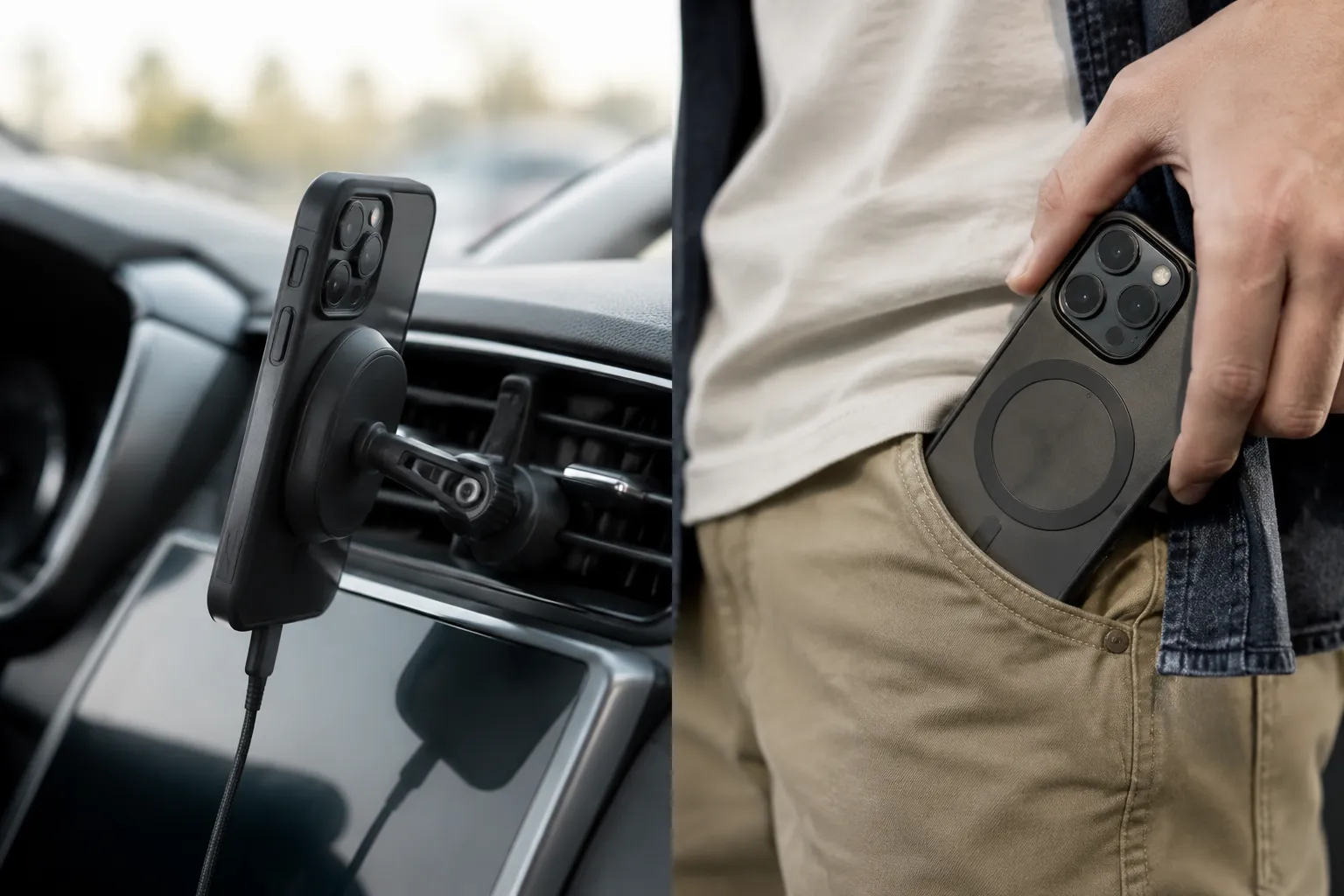
Anyone shopping for an iPhone case in the current era has to contend with MagSafe. The magnetic ring on the back of recent iPhones is not a gimmick. It enables a whole family of accessories: wireless chargers that snap into place, battery packs that attach without cables, car mounts that hold the phone securely, and wallets that stick to the back. A case that interferes with these magnets, or one that uses a weak magnet array, cuts the phone off from all of that functionality.
For a tech geek, this is a dealbreaker. They likely own at least one MagSafe accessory already, or they have been eyeing one. A case without proper magnetic alignment forces them to remove the case every time they want to charge or mount the phone, which defeats the entire purpose of having a case in the first place. The pick here needs strong, properly aligned magnets built into the case itself, not just a thin ring of metal that sort of works sometimes.
This consideration narrows the field considerably. Many budget cases on Amazon claim MagSafe compatibility but deliver magnets so weak that the phone slides off a car mount at the first pothole. The reliable options tend to come from brands that have invested in proper tooling and testing, and those are the ones worth gifting.
The Everyday Workhorse: A Case for the Commuter
For the person who takes public transit, walks city blocks, and juggles a phone in one hand while holding a coffee in the other, the priority is grip and drop protection. This person does not need a case that survives a three-story fall onto concrete; they need one that survives the fumble at the crosswalk when a bike suddenly swerves past. The difference is in the materials.
Thermoplastic polyurethane, or TPU, remains the gold standard for this use case. It flexes on impact, absorbs shock, and provides a grippy surface that does not become slick with hand oils over time. The best TPU cases also have reinforced corners, which is where phones actually hit the ground first in most drops. A case with uniform thickness all around looks fine but performs worse than one with slightly beefier corners and a thinner center.
One specific option worth considering is the Caudabe Synthesis. It uses a rigid backplate with a flexible bumper, a two-piece construction that feels premium without adding significant bulk. The texture on the back is subtle, not rubbery or sticky, and the buttons are clicky rather than mushy. It sits flush with the camera module, which prevents the rocking motion that plagues many cases with raised lips around the lens. For a commuter who values a clean profile and solid grip, this case hits a sweet spot that few others manage.
The Minimalist Who Hates Cases Entirely
Some tech enthusiasts fall into a particular category: they hate cases. They buy a phone for its industrial design, its titanium edges, its precisely machined buttons, and they resent covering any of it with a piece of plastic. Yet they also know, deep down, that a naked phone is one careless moment away from a cracked back panel that costs hundreds to replace.
For this person, the answer is not a case. It is a skin or a thin shell that protects against scratches and minor scuffs without adding meaningful bulk. The best option here is a product from a company like Peel or Totallee. These are sub-millimeter polypropylene shells that snap onto the back and sides. They do not offer serious drop protection, and anyone who claims they do is lying. But they do prevent the micro-abrasions that accumulate on a naked phone, and they add almost zero weight or thickness.
The trick with this category is managing expectations. A minimalist who hates cases will not suddenly love a case that looks like it is not there but actually is. The shell has to be nearly invisible, with precise cutouts and a matte finish that does not attract fingerprints. It also needs to be easy to remove, because this person will likely take it off at home and only use it when leaving the house. A shell that fights removal will end up in a drawer within a week.
The Road Warrior and the Laptop Sleeve
Laptop cases present a different challenge than phone cases. A laptop sleeve is not about protecting against drops so much as protecting against the chaos of a bag. The laptop shares space with cables, chargers, notebooks, pens, and whatever else accumulates in a daily carry bag. The sleeve needs to shield the device from pressure and abrasion, and it needs to do so without adding so much padding that the bag becomes impossibly stuffed.
The road warrior, the person who travels weekly for work and lives out of a rolling bag, has specific needs. The sleeve needs a secure closure that will not pop open during a security screening or a scramble through an airport. It needs a soft interior lining that will not scratch the aluminum finish. And it needs to be slim enough to slide into an existing backpack compartment without turning the whole setup into a nesting doll of padding.
A strong pick in this space is the Bellroy Laptop Sleeve. It uses a recycled felt material that provides surprising rigidity, and the interior fleece lining is genuinely soft to the touch. The magnetic closure is strong enough to stay shut but easy to open one-handed, which matters when going through airport security with a laptop that needs to come out of the bag. It comes in a few sizes that correspond to common laptop dimensions, and the fit is snug without being impossible to get the device in and out.
The key detail that separates this from cheaper options is the stitching and the edge treatment. Cheap sleeves often have raw cut edges that fray after a few months. The Bellroy uses a folded edge construction that resists wear, and the exterior material does not pill or look ragged after a year of heavy use.
The Tablet Case That Doubles as a Stand
Tablet cases are a different beast entirely because tablets are not just held; they are propped up, angled, typed on, and watched. A person who owns an iPad Pro or a high-end Android tablet likely uses it as a secondary screen, a note-taking device, or a content consumption machine. The case needs to accommodate those use cases or it will be removed and left in a drawer.
The most versatile option in this category is a folio-style case with a built-in stand that offers multiple viewing angles. The stand should adjust to a low angle for typing and a higher angle for watching video, and it should hold its position without slowly sagging over time. This is where cheap cases fail. Their hinges are often just a fold in the material, and after a few weeks of use, the fold weakens and the tablet starts to lean backward.
The ESR cases with their "multi-angle" stands are a reliable choice here. They use a series of magnets and a folding flap that locks into different positions. The mechanism is simple and durable, and the case itself offers decent protection on the corners and back. The front flap also supports the Apple Pencil or a stylus with a small loop, which matters for anyone who uses the tablet for drawing or note-taking.
One caution: these cases add weight. A tablet is already a substantial device, and a folio with a stiff front cover and a stand mechanism can make it feel like holding a hardcover book. For someone who primarily uses the tablet on a desk or a lap, this is fine. For someone who reads in bed while holding the tablet overhead, the added weight will cause arm fatigue within minutes.
The Materials Question: Leather, Silicone, or Something Else
Material choice is not just about aesthetics; it is about how the case ages. Silicone cases start out feeling great, soft and grippy, but they attract lint and dust in a pocket and they develop a sheen over time that looks greasy. Leather cases develop a patina, which some people love and others find unsettling. Polycarbonate cases stay clean but can feel hard and slippery.
For a gift, the safest bet is often a material that does not require a maintenance routine. Nobody wants to condition a phone case. Nobody wants to wipe fingerprints off a glossy back every time they set the phone down. The ideal case material is one that looks the same on day 300 as it did on day one, or one that ages gracefully without looking dirty.
Aramid fiber cases, often marketed under the brand name Kevlar, are the standout here. They are incredibly thin, strong, and have a woven texture that provides grip without being sticky. The most famous option is the Pitaka case, which uses a proprietary aramid fiber weave that is only about 0.6 millimeters thick. It feels almost like a bare phone in the hand, yet it provides real protection against scratches and minor drops. The carbon fiber pattern is subtle, not flashy, and it appeals to the person who appreciates advanced materials.
The downside is price. Aramid fiber cases cost significantly more than TPU or polycarbonate options, often two to three times as much. But as a gift, that premium price signals that the giver understands the recipient's taste and is willing to invest in quality. The aramid fiber case is the one that gets noticed by other tech enthusiasts, not because it is flashy, but because it is clearly not a cheap accessory.
The Multi-Device Holder for the Person Who Carries Everything
There is a subset of tech enthusiasts who do not just carry a phone. They carry a phone, a pair of wireless earbuds, a power bank, and a handful of cables, all in a dedicated pouch or organizer. For this person, individual cases for each device are less useful than a single solution that keeps everything organized.
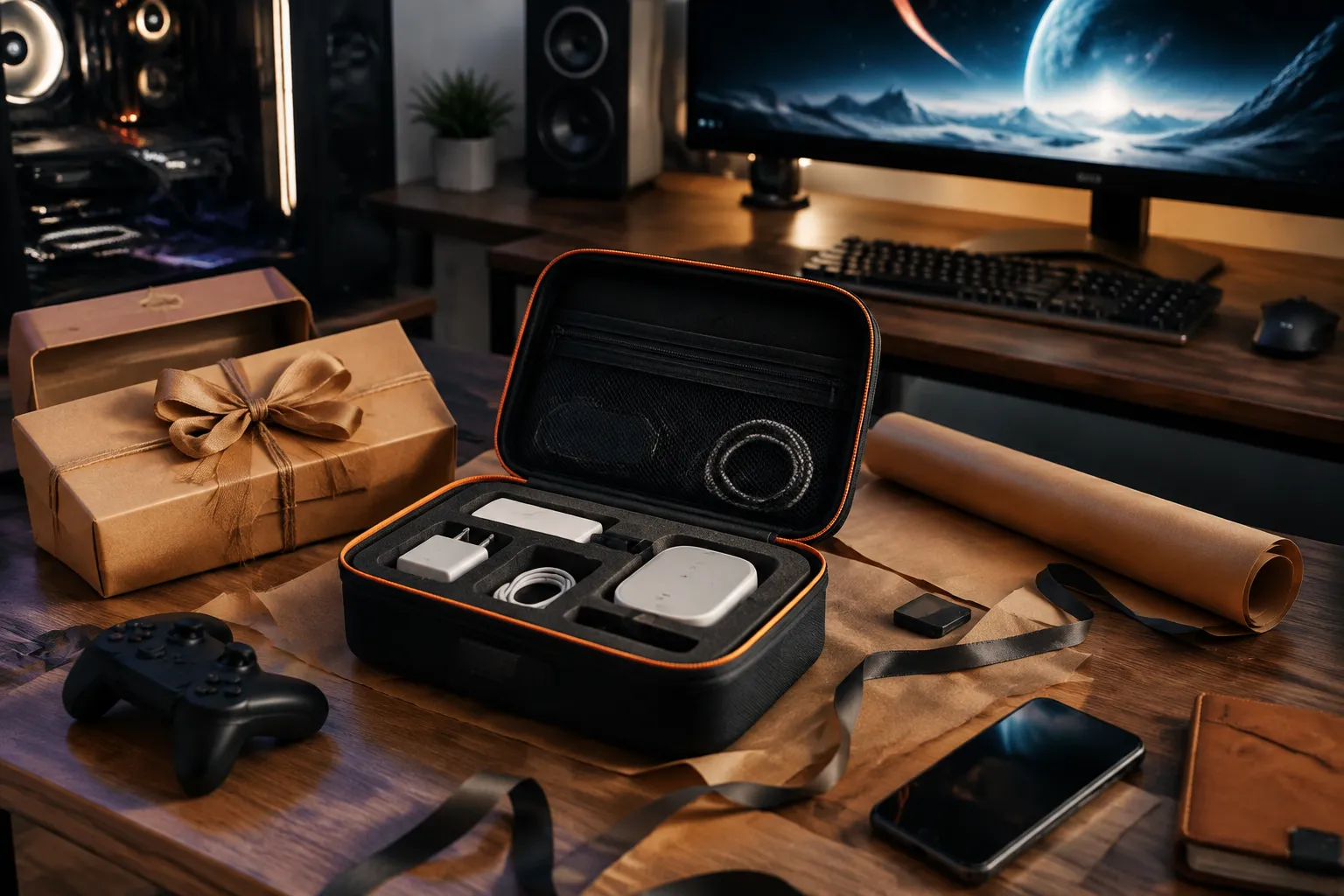
A tech organizer pouch, sometimes called a "tech kit" or "cable organizer," is the gift that keeps on giving. The good ones have multiple compartments with elastic bands and mesh pockets, allowing the person to assign a home to each item. No more digging through the bottom of a backpack for a charging cable. No more earbuds tangled around a set of keys.
The Peak Design Tech Pouch is the gold standard here, though it is larger than many expect. It stands upright like a small briefcase and opens fully flat, revealing a well-organized interior with enough space for a tablet charger, a small power bank, multiple cables, and a pair of earbuds. The exterior fabric is weatherproof, and the zippers are smooth and solid. It is the kind of purchase that feels expensive until the person uses it for the first time and realizes the price was justified by the daily convenience.
The smaller option, the Bellroy Tech Kit, is better for someone who just wants to corral a few cables and a charger. It has a clamshell opening with a mix of elastic loops and zippered mesh pockets, and it fits easily into a backpack side pocket. It does not stand on its own, so organization is slightly less accessible, but the footprint is smaller and more portable.
Reading the Person, Not Just the Spec Sheet
The fundamental error in most tech gift guides is treating the recipient as a generic "tech geek" rather than a specific person with habits. Someone who works from home and rarely leaves the house does not need a rugged commuter case. Someone who travels for work every week does not need a minimalist shell that offers no drop protection. The question to ask is not "What is the best case on the market?" but rather "Where does this person's device spend its time, and what happens to it there?"
Observe the person's current case. Is it scratched and beat up? That suggests they are hard on their gear and need something more protective. Is it pristine but clearly old, with yellowed clear plastic? That suggests they bought a cheap case and never replaced it, and they would appreciate an upgrade. Do they not use a case at all? That is a signal to respect their preference, not to force a thick wallet-style case on them.
The best gift givers also pay attention to color and finish. A person who dresses in muted tones and carries a black backpack probably does not want a bright red case with a geometric pattern. The person who buys limited-edition colorways of their phone might appreciate a clear case that shows off the device, or a case in a complementary tone. These small aesthetic choices signal that the gift was chosen for them, not for a generic audience.
There is also the question of future accessories. If the person just bought a new phone, they might not yet have invested in MagSafe chargers or car mounts. Gifting a MagSafe-compatible case, even if they do not currently own the accessories, positions them to adopt the ecosystem later. Conversely, if they already own a specific accessory, like a battery pack that attaches magnetically, the case needs to be compatible with that exact product.
The Gift of Genuine Utility
A case is not a romantic gift. It is not something that will be shown off at a dinner party or posted on social media. But it is a gift that gets used every single day, multiple times a day. Every time the person picks up their phone, they will feel the case. Every time they slide their laptop out of the sleeve, they will remember who gave it to them. That daily presence is a kind of thoughtfulness that a novelty gadget or a gift card cannot match.
The case market has become crowded with options that are all variations on the same theme. Cutting through the noise requires an understanding of materials, ergonomics, and the specific way a person lives with their devices. The right case is the one that the person forgets is there, because it integrates so seamlessly into their routine that it feels like part of the device itself. That is the moment a case becomes more than an accessory. It becomes invisible, and that invisibility is the highest compliment a gift can receive.