Drop a phone made of polycarbonate and the sound is a sharp, hollow crack that draws stares in a coffee shop. Drop the same phone wrapped in TPU and the sound is a dull thud, the kind of noise that gets absorbed by the floor and everyone ignores it. That acoustic difference is the entire argument in miniature, and it is the reason case manufacturers keep making both materials instead of settling on one.
The two plastics get lumped together because they both bend and both bounce, but they fail in opposite ways. Polycarbonate is stiff and hard. It resists impact by staying rigid, spreading the force across a wide area, and it does that until the day it simply cracks. TPU, thermoplastic polyurethane, is soft and elastic. It absorbs a hit by deforming, taking the energy into its own squishy body, and it does that until it tears or permanently gouges.
Most people never choose between them at all. They buy whatever case is on sale, or whatever color the phone store had in stock, and they only discover which polymer they own after the first drop. This comparison exists for the person who wants to know before that moment, and who understands that daily durability is not one test but a whole portfolio of small abuses.
The Drop Test Nobody Runs Properly
Every case review on the internet claims to have dropped a phone onto concrete from pocket height. Few of them tell you what angle the phone hit, because that angle decides everything. A flat landing on the back is the easy case, and both materials survive it. Polycarbonate may spider-web if the ground is rough enough, but TPU just flexes and pops back, looking untouched.
The hard test is a corner impact. The phone lands on one edge, concentrating the entire force of the fall into a square centimeter of material. Polycarbonate handles this surprisingly well because it does not give. The rigid shell takes the hit and transfers the energy around the corner, which is why a polycarbonate case often survives a corner drop while the screen inside stays intact. The plastic may show a stress mark, a pale line where the polymer molecules have been pulled apart, but it holds.
TPU behaves differently on that same corner hit. The soft material compresses, which is good for absorbing shock, but it compresses only so far. On a hard enough impact, the TPU bottoms out and the force goes straight through to the phone frame. A thick TPU case can handle this, but the slim ones, the popular ones, do not have enough material to absorb a serious corner strike.
The real difference shows up on the second drop, not the first. Drop a polycarbonate case once and it may be fine. Drop it a second time on the same corner and the stress mark from the first hit becomes a crack, which opens wider on the third hit. TPU does not crack, but it does wear. A single bad drop on rough asphalt can shave off a chunk of the corner, and that missing material never comes back.
Yellowing, the Aesthetic Death Sentence
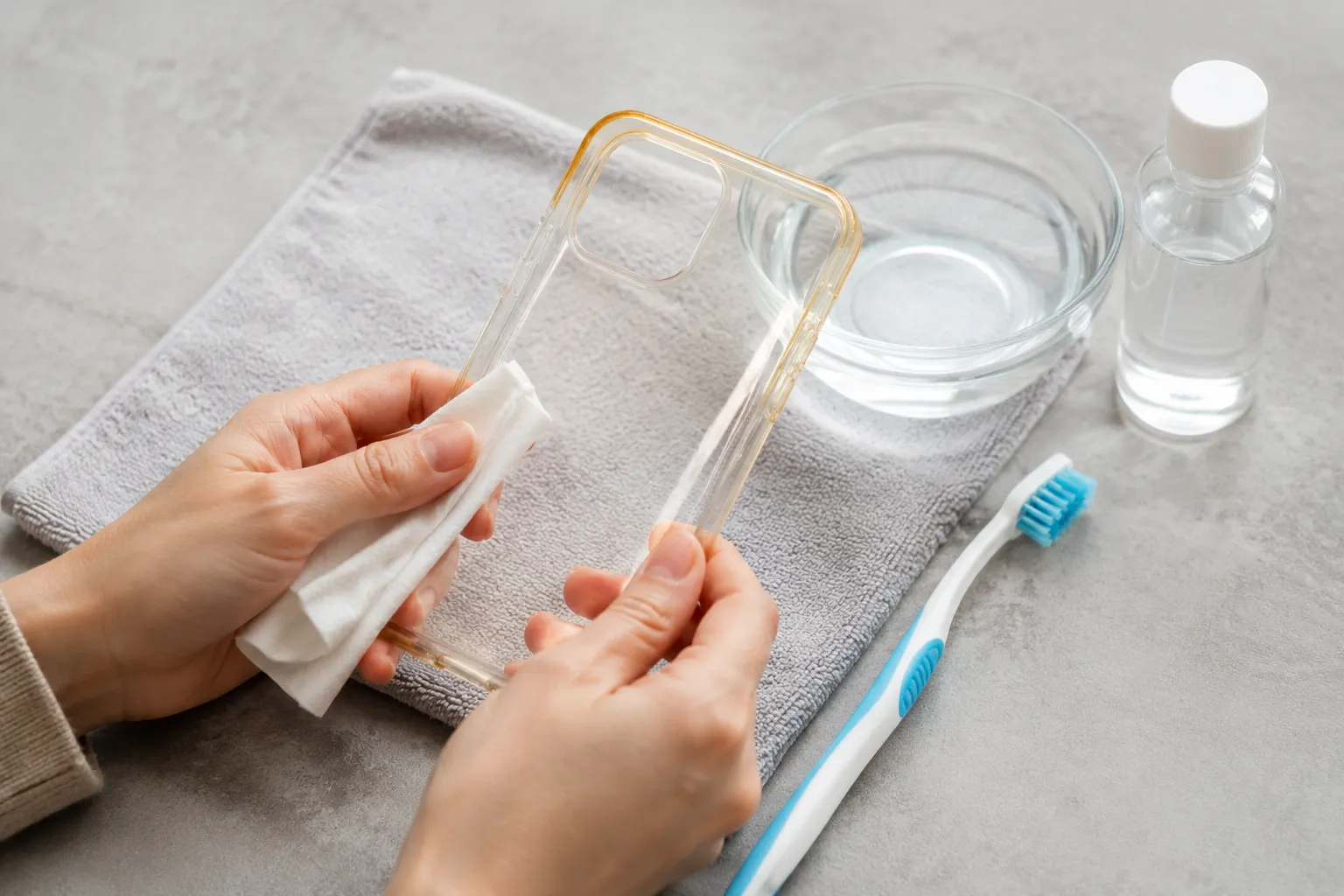
Clear TPU cases have a notorious lifespan. They start crystal clear, showing off the phone color underneath, and within three to six months they turn a shade that manufacturers euphemistically call honey. It is not honey. It is the color of a nicotine-stained window, and it makes an otherwise pristine phone look like a relic from a smoky 1990s bar.
The yellowing happens because TPU is chemically unsaturated. Ultraviolet light and oxygen both attack its molecular structure, breaking bonds and forming chromophores that absorb blue light and reflect yellow. No additive fully stops this. Stabilizers slow it down, sometimes to a year or more, but every clear TPU case eventually goes amber. This is not a quality issue. It is chemistry.
Polycarbonate does not yellow the same way. Clear polycarbonate cases stay clear for years because the polymer is inherently UV-stable, at least compared to TPU. The tradeoff is that polycarbonate scratches more visibly. A clear TPU case can take scratches that barely show because the material is soft enough to self-heal slightly, and because the yellowing happens anyway, nobody notices the fine lines. A clear polycarbonate case shows every key scratch in your pocket as a permanent white mark.
For anyone who uses a phone case as a fashion accessory rather than a piece of armor, this single difference determines the choice. Buy TPU and plan to replace it twice a year. Buy polycarbonate and live with a case that looks older than it is, worn in a different way.
Grip and the Physics of Slipping
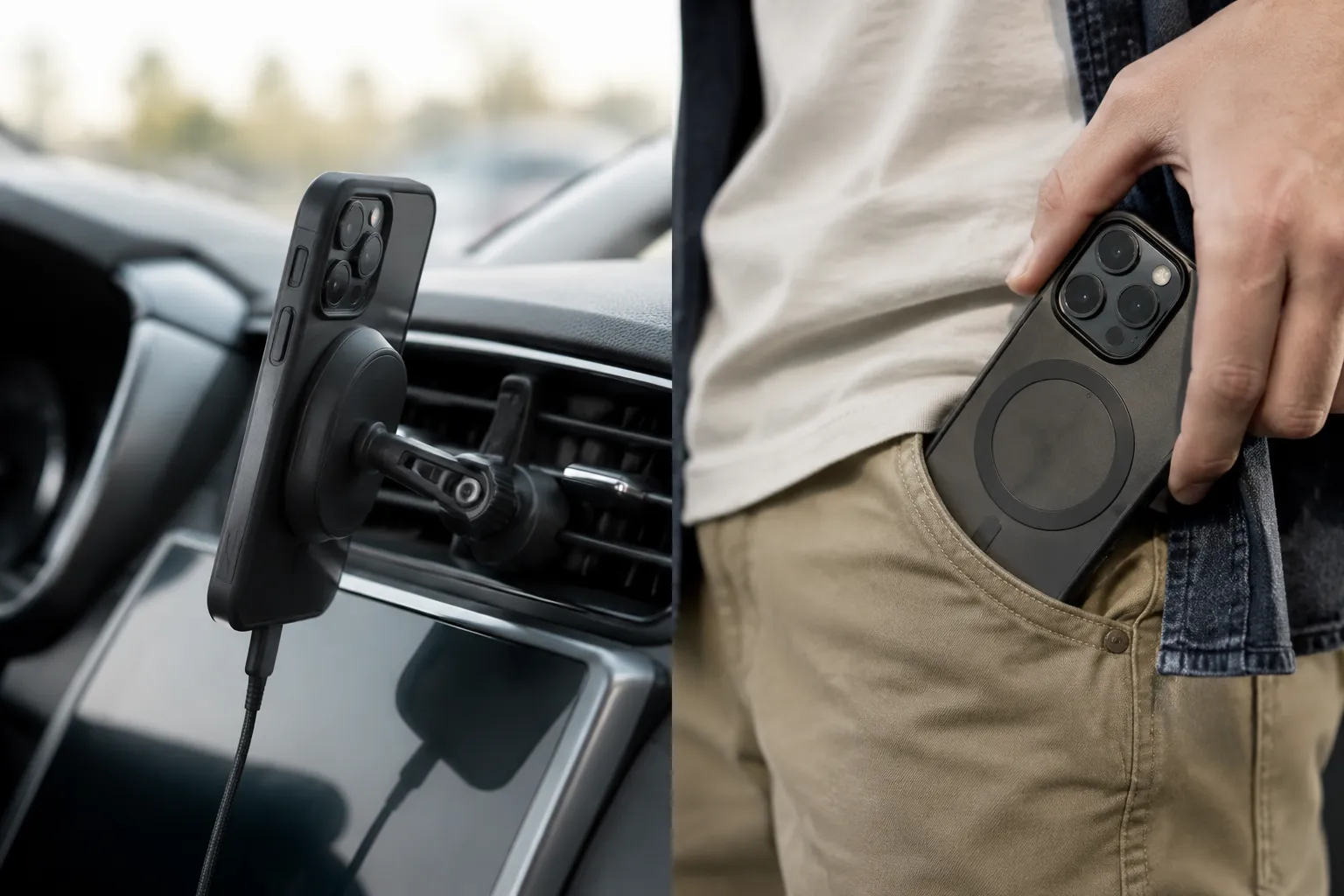
A phone case has two jobs related to grip. It must keep the phone from sliding out of a hand, and it must keep the phone from sliding across a table. Polycarbonate fails at both compared to TPU. The hard plastic has a smooth, almost glassy feel, especially after a few weeks of handling has polished its surface. A bare polycarbonate case on a sloped car dashboard will migrate toward the floor like it has a destination in mind.
TPU cases have a natural tackiness that makes them feel secure immediately. The material has a higher coefficient of friction, which means it resists sliding on most surfaces. Put a TPU-cased phone on a slightly angled surface and it stays put. The same phone in a polycarbonate case slides off.
That tackiness fades over time though. The surface of TPU breaks down with exposure to hand oils and UV light, becoming slicker and less pleasant. After a year of daily use, a TPU case feels less like rubber and more like cheap plastic that has lost its youth. Polycarbonate feels exactly the same on day 400 as it did on day one. Consistent, but consistently slick.
Some manufacturers solve this by coating polycarbonate cases with a soft-touch finish, a thin layer of paint-like material that feels like velvet. That coating wears off within months, leaving patches of bare glossy plastic underneath. A coated polycarbonate case starts out grippier than TPU and ends up worse than bare polycarbonate. The coating is a promise the manufacturer cannot keep.
Butt Pockets, Keys, and the Abrasion Question
Daily durability is mostly abrasion, not impact. A phone lives in a pocket with keys, coins, and the rough seam of a pair of jeans. It slides across desktops, restaurant tables, and the bottom of a bag. These repeated small scratches do more to age a case than the occasional dramatic drop.
Polycarbonate is the clear winner here. Its hardness, measured at around 120 on the Rockwell R scale, means it resists scratching far better than TPU. A polycarbonate case carried in a pocket with keys for a month will show fine surface marks under bright light, but nothing that affects the structure. TPU in the same conditions will show gouges. The soft material does not just scratch, it catches on the key edges and tears, leaving visible furrows that collect dirt and look far worse than any scratch on polycarbonate.
The pocket test matters more than the drop test for most people because phones get dropped once a month but they go into pockets twenty times a day. A case that looks battered after three weeks of commuting is not providing durable protection in the sense that matters. It is protecting the phone, sure, but it looks like it has been through a war while doing it.
TPU has a small advantage in this category that nobody talks about. Its softness means it grips the phone tightly, preventing the phone from moving inside the case. Polycarbonate cases, especially the snap-on types, can loosen over time as the plastic flexes and fatigues. A loose case lets the phone rattle inside, and a rattling phone is a phone that gains micro-scratches from its own case.
The Bending Problem in Thin Cases
Modern phone cases are thin. The market demands it, because nobody wants a brick in their pocket. That thinness changes the material comparison in a way that catches people off guard.
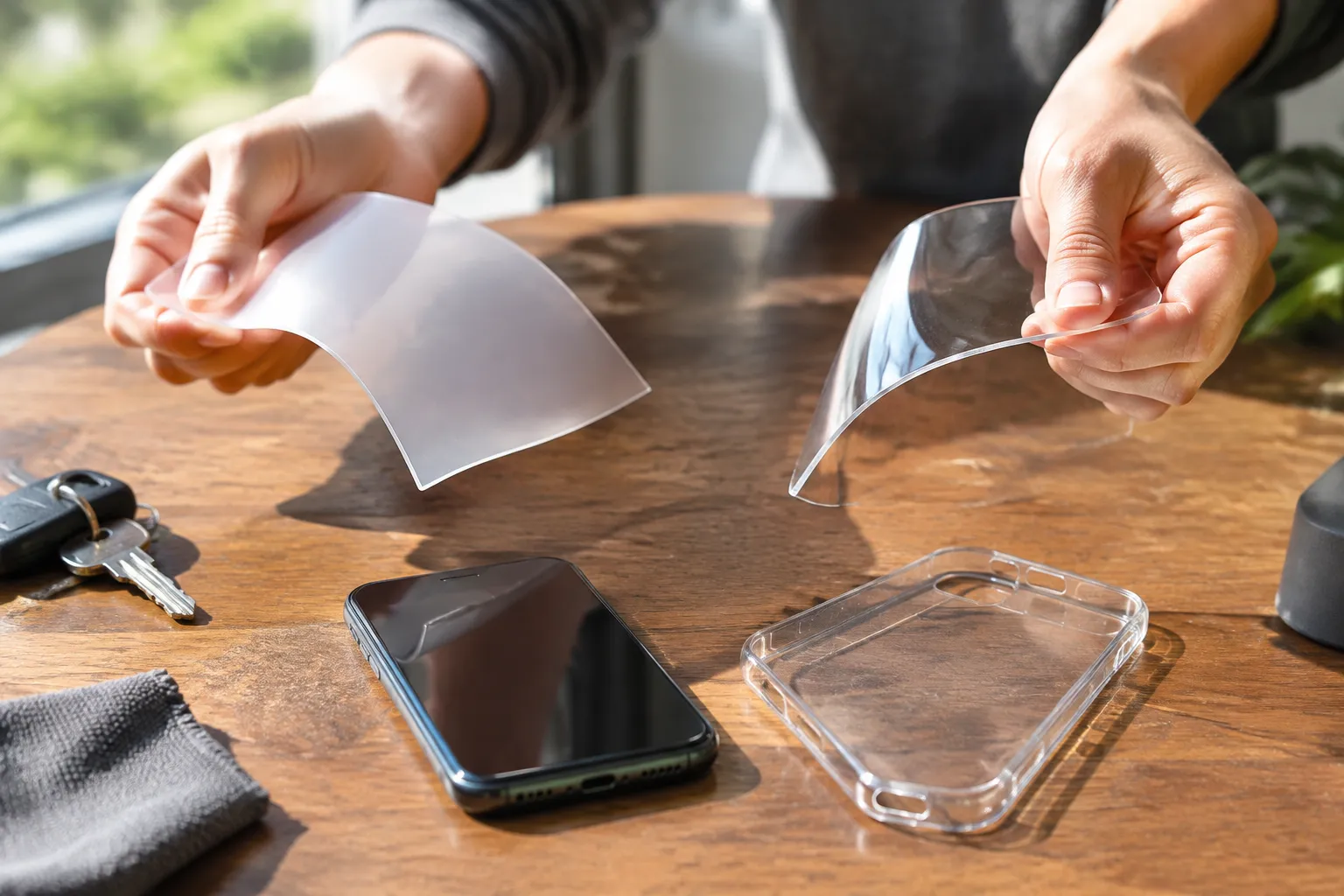
Polycarbonate at 1 millimeter thickness is remarkably stiff. That stiffness is what makes it protective, but it is also what makes thin polycarbonate cases brittle. A very thin polycarbonate case can crack from the stress of installation, when the corners are flexed to snap the phone in. This happens more than manufacturers admit, and it happens to new cases, not old ones.
TPU at the same thickness is floppy. It bends easily, which means it does not crack during installation, but it also does not provide much impact protection. A thin TPU case is basically a skin, a layer that prevents scratches and adds grip but does almost nothing against a serious drop. The phone inside might as well be bare for all the shock absorption happening.
The ideal thin case uses both materials, a rigid polycarbonate frame with TPU corners or a TPU bumper over a polycarbonate back. These hybrid cases exist for a reason. They solve the brittleness of polycarbonate and the floppiness of TPU by putting each material where it does its best work. The pure-material cases are compromises, and thin ones are the worst compromises of all.
What Heat and Cold Actually Do
Cars get hot. Phones on dashboards in summer can reach internal temperatures above 120 degrees Fahrenheit, and the cases around them get even hotter. Polycarbonate handles this heat well, with a glass transition temperature around 290 degrees Fahrenheit, meaning it does not soften or deform in any condition a human would tolerate. TPU is different. Its softening point is lower, and prolonged exposure to high heat can make it permanently deform, especially if the case is under stress, like a phone pressing against it from the inside.
Cold affects both materials. Polycarbonate becomes more brittle below freezing, so a phone dropped on concrete in a Minnesota winter is more likely to crack its case than the same drop in July. TPU stays flexible in cold, which is why winter cyclists and cold-weather outdoor workers tend to prefer it. The material does not stiffen to the point of shattering at temperatures that are survivable for humans.
One caveat about cold and TPU: it gets hard and slippery. The tacky grip that makes TPU pleasant in normal conditions disappears near freezing, and the case feels like a different material entirely. This is a minor issue, but it matters to anyone who uses their phone outside in winter, which includes anyone who has ever walked to a bus stop in January.
The Replacement Economics Nobody Counts
A good TPU case costs between fifteen and thirty dollars. A decent polycarbonate case costs the same, sometimes less. But the replacement schedule differs, and that difference is real money over the life of a phone.
A person who buys a clear TPU case and replaces it every six months when it yellows will spend sixty dollars over two years. A person who buys a polycarbonate case and keeps it for the same two years spends twenty-five dollars. The polycarbonate case may look more scratched, but it will still be structurally sound, still protecting the phone, still doing the job.
This is where the material choice stops being about feel and becomes about preference in a different sense. Some people treat cases as disposable accessories, like screen protectors that get replaced when they crack. Those people should buy TPU, accept the yellowing, and enjoy the grip and shock absorption. Others treat a case as a one-time purchase, something to buy and forget. Those people should buy polycarbonate and accept the scratches, because the alternative is a case that looks like it has jaundice.
Dropping the Phone on Purpose
There is a moment in the life of every phone case owner when they test their case on purpose. It is never a real test. It is a small drop from waist height onto a forgiving surface, like a carpeted floor or a wooden table. The owner watches the phone bounce, picks it up, checks for damage, and feels a small thrill of validation.
TPU cases excel at this moment. They bounce. A TPU-cased phone dropped on carpet lands with a muted flop and does not even skip. Polycarbonate cases land with a hard clatter that makes the owner wince, even when no damage occurs. The polycarbonate case might protect the phone just as well, but it does not feel like it does. The confidence gap is real, and it shapes how people treat their phones.
A person with a TPU case handles their phone more casually because the case feels like armor. They toss it onto couches, slide it across tables, let it sit loose in a bag. A person with a polycarbonate case is more careful, because the case transmits every impact to the hand, and the feedback suggests the phone is taking damage. In practice, the polycarbonate case may protect the phone better, but its owner is more protective, which means the phone is dropped less in the first place.
That feedback loop is the quiet variable in every material comparison. The best case is the one that makes its owner handle the phone with appropriate care, and different materials create different behaviors. A person who feels armored drops the phone more often. A person who feels vulnerable drops it less. The statistics of daily durability are shaped by human psychology as much as by polymer physics.