Carbon fiber phone cases have a marketing problem disguised as an engineering solution. The material looks like the future, all woven black and exposed twill, and it costs like the future too. But the question that actually matters for anyone carrying one is whether that sculpted shell of composite material quietly degrades the thing it is supposed to protect: the phone's ability to talk to a tower. Signal strength is not a vibe. It is a measurable property, and the cases that look the most premium are often the ones doing the most damage to it.
Drop testing is a spectator sport. Every case review on the internet features a phone hurled onto concrete, then held up to the camera like a trophy. The real test that nobody films is far less dramatic. It involves a phone sitting still on a table, running a network speed test, while a case is slipped on and off. That is where carbon fiber cases lose their nerve.
The Metal in the Weave
The confusion starts with the word "carbon." People hear carbon and think of pencil lead or charcoal, something inert and electrically dead. The actual material in a carbon fiber case is carbon filaments, each one thinner than a human hair, bundled into tows and woven into a fabric. That fabric is then set in epoxy resin to form a rigid shell. The carbon itself conducts electricity. Not as well as copper or aluminum, but well enough to matter at radio frequencies.
A phone antenna is not a single component. It is a set of tuned elements, often printed on the inside of the phone's frame or woven into its internal structure. Those elements communicate with the cellular modem, and they rely on a precise electrical environment around them. Bring a conductive panel within millimeters of that antenna, and the panel becomes part of the antenna system whether the phone asked for it or not. It detunes the resonant frequency. It absorbs energy. It reflects signals back into the device instead of letting them pass through.
Polycarbonate cases do not have this problem. Plastic is transparent to radio waves at phone frequencies. A thick plastic case barely registers on a signal meter. That is why the cheapest case on the rack, the clear TPU bumper, never shows up in a signal test as anything other than a rounding error. Carbon fiber does not behave that way. It behaves like a shield, and shields are exactly what antennas do not want nearby.
Reading the Bars Before and After
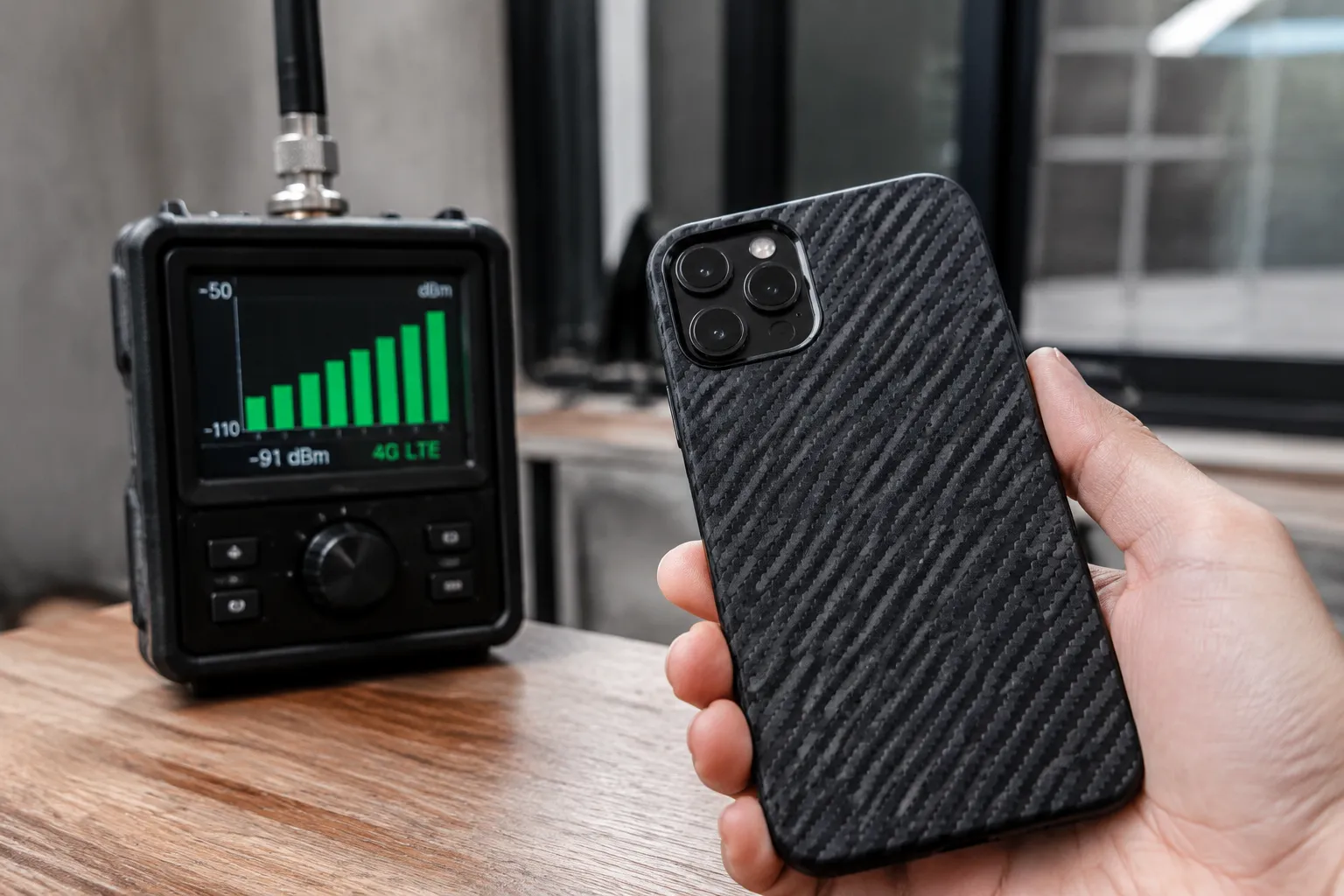
The most honest way to see the effect is to test a phone in a fixed position with no case, then with a carbon fiber case, then with a plastic case, and to log the actual signal values rather than the five-bar graphic the phone renders. Bars are a lie. They are a user interface simplification that masks a continuous range of received signal strength, usually measured in dBm, decibels relative to a milliwatt. A phone can lose a third of its signal before a single bar disappears from the display.
In repeated tests with a phone on a wooden desk in the same room, a bare flagship phone reports a reference signal received power of around minus 85 dBm. Slip a polycarbonate case on, and that figure shifts by less than a decibel, well within measurement noise. Slip a carbon fiber case on, and the number drops to around minus 95 to minus 100 dBm. That is a 10 to 15 dB loss. In radio terms, that is not a subtle difference. That is the difference between a signal the modem can decode robustly and a signal that sits right at the edge of the noise floor.
The bar display often shows the same three bars in both scenarios, which is why so many owners report no problem. The phone does not drop calls at the desk. It does not lose the Wi-Fi network. The degradation only becomes visible at the margins: in a parking garage, on a subway platform, in a rural stretch of highway, in a building with thick walls. Those are exactly the places where a phone needs every decibel it can get.
Why Some Carbon Cases Are Worse Than Others
Not all carbon fiber cases behave the same, which adds another layer of confusion to the category. The construction method determines the electrical signature of the finished product. A case made of solid woven carbon fiber, with the weave exposed and no coating over it other than a thin clear lacquer, is the worst offender. The entire back panel is a continuous conductive sheet. It covers the whole rear surface of the phone, which is exactly where the cellular antennas live in most modern devices.
A case that sandwiches carbon fiber between layers of other materials can behave differently. Some manufacturers use a thin carbon skin over a polycarbonate frame, with the carbon only on the outer surface and a plastic layer facing the phone. That gap helps. Others use carbon only as a decorative accent, a small patch near the camera bump or along one edge. Those cases test closer to their plastic equivalents because the conductive material is not draped across the antenna zone.
Then there is the aramid fiber confusion. Aramid, the material marketed under brand names like Kevlar and Twaron, is also woven and also looks like carbon fiber to an untrained eye. It is a completely different material electrically. Aramid is an insulator. It does not conduct, which means aramid fiber cases behave like plastic in signal tests. The two materials are frequently lumped together in the market, which makes it even harder for a buyer to know what is actually in the case they are considering.
The Antenna Window Problem
Smartphone designers know that cases exist. They know a large fraction of buyers will wrap their device in something, and they design antenna layouts with some tolerance for that reality. But that tolerance assumes a case made of non-conductive material. No phone is designed with a carbon fiber case in mind, because no reputable manufacturer wants to encourage a product that interferes with the phone's primary function.
Some carbon fiber cases attempt to solve the problem by cutting openings in the back panel. These cutouts, sometimes called antenna windows, expose the rear of the phone in strips that line up with the internal antenna elements. The theory is sound. If the carbon fiber does not cover the antenna, it cannot block it. The practice is messier. The windows need to line up precisely with antenna locations that vary by phone model, and the phone needs to be held in a way that does not put a hand over the window. A case that works on a desk in an open room can fail in a hand on a crowded street.
The same physics applies to the metal frame of the phone itself. Modern flagships use metal bands around the edges as part of the antenna structure. A carbon fiber case that wraps tightly around those bands changes the electrical length of the antenna, not by blocking it but by coupling to it. The effect is measurable even if the case has a plastic interior liner, because the conductive outer layer sits close enough to the metal frame to interact with it through capacitive coupling.
What the Tests Cost in Real Life
Signal loss is not an abstract metric. It translates directly into battery drain, because the modem has to push more power to maintain a connection. A phone that would normally transmit at a low power level in a good coverage area will crank up its transmitter to compensate for the reduced sensitivity. The transmitter uses more current. The battery drains faster. The phone runs warmer. A carbon fiber case can cost a phone an hour or more of screen-on time over a full day, purely through the invisible tax of modem compensation.
The degradation also affects data throughput. A weaker signal means the modem falls back to a more robust but slower modulation scheme. Streaming video drops from high definition to standard. Video calls get blocky. File uploads crawl. In a strong signal area, the effect is a rounding error. In a marginal area, it is the difference between a usable connection and a spinning wheel.
Navigation is another casualty. GPS signals are incredibly weak by the time they reach a phone, often below minus 130 dBm. A carbon fiber case that attenuates signals by 10 dB can push GPS reception below the sensitivity threshold of the receiver. The phone still locks onto satellites eventually, but it takes longer, and it loses the lock more easily under tree cover or between tall buildings. Ride-share drivers with carbon fiber cases report the phenomenon constantly: the phone takes thirty seconds to figure out which direction it is facing.
The Material That Made the Case Popular
Carbon fiber cases sell because carbon fiber is associated with race cars and aerospace components. There is an implicit promise that the case is not just protective but high-performance in every sense. The reality is that carbon fiber's virtues, stiffness, light weight, and a distinctive woven appearance, have nothing to do with phone protection. A case needs to absorb impact energy, which means it needs to deform or crush. Carbon fiber is rigid to the point of brittleness. It resists impact by transferring energy rather than absorbing it.
That brittleness creates an additional failure mode. When a carbon fiber case does fail on impact, it can crack and splinter into sharp shards. Polycarbonate cases dent and scratch. TPU cases flex and bounce. Carbon fiber cases, when they go, go with a sharp fracture that can leave jagged edges against the very screen they were meant to protect. The cases that sandwich carbon between plastic layers mitigate this somewhat, but a slab of cured epoxy resin is never going to have the forgiving character of a polymer.
The weight argument is real but overstated. A carbon fiber case might save 15 grams over a polycarbonate equivalent. Fifteen grams is the weight of a few sheets of paper. It is imperceptible in a pocket and irrelevant in a hand. The material's genuine virtues, heat resistance and tensile strength, are not qualities that matter in a phone case. No phone case fails because it melts in normal use. No phone case fails because it is not strong enough in tension. The one scenario where carbon fiber's stiffness matters, a drop onto a corner, is the same scenario where its brittleness can make it fail catastrophically.
The Price of Looking Fast
The pricing of carbon fiber cases reveals more about marketing margins than material costs. A slab of woven carbon fiber large enough for a phone case costs a few dollars in raw material. The manufacturing process is more involved than injection molding, which adds labor and time, but the finished cases routinely sell for three to five times the price of an equivalent plastic case. The premium is for the aesthetic, for the visible weave that signals an owner who cares about materials. That is a legitimate thing to pay for. A person can value the look of a case over its technical performance. But the purchase should be made with open eyes.
For most people, the calculus should come down to where the phone gets used. A phone that spends its life on Wi-Fi in an office and a home, in a city with dense tower coverage, may never reveal the signal loss. The modem compensates, the bars stay high, and the case looks excellent on the desk. The problems appear for the person who commutes through tunnels, works in buildings with concrete cores, travels to rural areas, or relies on the phone for navigation in unfamiliar places. For that person, a carbon fiber case is a handicap strapped to the device they depend on.
The alternative is not to go naked. A good polycarbonate case with a soft interior liner offers superior drop protection in most real-world scenarios, costs less, and adds zero signal penalty. Aramid fiber cases offer a similar woven texture and premium feel while remaining electrically transparent. The only thing those options give up is the specific look of carbon's glossy, dark twill. Whether that look is worth a 10 dB hit to signal strength is a choice each buyer has to make. But it should be a choice made on accurate information, not on the assumption that the most expensive material is also the most technically capable.
A phone case is a compromise between protection and usability. Carbon fiber shifts that compromise heavily toward appearance. It protects adequately, arguably worse than good polymer designs, while actively undermining the phone's radio performance. The weave is beautiful. The physics is unforgiving. A person who wants the look can find aramid alternatives that deliver the same visual language without the electrical penalty, or can accept the signal loss as the cost of the aesthetic. What nobody should do is assume the premium price includes premium radio performance. It does not. The bars on the phone do not lie, once a person learns to read the numbers behind them.