The problem with most slings is that they solve a problem a person no longer has. The early ones were tiny, barely big enough for a phone, a wallet, and the anxiety of leaving the house without a jacket pocket. Then the market swung hard the other way, and suddenly everyone was carrying a bag that looked like a deflated duffel, one that swallowed a 16-inch laptop and encouraged the owner to pack for a weeklong trip they were not taking. Somewhere in the middle, between the fanny pack resurgence and the tactical EDC crowd, there is a genuinely useful size class: the sling that can carry a tablet, a camera, and a few cables without turning into a backpack or a purse.
A good practical EDC sling sits in a narrow volume band, roughly 6 to 9 liters. Below that, the tablet struggle is real. Above that, the bag stops feeling like a sling and starts feeling like a messenger bag with commitment issues. This size range is not new, but the current crop of bags in it has gotten noticeably better at the details that matter: how the bag sits against the body, how the interior is organized, and how quickly a person can get a camera out without performing a magic trick.
The tablet is the load that defines this category. A 10 to 11 inch tablet fits in a 7-liter sling without dominating it, but the bag's shape matters more than its raw volume. A sling that is round and puckered, designed for a water bottle, will fight a flat rectangular tablet all day. The bags that work treat the tablet pocket as the structural spine of the whole design, with the other compartments arranged around it like rooms off a hallway. When the tablet pocket is the deepest part of the bag and the front compartments are shallow, the bag keeps a low profile instead of bulging out like a stuffed crepe.
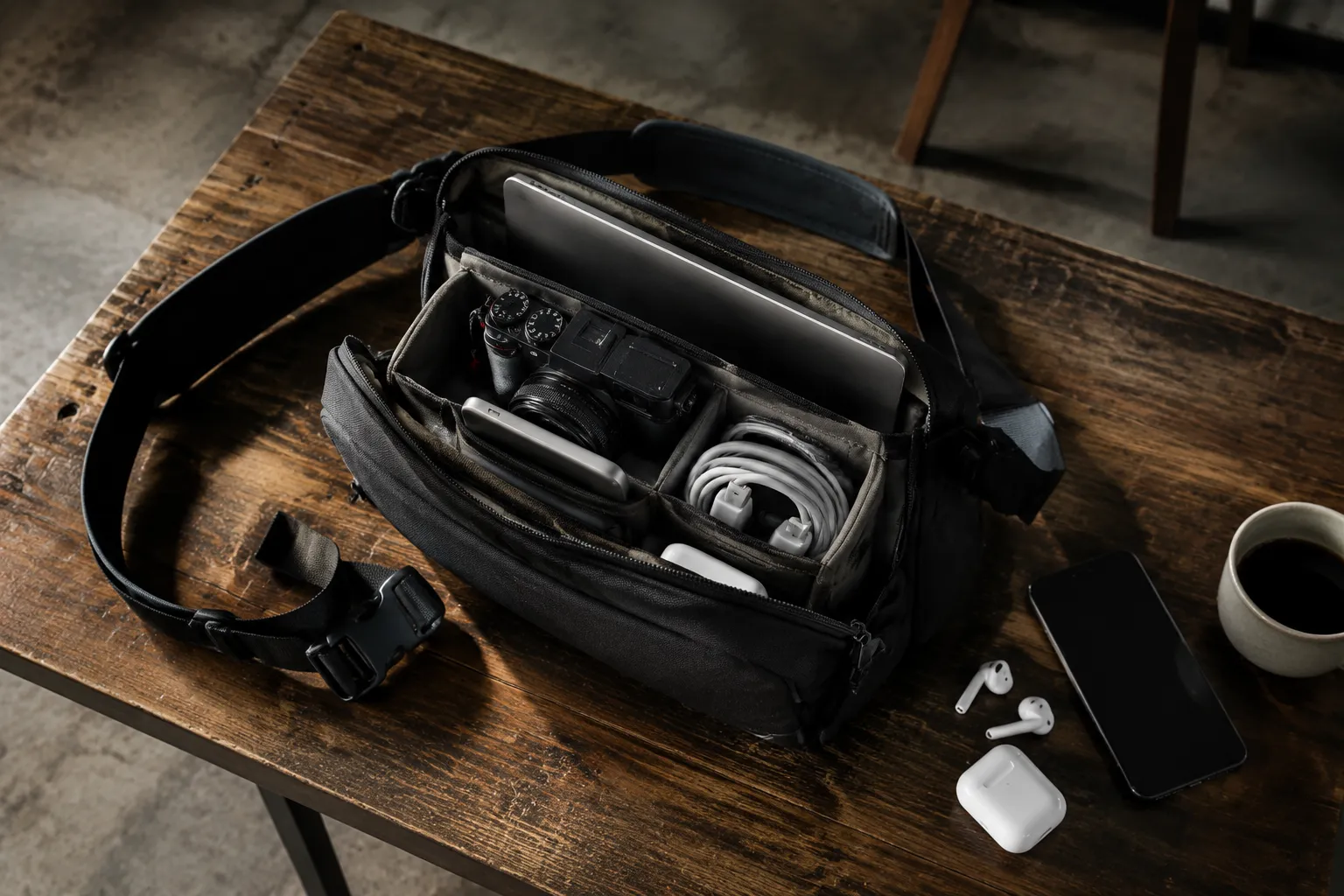
Camera carry is where most slings reveal their limits. A mirrorless body with a compact prime lens is roughly the size of a thick paperback and can slide into a generic padded divider. The practical sling handles this fine. The trouble starts with a body plus a zoom lens, or any setup that needs a second lens, which turns an easy grab into a game of Tetris. The honest solution is to accept that a 6 to 9 liter sling is a one-lens bag. The person who needs two lenses and a flash should be looking at a bigger bag and admitting the sling is not the right tool for that job, no matter how many clever straps the manufacturer installed.
What separates the genuinely useful slings from the decorative ones is how they handle the cable and accessory layer. Nobody buys a sling for cables. The cables are the stuff that gets thrown in because the alternative is a coat pocket full of tangled USB-C spaghetti. A good sling gives these items a home without making the person dig through the main compartment. A back zip pocket, the kind that sits flush against the wearer's back, is the ideal spot for a flat cable organizer. It is out of the way, does not steal volume from the main compartment, and keeps the cables from scratching a camera lens or a tablet screen.
The strap is the part that gets the least attention and matters the most. A sling only works if it stays put. The cheap ones slide around, creep up the chest, or swing forward every time the wearer bends over. Stabilizer straps, the little clip that connects the sling strap diagonally across the back, make a noticeable difference. Without it, the bag drifts to the front when the wearer leans forward to tie a shoe or pick up a dropped pen. With it, the bag stays planted on the upper back. The tradeoff is that a stabilizer strap makes the sling slower to rotate to the front for access, and that friction is exactly why some people abandon the category entirely.
There is a reason the one-strap format keeps losing to the backpack for people who actually use their gear. A backpack is stable, distributes weight across both shoulders, and never needs to be repositioned. The sling wins only when the wearer needs frequent access to the contents without taking the bag off. That is the real use case: a photographer walking through a city, a commuter hopping between train and bus, a person who needs the tablet for a meeting and the camera for the walk back. The sling is a grab-and-go bag for a moving person, and the design should serve that motion.
The Body of the Bag
The material conversation is boring until it is not. Most slings in this range use a 500 to 900 denier nylon or a recycled polyester that feels fine in a store and starts to pill at the edges after a year of daily use. The better option is a laminated fabric, usually a nylon with a TPU or PU coating, which gives the bag a slightly waxy feel and a real resistance to light rain. This is not a dry bag, and it should not be sold as one, but the coating means a sudden shower does not force the wearer to cradle the bag like a newborn. The coating also makes the bag easier to wipe clean, which matters more than most people expect once the bag has lived through a few commutes.
Zippers are the real quality signal. A chunky zipper with a cord pull operates smoothly with one hand, even when the wearer is holding a coffee in the other. The waterproof zippers, the kind with the plastic teeth that look like they belong on a drysuit, are stiff and annoying at this size. A standard YKK zipper with a rubberized pull is the right call. The bag should open and close with a single motion, because the entire point of the sling format is that the wearer can rotate it to the chest, unzip, grab a camera, and zip back up without setting the bag down anywhere.
The interior organization is where the practical sling either earns its keep or becomes a black hole. A single cavernous compartment with no dividers forces the wearer to rummage, which defeats the purpose of the format. The useful layout has three distinct zones: a padded tablet sleeve against the back panel, a main compartment with at least one divider or a small pocket for the camera body, and a front slash pocket for flat items like a phone, a passport, or a pack of gum. The front pocket should not be deep enough to swallow a hand. It should be shallow, so the contents are visible at a glance.
A common miss is the key leash. Many bags include one, and most of them are placed in the main compartment, which means the keys dangle against the camera or scratch the tablet screen. The practical design puts the key clip in the front pocket, away from the expensive gear. That simple placement decision tells the wearer more about the bag's designer than any marketing copy about "urban exploration" or "everyday versatility."
How the Tablet Actually Fits
Testing a sling with a tablet requires more than checking whether the tablet physically slides into the pocket. The question is whether the bag still closes flat when the tablet is in the sleeve and the camera is in the main compartment. Many slings pass the empty test and fail the loaded test, because the tablet sleeve is sewn too close to the outer wall. When a camera body sits against that wall, the combined thickness pushes the tablet sleeve into a curve. The result is a bag that looks pregnant and a tablet that takes on a slight bend when the bag is worn tight. The fix is padding in the right places: a firm foam panel between the tablet sleeve and the main compartment, so the two loads do not fight each other.
Weight distribution follows the same logic. A tablet on the back panel and a lens on the front wall creates a balanced load that sits close to the spine. The moment everything gets crammed into one side, the bag starts to sag and the strap digs into the opposite shoulder. The smart move is to pack the heavy flat items against the back and the light bulky items toward the front, which every experienced sling user figures out after a week of trial and error. The better slings make this the only natural option by design, with the tablet sleeve fixed to the back panel and the front compartment kept deliberately shallow.
The Cable Problem, Solved Quietly
Cables ruin bags because they are both bulky and lightweight. They take up volume without adding weight, which means they compress whatever is beneath them and create lumps in all the wrong places. The practical solution is not a dedicated cable pocket, which wastes space when empty, but a flat organizer that can be pulled out and used separately. A small zippered pouch, roughly the size of a glasses case, holds a 1-meter USB-C cable, a wall plug, and a card adapter. That pouch lives in the back zip pocket, and it comes out when the bag is emptied at the end of the day.
Some slings try to solve this with elastic loops sewn into the interior. These work for exactly one cable, and they fail the moment the wearer carries a second cable or a charger that is not the exact diameter the designer had in mind. The pouch approach is more flexible because it does not care what the cable looks like, and it keeps the tangle contained. A person who needs a laptop charger, a phone cable, and an external battery is carrying too much for a sling anyway, and should be honest about that.
Wearing It Right
The wear position changes the bag's behavior more than any feature list. Worn high under the armpit, the sling stays out of the way on a crowded train and resists pickpockets, but access requires a slight shrug and a rotate that can feel awkward in a meeting. Worn low on the hip, the sling is easier to reach, but it swings forward when the wearer walks fast and catches on door handles. The sweet spot for most people is somewhere between the two, with the bag resting at the lower ribs, where it does not interfere with arm swing and can be rotated to the front with a single shoulder movement.
Left-shoulder versus right-shoulder is not a preference, it is a physics decision. A right-handed person who wears the bag on the left shoulder and reaches across the body with the right hand gets smooth access without taking the bag off. The same person wearing the bag on the right shoulder has to either use the wrong hand or twist into an unnatural position. This seems obvious, yet a surprising number of slings are designed with the zipper pulls and quick-access pockets favoring one side only, which locks the wearer into a single orientation.
What a Few Good Options Look Like
The current market has a few bags that understand this brief. The Aer City Sling 2, at roughly 6 liters, fits a tablet and a compact camera with an organization layout that makes sense. The Alpaka Elements Tech Sling, around 8 liters, adds a bit more room and a better strap system. The Bellroy Sling, in its larger variants, has the cleanest exterior but skimps on internal organization. These are not the only options, and the specific model numbers will change as manufacturers refresh their lines, but the shared trait is the one that matters: each bag keeps the tablet against the back, gives the camera a padded zone, and does not waste volume on pockets that only fit a specific brand of pen.
The cheaper alternatives, the $30 bags from generic brands, fail on the strap and the zippers. The fabric may be fine, but the strap padding compresses after a month, and the zipper pulls snap off. A person who buys one of those bags and uses it daily will replace it within a year. The mid-range bags, priced from $80 to $150, last through several years of daily use because the strap hardware is metal, the zippers are name-brand, and the stitching holds at the stress points. This is not a luxury goods argument. It is a cost-per-wear argument, and the math favors spending a little more on the bag that does not need replacing every season.
The Limits of the Format
The practical EDC sling has a ceiling, and respecting that ceiling is what keeps the bag useful. A sling cannot replace a backpack for a full workday load. It cannot carry a 14-inch laptop, a full-frame camera with a 24-70mm lens, and a lunch. Attempting to force that load into a 7-liter bag produces the exact bulk the title promises to avoid. The wearer ends up with a bag that bulges in three directions, a strap that digs into the shoulder, and the constant sensation of something about to unzip itself.
The right test for whether a sling is the correct bag is the 20-minute rule. If a person needs everything in the bag within a 20-minute window, a sling works. A commute, a photo walk, a coffee shop work session, a museum visit. If the need stretches beyond that, or the load includes gear for an entire day away from home, the backpack is the honest answer. The sling is a supplement to a bigger bag, not a replacement for it, and the people who get the most use out of the format are the ones who treat it as a quick-access companion rather than a do-everything solution.
The best practical sling disappears until it is needed. It sits flat against the back, does not announce itself with jangling hardware or a logo the size of a dinner plate, and delivers its contents without a struggle. When the camera comes out for a shot and goes back in without the wearer breaking stride, when the tablet slides out for a note and slides back in before the train doors close, the bag has done its job. That quiet efficiency is the entire appeal, and it is harder to engineer than any amount of technical fabric or modular attachment points. The bags that get it right make the wearer feel like they are carrying nothing at all, right up until the moment they need something, and then the bag opens like it knew exactly what was coming.