Clear phone cases occupy a strange place in the world of accessories. They are bought with the explicit promise of showing off the device beneath, a window into the owner's taste in color and finish. Within three months, that same window fogs into a jaundiced haze. The clear case, the one meant to display a pristine blue or graphite back, turns the color of a well-worn paperback and makes a new phone look like it survived a decade in a smoker's glovebox. The yellowing is treated as inevitable, a chemical betrayal, and most people simply buy another one. That is a mistake. Yellowing can be slowed, stalled, and in some cases reversed, but only with a routine that starts on day one.
The first thing to understand is that the enemy is not just time. It is a combination of ultraviolet light, body oils, and heat, and each one attacks the case material differently. Most clear cases are made of thermoplastic polyurethane, or TPU, which is flexible, shock-absorbent, and cheap to mold. TPU has a molecular structure that degrades when exposed to UV radiation, and the degradation products are what turn yellow. The harder polycarbonate backs on two-piece cases resist UV better, but the soft TPU bumper around the edges is still the weak point. A case made entirely of polycarbonate will stay clearer longer, but it will also transfer every drop straight to the frame of the phone, because the material is too rigid to absorb impact. The flexible cases that people actually prefer for protection are the ones most prone to discoloration.
This is the trade that nobody mentions at the point of sale. The case that feels good in the hand, the one with the satisfying give when it bends, is the case that will yellow. It is a material compromise, not a manufacturing defect. Knowing that changes the approach. A person cannot buy their way out of this with a more expensive TPU case. They can only manage the conditions.
The Sun Is the Primary Culprit
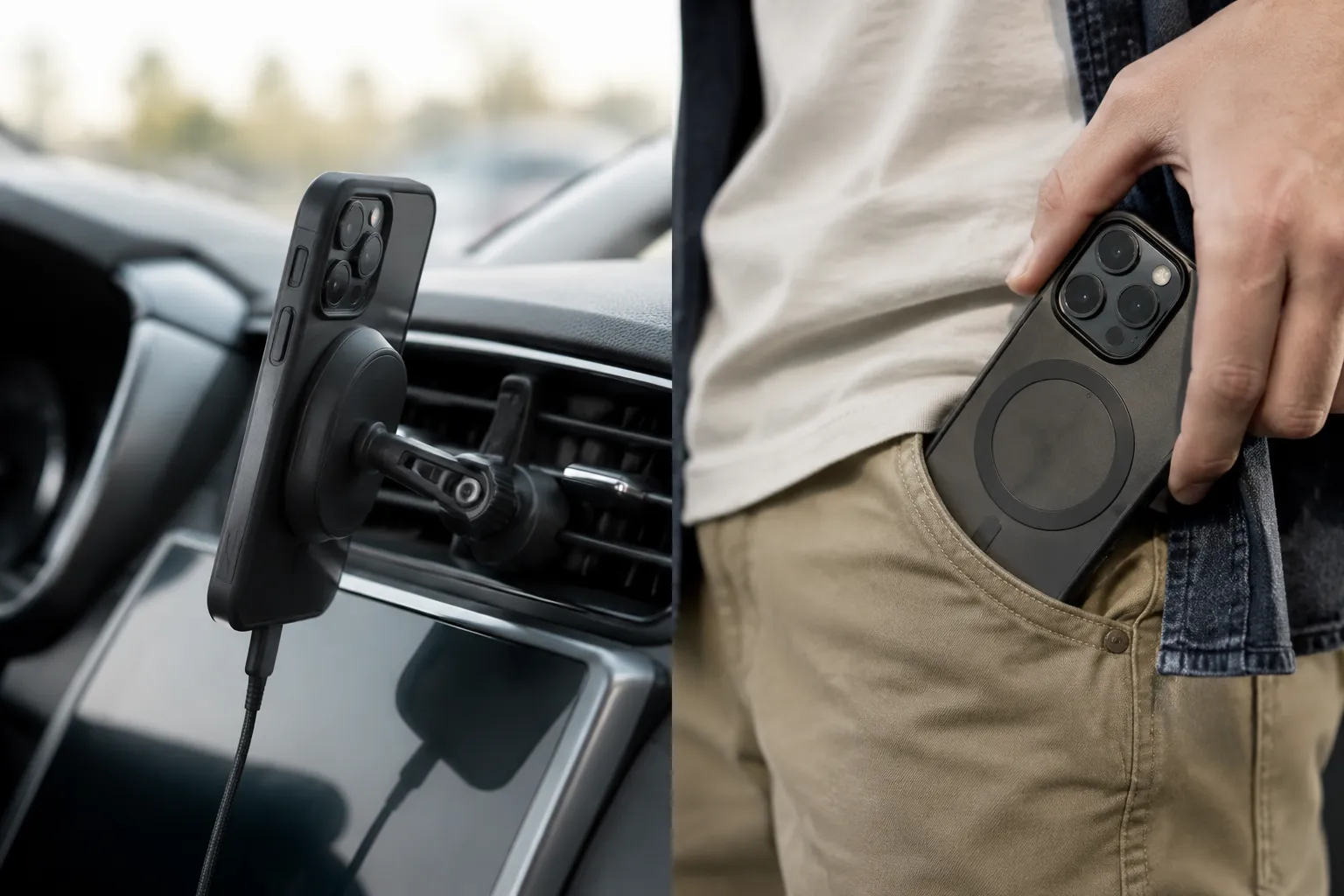
UV light accelerates the breakdown of the polymer chains in TPU faster than any other single factor. A case left on a dashboard, a desk near a south-facing window, or a car mount that faces the windshield will yellow in weeks. The same case kept in a pocket or a bag, mostly shielded from direct light, will stay clear for many months. The difference is stark enough that two identical cases bought on the same day can look like different products after a single summer, depending entirely on where they spend their daylight hours.
The obvious answer is to keep the phone out of direct sunlight, but that is harder than it sounds. Most people do not consciously park their phones in the sun. They set the phone on the passenger seat during a commute, and the angle of the window puts a beam of light directly on the back for forty minutes. They leave it on the kitchen counter while cooking, under a skylight. The case absorbs UV exposure cumulatively, and the damage is permanent once it happens. UV degradation does not heal. The only real defense is physical blocking.
Some case manufacturers add UV inhibitors to the TPU mixture, and these do slow the process measurably. The compounds absorb the UV radiation and dissipate it as heat before it can break the polymer bonds. But the inhibitors are finite. They get consumed over time, and once they are spent, the yellowing proceeds at the normal rate. A case with good UV inhibitors might stay clear for a year instead of three months. That is a real difference, but it still puts the case on a timer. The informed buyer checks for the word "UV resistant" in the listing, but the more informed buyer knows it is a delay, not a cure.
Sweat and Sebum Do the Rest
Light explains the cases that yellow on the back panel. It does not explain the more common pattern, where the edges and the area around the camera module turn first while the center stays relatively clear. That pattern is the fingerprint of human chemistry. The skin produces sebum, an oily secretion that contains unsaturated fats, and those fats oxidize on contact with air. Oxidized oils are yellow. The same chemistry turns old magazine pages brown around the edges where fingers held them. A phone case pressed against a palm for several hours a day absorbs sebum into its surface, and the oils darken over time.
The effect is concentrated where the hand grips most: the lower edges, the side rails, the area around the fingerprint sensor. The center of the back, which touches only the inside of a pocket, stays cleaner. This is why wiping a case down with a dry cloth never seems to help. The oils have penetrated below the surface. They are not sitting on top waiting to be wiped away. They have soaked into the top layers of the polymer, and they are oxidizing from within.
Heat makes this worse. A phone in a pocket runs at body temperature, around 98 degrees, and a phone in a car mount on a sunny day can easily reach 120 degrees. Every 10 degrees of temperature increase roughly doubles the rate of chemical reactions, including oil oxidation and polymer degradation. The case on a heavy phone user's device, held tight, pocketed warm, and charged wirelessly (which adds its own heat), is essentially an incubator for yellowing.
A Daily Wipe Is the Whole Secret
Given all that, the solution sounds almost too simple. Clean the case every day. Not with soap and water, not in a sink, not with any elaborate ritual. A single pass with a microfiber cloth and a tiny amount of gentle dish soap or hand soap, followed by a dry wipe, removes the sebum before it can soak in and oxidize. The whole process takes thirty seconds and should happen at the end of the day, when the case has accumulated a full day's worth of skin contact.
The timing matters more than the method. A person who wipes the case once a week is removing a week's worth of hardened oils, and some of that oil has already penetrated and begun to yellow the material. A person who wipes every day never lets the oil reach the penetration stage. The lipid layer on the surface is only a few molecules thick at the end of a single day. It has not had time to migrate into the polymer. At seven days, it has. Daily cleaning is not about keeping the case looking shiny. It is about interrupting the chemical process at a stage where it is still reversible.
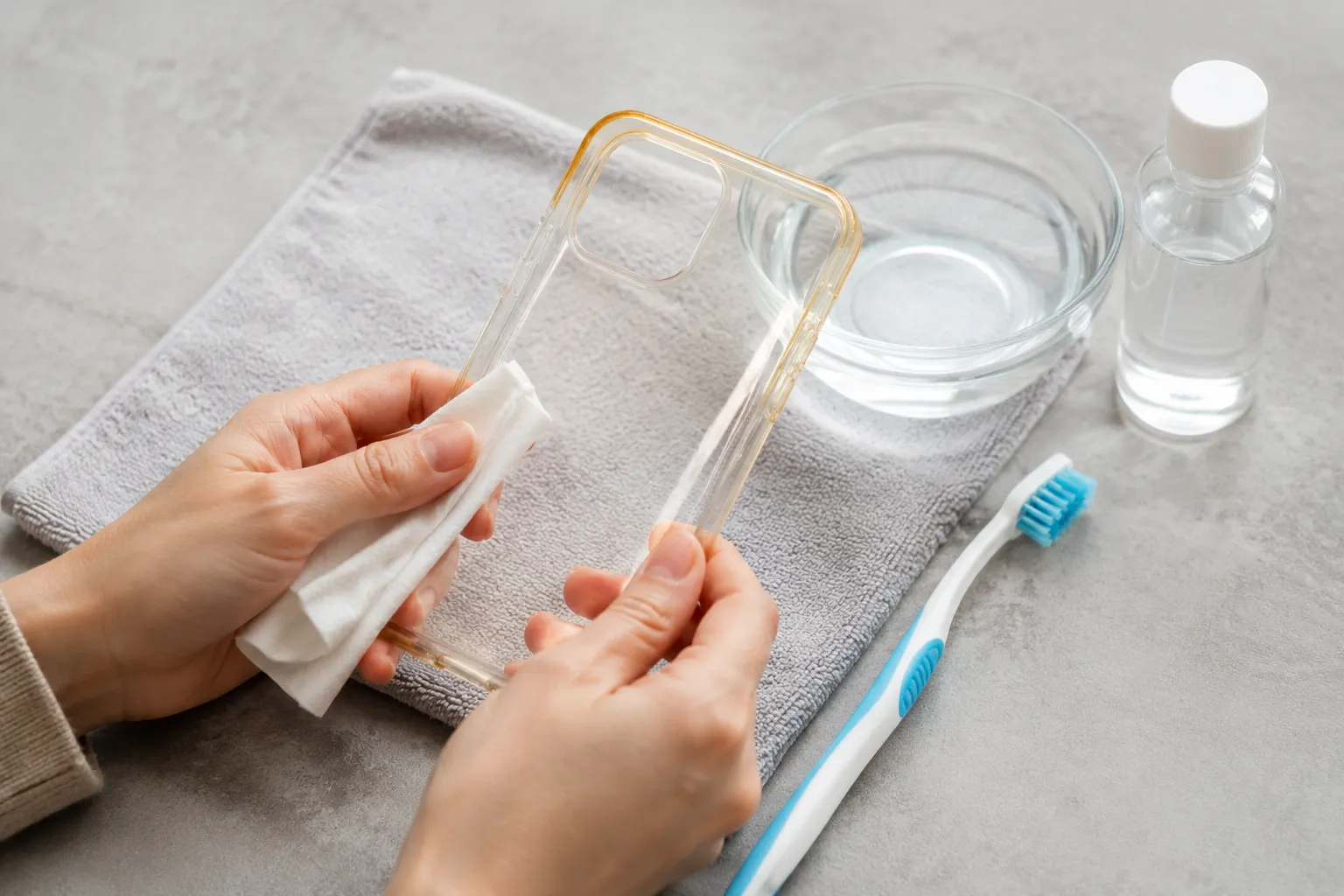
The soap matters too. Plain dish soap cuts grease effectively, and it is gentle enough for daily use. Anything with alcohol, solvents, or citrus oils should stay away, because those can strip the coating or cloud the TPU. A drop of soap on a damp cloth, a wipe over the entire surface, a rinse of the cloth, and a second wipe to remove the soap residue. Then dry it with a fresh section of the cloth. It is the same motion as cleaning a pair of glasses, just slower and more thorough.
The Weekly Deep Clean
Once a week, the case should come off the phone entirely for a more thorough wash. Warm water and a drop of dish soap in a small bowl. The case goes in, gets swished around, and gets scrubbed gently with a soft toothbrush, especially in the crevices around the camera cutout and along the edges where grime collects. A toothbrush with soft bristles is important. Hard bristles can microscratch the clear surface, and scratched TPU scatters light in a way that makes the case look hazy even when it is perfectly clean.
After the wash, the case needs to dry completely before it goes back on the phone. TPU absorbs a small amount of water, and trapping moisture against the back of the phone is a bad idea. Air drying on a counter for an hour is sufficient. The case should not go in direct sunlight to dry, for reasons already established. A shaded spot with good airflow works best.
The weekly clean also serves as an inspection moment. This is when a person notices whether the case has developed a faint yellow tint that the daily wipe is not preventing. It is also when they notice the other signs of wear: the loosening around the corners, the small cracks near the charging port, the way the case no longer snaps flush against the camera ring. A clear case that has gone through a year of daily cleaning will not look brand new. It will look clean but aged, like a well-maintained tool. That is the goal. The goal is not eternal clarity. The goal is a case that lasts until it is functionally worn out, not until it is cosmetically embarrassing.
Removing Yellowing That Has Already Set In
What about the case that is already yellow? There is one legitimate trick, and it works better than most people expect. Hydrogen peroxide, the standard 3% solution from a pharmacy, can bleach the oxidized compounds out of the top layers of TPU. The method is simple: the case is cleaned with soap and water first, then submerged in hydrogen peroxide and placed in indirect sunlight or under a UV lamp for several hours. The peroxide breaks down the yellow chromophores, and the UV light activates the reaction.
The results vary wildly. A lightly yellowed case, one that has only begun to tint, can come out almost clear. A badly yellowed case, one that has gone fully amber, will lighten but never return to its original transparency. The process also does nothing for the structural degradation. A case that has yellowed has also become more brittle, even if it does not feel like it yet. The peroxide treatment is a salvage operation, not a restoration. It buys a few more months of use from a case that should probably be replaced.
Peroxide carries risks. Left on too long, it can make the TPU tacky or cloudy. It can also lighten the color of the phone itself if it seeps through the case, so the phone must come out first. And the process should not be repeated more than once or twice, because each treatment strips a little more of the case's structural integrity. Use it as a last resort, not as a maintenance step.
The Case for Accepting the Inevitable
There is a school of thought that says all this cleaning is wasted effort. A clear case is a disposable item, the argument goes, priced at ten or twenty dollars, designed to last one phone cycle at most. Spending thirty seconds a day maintaining it is a poor use of attention. Better to buy a two-pack, run the first one until it yellows, swap in the second, and order another two-pack. The economics are hard to argue with. Time is finite, and a case is not a heirloom.
But that argument misses what a clear case actually is. A clear case is a promise to keep the phone looking like the phone, not like a black slab in a black rectangle. The moment the case yellows, it breaks that promise. It turns the phone into something it is not: an old, worn, neglected object. The people who buy clear cases are usually the same people who notice the seams on their clothing and the patina on their leather goods. They care about how objects age. For those people, the daily wipe is not a chore. It is the price of admission to a phone that still looks new on day 400.
The deeper point is that a clear case is the only accessory that cannot hide its age. A black case that gets scratched and worn looks like it has character. A navy case that fades looks intentional. A clear case that yellows just looks dirty, even when it is spotless, because the discoloration is inside the material. The maintenance routine is not about preserving a piece of plastic. It is about preventing the phone from looking like something it is not. That is worth thirty seconds a day.