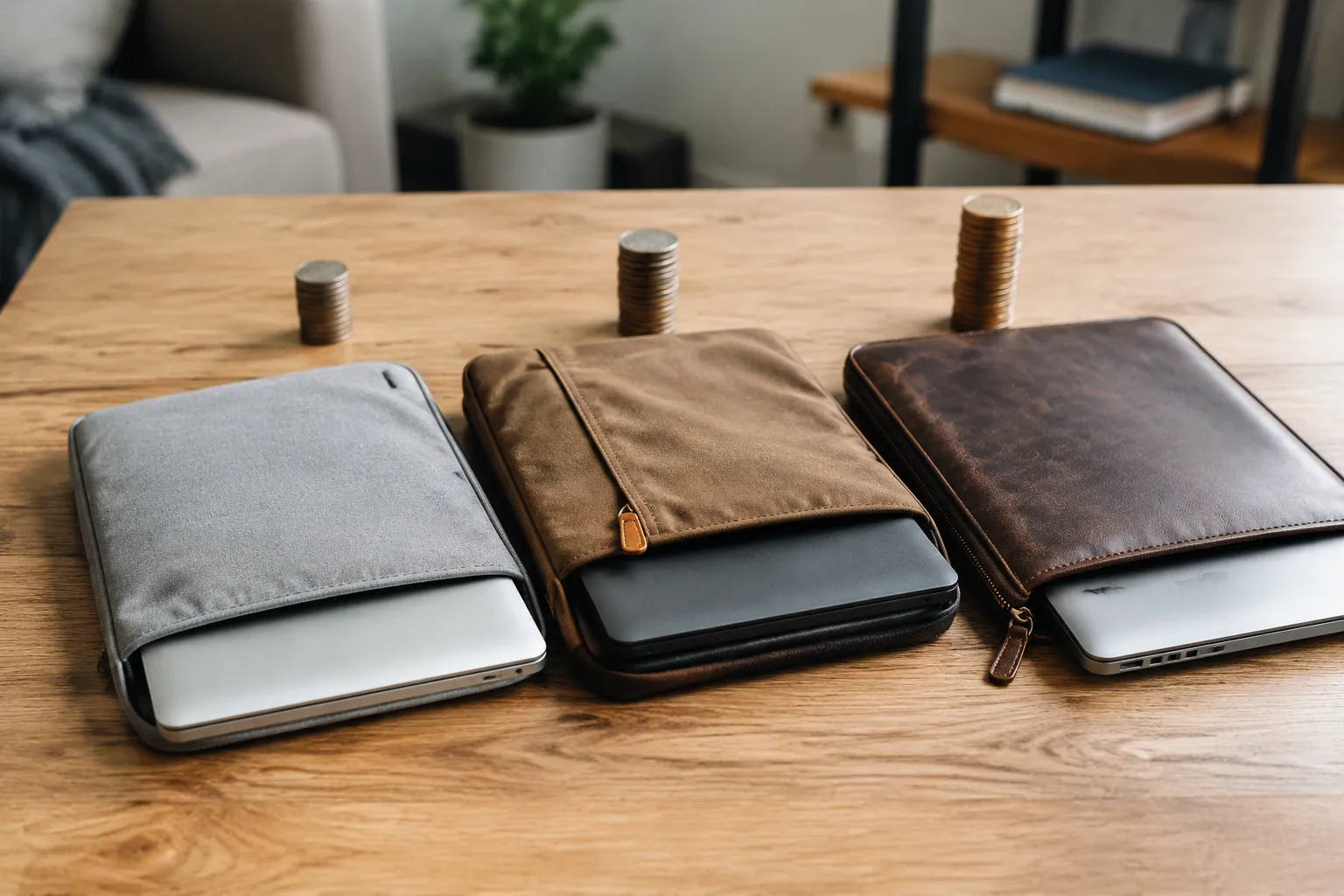
Most people buy a laptop sleeve the way they buy a phone case: as an afterthought at the register, driven by whichever color happens to be on sale. The sleeve gets chosen in under ninety seconds, often at the same moment as the laptop itself, and the buyer carries that decision with them every single day for the next three or four years. It is a wildly unfair purchase timeline. A person will spend eleven hours researching a processor that does the same thing as the processor from last year, then buy the protective shell that carries that machine through airports, coffee shops, and crowded trains based on nothing but a glance at a price tag.
The sleeve market sorts itself into tiers that rarely make sense on paper. A twenty-dollar nylon pouch and a two-hundred-dollar leather folio both do the same nominal job: they hold a laptop and keep it from getting scratched. But the difference between those extremes is not quality of protection. It is quality of judgment. Understanding where the smart money goes means separating the genuine engineering from the branding, and accepting that the right answer changes depending on how the sleeve actually gets used.
The Twenty-Dollar Zone: Honest Protection, Low Stakes
The entry tier, roughly fifteen to thirty dollars, is where most sleeves get sold and where most of them should stay. These are the neoprene slipcases and the basic padded envelopes with a zipper across the top. They come from brands like AmazonBasics, Tomtoc, and a dozen names that exist only as search results. The materials are unremarkable: a soft inner lining, a thin layer of foam, a polyester or nylon shell that shrugs off light rain but would not survive a drop into a puddle.
What these sleeves do well is absorb the small indignities of daily carry. A laptop sliding around in a tote bag next to keys and a water bottle needs a barrier. The foam in a cheap sleeve handles that job completely. Scratches, scuffs, the occasional bump against a table edge, all of it gets absorbed by a layer of padding that costs almost nothing to manufacture. For a person whose laptop lives mostly on a desk and travels only between home and one office, the cheap sleeve is not a compromise. It is the correct tool.
The failure mode of the entry tier is not poor protection. It is poor longevity of the sleeve itself. The zippers are the first casualty, usually within a year of daily use. The stitching on the seams pulls loose at the corners. The inner lining starts to pill and shed. These sleeves die slowly, and most people do not notice until the day the zipper track separates and the laptop takes a three-foot fall onto concrete. That is the moment the twenty-dollar sleeve stops being a bargain.
The other flaw is aesthetic. A cheap sleeve signals that the laptop inside is a tool and nothing more. For many people that is fine. For anyone who carries the laptop into client meetings, teaching spaces, or anywhere the object itself gets judged, the visual cheapness carries a cost that never shows up on a receipt.
The Fifty-Dollar Middle: Where Specs Start to Matter
Between thirty and sixty dollars, the market shifts from generic padding to actual design. This is the tier where brands like Thule, Incase, and Bellroy start showing up, and where the sleeve stops being a passive bag and becomes a piece of engineered carry. The differences are subtle but real. The padding gets denser and more strategically placed. The zippers come from YKK and feel smooth rather than gritty. The materials develop water resistance that actually works in a downpour rather than just resisting a splash.
The mid-tier sleeve earns its price in two specific ways. The first is fit. A cheap sleeve is often sized loosely, with a laptop rattling around inside a cavity that was cut for a range of machines. A good mid-tier sleeve is cut to the exact dimensions of a specific laptop generation. The machine slides in with a satisfying resistance and sits still once inside. That tight fit matters more than the padding thickness, because a laptop that moves inside its sleeve is a laptop that hits the sleeve walls on every swing of a commute.
The second upgrade is the closure system. Cheap sleeves use zippers because they are simple and universal. Mid-tier sleeves experiment with magnetic flaps, fold-over tops, and tension closures. These alternatives remove the single most common failure point of the entry tier, and they make the daily motion of getting the laptop out noticeably smoother. A magnetic flap that opens with one hand and closes without looking is a small quality-of-life win that registers every single time the sleeve gets used.
This is also the tier where protective standards start appearing. Some sleeves in this range advertise drop protection from a specific height, usually around four feet. That claim is testable and mostly honest. The foam inside these sleeves is often the same closed-cell material used in camera bags, and it genuinely absorbs impact energy. A laptop in a well-designed fifty-dollar sleeve can survive a fall that would crack the screen of a laptop in a twenty-dollar pouch.
The mid-tier fails only when people expect it to do something it was never designed for. A fifty-dollar sleeve is not a briefcase. It does not carry cables, chargers, or documents. It protects the laptop and nothing else. Buyers who try to stuff accessories into the same compartment stretch the sleeve and defeat its fit. The sleeve needs a bag around it to work properly, which means the total carry cost includes whatever backpack or tote carries the sleeve.
The Hundred-Dollar Question: Leather and Status
Once the price climbs past seventy-five dollars, the sleeve stops being a protective object and becomes a statement about its owner. This is the domain of full-grain leather folios from brands like Harber London, Nomatic, and the fashion houses that put their logos on anything with a zipper. The protection offered by these sleeves is roughly equivalent to the fifty-dollar tier. The padding is comparable. The water resistance is often worse, because leather needs to breathe and ages poorly when constantly wet.
What the hundred-dollar sleeve buys is presence. A leather folio changes how the laptop reads in a room. It looks like a serious object, the kind of thing a person brings to a board meeting or a book deadline. The leather develops a patina over years, acquiring scratches and dents that tell a story. For a freelancer who meets clients in cafes or a consultant who walks into offices where first impressions carry weight, that visual signal has measurable value. It is not silly to pay for it. It is a business expense dressed up as an accessory.
The pitfalls of this tier are real. Cheap leather is everywhere, and it is nearly impossible to distinguish from good leather in a product photo. Many so-called leather sleeves at this price point are actually bonded leather, a material made from leather scraps ground up and glued together with polyurethane. Bonded leather peels and cracks within a year. The only safe way to buy a leather sleeve is to handle it in person or buy from a brand with a verifiable tanning story and a return policy that allows for close inspection.
The other trap is weight. A quality leather sleeve adds between one and two pounds of material around a laptop that already weighs three or four. Carrying that combination through an airport terminal is noticeably more tiring than carrying the same laptop in a nylon sleeve. The leather folio demands a trade: elegance in exchange for heft. People who buy one and immediately complain about the weight have made a category error, not a product error.
The Real Divide: Bag Life Versus Desk Life
The smart money decision does not actually depend on budget. It depends on how the sleeve travels. A laptop that lives in a backpack and comes out twice a day needs a different sleeve than a laptop that gets carried by hand from meeting to meeting. The distinction is rarely discussed in product reviews, but it determines which tier makes sense.
For the backpack commuter, the sleeve is a secondary layer. The backpack provides the structural protection, the weather defense, and the organization. The sleeve only needs to prevent scratches and minor bumps inside the main compartment. A twenty-to-thirty-dollar sleeve is the rational choice here, and spending more delivers almost no measurable benefit. The extra money goes into padding that duplicates what the backpack already provides.
The person who carries the laptop alone, under an arm or in one hand, faces a different calculation. That person is relying on the sleeve to be the entire protective system. Drops matter. Weather matters. The sleeve absorbs every impact and every splash. For that use case, the fifty-to-seventy-dollar tier with its denser padding, better zippers, and precise fit is worth every dollar of the premium. The sleeve is doing the job that a bag would otherwise do.
The leather folio buyer is in a third category entirely. That person is not optimizing for protection or weight. They are optimizing for how the object presents them in the world. The laptop inside is often a work device that never leaves a single city, and the sleeve is part of a uniform. For that person, the hundred-dollar sleeve is not an indulgence. It is the cheapest piece of professional clothing they will buy all year.
Watching for the Spec Sheet Shell Game
Marketing departments have learned that shoppers in this category respond to technical language. So the listings now talk about ballistic nylon, aerospace-grade aluminum corner guards, and military-spec drop testing. Some of this is real. Most of it is theater. The phrase military-grade appears on products that have never been within a hundred miles of a military procurement office. Drop test ratings are conducted by the manufacturer on their own equipment with their own definition of pass.
A person can cut through the noise by looking at three things. The zipper brand, which should be YKK or an equivalent name. The material weight, listed in denier for fabrics, where higher numbers mean thicker weave. And the warranty, which is the single most honest signal a company sends about its confidence in a product. A sleeve with a lifetime warranty is a sleeve the manufacturer expects to last. A sleeve with a ninety-day warranty is a sleeve the manufacturer expects to be replaced.
The other trick is the size matrix. Sleeve manufacturers deliberately list a wide range of compatible laptops for each product size, because they want to sell one SKU to as many people as possible. A sleeve listed as fitting thirteen-to-fourteen-inch laptops is a sleeve that fits neither particularly well. The honest listings give exact external dimensions and specify the maximum laptop thickness. A person who measures their laptop before buying, instead of trusting the marketing matrix, will end up with a dramatically better fit at the same price.
The Case for Owning Two
The most practical advice in this entire category is also the least convenient to hear: most laptop owners should own two sleeves. One cheap nylon or neoprene sleeve for the daily grind, the commute, the thrown-in-a-bag chaos of ordinary life. One nicer sleeve, leather or a premium fabric, for the days when the laptop goes somewhere that matters. The cheap sleeve takes the abuse. The nice sleeve makes the impression.
This doubles the cost, which is precisely why nobody does it. But the alternative is buying one mid-priced sleeve that does neither job well, or one expensive sleeve that gets ruined by a year of rough handling. A single leather folio that goes through daily subway commutes will look battered within eighteen months. The same folio used twice a week for client meetings will look excellent for a decade. The sleeve does not wear out from age. It wears out from use.
Buyers who resist the two-sleeve approach should at least match their single purchase to their worst day, not their average day. The sleeve needs to handle the roughest commute, the heaviest rain, the most careless toss into an overhead bin. A sleeve that survives those moments will feel overbuilt on quiet days. That is the correct trade. The alternative, a sleeve that looks great on calm days and fails on the one day it gets tested, is how laptops end up cracked.
The industry would prefer this decision to be simpler than it is. Every brand wants to sell one premium sleeve at a premium price and call the matter settled. The honest answer is that the right sleeve depends on the life it leads, and most laptops lead two lives. The cheap sleeve and the nice sleeve are not competing products. They are two halves of a complete carry system, and the smart money buys both.