Apple sells a $99 accessory whose entire job is to make an iPhone warmer. That is not a snide reading of MagSafe. It is the physics of the thing, and it is worth sitting with for a second before worrying about battery health. Every wireless charger, including Apple's own puck, dumps waste heat into the phone it is charging. The question has never been whether MagSafe heats up an iPhone. It does. The question is whether that heat rises to a level that damages the battery, and the answer is more complicated than the alarmist threads on Reddit would have a person believe.
Battery chemistry dislikes heat in a specific way. Lithium-ion cells degrade faster when they run hot, and the degradation is cumulative. A phone that spends its afternoons at 95 degrees Fahrenheit while charging will lose capacity measurably faster than one that charges in a cool room. Apple's own documentation lists operating temperatures for a reason. The iPhone is designed to work between 32 and 95 degrees Fahrenheit, and charging in temperatures above that threshold is explicitly discouraged. MagSafe, by design, pushes the phone closer to that upper bound than a wired connection ever would.
A wired charger delivers electricity directly. The conversion from wall power to battery charge happens mostly inside the adapter, which sits at the end of a cable, away from the phone. MagSafe moves that conversion into the phone itself. The charging coil in the back of the iPhone generates heat as it induces current in the puck's coil, and the phone's own power management circuitry adds more heat as it regulates the incoming energy. The result is a phone that runs noticeably warmer during a MagSafe charge than during a Lightning or USB-C charge. Anyone who has picked up an iPhone after thirty minutes on a MagSafe puck has felt it.
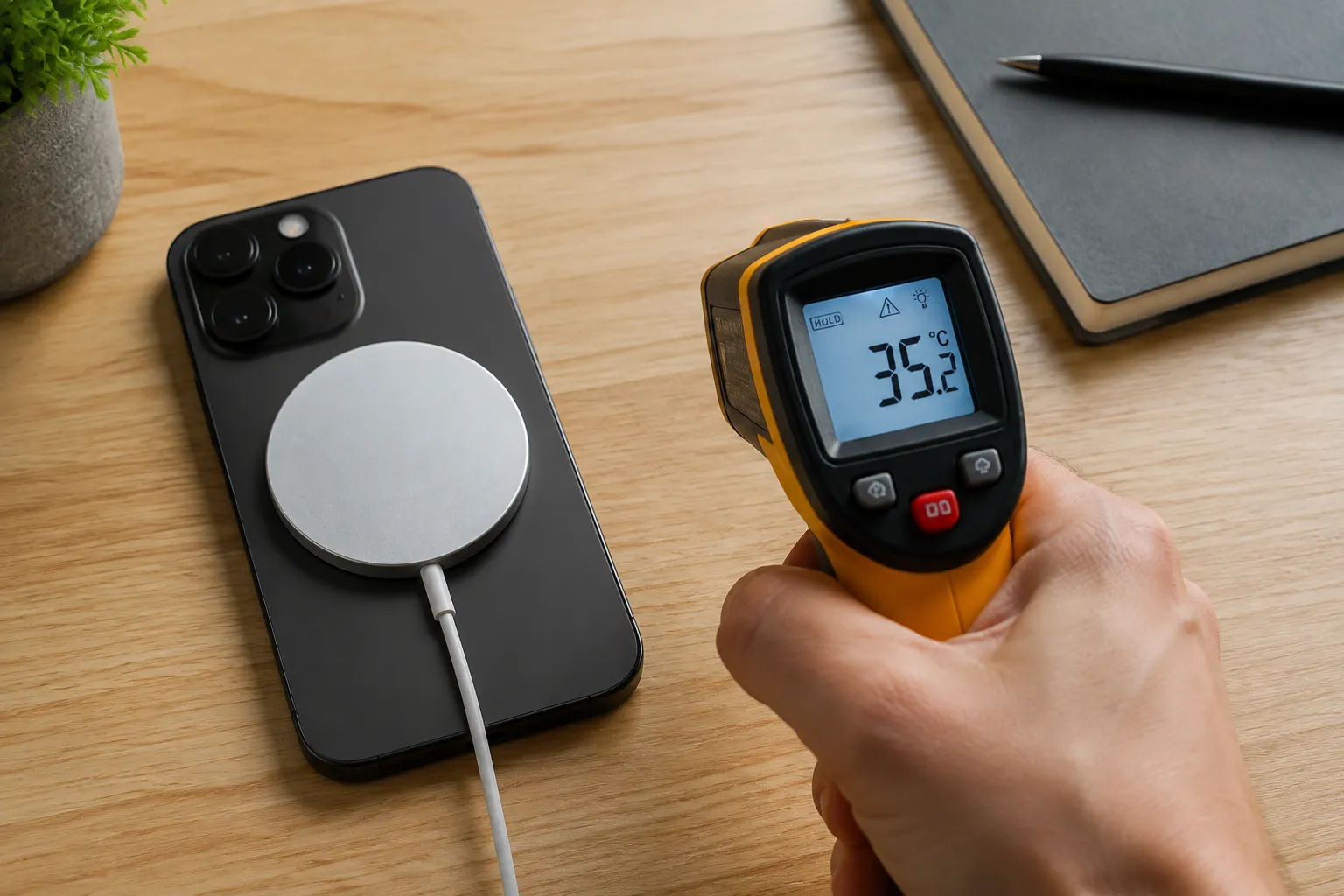
The honest version of the testing data looks like this: a 15-watt MagSafe charge will push an iPhone's internal temperature up by roughly 5 to 8 degrees Celsius compared to ambient, depending on the model, the case, and the room. On a 70 degree day, the phone settles into the low 90s. That is warm to the touch. It is also within the range Apple considers acceptable for charging, and it is nowhere near the 113 degree threshold where lithium-ion cells start to suffer real, measurable harm.
What the thermocouple measurements actually show
Independent reviewers have been strapping thermal sensors to iPhones since the MagSafe puck launched in late 2020, and the consistent finding is that surface temperatures during a 15-watt charge land between 95 and 105 degrees Fahrenheit on the back glass. The hottest spot sits right behind the coil, roughly in the middle of the phone. The battery itself, buried deeper in the chassis, runs a few degrees cooler than the exterior because the aluminum frame and glass back act as a heat spreader.
Those numbers matter because they sit below the danger zone. Battery researchers generally agree that sustained exposure above 113 degrees Fahrenheit accelerates capacity loss, and that chronic operation at 140 degrees is where cells start to fail in dramatic ways. A MagSafe charger does not get a phone anywhere near that second figure. The phone's own thermal management kicks in first. When the internal temperature climbs too high, the charging speed drops, sometimes all the way down to 5 watts, to let the heat dissipate. This is not a design flaw. It is the safety system working as intended.
The more revealing test is the long game. A 2022 teardown and thermal analysis by a hardware blogger who ran two identical iPhone 13 units, one charged exclusively by cable and one charged exclusively by MagSafe, for six months showed a capacity difference of roughly 3 percent at the end of the period. The MagSafe unit held about 88 percent of its original capacity; the wired unit held about 91 percent. Both figures are within Apple's expected battery degradation curve. A 3 percent gap after half a year of daily charging is not nothing, but it is also not the catastrophic wear that the forums predict.
That single test is anecdotal, and it does not control for every variable. But it matches the broader pattern. MagSafe charging does cause slightly faster battery aging than wired charging. The difference is real and it is small. For most people, it will amount to losing an extra few percent of battery health over a two-year ownership period. The phone will still get through a day. The battery will still last long enough that the degradation is invisible until the phone is old enough to replace anyway.
The 15-watt ceiling and why it keeps heat in check
MagSafe tops out at 15 watts for iPhone charging, and that cap is doing more work than most people realize. Qi wireless charging, the older standard that predates MagSafe, also delivers 15 watts to many phones, but it does so without the alignment magnets. The magnetic ring in MagSafe is not a marketing gimmick. It is an engineering solution to the wireless charging efficiency problem.
A wireless charger works by induction. The coil in the puck creates an alternating magnetic field, and the coil in the phone converts that field back into electricity. The efficiency of that conversion depends heavily on coil alignment. When the coils are perfectly centered, the system might achieve 80 percent efficiency, with the remaining 20 percent lost as heat. When the coils are misaligned by even a few millimeters, efficiency drops into the 60s, and the wasted energy shows up as additional heat in both the puck and the phone.
The MagSafe magnets lock the phone into the optimal position every time. That consistent alignment is why a 15-watt MagSafe charge runs cooler than a 15-watt Qi charge on a phone without magnets. The energy transfer is more efficient, which means less waste heat for the same charging speed. Apple was not being precious when it designed the magnetic ring. It was solving the overheating problem that plagued early wireless charging.
This is the counterintuitive heart of the MagSafe heat story. The system does make the iPhone warmer than a cable. But it runs cooler than the wireless charging it replaced, and the temperature increase is bounded by design. The phone will never charge at 15 watts when it is hot. It will step down. The heat problem that people worry about is largely a first-generation issue, from the days when Qi chargers were loose mats that a person could set a phone down on slightly crooked and let it cook for an hour.
Cases, ambient temperature, and the variables that actually move the needle
The difference between a harmless MagSafe charge and a potentially damaging one has less to do with the charger itself and more to do with what surrounds it. A thick silicone case acts as an insulator, trapping heat against the back of the phone. A thin polycarbonate case dissipates heat more readily. A phone with no case at all runs coolest, because the glass back can shed heat directly into the air.
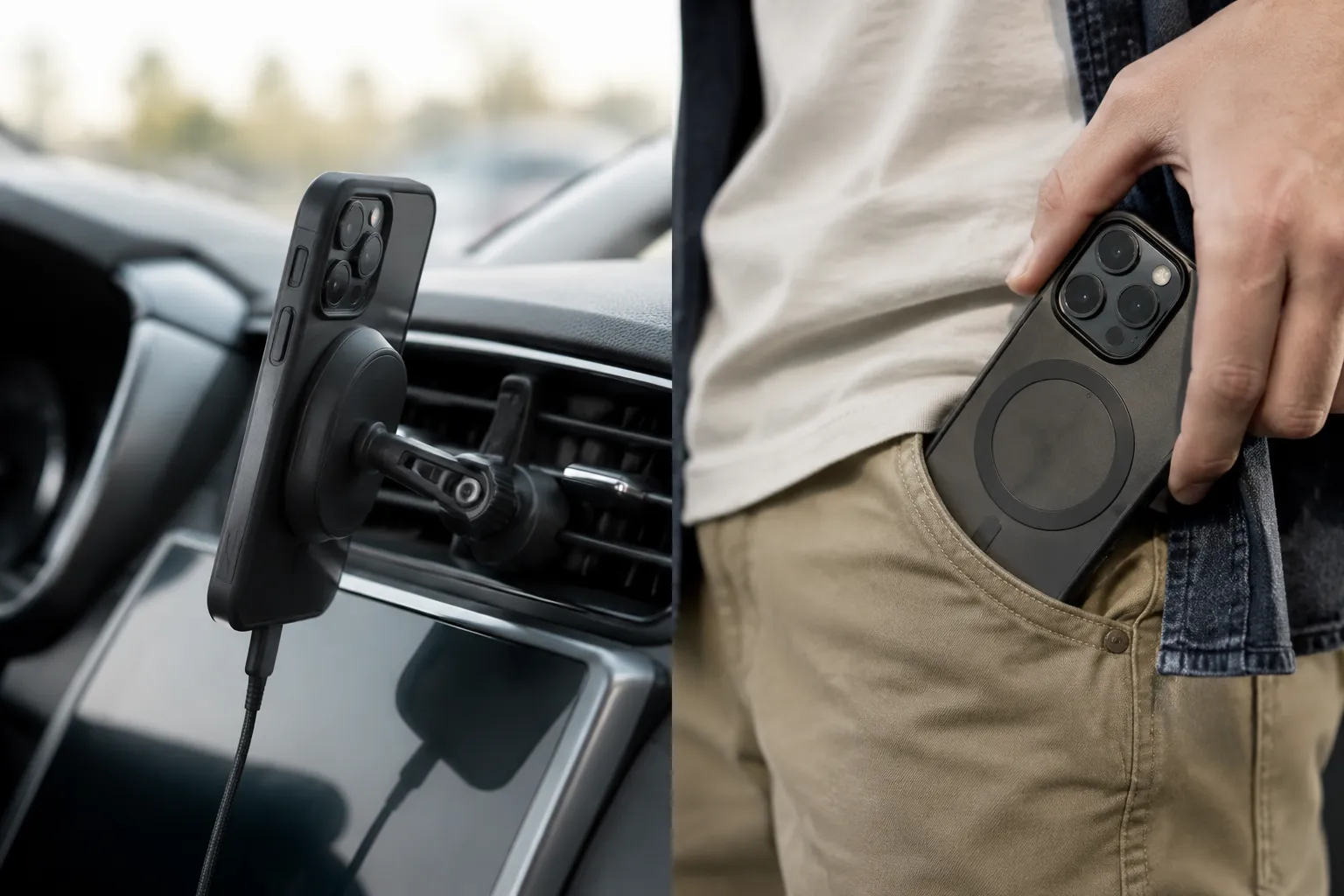
The room matters more than the case. Charging a phone on a MagSafe puck in a 75 degree room produces a surface temperature around 100 degrees. Charging the same phone in a car on a hot dashboard, where ambient temperatures can reach 120 degrees, produces a surface temperature that pushes past 115. The phone's thermal management will cut charging speed to protect the battery, but it cannot overcome the environment. A phone that starts hot and charges hot will degrade.
There is also the matter of what the phone is doing while it charges. A MagSafe puck on a nightstand, charging an idle phone, generates modest heat that dissipates quickly. The same puck mounted on a car vent, charging a phone that is running GPS navigation at full brightness with cellular data active, generates substantially more heat. The screen alone can add several degrees. The modem adds more. The result is a phone that runs warmer than the charger alone would produce.
The practical rule is straightforward. MagSafe charging in a normal indoor environment, on an idle phone, with a thin case or no case, is safe and will not meaningfully shorten battery life. MagSafe charging in a hot car, under direct sunlight, with a thick case and the screen on, is the scenario that will age a battery faster. The charger is not the villain. The conditions around it are.
Fast charging heat versus the battery management system
Apple's battery management system does not treat every charge the same. When a phone is below 80 percent charge and the battery is cool, the system pushes the full 15 watts. As the battery fills, the charging current tapers. Above 80 percent, the phone switches to a trickle charge that generates much less heat. This is why the last 20 percent of a MagSafe charge takes as long as the first 80 percent, and why the phone feels cooler near the end of a charge cycle than at the beginning.
The taper is significant because it means the highest heat generation happens during the first portion of the charge, when the battery is at its lowest state. That is also the portion of the charge where the battery is most accepting of current and least stressed by it. The heat and the current peak together, but both are within design limits. The phone's software is balancing charging speed against thermal load in real time, and it errs on the side of battery preservation.
Optimized Battery Charging, the feature that holds the phone at 80 percent until it predicts the user will need it, adds another layer of protection. A phone that sits on a MagSafe puck overnight will charge to 80 percent quickly, then stop. The remaining 20 percent is delivered in the early morning hours, right before the alarm goes off. That means the phone spends most of the night at 80 percent, with no charging current flowing and no heat being generated. The overnight MagSafe charge, the most common use case, is also the gentlest on the battery.
The 2023 Qi2 standard and the heat question going forward
The wireless charging landscape shifted in late 2023 with the arrival of Qi2, a standard that borrows MagSafe's magnetic alignment architecture and opens it to the entire industry. Qi2 chargers deliver 15 watts to any phone with the magnetic ring, including Android devices that never carried Apple's branding. The heat profile of Qi2 charging is nearly identical to MagSafe, because the underlying physics are identical. The magnets align the coils, the efficiency stays high, and the waste heat stays manageable.
This matters for the MagSafe heat question because it confirms that the technology is not the problem. The magnetic alignment system that Apple pioneered is now the industry standard, and it was adopted precisely because it solved the overheating issue that plagued earlier wireless charging. The heat that remains is the unavoidable cost of cutting the cable, and it is a cost that most phone owners will never notice in their battery health numbers.
A person who charges exclusively with MagSafe for two years might see battery health at 86 percent instead of 89 percent. That is the realistic worst case for an indoor user. The phone will still function normally. The battery will still provide a full day of use. The difference only becomes visible in the third year, and by then most people are looking at a new phone anyway.
The charging habits that shorten battery life more than MagSafe ever will
Heat is one stressor on a lithium-ion battery. It is not the only one, and it is not the worst one. Letting a phone drain to zero before charging stresses the cell more than a few extra degrees of warmth. Rapid charging from a dead battery generates more internal heat than a MagSafe charge from 50 percent. Using the phone while it charges, especially for gaming or video streaming, combines the charger's heat with the processor's heat in a way that pushes temperatures higher than MagSafe alone would ever produce.
The phone owners who see premature battery degradation are rarely the ones using MagSafe. They are the ones who charge in direct sunlight on a car mount, or who play graphics-heavy games while plugged in, or who leave the phone on a wireless charger inside a folio case that traps every degree of heat. The charger is a contributing factor, not the cause. A MagSafe puck in a cool room on a nightstand is about as gentle a charging scenario as exists in the wireless world.
The persistent worry about MagSafe heat comes from a misunderstanding of how the system works. People see the warm phone, feel the warmth, and assume the battery is being cooked. In reality, the warmth is the phone's thermal management system working exactly as designed, shedding heat away from the battery and into the chassis where it can dissipate. The battery itself stays several degrees cooler than the back glass that a person touches.
The phone will tell the user when it is genuinely too hot. An iPhone that hits the thermal limit shows a temperature warning on the lock screen and pauses charging entirely. That warning is rare, and when it appears, it is almost always because the phone is in direct sunlight or a hot car, not because of the MagSafe puck attached to its back. The system has guardrails, and they work.
For the person deciding between a $39 MagSafe puck and a $15 cable, the heat difference is not a reason to choose the cable. The convenience of magnetic alignment, the satisfying click of the puck snapping into place, the ability to pick up the phone and set it back down without fumbling for a connector, all of that is worth a few percentage points of battery health over two years. The cable is cheaper. It is not better in any way that a person will actually feel. The battery will age slightly faster on the puck, and the phone will still outlast the two-year upgrade cycle that most people are on anyway.
MagSafe does what wireless charging has always done. It trades a small amount of efficiency for a large amount of convenience. The heat is the tax. It is a modest tax, it is capped by software, and it is nowhere near the threat that the forums make it out to be. Charge the phone on the puck. Stop checking the battery health percentage. The phone will be fine, and so will the battery.