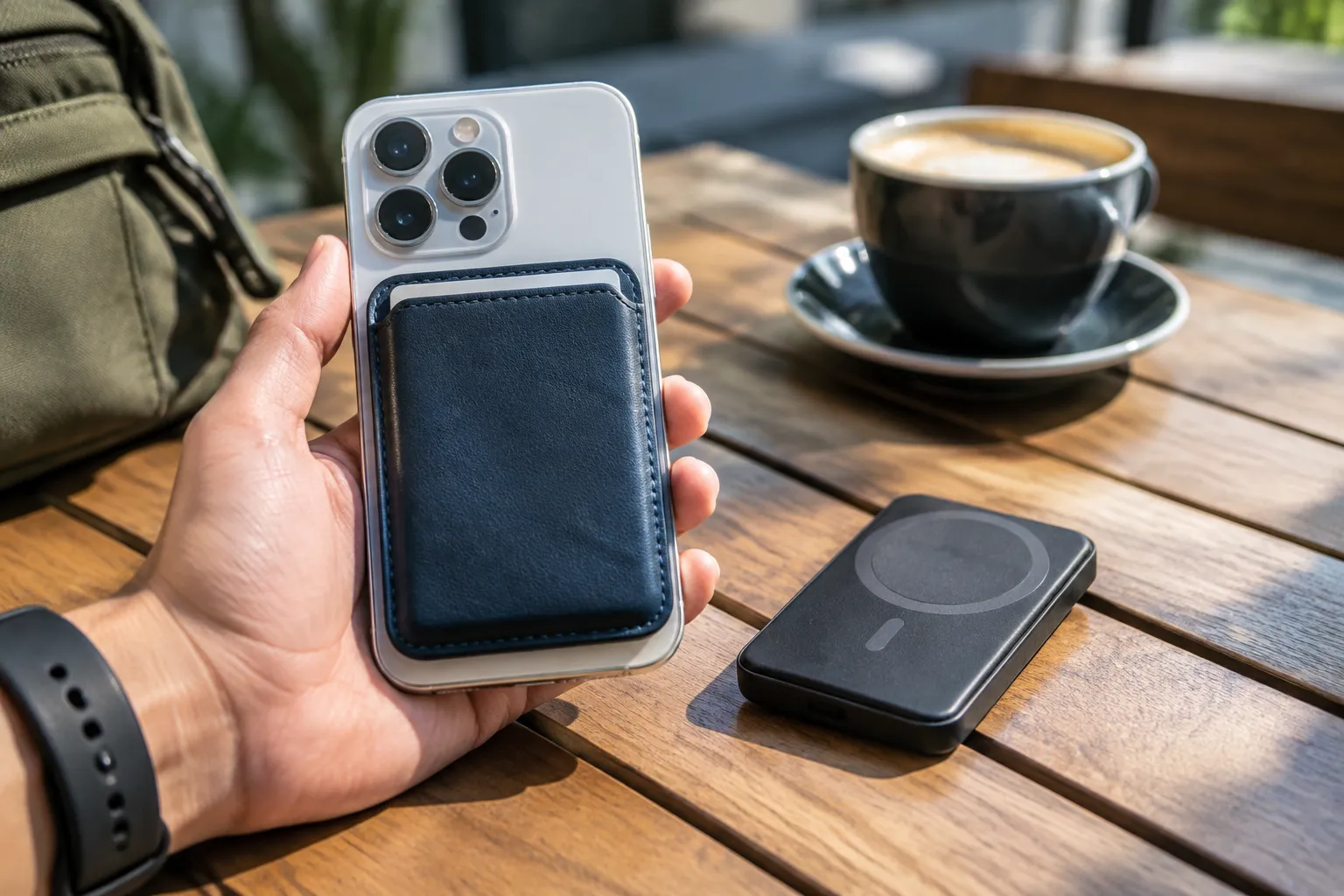
The first time a MagSafe wallet let go, it was not dramatic. No fumble, no clatter on the pavement, just the quiet realization that the pocket on the back of a phone had become lighter. By the time the hand reached back to check, the wallet was already on a restaurant banquette or in the gap between a car seat and the center console. The Apple Wallet with MagSafe, and the dozens of imitations that followed, solved a real problem: carrying two or three cards without a pocket bulge. Then the magnets introduced a new one.
The adhesive and magnet array inside these wallets is a compromise. Apple rates the magnets for a firm grip, but the holding force drops when the wallet slides against a slick surface, when the phone gets hot, or when the wallet is loaded past its intended thickness. Gravity wins eventually. The trick is not to fight the physics but to work around the specific failure points.
The magnet grip ceiling
Every MagSafe wallet relies on the same circular magnet array that snaps the phone to a charger. That array has a rated holding force somewhere around one kilogram when the phone is flat and the wallet is centered. Real life rarely presents those ideal conditions. A phone in a pocket slides against fabric, the wallet catches on a seatbelt or a jacket lining, and the leverage from a sideways bump multiplies the force needed to break the connection.
The first thing to understand is that most drops happen after a slide, not a straight pull. A wallet pulled directly away from the phone has to overcome the full magnetic force. A wallet pushed sideways or torqued at an angle can peel off with a fraction of that force. The phone case itself also matters. A bare glass back provides a smooth, high-friction surface. A silicone case grips better. A slippery polycarbonate case gives the wallet room to slide before the magnets even engage fully.
The point is that no technique eliminates the limit of the magnet array. What the techniques below do is address the conditions that push the wallet past that limit.
Technique one: controlling the card load
The most common cause of a MagSafe wallet failure is overstuffing, and it is also the easiest to fix. These wallets are designed for two, sometimes three cards. The spring mechanism or elastic band that holds cards in place has to press them tight against the back plate. When a third card goes in, the whole assembly thickens, the wallet's back bulges, and the magnet plate inside shifts slightly away from the phone's magnet ring.
That distance, even a fraction of a millimeter, changes the magnetic pull significantly. The holding force falls off with the square of the distance. A wallet that grips firmly with two cards becomes noticeably looser with a third or a fourth. The fix is a hard limit: two cards max, and only if they are standard credit-card thickness. A folded bill or a transit card with an embedded chip can add just enough bulk to break the grip.
There is also a less obvious version of this problem. The cards themselves can slide inside the wallet when the phone is in a pocket. A card that has worked its way sideways creates an internal bulge that pries the wallet off from the inside. The simplest habit is to check that the cards are seated flush before every use. A quick squeeze of the wallet to recenter the stack takes a second and prevents the slow wedge that loosens the magnetic connection.
For people who need more than two cards, the honest answer is that a MagSafe wallet is the wrong tool. A phone with a case that holds a single card, or a separate slim card holder in the front pocket, serves better than trying to force a magnetic wallet to carry what it cannot hold securely.
Technique two: the case texture and surface prep
The surface the wallet attaches to matters as much as the magnet strength. Most MagSafe wallets come with a leather or silicone back. The phone side is either bare glass or a case back. The friction between those two surfaces is what stops the wallet from rotating or sliding before the magnets can fail.
On a bare glass iPhone, the leather back of an Apple Wallet grips reasonably well. On a glossy polycarbonate case, the wallet can spin in place like a lazy Susan. A person who wants drop-proof performance should look for a case with a textured back: silicone, fabric, or a matte finish with some tooth to it. The stickier the interface, the more force it takes to start a slide that leads to a fall.
Beyond the case, a thin layer of something grippy on the wallet's back plate helps. A small circle of adhesive-backed silicone, sold as a phone grip or a cabinet liner pad, can be cut to fit the wallet's contact area. This adds friction without interfering with the magnets. The same trick works for the wallet itself: a strip of rubberized tape along the wallet's back edge increases the force needed to start a peel.
One warning: any layer between the wallet and the phone must be thin. A thick pad or a case with a raised camera bump can push the wallet just far enough from the magnet ring to reduce the hold. The goal is to add friction, not distance.
Technique three: positioning and the pocket direction
Most people attach a MagSafe wallet dead center on the back of the phone. That position looks balanced, but it is not always the most secure. The wallet should sit where the hand naturally grips the phone, and that spot is often lower or slightly off-center. When the wallet is positioned where the fingers and palm wrap around it, the user gets a constant tactile check that it is still attached. A wallet mounted up near the camera module sits in dead space where a hand rarely touches it.
The pocket direction matters just as much. When a phone goes into a front pocket with the wallet facing the leg, the fabric presses against the wallet with every step. That pressure is fine. The problem starts when the phone is pulled out quickly. The wallet catches on the pocket lip, and the user pulls the phone away at an angle that peels the wallet off. Sliding the phone out with the wallet side facing the pocket's back wall, or turning the phone slightly during the pull, reduces the chance of that snag.
For jacket or coat pockets, the opposite risk appears. A deep pocket can hold the phone loosely, and the wallet can catch on the pocket interior when the phone shifts. The fix is to place the phone in the pocket wallet-side down, so the wallet rests against the pocket floor rather than against a seam or a key.
The carry position also affects how the wallet ages. A wallet pressed against a thigh for eight hours a day takes on body heat and moisture. The leather softens, the magnets inside can shift slightly, and the whole assembly becomes more flexible and more prone to peeling. Rotating the phone in the pocket, or switching between front and back pockets, distributes that wear.
Technique four: the aftermarket reinforcement options
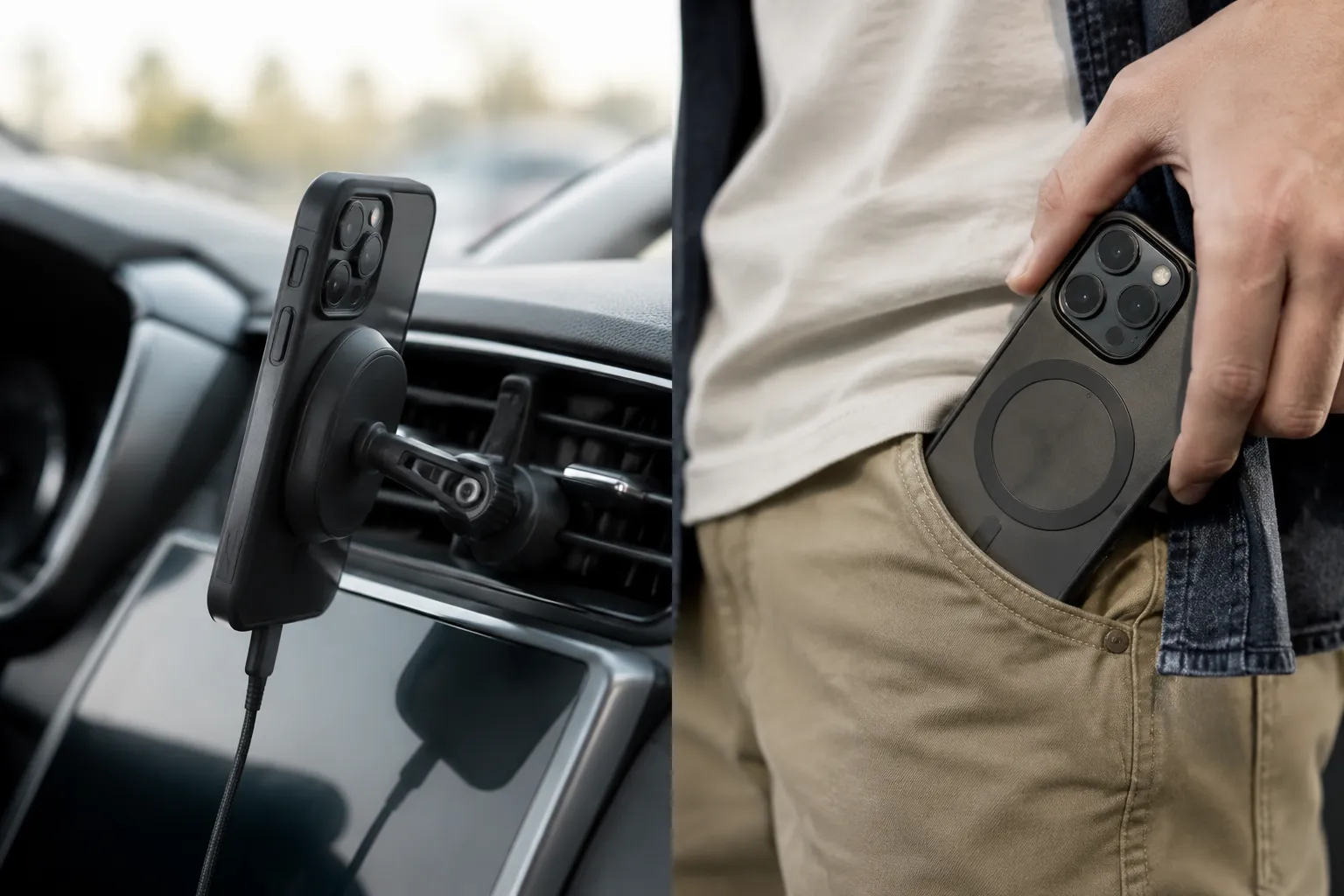
When the standard magnet array is not enough, several aftermarket products close the gap. The first is a MagSafe case with a stronger magnet ring built in. Cases from brands like Mous, Peak Design, and Caudabe embed a wider or thicker magnet array than Apple's own cases. These cases can hold a wallet noticeably more firmly, especially when the wallet is loaded with cards.
The second option is a metal plate or adhesive magnet ring applied to a non-MagSafe case. A person with a favorite case that has no magnets can add a circular ring of neodymium magnets, sold as a MagSafe conversion kit, to the inside of the case. Once installed, the exterior surface gains magnetic properties without a visible plate. This approach works best with a hard plastic or silicone case that will not flex.
The third reinforcement is a wallet with a mechanical lock beyond magnets. Brands like Bellroy and Moment sell MagSafe wallets with a ridged back or a hook that slides under the phone's edge. These designs add a physical barrier that stops the wallet from sliding off even if the magnetic connection fails. They are bulkier than a plain Apple Wallet, but they remove the worry entirely.
Finally, some cases include a built-in magnet ring on the exterior that is thicker than Apple's spec. This creates a stronger hold but also makes the back of the phone slightly raised. The tradeoff is worth it for anyone who has already lost a wallet once.
The temperature and wear factor
Few people consider how heat affects the magnetic hold. A phone left on a car dashboard in summer, or held in a hand during a long navigation session, warms the back plate. The magnets inside both the phone and the wallet lose strength as temperature rises. The effect is temporary, but it coincides with the moments when people are most likely to be moving around with the phone: getting out of a car, walking from a sunny street into a store.
The wear factor is slower but more permanent. A MagSafe wallet that has been dropped a few times develops micro-cracks in the internal magnet housing. The leather back stretches. The card spring weakens. After about a year of daily use, the holding force drops below the threshold needed for reliable carry. The eventual failure is not a sudden snap but a loosening that makes the wallet feel slightly wobbly. At that point, the only real fix is replacement.
A person who checks the wallet's grip every few weeks catches this decline early. The test is simple: hold the phone by the wallet and give it a gentle shake. If the wallet shifts or slides, the magnets have weakened past the safe zone.
What the drop actually costs
A single lost wallet is not just the cost of replacing it. The cards inside need to be canceled and reissued. A driver's license, a transit pass, a payment card: each one takes days and phone calls to replace. The time cost is worse than the money. And the moment of realization, the pat of a pocket that comes up empty, has a particular sinking quality that no amount of careful storage prevents once the wallet is gone.
The people who never lose a MagSafe wallet are not the ones with the strongest magnets or the most expensive cases. They are the ones who treat the wallet as a temporary attachment rather than a permanent fixture. They check it before leaving a table. They feel for it when they stand up from a seat. They keep the card load light and the surface clean. These habits matter more than any single product decision.
In the end, the MagSafe wallet is a convenience device that asks for a small amount of attention in return. A person who understands the magnet's limits, controls the variables that cause it to fail, and builds a quick physical check into the daily routine gets the convenience without the panic. The wallet that never falls off is the one that is never given the chance to fall.