Magnetic alignment is the quiet detail of the iPhone accessory world that people only notice when it fails. A wallet that sits crooked on the back of a phone looks like a mistake. A battery pack that refuses to charge because the coils are two millimeters off makes a person swear at an inanimate object. The problem is that there are two competing ways to build the magnet into a case in the first place: an adhesive ring that sticks to the inside of the case, or a magnet that gets molded directly into the case's structure during manufacturing. The names are almost identical, the prices are not, and the difference matters far more than most buyers realize.
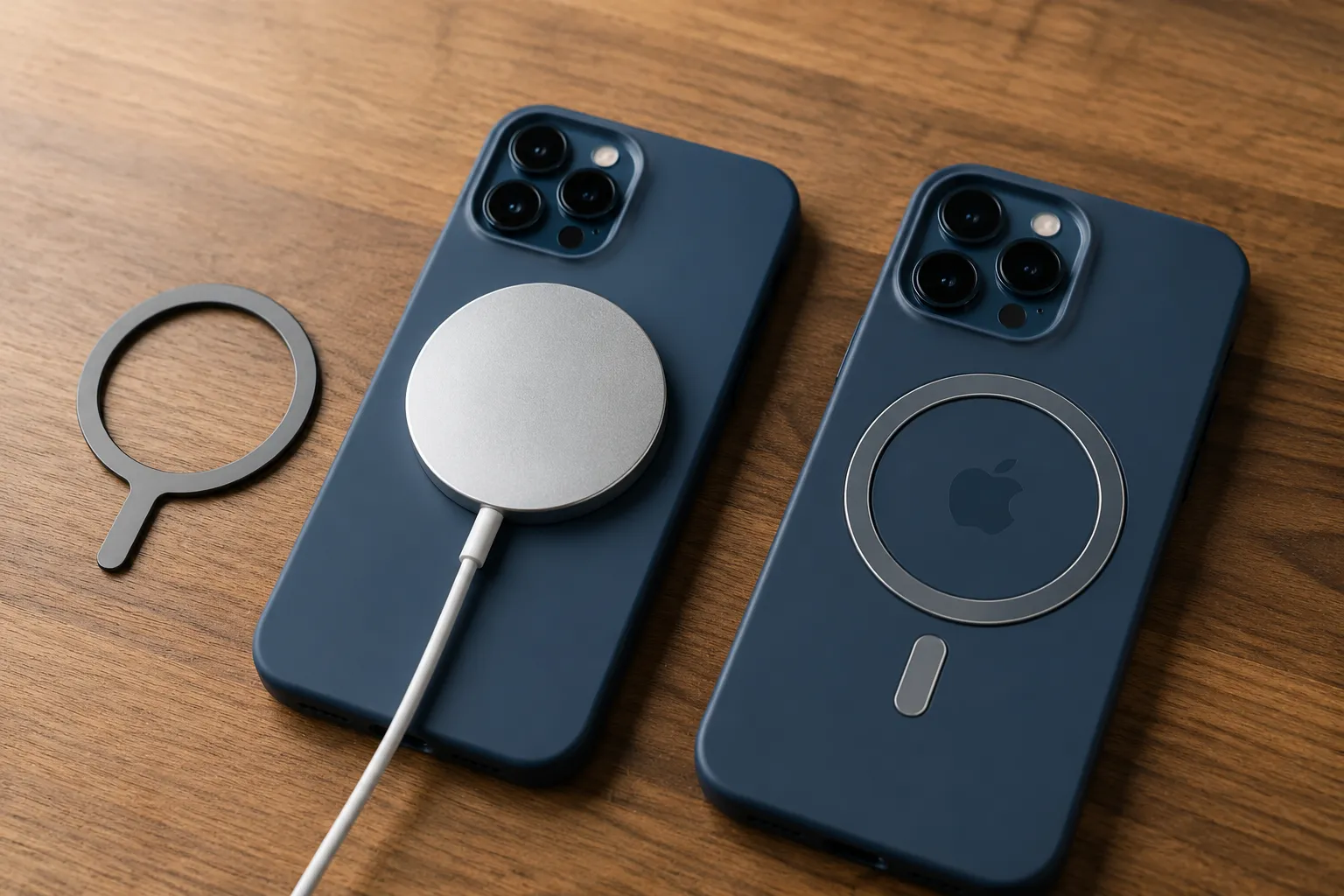
The straightforward definition gets confusing fast because of marketing. A "MagSafe-compatible case" can use either method. A built-in magnet means the case manufacturer embedded an array of magnets into the case itself, usually via a molded pocket or a co-molding process. A magnetic ring is an add-on: a separate adhesive ring, purchased for a few dollars, that sticks to the inside of a non-magnetic case to give it magnetic properties. Both work. Both demonstrably hold accessories. The difference is in the tolerances, the durability, and the fit over time.
Most people discover the ring option first because it is cheap and it seems like an elegant hack. The ring looks like a metallic sticker with a precise circle of holes, sold by brands like ESR, Spigen, and a dozen no-name companies. It costs between eight and fifteen dollars, which feels like nothing compared to replacing a case. The promise is that any existing case, even a beloved leather one, can gain magnetic powers without a new purchase. The application process is simple enough: clean the inside of the case, peel the backing, press the ring down, wait a few hours for a full bond. That wait matters. The adhesive needs time to cure, and plenty of people skip it, then watch the ring slide around inside the case the next morning.
Built-in magnets solve one immediate problem on day one: they are flush. A molded magnet array sits inside the case's back panel, completely hidden, with no bump and no adhesive layer bothering the back of the phone. A phone dropped into a case with a built-in magnet just seats itself. The phone backs themselves are slippery, glass and aluminum surfaces with no friction to speak of, and a case with a built-in magnet holds the phone in place with a firm, even pressure. The ring version has a physical thickness. The ring is usually 1 to 2 millimeters thick, adhesive included. The phone does not lie flat and flush against the case interior; it rocks slightly on the ring. For some cases that is imperceptible. For thinner cases, a person can feel the ring under the phone's glass back, a faint ridge that sometimes causes a tiny wobble when the phone rests on a flat desk while typing.
Wireless Charging Heat and the Adhesive Weak Point
Heat is the great enemy of adhesive rings, and wireless charging generates heat. A MagSafe charger pushes around 15 watts into the phone, and that energy does not all go cleanly into the battery. A meaningful portion becomes heat radiated through the phone's back and into the case. The case gets warm. The adhesive ring gets warm. And warm adhesive slowly loses its grip. Not in a dramatic, catastrophic way, but in a creeping, millimeter-by-millimeter way. After a few months of daily charging, the ring begins to slide. A person picks the phone up out of the case, feels a slight resistance, and then watches the ring stay stuck to the phone's back rather than the case. At that point, the ring has failed. It needs to be peeled off the phone, re-seated, or replaced.
Built-in magnets do not have this failure mode because they are not glued; they are held in place by the case's own plastic, silicone, or leather structure. Heat is still a factor in that it can degrade the case material itself over time, but that is a far slower process than adhesive failure. A good case with a molded magnet will outlast the phone's usable life in almost every scenario. The magnet array stays exactly where the manufacturer placed it on day one. The alignment does not drift.
The counterintuitive twist is that the ring can sometimes give a stronger initial hold. A ring is typically a single solid piece of magnetic material or a dense array of magnets, and it sits closer to the phone's back than a built-in magnet that is buried under a layer of case material. The closer the magnet is to the phone's internal magnet array, the stronger the coupling. Some ring users report a firmer snap when attaching a wallet, at least for the first month. The built-in version, depending on the case's thickness, has a slightly weaker initial pull because the magnets sit farther from the phone. This is not an enormous difference, and most people would not notice it side by side, but it is real in the first week.
Alignment Precision: The Underrated Metric
Alignment precision is where the ring genuinely loses, independent of durability. A MagSafe charger has a specific circular coil layout. The phone has its own internal coil. The case magnet needs to center itself exactly over that coil, or the charging efficiency drops. An off-center alignment of even a few millimeters can halve the charging speed. This is the dirty secret of cheap magnetic cases: they charge, but they charge slowly, because the embedded magnet array is not perfectly centered.
A ring has one advantage here in theory: the user can position it precisely before pressing it down. The ring can be aligned to the phone's exact center with a careful eye, using alignment guides that some sellers include. In practice, most people eyeball it, and eyeballing a translucent ring on a dark case interior is not easy. The ring can be a fraction of a degree off and the user would never see it clearly until the phone is on the charger and the charging screen shows reduced wattage.
Built-in magnets are positioned by machine. A manufacturer like Apple, OtterBox, or Mous uses a jig, a physical template, to place the magnet array before the case material is formed around it. The tolerance is much tighter than human hands can achieve. Even a budget case with a built-in magnet, one made in a factory that uses automated placement, will have more consistent alignment than a hand-applied ring. The exception is a case with a built-in magnet that was designed poorly, with the magnet array placed slightly off-center from the factory. That is a design flaw, not an installation error, and it is harder to detect because the buyer assumes the manufacturer got it right.
The Second Charger Problem and PopSocket Grip Cases
The single best test for distinguishing a good magnetic case from a bad one is the second charger. A person owns a MagSafe puck in the car, a stand on the nightstand, a charger in the office. Each of those has its own coil alignment. A case that works perfectly on one charger might slip slightly on another, because the third-party charger's own tolerance is different. A ring that has drifted by a millimeter will still work on the first charger, the one that happens to have a slightly larger coil or a slightly more forgiving alignment, and fail on the second. The phone shows the charging icon but the battery percentage crawls upward at an agonizing pace. This is the scenario that sends people to forums to ask why their battery is charging slowly, and the answer is often the ring shifted by less than half a millimeter.
PopSockets add another layer of complexity. The PopSocket grip with a built-in magnet is popular because it lets a person swap grips between cases. But the grip's magnet needs to interface with the case's magnet, and a built-in case magnet creates a cleaner interface. A ring on the inside of a case means the grip magnet is actually attracting the ring, which is then attracting the phone. That extra link in the magnetic chain weakens the hold. A person grabs the PopSocket to pull the phone out of a bag, feels a slight give, and wonders if the grip is going to detach entirely. The ring version also magnetically interferes with the grip's own alignment; the grip spins slightly off-center, never quite settling into the same position twice.
Fit, Texture, and the Case Material Question
The ring method has one true home turf: cases that are too thin or too textured to embed a magnet. A fine leather case from a small maker, one that is literally just a stitched piece of leather wrapped around the phone, cannot have a magnet molded into it. There is no molded structure. The only option for that case to become magnetic is a ring stuck inside. The same goes for ultra-thin polycarbonate shells that are barely a millimeter thick. A built-in magnet requires a minimum case thickness to accommodate the magnet array, and that thickness adds bulk. People who want a case that protects against scratches but adds almost zero footprint are locked into the ring world.
Texture matters here in a way people rarely discuss. A ring on the inside of a smooth polycarbonate case will grip well because the adhesive bonds to the flat surface. The same ring on the inside of a case with a microfiber lining, common on higher-end cases, will bond to the microfiber instead of the case's hard shell. Microfiber does not hold adhesive well. The ring starts to peel at the edges within weeks, catching on the phone's back edge when the phone is inserted or removed. The fix is to peel back the microfiber lining where the ring sits, which ruins the lining's protective purpose, or to skip the ring entirely and buy a magnetic case.
Wallet Stacking and the Car Mount Compromise
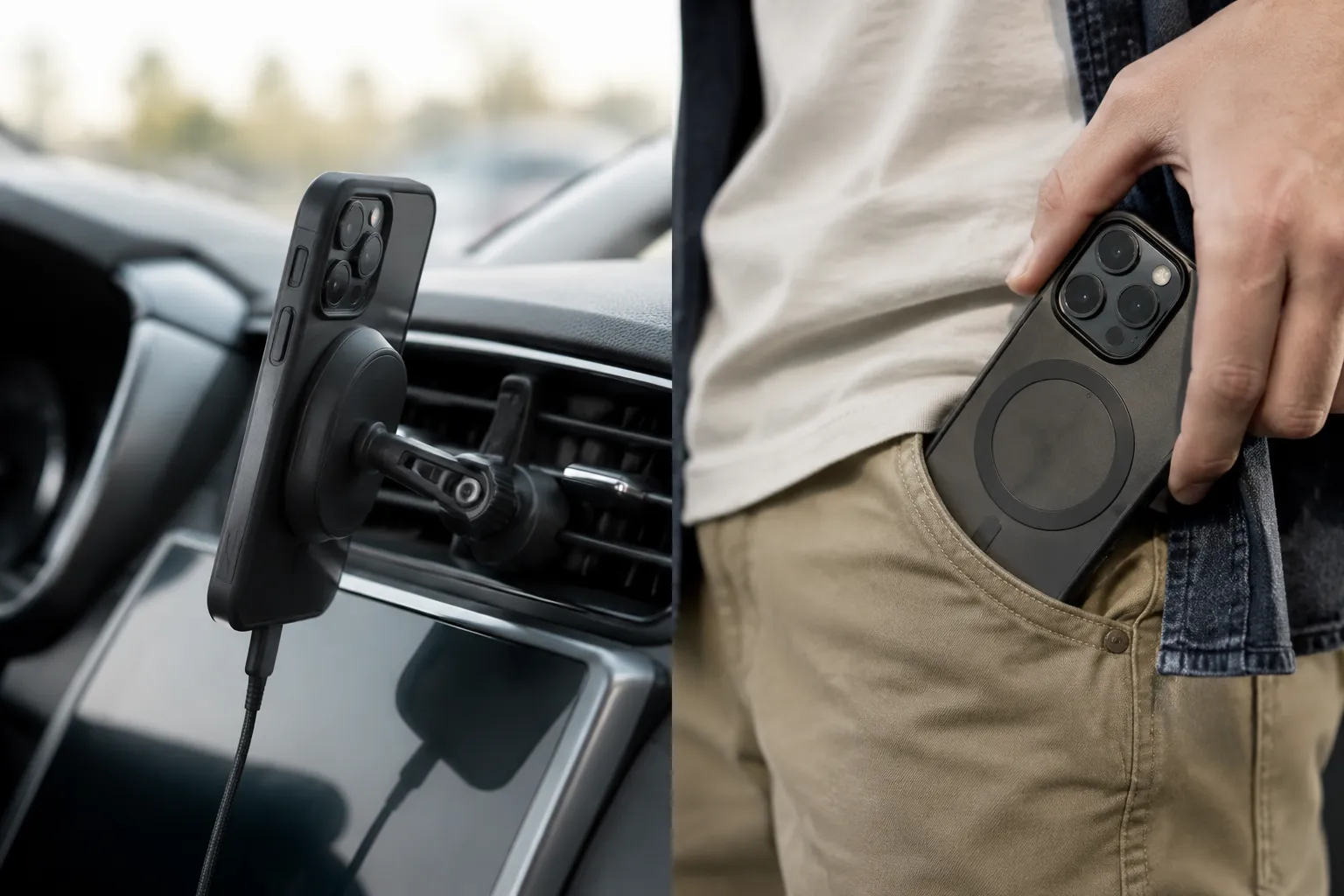
Stacking is the final practical test. A person uses a magnetic wallet on the back of the case and wants to charge the phone wirelessly while the wallet is attached, or wants to mount the phone on a magnetic car vent mount with the wallet still on. The combined thickness of phone, case, ring or built-in magnet, and wallet creates a gap that weakens the magnetic coupling to the charger or mount. A built-in magnet, because it is closer to the phone and the case surface is flatter, maintains a slightly better grip in this stacked configuration. The ring adds two extra layers of metal and adhesive, increasing the effective distance. The phone on a car mount may shudder or slide down slightly over a rough road because the wallet is slipping relative to the case's magnet, and the case's ring is not holding the phone as firmly as it should.
A person who just slaps a ring on a cheap case and uses a wired cable will never notice any of this. The case works, the phone stays protected, and the magnet is enough to attach a wallet that stays in place until deliberately removed. That person paid eight dollars and should not be talked out of it. The ring is a valid solution for a simple use case with low demands. It fails when the demands go up: daily wireless charging, frequent wallet attachment and removal, car mounting, and any scenario where the user grabs the phone by the magnetic accessory and expects it to hold without fail.
The People Who Should Never Buy a Built-In Magnet Case
There is one category of person who should actively avoid built-in magnets, and it is not who most people would guess. People who change cases frequently, sometimes multiple times a week, buy cheap cases from Amazon and swap them based on outfit or mood. For that person, paying forty to sixty dollars for a premium case with a built-in magnet is absurd. They want the magnetic function at a low price, and they are willing to replace the case when the ring drifts. The ring lets them turn a seven-dollar clear case into a magnetic case. The ring will fail in a few months, but the case was already failing in terms of yellowing and scratches anyway. The replacement cost is trivial. The ring is the right call for that workflow, and pretending otherwise would be dishonest.
The person who should always buy built-in is the one who wants to forget about the case entirely. Someone who buys a premium case with a two-year warranty, charges wirelessly every night, uses a car mount on the commute, and wants the accessory to be invisible. That person should never touch an adhesive ring. The ring will fail during a moment of complete unimportance, like picking the phone up off the nightstand in the dark, and that person will not remember the eight dollars they saved. They will remember the annoyance.
The Test That Ends the Debate
The cleanest way to decide is a simple test performed on day one and repeated after three months. Place the phone in the case, attach a MagSafe charger, and note the battery percentage after ten minutes. Then remove the case, attach the charger directly to the bare phone, and note the percentage after another ten minutes. The difference between the two numbers is the case's efficiency loss. A good built-in magnet case will show a loss of roughly 5 to 10 percent. A ring that is even slightly misaligned will show a loss of 15 to 25 percent. After three months, run the same test. The built-in magnet case will show the same numbers. The ring case will show a larger loss, because the adhesive has compressed, the ring has shifted, or it is no longer sitting flush. That widening gap is the entire argument in two measurements.
The ring method gets a bad reputation from users who install it poorly and then blame the product. The built-in magnet gets a free pass from buyers who assume any case marketed as magnetic is engineered correctly. Both are wrong. The honest assessment is that a built-in magnet is the better engineering solution for nearly every mainstream use case, and the ring is a stopgap for thin cases, cheap cases, and people who treat cases as disposable accessories. Neither is a scam. The ring just asks the user to do the work that a factory does better.