The black hole at the bottom of a backpack is a modern failure of engineering. It swallows USB-C cables, earbuds, dongles, and wall adapters, and it returns them only after a frantic five-minute rummage that usually ends with a person on their knees in a hotel lobby, pulling out a crumpled receipt and a granola bar wrapper before finally locating the lightning cable. The tech pouch is the designated fix for this chaos, yet most commercially available organizers simply move the disorder into a smaller, more expensive container. A pouch that cannot be packed with intention is just a purse for trash.
The market has settled on a standard template: a rectangular clamshell with a mesh lid, a few elastic loops, and a zippered pocket. It works well enough for the person who carries exactly one cable and one brick. The trouble begins when a realistic daily carry involves two phones, a laptop charger, a mouse, a portable SSD, and the assorted adapters that live in a modern bag. The elastic loops are either too tight for a braided cable or so loose that the cable slips out at the first jostle. The mesh pockets hold small items but obscure them. The result is a pouch that requires a full unpacking to find anything, which defeats the entire purpose.
The case for zoning over general storage
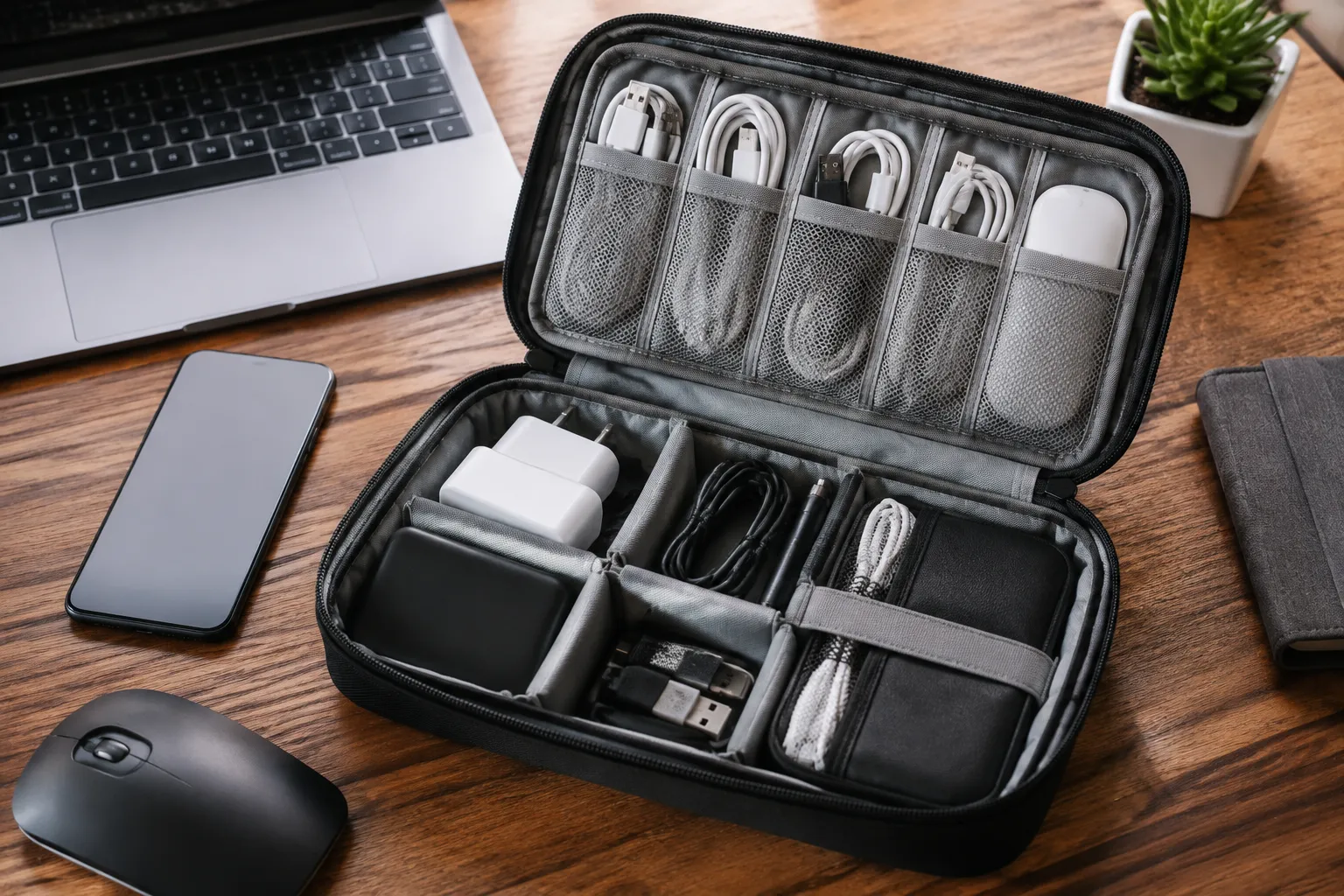
The most effective tech organizers treat the interior like a small apartment with designated rooms, not like a studio loft where everything shares space. A cable thrown into a single large compartment will tangle with every other cable in that compartment, regardless of how premium the exterior fabric is. The solution is a pouch with multiple distinct zones, each with a specific job, so that a person never has to dig through a pile of unrelated gear to find the one item they need.
This zoning principle explains why the simple fabric pencil case, which seems like it should work, fails so consistently. It has one room, and everything in it becomes roommates. The charger scratches the phone. The earbuds tangle with the cable. The USB stick falls to the bottom and is forgotten for weeks. A proper organizer separates these items by function, so the charger has its own elastic loop, the earbuds have a dedicated soft pocket, and the small adapters live in a zippered compartment that keeps them from becoming projectiles.
The best organizers on the market understand this and build in a mix of open space and structured holders. The open space is for the bulky items that do not fit neatly into a loop, like a wall charger with folding prongs or a portable battery. The structured holders are for the items that need to stay put. A good rule of thumb is that the pouch should be about 30 percent open space and 70 percent organized zones. A pouch that is all organization is too rigid for real gear, and a pouch that is all open space is just a bag inside a bag.
What the material actually does
Outer fabric matters more for durability than for looks, and the current obsession with waxed canvas and full-grain leather is mostly aesthetic. The real requirement is that the material resists abrasion from the other items in a backpack, because the pouch will always be packed against a laptop corner, a set of keys, or the metal zipper of another compartment. A synthetic ripstop nylon at 300 denier or higher handles this abuse well. Ballistic nylon is even better, and it does not show wear the way that a lighter fabric will after a few months of daily commuting.
The interior lining gets less attention, but it deserves more. The cheapest organizers line their interiors with the same slick nylon they use on the outside, which means cables slide around freely and small items migrate between sections. A soft, grippy interior, often a polyester fleece or a padded tricot lining, holds items in place and prevents the constant shuffling that creates tangles. When a person opens a well-lined pouch, the contents stay exactly where they were packed, which is the quiet pleasure of good organization.
Zippers are where manufacturers cut costs, and the difference is immediately apparent in daily use. A cheap zipper catches, skips teeth, and eventually separates from the track after a few hundred cycles. A good zipper from YKK, which costs the manufacturer only a few cents more, runs smooth and silent for years. The zipper should also be the waterproof kind, with a coated interior, because the pouch will inevitably sit on a damp bathroom counter or get splashed at an outdoor table.
The sizing trap and the one-bag traveler
Tech pouch sizing sits at the intersection of two opposing failures. The first is the overstuffed pouch that tries to carry an entire home office setup, ending up as a dense brick that eats a third of a backpack's volume. The second is the too-small pouch that fits beautifully in a jacket pocket but cannot hold a laptop charger, which forces the charger to float loose in the bag anyway.
The ideal size for a daily carry pouch is roughly 9 by 6 by 2 inches, which is just large enough for a 65-watt GaN charger, two cables of reasonable length, a mouse, and a few adapters. This size slips into the main compartment of a backpack or a large tote without dominating the interior. The pouch that works for a one-bag trip is larger, closer to 11 by 8 inches, because it also needs to hold a passport, a card holder, and a few international plug adapters. Buying a single pouch for both scenarios forces a compromise that fails at one end or the other.
The thickness of the pouch is the detail that most buyers overlook. A flat pouch that lies slim when empty is tempting, but the moment a real charger goes inside, it bulges awkwardly and becomes difficult to pack against other items. A pouch with a gusseted bottom, which allows the interior to expand by an extra inch or so, distributes the bulk more evenly and packs much better. The trade-off is that a gusseted pouch never looks as sleek, but it functions like a proper container rather than an envelope.
A packing method that survives airport security
Every frequent traveler has watched the person in front of them at security rummage through a bag for ten seconds too long, finally pulling out a laptop and a tangle of cables that used to be an organizer. The pouch only helps at security if the person can find the laptop charger without unpacking the rest of the pouch. This requires a deliberate packing order that puts the most-needed items at the most accessible points.
The method starts with the charger and its cable, which should be the first items placed in the pouch. The charger goes into a dedicated elastic loop or a snug pocket at one end, and the cable wraps around it in a loose figure-eight, not a tight coil. Tight coils create memory in the cable and lead to tangles. A loose figure-eight, secured with a small Velcro strap or a silicone band, sits flat and releases easily.
The secondary items, like a portable SSD, a mouse, and a card reader, go into the open central space or their own pockets. These are the items that a person needs less frequently, so they can be tucked deeper into the pouch. The final layer, the small adapters and USB sticks, goes into the zippered mesh pockets or a dedicated flat compartment near the top. This arrangement means that opening the pouch reveals the most-used items immediately, and the less-used items require only one additional step to reach.
This packing order also prevents the most common failure of tech organizers: the buried small item. A USB-C to USB-A adapter is tiny, black, and nearly invisible against a dark interior liner. If it sits loose in a large compartment, it will be lost for days. If it lives in a small zippered pocket with a contrasting liner color, it is always a two-second retrieve. The liner color is not a style choice; it is a visibility feature.
Cable management beyond the pouch
The organizer solves the problem of where cables live, but the cables themselves need to be prepared for the pouch before they go in. Nobody should ever pack a cable the way it came out of the box, with the factory twist tie or the tight plastic wrap. Those wraps damage the cable over time and make the cable harder to use, because it has a memory of being folded.
The over-under wrapping technique, which stagehands and sound engineers use for XLR cables, works just as well for smaller USB cables. The method alternates the direction of each loop, which prevents the cable from twisting on itself and keeps it tangle-free. A person who learns this technique will never go back to the haphazard coil-and-stuff method, and their cables will last longer without developing kinks.
The other essential accessory is the small hook-and-loop strap, often sold in multi-packs as cable ties. A single strap at the middle of a folded cable keeps the whole bundle together without putting stress on the connectors. The common mistake is to wrap the strap tightly around the cable ends, which bends the connector at an awkward angle and eventually breaks the internal wiring. The strap belongs in the middle of the cable, never around the connector.
The expensive organizer is not always better
A premium tech pouch can cost well over a hundred dollars, and the price buys a specific set of features: YKK zippers, a padded exterior, a well-designed interior with multiple compartments, and a brand name that carries a warranty. A budget pouch at a tenth of the price can offer a similar layout but with thinner padding, a cheaper zipper, and a generic nylon that pills after a year. The honest assessment is that most people should buy the budget version first, and only upgrade when the budget version fails in a specific way that annoys them regularly.
The exception is the traveler who lives out of a backpack for weeks at a time. For that person, the durability and warranty of a premium organizer are worth the cost, because a zipper failure on day three of a two-week trip is a genuine crisis. The rest of the world, the daily commuter and the occasional weekend tripper, will get more value from learning the packing method and buying a mid-priced organizer that fits their actual gear.
The real test of an organizer comes after a month of use, not on the first day. A person should open the pouch, look at the contents, and know exactly where everything is without thinking. If the pouch requires a search for the headphone dongle every single time, the organizer has failed, and no amount of interior pockets can fix a fundamental mismatch between the pouch's layout and the person's gear. The right pouch makes the weekly packing routine a thirty-second task. The wrong pouch turns it into a daily negotiation.
The final measure of success is not whether the pouch looks organized on a shelf. It is whether a person can reach into a dark backpack at the bottom of a theater row, pull out the pouch, find the specific cable needed to charge a phone, and put everything back without ever seeing what they are doing. That is the standard. Most organizers never reach it because they prioritize neatness over access. The ones that get it right understand that organization is not about everything having a place. It is about the right thing being the first thing a hand touches.