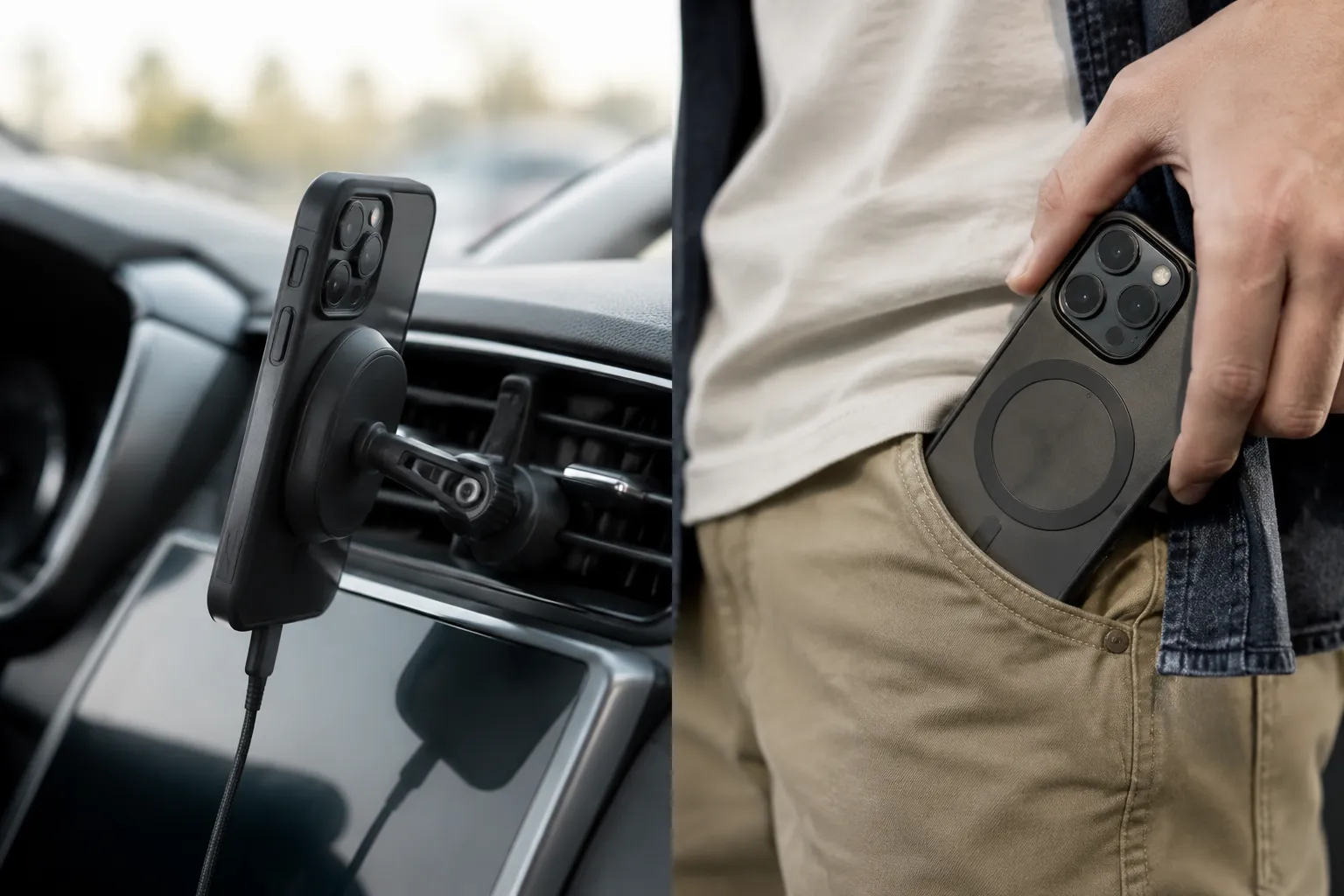
The iPhone 15 Pro Max sat flat on the passenger seat, and the magnetic vent mount by the air conditioner simply let go. Not during a pothole, not during a hard corner. The phone tipped over during a gentle left turn onto a residential street, the kind of turn a person makes every single day without thinking. That was the moment the case, a slim aramid fiber model that cost nearly as much as a nice dinner, revealed its one true weakness: the magnet ring inside it was barely strong enough to hold a phone vertically, let alone survive the vibrations of actual driving.
Weak MagSafe grip is the most common complaint about third-party cases, and it is almost never the phone's fault. The iPhone's internal magnet array is consistent across units of the same model. The variable is the case. Some manufacturers embed a thin, flexible magnetic sheet that works fine when the phone is new and the case is flat, then degrades as the case flexes. Others use a ring that is simply too weak. And a few, the frustrating ones, skip the magnets entirely and rely on a metal plate that sticks to the phone's magnets through a thick layer of material, which is why the grip feels fine for a day and then fails on the first warm commute.
The fix depends on which failure mode the case has, and diagnosing that takes about thirty seconds longer than most people spend before buying a replacement.
The Difference Between a Metal Plate and a Real Magnet Ring
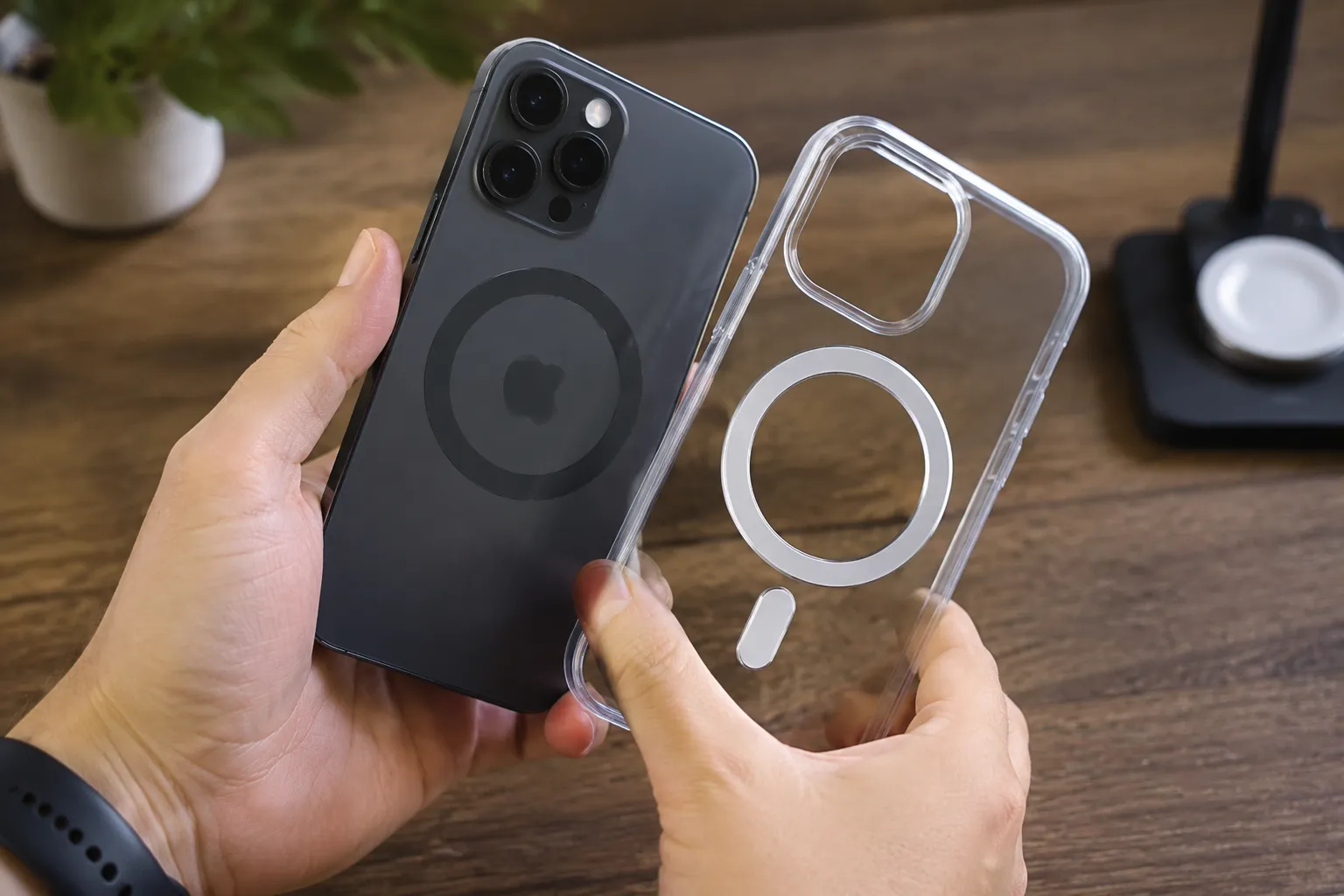
Hold the empty case in one hand and a MagSafe charger in the other. Slide the charger across the back of the case. If it snaps into place with an audible click and holds firm when lifted, the case has a genuine magnet ring. If it slides around, catches weakly, or only sticks when the charger is centered perfectly, the case is using a ferromagnetic plate that attracts the phone's magnets through the case material.
That distinction matters because the two designs fail differently. A metal plate never loses its magnetic properties, but it also never gains any. The grip strength is entirely dependent on the distance between the plate and the phone's magnets. A thin case with a plate can feel almost as strong as a real ring. A thick case with a plate feels like a weak handshake from the first day. The plate also spreads the magnetic field over a wider area, which is why accessories like wallets and battery packs sometimes wobble or refuse to align properly even when they do stick.
A real magnet ring, by contrast, has its own field. The ring grabs the charger directly, and the phone's magnets reinforce it. That is why Apple's own cases, which use an embedded ring, hold accessories with a reassuring firmness that third-party plates rarely match. The ring is also more tolerant of case thickness, because the field comes from the case itself rather than from the phone on the other side of the material.
Why Thin Cases Fail First
The irony of the aramid fiber case that failed on the passenger seat is that it was advertised as having "built-in magnets." It did. They were just small. The manufacturer, chasing a slim profile that would appeal to people who hate bulky cases, used a ring that measured a fraction of a millimeter thinner than the standard. That saved maybe 0.3 millimeters of total case thickness and cost about half the magnetic pull.
Thin cases also flex. A rigid case holds its magnet ring in a flat plane, which keeps the magnetic field uniform across the surface. A flexible case bends when a person grips the phone or when it sits in a tight pocket. Each bend slightly distorts the ring, and over months of use, the ring can develop a permanent curve. A curved magnet ring loses contact with the flat surface of a charger or mount, and the grip weakens progressively until the phone slides off at the worst possible moment.
This is why the cheap silicone cases that feel grippy and thick often hold MagSafe accessories better than premium thin cases. The silicone case has room for a proper ring, and the material's flexibility returns to flat after each bend. The thin case has no such margin.
The Adhesive Ring Repair That Actually Works
For a case that has a real magnet ring but a weak one, the most reliable fix is not to buy a new case. It is to add a second ring on the outside of the case, directly over the existing one. Adhesive magnet rings, sold by several accessory makers, are thin neodymium rings with a sticky backing. They align perfectly with the phone's internal magnet array, and when stacked over an existing ring, they roughly double the magnetic pull.
The key word is "aligned." A person cannot just stick a ring anywhere on the back of a case. The ring must match the phone's internal magnet pattern, which is a specific circle with a specific offset from the camera bump. Most aftermarket rings are designed to match Apple's layout, but cheap ones sometimes have a slightly different diameter or a different gap in the ring. A misaligned ring cancels out part of the phone's magnetic field instead of reinforcing it, and the result is a grip that feels strong at the center but weak at the edges.
The application process demands more care than most people give it. The case surface must be clean, dry, and free of any oily residue from fingers. Alcohol wipes work, but the surface needs a full minute to dry before the adhesive goes on. Pressing the ring into place with a flat object, like the back of a spoon, ensures even contact across the entire ring. Then the case should sit untouched for several hours, ideally overnight, so the adhesive fully cures.
This fix adds a visible ring to the back of the case. On a clear case, it looks like a deliberate design choice. On a colored or textured case, it looks like a sticker, because it is one. For people who care about aesthetics, the external ring is a non-starter. For people who care about the phone staying attached to a mount, it is a ten-minute repair that costs less than a third of a new case.
Internal Installation for Cases Worth Saving
Some cases, particularly leather and aramid fiber models that cost over sixty dollars, deserve a cleaner repair than an external sticker. These cases have an interior lining that can be carefully lifted, allowing a magnet ring to be installed between the case shell and the lining. This is a fiddly job, but the result looks factory-made.
The process involves peeling back the inner fabric or microfiber lining from the back panel. Most linings are held with a light adhesive that releases with gentle heat from a hair dryer. Once the lining is lifted, the existing magnet ring, if present, can be examined. If it is weak but present, a second ring can be stacked directly on top. If the case has no ring at all, a new ring goes in its place.
The danger here is tearing the lining or leaving bubbles when pressing it back down. A person with steady hands and some patience can do this successfully. A person in a hurry will ruin a good case. The reward is a case that keeps its original appearance while gaining genuine magnetic strength, and the repair is invisible to anyone who does not know to look for it.
This internal route is also the right choice for cases that use a metal plate instead of a magnet ring. A plate can be peeled out and replaced with a proper ring, transforming a case that never held well into one that clicks firmly onto every charger and mount. The plate is usually visible as a smooth metal disc behind the lining, and removing it requires the same careful lifting process.
When the Case Is the Problem, Not the Magnets
Sometimes the magnets are fine, and the case is still the culprit. Thick cases, particularly those with built-in stands, card slots, or rugged bumpers, create a simple physics problem. The distance between the phone's magnets and the accessory's magnets increases with every millimeter of case material. Magnetic force falls off with the square of distance, which means a case that adds two millimeters of thickness reduces grip to roughly a quarter of what it would be with no case.
A case with a card slot in the back is even worse. The cards themselves, particularly the magnetic strips on hotel keys and some transit passes, sit between the phone and the mount. The phone's magnetic field has to penetrate the case, the cards, and the accessory's own field. The result is a grip that works on a flat desk but fails on a bumpy road.
For these cases, no amount of added magnet rings will fully solve the problem. The rings would need to be impractically thick to overcome the distance. The honest answer is that a rugged case with a card slot is incompatible with reliable MagSafe mounting, and a person who needs both should carry the cards separately or use a mount that grips the phone mechanically rather than magnetically.
Testing the Fix Before Trusting It
After installing a new ring or stacking a second one, the real test is not whether the phone sticks to a charger on a desk. It is whether the phone stays attached during an actual drive, with the mount positioned at the angle a person actually uses. The desk test is meaningless because a horizontal surface provides gravity assistance. The vertical mount test is the only one that matters.
A useful intermediate test involves holding the case with the phone inside and gently shaking it in the air, with the accessory attached. If the accessory holds through a vigorous shake, the grip is adequate for most uses. If it slides or detaches, the ring is still too weak or misaligned. Some people also test by attaching the phone to a mount and then tapping the mount with a finger, simulating the vibration of a car. A phone that survives a few firm taps will likely survive a commute, though rough roads remain the ultimate judge.
A weak connection also manifests during wireless charging. A phone that charges through a case at a slow rate, or that stops charging when the case is bumped, is not making full contact with the charging coil. The magnet ring helps alignment, and alignment affects charging efficiency. A case that holds the charger firmly in place will charge faster and more reliably than one that lets the charger slip a few millimeters off-center.
The Case That Failed on the Passenger Seat
That aramid fiber case on the passenger seat did not get an external ring. It did not get an internal one either. It got replaced, not because the repair was impossible, but because the case had another problem that became obvious during the diagnosis. The magnet ring was weak, yes, but the case also flexed noticeably when twisted. No added ring could fix the underlying instability of the case itself. The repair would have been a bandage on a structural flaw.
The replacement case, a slightly thicker model from a brand that publishes its magnetic pull force in the product specifications, has held every charger, wallet, and mount without a single slip. The spec sheet claimed a pull force that sounded impressive, but the real proof came in the first week of driving, when the phone stayed firmly planted through potholes that made the car's suspension groan. The case costs more than the failed one, but the margin of difference in daily use is enormous.
Anyone facing a weak MagSafe grip should start with the diagnosis, because the cheapest fix is sometimes a ten-dollar ring, and the most expensive mistake is buying another thin case with the same hidden weakness. The magnet ring is the quiet workhorse of the modern phone, and it deserves more attention than the finish or the weight of the case that houses it. A case that looks elegant but drops the phone at the first opportunity is not elegant at all. It is just an accident waiting for a speed bump.