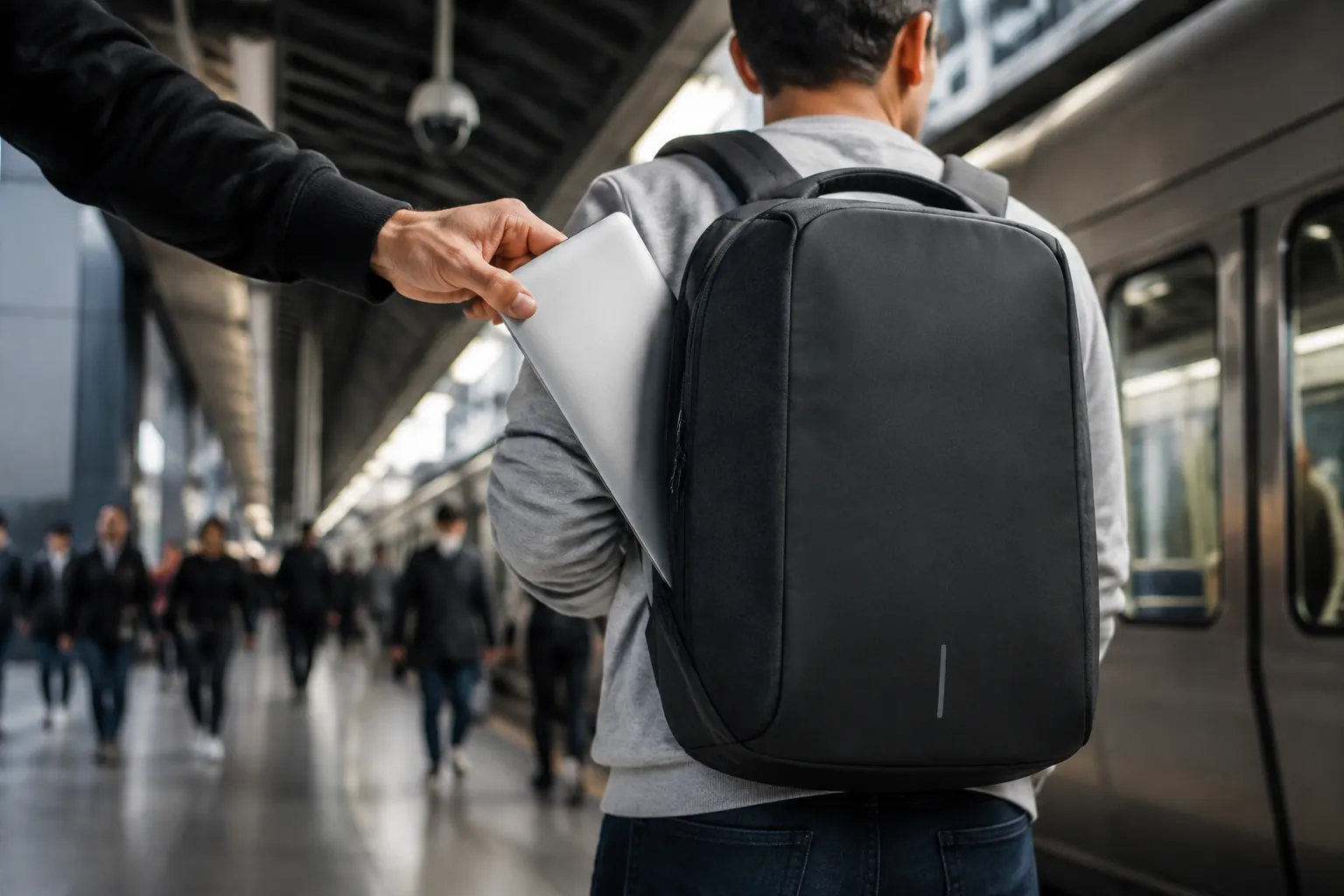
Theft of laptops from public spaces has become so routine that most cities have a designated spot where it happens. In London it is the Tube carriage doors during rush hour. In San Francisco it is the coffee shop patio near the Mission. In New York it is the subway platform right as the train pulls in, when a person's hands are occupied with a phone and a coffee and the backpack is slung over one shoulder, unzipped, facing the crowd.
Against that specific threat, a padded sleeve from 2014 will not do. What matters is how the bag opens, where the zippers sit, and whether the laptop compartment touches the wearer's back or the open air. A backpack that a thief can open without the owner feeling it is not an anti-theft bag. It is a carrying case with a zipper.
Why the Locked Zipper Is Not the Whole Answer
The first thing most people check is whether the zippers lock. That instinct is correct but incomplete. A locking zipper stops a casual dip, the kind where a hand slides in and out during a crowded escalator ride. It does almost nothing against a person who carries a box cutter or a sharp pen. Slashing the fabric next to the zipper takes two seconds and makes less noise than a dropped phone.
The better designs treat the zipper as one layer of a system. The zipper should be hidden, or the fabric around it should be reinforced, or the bag should force the thief to rotate the whole pack to access the main compartment. Rotation is the key detail. A backpack worn on the back has a natural dead zone: the area a person cannot see or feel. If the laptop compartment only opens from that dead zone, the thief must swing the bag around to the front to get inside. That movement is visible, and it changes the risk calculation for the thief entirely.
Some bags use a flap that covers the zipper track. Others route the zipper along the back panel, so it is pressed against the wearer's spine and cannot be opened without significant tugging. A few use a magnetic latch that requires two hands in different positions. All of these work better than a padlock on a single zipper pull, because they address the geometry of theft rather than just the hardware.
The Pacsafe Metrosafe X: The Standard Bearer with a Flaw
Pacsafe built its reputation on travel security, and the Metrosafe X is the model that most urban commuters try first. Its signature feature is the eXomesh slashguard, a stainless steel wire mesh embedded in the fabric that resists cutting. A thief with a razor will find the blade skidding across the wire instead of slicing into the liner. The main compartment also has a locking zipper that tucks into a side release, and the back panel contains a hidden pocket for a passport or phone.
The laptop compartment sits against the back, which is correct. The bag holds a 15-inch MacBook Pro with room to spare, and the exterior fabric has a stiffness that suggests durability without feeling like luggage. The shoulder straps are padded enough for a 2.5-kilogram load, though not plush enough for a full day of walking.
The flaw is the organization. The front pocket swallows smaller items into a single deep cavity, so a charger, a set of keys, and a phone end up in a tangle at the bottom. A person who needs quick access to a transit card or earbuds will spend more time digging than they expect. That is a minor complaint for a bag whose primary job is thwarting theft, but it matters for daily use.
The Metrosafe X is the right choice for someone who commutes through a known high-risk area and wants the highest possible slash resistance in a conventional silhouette. It looks like a normal backpack, which is itself a security feature. A bag that screams "anti-theft" advertises that it contains something worth protecting.
The Nomatic Navigator: For the Person Who Carries Everything
Nomatic's Navigator takes a different approach. Instead of armor, it relies on the hidden zipper layout. The main compartment opens from the back panel, which means the wearer must take the bag off and lay it flat to access a laptop. That is inconvenient in a crowded aisle, but it makes theft nearly impossible while the bag is worn. A thief cannot unzip a compartment that is pressed against the wearer's spine.
The Navigator has a 20-liter capacity that expands to 24 liters, which sounds small until a person packs it. The internal organization is exceptional: dedicated pockets for a water bottle, a sunglasses case, a passport, and a separate fleece-lined pocket for electronics. The laptop sleeve fits a 16-inch MacBook Pro and is suspended slightly above the bottom of the bag, so a hard drop does not transmit the full impact to the machine.
The trade-off is the aesthetic. The Navigator has a sleek, minimalist look that works in a creative agency but feels out of place on a construction site or a hiking trail. The fabric is a tarpaulin-like material that resists water and stains, but it also has a slightly plastic feel. Some people love that. Others find it cold.
The Navigator is the pick for the person who lives out of the bag: gym clothes in the morning, laptop for work, a book for the train, a light jacket for the evening. The theft protection comes from the design rather than the materials, and it holds up because the wearer must engage with the bag to open it. That engagement is the point.
The Alpaca Elements Pro: The City Proof Choice for Shoulder Strain
Backpack weight distribution rarely gets discussed in anti-theft reviews, but it should. A 15-inch MacBook Pro weighs about 1.6 kilograms. Add a charger, a water bottle, a notebook, and a few incidentals, and the load crosses 4 kilograms quickly. A bag that carries that weight poorly will end up slung on one shoulder, which defeats every anti-theft feature the manufacturer installed.
The Alpaca Elements Pro solves this with a frame sheet and a hip belt that actually functions. The frame sheet keeps the load close to the spine, which reduces the forward pull that causes shoulder fatigue. The hip belt transfers up to 60 percent of the weight to the hips when properly tightened, and it tucks away behind a zippered flap when not in use.
The anti-theft features are less flashy but effective. The main compartment opens away from the body, so a thief would need to rotate the entire bag to access it. The zippers are lockable, and the exterior fabric is a 1680D ballistic nylon that resists both cuts and abrasion. The laptop sleeve fits a 16-inch MacBook Pro and sits against the back panel, which is the safest position.
The Elements Pro holds 25 liters, which is the upper end of daypack capacity. It fits a full change of clothes, a lunch container, and a laptop without looking like a mountaineering pack. The exterior has a series of compression straps that can cinch the load down, and those same straps double as attachment points for a helmet or a rolled-up jacket.
This is the bag for the person whose commute includes a 20-minute walk, a train transfer, and then another 15-minute walk on the other end. The carrying comfort is what makes the anti-theft design effective, because the wearer will keep the bag on both shoulders and properly positioned.
The Tom Bihn Synik 30: The Quiet Overachiever
Tom Bihn is a small manufacturer in Seattle that has built a cult following among frequent travelers. The Synik 30 is their flagship backpack, and it costs more than most of the other options here. The price is justified by construction quality that borders on obsessive: the stitching is reinforced at every stress point, the zippers are YKK with a smooth action, and the fabric is a 525d ballistic nylon that has a pleasant, tactile weave.
The anti-theft feature is the cache system. The laptop compartment is on the back panel, and it opens from the top rather than the side. A thief reaching from behind cannot unzip a top-opening compartment without the wearer feeling the motion. The bag also has a lockable zipper on the main compartment, but the real security comes from the way the bag forces a would-be thief to make large, visible movements.
The Synik 30 holds 30 liters, which is roomy enough for a weekend trip, and it compresses down to a slim profile when lightly loaded. The organization is the best in this category: the front pocket has a key leash, a pen slot, and a divided section for small electronics. The side pockets are gusseted and expand to hold a water bottle or an umbrella, and they cinch closed so nothing falls out.
The downsides are the price and the look. The Synik 30 costs nearly triple what a comparable Pacsafe costs, and the aesthetic is utilitarian in a way that does not photograph well. It looks like a bag a mail carrier would carry. But the person who buys it will likely keep it for a decade, and the resale value is high. The Synik 30 is the choice for someone who treats a backpack as a long-term tool rather than a seasonal accessory.
The Incase EO Travel Backpack: The Slim Fit with a Hidden Layer
Incase is better known for laptop sleeves than for anti-theft packs, but the EO Travel Backpack deserves attention for a specific reason: it is the thinnest option that still protects a MacBook from a targeted theft attempt. The bag is 18 liters, which makes it suitable for a person who carries only a laptop, a charger, and a few flat items.
The laptop compartment is accessed from the back panel, and it has a false bottom that sits above the base of the bag. That detail matters for drops, because the laptop does not hit the ground when the bag is set down hard. The exterior fabric is a water-resistant nylon with a diamond-ripstop weave that resists punctures from sharp objects.
A hidden pocket sits behind the back padding, accessible only when the bag is off. This is the spot for a passport, a phone, or a wallet, and it is invisible to anyone looking at the bag from the outside. The pocket is the single best anti-theft feature on the bag, because no one would think to look for a zipper behind the shoulder straps.
The EO Travel Backpack is not for the person who carries a gym kit or a lunch. It is for the person who wants the smallest possible bag that still fits a 16-inch MacBook Pro and provides a meaningful layer of theft protection. The shoulder straps are thin but adequate for the light load, and the bag slides under an airplane seat without protest.
The Travelon Anti-Theft Classic Backpack: The Budget Option That Respects the Threat
Travelon has been making anti-theft bags for years, and the Classic Backpack is their entry-level offering. It costs about a third of the Tom Bihn and half of the Pacsafe, which makes it the accessible option for a student or a first-time buyer. The question is whether the budget price forces unacceptable compromises.
The Classic Backpack includes the essentials: lockable zippers, a slash-resistant shoulder strap with a steel cable inside, and a cut-resistant mesh layer in the main body. The laptop compartment fits a 15-inch MacBook Pro, and it sits against the back panel. The fabric is a polyester that feels thinner than the ballistic nylon on pricier bags, but it has held up in testing without visible wear.
The compromises show in the details. The zipper pulls are small and fiddly, especially when a person is wearing gloves. The padding in the laptop compartment is thin, so a hard drop transmits more shock than a suspension system would absorb. The exterior pockets are shallow, and the water bottle pocket does not fit anything larger than a standard 500-milliliter bottle.
The Travelon is the right choice for someone who wants anti-theft features on a budget and understands the limitations. It will stop a pickpocket and slow down a slasher. It will not survive a determined theft attempt with a heavy blade, because the materials are not at that level. For the price, that is a reasonable trade.
What the Wearer Does Matters More Than the Bag
Every bag in this list will fail if the wearer does not practice basic habits. The first habit is keeping the backpack on the front of the body in crowds, even though it looks awkward. The second is never hanging the bag on the back of a chair in a cafe, because that position exposes the back panel, which is the one side without slash protection. The third is removing the laptop at the end of the day, so the bag never advertises that it carries a valuable machine.
A person who does those three things could carry a canvas tote and be safer than someone with a Pacsafe who drapes the bag over a chair. The bag is a tool, not a shield. The best tools make the good habits easier, and they do not punish the wearer for a moment of inattention.
The city is not a war zone, but it is also not a library. A laptop is a portable workstation worth more than the cash in most wallets, and it is carried in plain sight. The anti-theft backpack industry exists because that combination of value and visibility creates a predictable pattern of theft. A good bag breaks the pattern by forcing the thief to choose an easier target. The six options above do that in different ways, and the right one depends on how much a person carries, how far they walk, and what they are willing to pay for peace of mind on a crowded platform.