The smartphone camera bump is now the defining silhouette of the modern device. A person can spot the make and model of a phone from across a cafe by the shape of the raised glass and metal island on its back, even before the screen lights up. The bump exists because physics will not cooperate with industrial design. The lens needs distance from the sensor, and the sensor needs to sit flush against the optics, which means something has to protrude when the rest of the phone is only a few millimeters thick. This arrangement produces excellent photographs and a structural vulnerability that most owners do not think about until the first scratch appears on the glass or a sharp knock chips the rim.
The bump is a trade. It buys a larger aperture and a bigger sensor at the cost of making the back of the phone no longer flat. A flat object slides in and out of a pocket smoothly. A flat object rests on a table without rocking. A flat object does not collect dust and grit in the crevice where the protrusion meets the chassis. The moment the back gains a raised element, the phone behaves differently in the hand. It catches on fabric when pulled from a jeans pocket. It wobbles when laid on a hard surface and tapped near one of its corners. And every time the phone is set down on a table face up, the entire weight of the device transfers to that small, vulnerable island.
Most owners respond to this by buying a case. The case industry has grown fat on the anxiety created by the bump. A thick, rubberized shell with a raised lip around the camera module solves the wobble and the scratch risk in one stroke. It also adds bulk, hides the design work that went into the device, and often interferes with the very thing it protects. Cases with deep cutouts around the camera collect pocket lint and fine sand, which then sits against the lens ring and grinds into the finish with every slight movement of the phone in a bag. The protection becomes a source of abrasion.
The interesting development is not the case, though. The interesting development is the aftermarket camera bump protector, a distinct accessory that does not wrap the phone at all. It is a small piece of metal or hardened plastic, usually with an adhesive backing, applied directly over the camera module. A person with a slim case that offers no lip around the lens can add one of these and gain a sacrificial layer against drops. The protector takes the impact, and the glass underneath survives. In principle, the idea is sound. In practice, it depends entirely on the quality of the adhesive and the thickness of the material.
The flaw in the stick-on shield
The first generation of these protectors was essentially a sticker with a thin piece of glass or acrylic on top. It applied like a screen protector and behaved like one, which meant it shattered on impact, absorbing the energy of a drop. The problem was that it also added a layer of material between the camera and the world. Light passes through the main lens and then through the protector, and any imperfection in that extra layer degrades image quality. Air bubbles, smudges, and micro-scratches on the protector show up as flares, softness, and reduced contrast in the photographs. A cheap protector can turn a flagship camera into a mediocre one.
Better versions use a metal rim that surrounds the lens and leaves an open hole for the glass, so light passes through nothing extra. The metal ring sits slightly proud of the lens glass. When the phone lands on its back, the ring hits the ground first. This is the same principle as a raised lip on a case, but applied directly to the module. The advantage is precision. A well-designed metal protector fits the exact contours of the camera island, adding less than a millimeter of height. The phone stays relatively flat, the case fits over it without bulging, and the lens glass never touches a surface.
There is a catch with the metal ring. It is unforgiving when the impact comes at an angle. A flat drop on the back transfers force straight into the protector, which spreads it around the rim. An angled drop, hitting the corner of the ring, can dent the metal and transfer the shock directly into the camera module or the glass. Some protectors solve this by using a soft inner lip, a thin gasket between the metal and the phone's own housing. Others simply rely on the owner accepting that the protector will deform and need replacement after a significant drop.
The raised bevel on the case itself
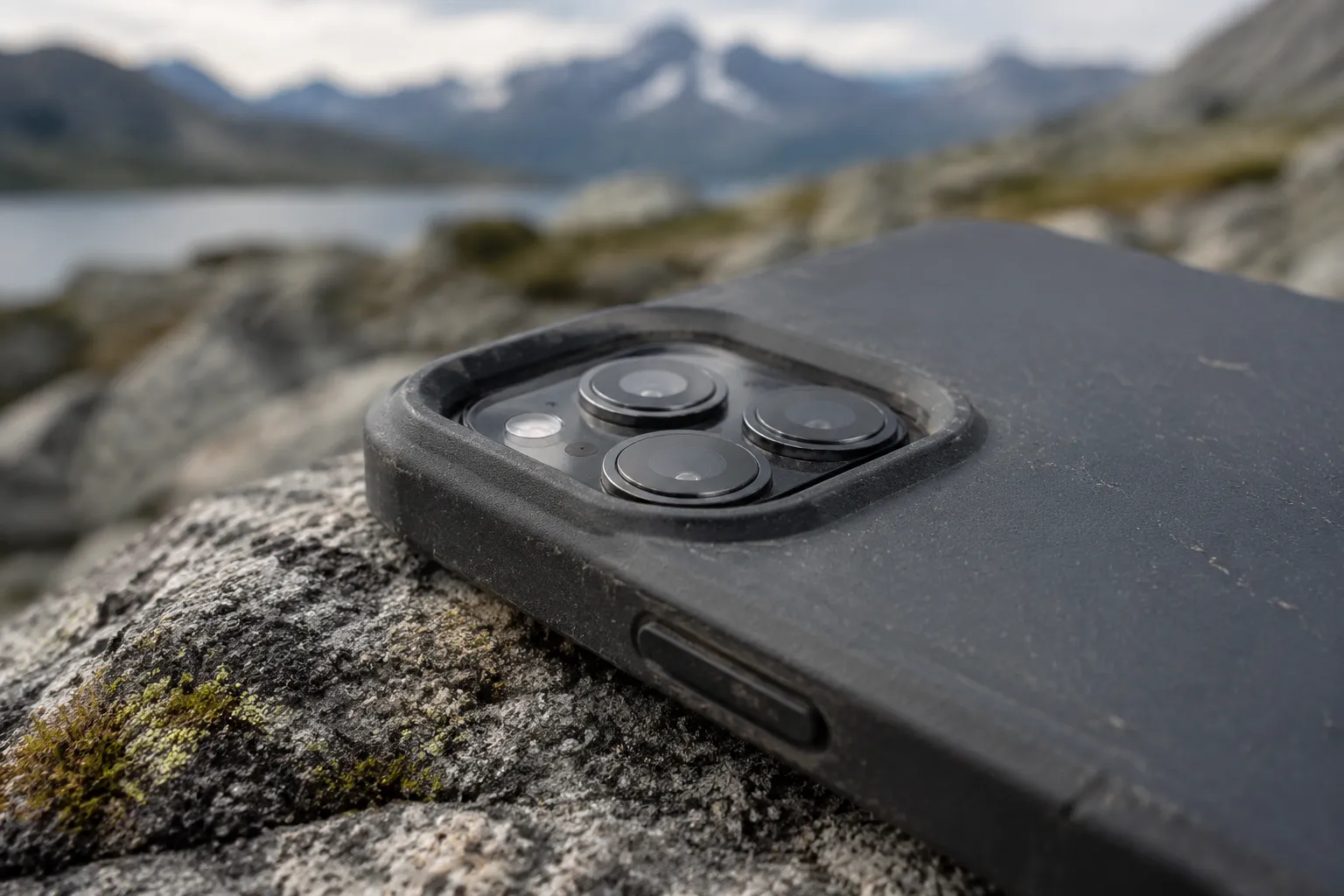
Manufacturers of protective cases have refined the raised bevel into an engineering feature rather than an afterthought. The bevel, the slight ridge that rises above the camera lens when the phone is placed face up, now appears on almost every serious case. The height matters. A bevel that rises a full millimeter above the lens glass protects against most surfaces. The lens will not touch a flat table, a countertop, or a desk. A bevel that rises only half a millimeter protects against everything except the tiny particles of grit that can sit on a surface and elevate the contact point.
The geometry of the bevel also affects grip. A case with a sharp, angular bevel around the camera module gives the index finger a distinct edge to rest against when holding the phone in landscape orientation for a photograph. This can be a comfort or an annoyance depending on hand size and grip style. Some cases slope the bevel gently so the finger glides over it. Others cut a small indentation into the bevel to create a finger rest. A thoughtful case design treats the camera bump as part of the ergonomic surface, not just a hazard to be fenced off.
Materials change the calculus entirely. A hard polycarbonate case with a raised bevel transmits a sharp impact directly to the phone frame below. A case with a soft TPU bumper absorbs the same impact by flexing, but TPU degrades under ultraviolet light and eventually discolors and loses elasticity. The owner replaces a yellowed case every year or two, which is a modest cost compared to a camera repair but an ongoing one. Premium cases now use a dual-layer construction: a hard outer shell for structural rigidity and a soft inner liner for shock absorption. The raised bevel on these cases is usually part of the outer shell, which means it stays rigid and transmits force to the entire case body rather than concentrating it on the module.
What the lens actually survives
Modern smartphone camera glass is sapphire composite or a chemically strengthened aluminosilicate. It resists scratching far better than the glass on the front of the phone. A set of keys in the same pocket rarely marks it. The real threat is not keys but sand. Quartz particles, common in beach sand, concrete dust, and even the grit carried on a city sidewalk, are harder than most smartphone glass. A single grain of sand trapped between the lens and a hard surface, combined with the weight of the phone pressing down, can leave a permanent scratch. The raised bevel or protector keeps that grain from ever contacting the lens, which is why the protection matters more for the lens than for any other part of the phone.
Drops are the second threat. A phone falling from hand height hits the ground at roughly the speed of a person walking briskly. The glass lens can survive that impact if it strikes a flat surface directly, because the force spreads evenly across the whole module. The failures happen when the lens strikes an edge, a small stone, or an uneven surface that concentrates the force on a tiny point. A protector with a thick rim changes the contact geometry. The rim takes the point impact, and the lens never touches what it fell on.
The tradeoff for this protection is image quality in specific lighting conditions. Any raised rim around the lens, whether from a case bevel or an applied protector, creates a potential for vignetting at wide apertures. The rim casts a shadow on the outer edge of the lens element. In daylight, the effect is negligible. In low light, with the camera struggling to gather photons and the lens aperture wide open, the shadow can darken the corners of the frame by a measurable margin. The effect is invisible in most photos but noticeable in astrophotography, long exposures of the night sky, and some indoor shots with a bright light in the frame.
The repair cost makes the math easy
A cracked rear lens on a flagship phone is not a minor repair. The camera module is tightly integrated with the phone body, and repair work requires specialized equipment to keep dust out of the assembly. In many regions, the repair costs between a quarter and a third of the phone's original price, and it voids the water resistance rating that the factory sealed in. The owner who skips protection to save a few dollars on a case risks a bill that dwarfs the savings by a factor of twenty or more.
This is why the aftermarket protector market has exploded. A person with a phone case that fits poorly around the camera module now has a second line of defense. The protector is not a replacement for a good case. It is a supplement. The case handles the frame and the screen. The protector handles the exposed island. A phone with both protections has no part of its back that touches a flat surface directly.
A person who carries the phone naked, without a case or protector, is making a calculated bet. The phone looks better in hand. The slim profile feels better in a pocket. The camera glass gets no interference from an extra layer. The bet fails exactly once. The scratch appears after a day at the beach, or the crack appears after a drop on a stair edge, and the calculation reverses. The aesthetic gain was temporary. The damage is permanent.
How the protector market sorted itself out
Brands responded to the demand with an odd array of products. There are protectors made from liquid metal, applied as a paste that hardens into a thin shell over the module. There are peel-off films that offer almost no drop protection but do prevent scratches. There are machined aluminum rings with precise tolerances that snap onto the camera island as if they were part of the phone's original design. And there are ornate protectors, plated in gold or colored to match the phone finish, which serve more as accessories than as functional armor.
The liquid metal products deserve skepticism. They require precise application, dry unevenly if the phone is moved during curing, and provide minimal impact resistance. They are scratch coats, not impact absorbers. The machined rings are the better bet. They add structural rigidity to the module itself, spreading a point impact across the entire ring surface. The best ones use an aerospace-grade aluminum or titanium alloy and a medical-grade adhesive that holds firm against the heat generated by prolonged camera use during video recording.
The critical factor is the adhesive. The camera module gets warm during use. A phone recording video in 4K for thirty minutes reaches temperatures that soften cheap adhesives. A protector that shifts or peels at the middle of a recording session is worse than no protector, because the misaligned edge can scratch the lens glass it was meant to shield. Reputable brands specify the operating temperature range of their adhesive. Unknown brands from online marketplaces offer no such specification, and performance varies wildly.
A field test worth describing
A phone was set up on a table during a week of outdoor work on a farm. The phone lived in a pocket, was taken out dozens of times per day, set down on wooden workbenches, steel trailer beds, and occasionally the ground. The case had a raised lip around the camera, and a small metal ring protector was added to the module. After a week, the case showed scuffs on its corners and a hairline scratch on its back panel. The ring protector had two visible marks where it had met a metal edge. The lens glass beneath was pristine. The phone photographed farm life all week without a single artifact from the protection.
The opposite scenario plays out in urban environments. A phone carried in a soft bag, set down on glass cafe tables and varnished wooden counters, rarely encounters the same grit and rough edges. The protection adds bulk and visual weight that the owner must tolerate. For the urban user, a slim case with a modest bevel is usually sufficient. The harsh conditions that demand a dedicated ring protector do not appear in the daily commute.
The conclusion is not that every phone needs the maximum protection. The conclusion is that the decision should be based on the surfaces the phone encounters, not on the fear of a worst-case scenario. A phone that lives in a clean office and spends its time on smooth desks needs less protection than one that rides in a work truck and gets set down on dirty concrete. The market now offers options for both, and the buyer who matches the protection to the actual use pattern gets the best balance of safety and usability.
The camera bump is not going away
Foldable phones have complicated the equation. A foldable with a camera bump on the outer shell faces the same risks plus the added fragility of the hinge. The protection industry has responded with cases that cover the hinge and the camera in one piece, but the added bulk undermines the point of a device designed to fold into a compact form. The owner of a foldable faces a sharper tradeoff between protection and the device's core benefit.
Some manufacturers have attempted to eliminate the bump through clever engineering. The rear camera that slides out on a mechanism when activated appeared in a few models but proved fragile and collected dust in the sliding joint. Periscope lenses that fold the light path internally reduce the height of the module but still protrude. The industry standard has settled on accepting the bump and designing the phone around it. The bumps have grown larger as camera sensors have grown more capable, and the latest flagship models feature a module that covers nearly a quarter of the back surface.
The protection industry will continue to evolve alongside the hardware. The next generation of protectors will likely integrate with the case as a single unit, machined to match the exact curves of each phone model. Some cases already include a replaceable camera module cover that snaps on and off, allowing the owner to swap a scratched cover for a fresh one without replacing the entire case. This is the right direction. The lens glass itself is the last line of defense, not the first, and the owners who treat it that way end up with the fewest repair bills and the clearest photographs.