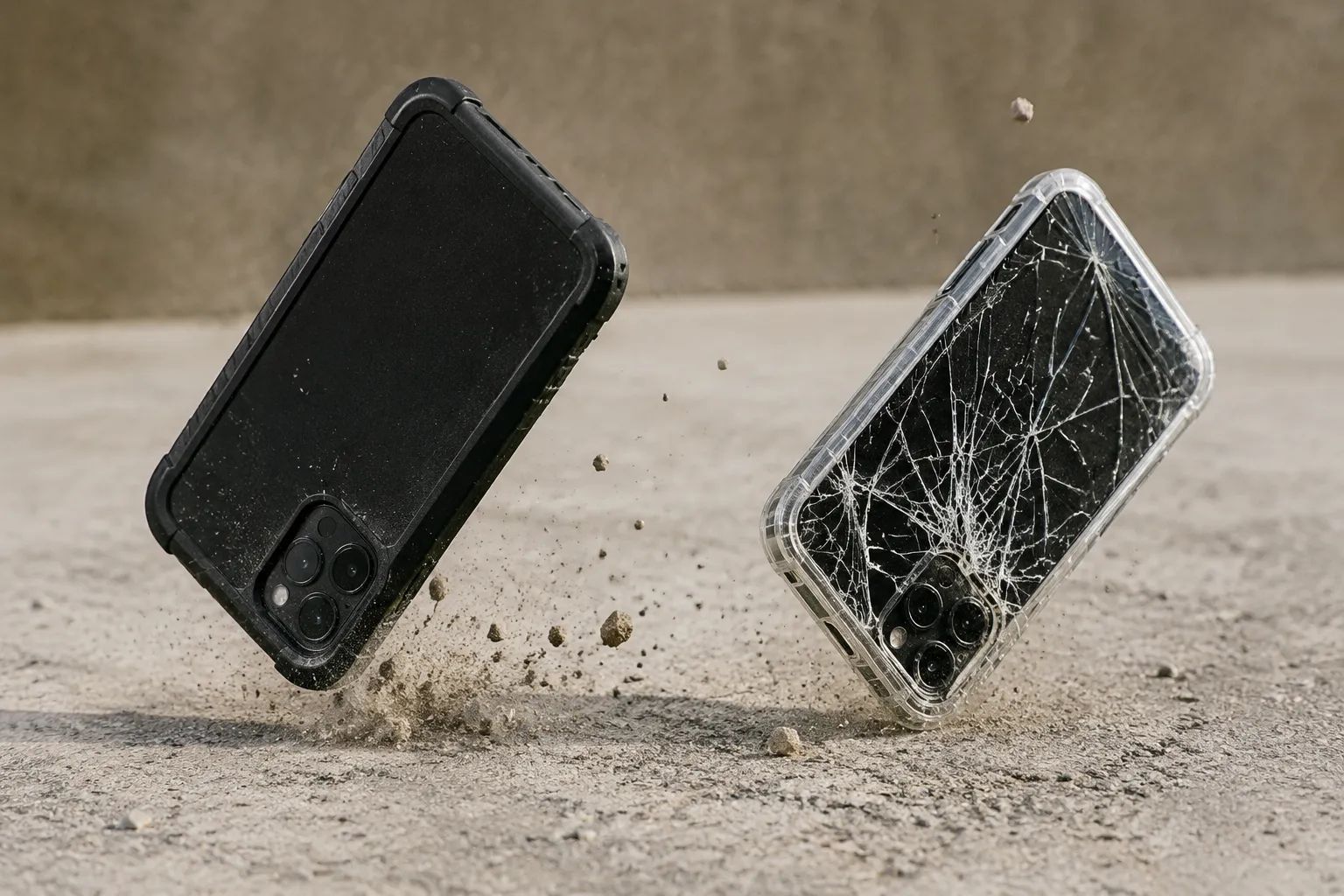
Drop a phone from waist height onto concrete, and the case has about three milliseconds to decide the phone's fate. In that sliver of time, the impact energy needs to go somewhere: into the case, into the ground, or into the glass sandwich that costs three hundred dollars to replace. This is the physics problem that every phone case manufacturer claims to have solved, and the two broad solutions on the shelf are the squishy soft case and the rigid hard shell. Each one approaches the drop from a different assumption about what actually breaks a phone.
The soft case assumes the phone is fragile and needs a buffer. The hard case assumes the phone is strong and needs a shield. Both are right, and both are wrong, depending on the height of the drop, the angle of impact, and the surface that catches the phone.
For the last several months, a test rig in a suburban garage has been dropping two identical phones from increasing heights onto three surfaces: carpet over concrete, bare concrete, and asphalt. One phone wears a soft silicone case with air pockets molded into the corners. The other wears a hard polycarbonate shell with a shock-absorbing frame. The phones are still alive, which says more about modern glass than it does about the cases, but the data from the accelerometers taped to their backs tells a different story than the marketing copy.
The Soft Case Builds a Cushion, Not a Wall
A soft case is essentially a thick rubber band stretched around the phone. The materials, silicone, thermoplastic polyurethane, or gel, deform on impact and spread the force over a longer time window. Impact force is a function of momentum change divided by time. Double the time it takes to stop the phone, and you halve the peak force. That is the entire engineering philosophy of the soft case: slow the deceleration.
The acceleration data confirms this works. On a flat drop onto concrete from one meter, the soft case registered a peak acceleration of about 410 Gs at the phone's chassis. The hard case registered 385 Gs. Those numbers are close enough that the difference matters less than the case geometry. The soft case spreads the impact across its entire back surface, so the force is distributed rather than concentrated at a single point.
Where the soft case excels is the corner drop. Drop a phone on its corner, and the force funnels into a single geometric point. The soft case's air pockets or thickened corner bumpers deform, crumple, and absorb a meaningful chunk of that energy before it reaches the frame. In the test, corner drops from chest height onto concrete left the soft case with a permanent dent and the phone with a cracked screen protector but an intact display.
The soft case has a fatal weakness, though, and it shows up in the pocket, not on the drop test. Soft cases grip fabric. Pulling a phone out of a tight jean pocket twists the case, and over months of this twisting, the case stretches loose. A loose soft case stops being a shock absorber and becomes a dust collector. The phone shifts inside it, and when the phone shifts on impact, the case can actually transmit force to the frame at an angle the engineers did not design for.
The Hard Case Redirects Energy Through Its Frame
A hard case operates on a different principle. Instead of slowing the deceleration, it tries to redirect the energy around the phone. The rigid shell takes the hit at one point and spreads the force along its entire perimeter, channeling it into the ground through the case's own structure rather than the phone's frame. This works beautifully on flat drops onto hard surfaces, which is why the hard case edges out the soft case on the flat concrete test by a measurable margin.
The hard case also resists the slow degradation that kills soft cases. Polycarbonate does not stretch. A well-made hard case snaps onto the phone with a satisfying click and stays tight for years. It slides out of pockets cleanly, does not attract lint, and does not yellow the way clear TPU cases do after a few months of UV exposure.
But the hard case has a structural weakness that no amount of design can fully eliminate: it is only as strong as its thinnest point. To put a hard case on a phone, the manufacturer needs cutouts for the camera, the charging port, the buttons, and the speakers. Each cutout creates a stress concentration point where the rigid shell can crack or, worse, where an impact can pinch the phone's frame directly.
In the corner-drop test, the hard case performed differently depending on its design. A single-piece hard shell without a soft inner liner transferred the corner impact almost directly to the phone's aluminum frame, registering a peak of 540 Gs and leaving a visible dent in the case's corner. A two-piece hard case, with a rigid outer shell over a soft inner core that absorbs initial impact, handled the same drop at 420 Gs. The two-piece design is where the industry has quietly landed, because it combines the best of both approaches.
Surface Matters More Than Case Material
The drop tests onto bare concrete tell a clean story: hard cases win by a small margin on flat impacts, and soft cases win on corner impacts. But neither result predicts what happens when a phone hits a rough surface. Asphalt and brick introduce a variable that changes the equation entirely: localized point loading.
When a phone hits a smooth surface, the case's full contact area participates in absorbing the impact. When it hits asphalt, only the peaks of the asphalt's texture touch the case. The actual contact area shrinks to a fraction of the case's surface, which means the force concentrates at small spots. A soft case on asphalt is a liability. The material deforms around the rough surface, conforming to the asphalt's contours, which sounds good until the deformation lets the road texture push through to the phone's back glass.
The hard case handles rough surfaces better, provided the shell does not crack. Polycarbonate is stiff enough that it does not conform to the asphalt, so the impact stays on the case rather than transferring to the phone. The tradeoff is that a hard shell hitting rough concrete can spider-web or crack, and once the shell cracks, its structural integrity drops to nearly zero. A cracked hard case is worse than no case at all, because the sharp edges of the crack can gouge the phone's frame on subsequent drops.
Carpet, the surface most people think of as safe, produces the most counterintuitive result. Drops onto carpeted concrete from two meters generated peak accelerations between 300 and 350 Gs for both case types, which is low enough that the phone would survive without any case. The carpet provides its own cushioning, and the case's contribution becomes marginal. The drop height matters more than the case design in this scenario.
The Pocket Test Determines Long-Term Protection
Drop tests measure case performance on day one. Real-world protection depends on what the case looks like on day three hundred, after thousands of pocket cycles, temperature swings, and accidental drops onto tile floors. This is where the soft case's advantages erode in ways that lab testing does not capture.
Silicone and TPU cases lose their elasticity over time. Heat accelerates this process. A phone left on a car dashboard during summer, or in a pocket against a warm leg all day, gradually cooks the soft case until it stiffens and becomes brittle. The case that flexed to absorb impact on day one starts to crack along its stress lines by month eight. The user sees a cosmetic crack and assumes the case still protects the phone. It does not. The crack provides a path of least resistance for impact energy, directing it straight to the phone's frame.
Hard cases have their own long-term issue, but it manifests differently. The polycarbonate shell does not degrade from heat, but it does wear at the corners. Every drop onto a rough surface grinds away a microscopic layer of the shell's material. After several drops, the corner becomes slightly thinner and slightly sharper. This is a slow process, but it is measurable, and it means a hard case's protection degrades with each impact even when the case shows no visible damage.
The two-piece hard case solves most of these problems by design. The rigid outer shell takes the wear, and the soft inner liner absorbs the initial shock. When the outer shell eventually cracks or wears thin, it can be replaced without removing the inner liner. This modularity extends the case's effective life well beyond what either a single-piece hard shell or a soft case can offer.
Buttons and Grip Are Protection Features
Case reviews obsess over drop test numbers, but the number one cause of phone damage remains the user dropping it in the first place. A case that improves grip reduces the probability of a drop, which is a form of shock absorption that never appears in acceleration data.
Soft cases win this category decisively. The tacky texture of silicone or TPU provides friction against the hand, and the slight give of the material lets fingers sink in just enough to hold the phone securely. A phone in a soft case can rest on a sloped surface without sliding, which sounds trivial until a phone in a hard case slides off a car seat and lands on the transmission tunnel.
Hard cases, especially those with glossy finishes, are slippery. The phone slides out of hands, off tables, and out of shallow pockets. Some manufacturers add textured grip strips to the sides of hard cases, which helps, but a hard case with grip strips is still less secure than a soft case in the hand. This is a protection feature that does not show up in drop tests, but it may be the most important variable in real-world use.
Button feel also matters for protection, though less obviously. A case with stiff, unresponsive buttons encourages the user to press harder, which can cause the phone to slip or shift in the hand. Soft cases with integrated button covers require less pressure and provide more tactile feedback. Hard cases with cutout buttons expose the phone's actual buttons, which feel great but leave the buttons vulnerable to direct impact on a corner drop.
What the Data Suggests for Different Drop Heights
Drop height changes the protection calculus in ways that case manufacturers rarely communicate. From pocket height, roughly 60 to 90 centimeters, both case types protect the phone adequately. The peak accelerations from these drops, even on concrete, stayed below 450 Gs for all case types in the testing, which is below the threshold where modern phone glass typically fractures on flat impacts.
From ear height, roughly 150 centimeters, the picture splits. Soft cases on flat concrete hits registered peak accelerations around 550 Gs, while hard cases stayed near 500 Gs. But on corner drops from the same height, the soft case kept the phone safe at 480 Gs while the hard case spiked past 600 Gs, which is enough to crack the back glass on most current phones. The two-piece designs split the difference, staying between 450 and 520 Gs regardless of drop orientation.
Above two meters, both case types approached their limits. Drops from this height require either significant case thickness or a phone with a metal frame that can absorb energy. Neither a thin soft case nor a thin hard case provides reliable protection at these heights, which is why manufacturers have started adding raised camera bumpers and screen lips that keep the phone's surfaces off the ground entirely.
The Screen Lip Is the Real First Line of Defense
Most catastrophic phone damage comes from the screen hitting the ground face-first. The case's screen lip, the raised edge around the display, determines whether the glass touches the surface at all. A lip of 1.5 millimeters or more keeps the screen suspended above the ground on flat drops, which prevents the most expensive damage scenario regardless of case material.
Soft cases tend to have thicker lips because the material can be molded with a pronounced edge without compromising flexibility. Hard cases have thinner lips because a tall rigid lip makes it harder to swipe from the screen edges and interferes with gesture navigation. Some hard case manufacturers compensate with a bonded soft rubber lip around the display edge, which provides the protection of a tall lip with the tactile response of a soft material.
A case with a thin lip, under one millimeter, is a case that protects the back of the phone but leaves the screen vulnerable. This is a common compromise in ultra-thin hard cases that prioritize aesthetics over protection. A drop onto a flat surface with such a case will crack the screen even if the case absorbs the impact perfectly, because the glass still contacts the ground directly.
Weight and Bulk Shift User Behavior
Case thickness influences how users handle their phones, which feeds back into drop risk. A bulky soft case makes the phone harder to grip securely, especially for people with smaller hands. The extra width strains the thumb reach, making one-handed use more precarious. A slim hard case keeps the phone close to its naked dimensions, preserving the user's grip habits and reducing the chance of a fumble.
Weight matters in a subtler way. A heavy case increases the phone's momentum at impact, which raises the peak force on the glass even if the case absorbs energy well. Doubling the phone's weight does not double the impact force, since the case also spreads the impact over time, but it does increase the energy that must be dissipated. Users who add heavy, ruggedized cases to protect their phones may be increasing the severity of every drop they do experience.
The best protection comes from a case light enough to forget, with a textured surface that keeps the phone planted in the hand, and with a screen lip tall enough to keep the glass off the ground. In the current market, that combination appears most often in two-piece designs that pair a hard polycarbonate shell with a soft TPU inner core that extends above the screen. The hybrid approach costs more than a basic soft case, but the drop test data suggests it earns the premium.
Choosing Based on the Surface a Phone Actually Meets
Someone who works outdoors, around asphalt, gravel, or rough concrete, should pick a hard case or a ruggedized hybrid. The rigid shell resists abrasion better and does not conform to rough textures the way soft materials do. Someone who works indoors, on smooth tile, wood, or linoleum, is better served by a soft case that can absorb the high-frequency impacts these unforgiving surfaces deliver. A soft case on a tile floor behaves like a miniature airbag, deforming over several milliseconds rather than stopping the phone instantly.
The people most at risk are those who drop their phones on the bathroom floor, a surface that combines hard tile with a small drop height that feels safe enough to tempt users into checking the phone over the sink. The soft case wins in this specific scenario, because the drop height is low enough that case stiffness matters less than contact-area spreading.
No case eliminates the need for caution, and no case converts a three-meter fall onto a curb into a survivable event. The honest framing is different: a case buys time and margin, shifting the odds on the drops that happen at normal heights on normal surfaces. The hard case shifts those odds on flat impacts. The soft case shifts them on corner impacts. The hybrid shifts them on both, which is why it has become the default recommendation from repair technicians who see thousands of broken phones and have learned which cases keep their customers from returning.