Apple's own silicone case for the iPhone 15 Pro weighs about 29 grams and adds roughly 3.5 millimeters to the phone's width. Those numbers matter because they sit at the center of a persistent misunderstanding in the accessories market. Buyers ask for a strong case, and the industry hears "thick case." The two are not the same thing, and the difference has never been more visible than in the current generation of MagSafe accessories for the 15 Pro.
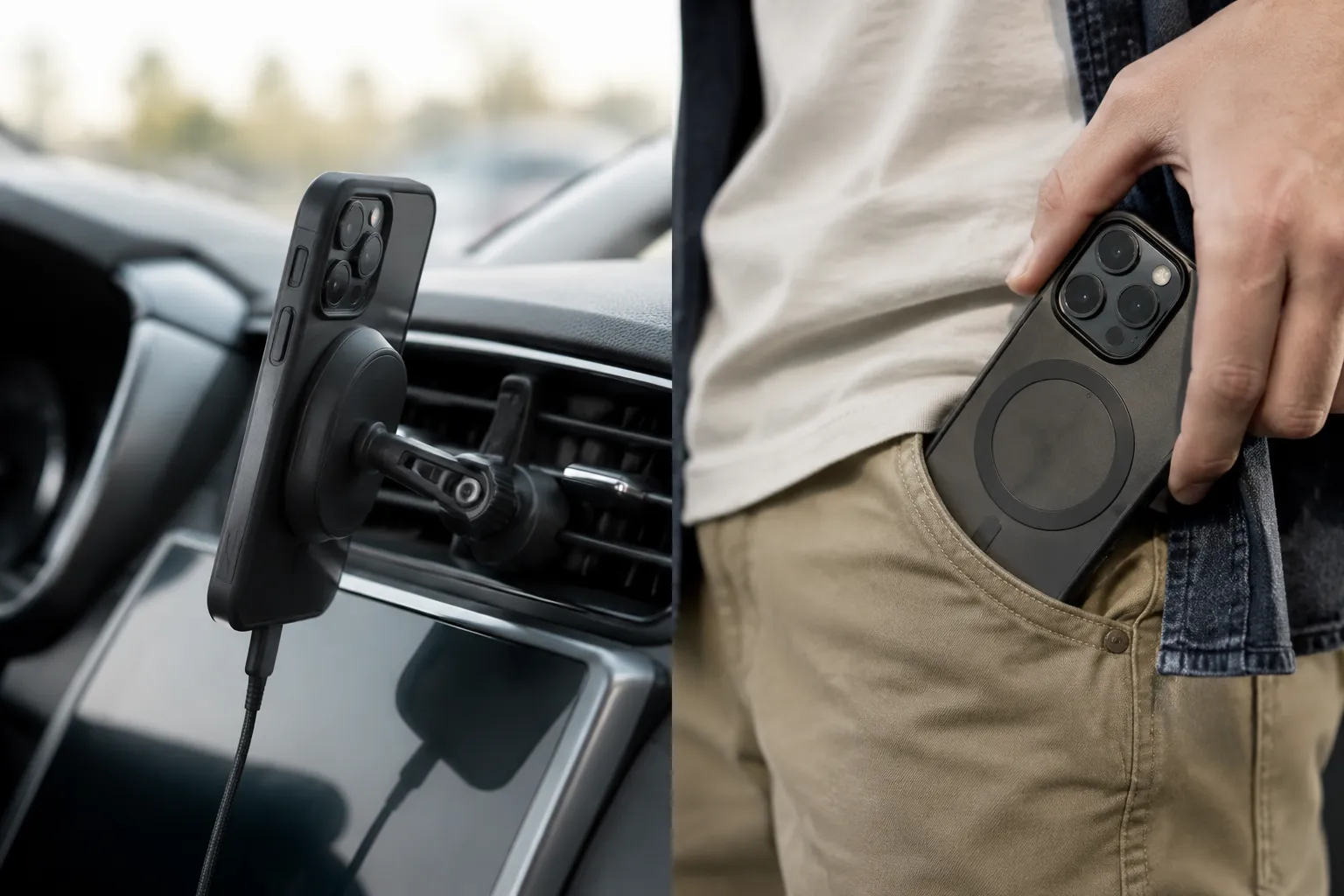
The 15 Pro is already a dense, slippery object. At 187 grams with a titanium frame that feels like polished glass when gripped wrong, it begs for protection. But the phone also has a specific party trick that complicates the case decision. The MagSafe ring on the back is strong enough to hold the phone to a desk mount or a car vent, yet that same magnetic force gets diluted by every millimeter of material placed between the phone and the magnet. A case that protects well but kills the magnetic grip is a case that fails at the one job the 15 Pro added over earlier models.
This leaves a narrow window. A case needs to absorb drops, resist bending, and keep the camera bump from touching a table. It also needs to let a wallet or a battery pack snap on with confidence, not with the weak hesitation of a magnet sensing too much distance. Several manufacturers claim to hit this window. A few actually do.
What follows is not a ranking of every shell on the market. It is a look at the cases that treat slimness and strength as a single engineering problem rather than a trade-off, and a warning about the ones that just look like they solved it.
The thickness problem nobody mentions
MagSafe works on a simple principle. The magnets in the phone are arranged in a circular pattern, and the accessory needs to get close enough to that pattern to lock on. Apple's design uses 18 magnets in the iPhone 15 Pro, and the pull strength tops out at roughly 1,000 grams when measured against an Apple wallet. That number drops fast. A case that adds 1.5 millimeters of material can cut the holding force by a third. A case that adds 3 millimeters can make the whole system useless for anything heavier than a card holder.
This is why the thinnest cases on the market, the ones that measure in at under 1 millimeter, feel like they have no protection at all. They flex when twisted, offer nothing against a corner drop, and often leave the camera lens exposed by a fraction of a millimeter. The strong cases, meanwhile, tend to stack on layers of rubber and polycarbonate until the phone feels like a brick wrapped in a tire.
The good options sit between 1.2 and 2 millimeters of total thickness. In that range, a case can still use a rigid back plate for drop resistance while keeping the magnet close enough to the accessory to maintain a solid grip. The trick is material choice. Aramid fiber, also sold under the brand name Kevlar, offers the best strength-to-thickness ratio available in consumer electronics. It is the material that makes the slim-and-strong category possible at all.
Aramid fiber changes the math
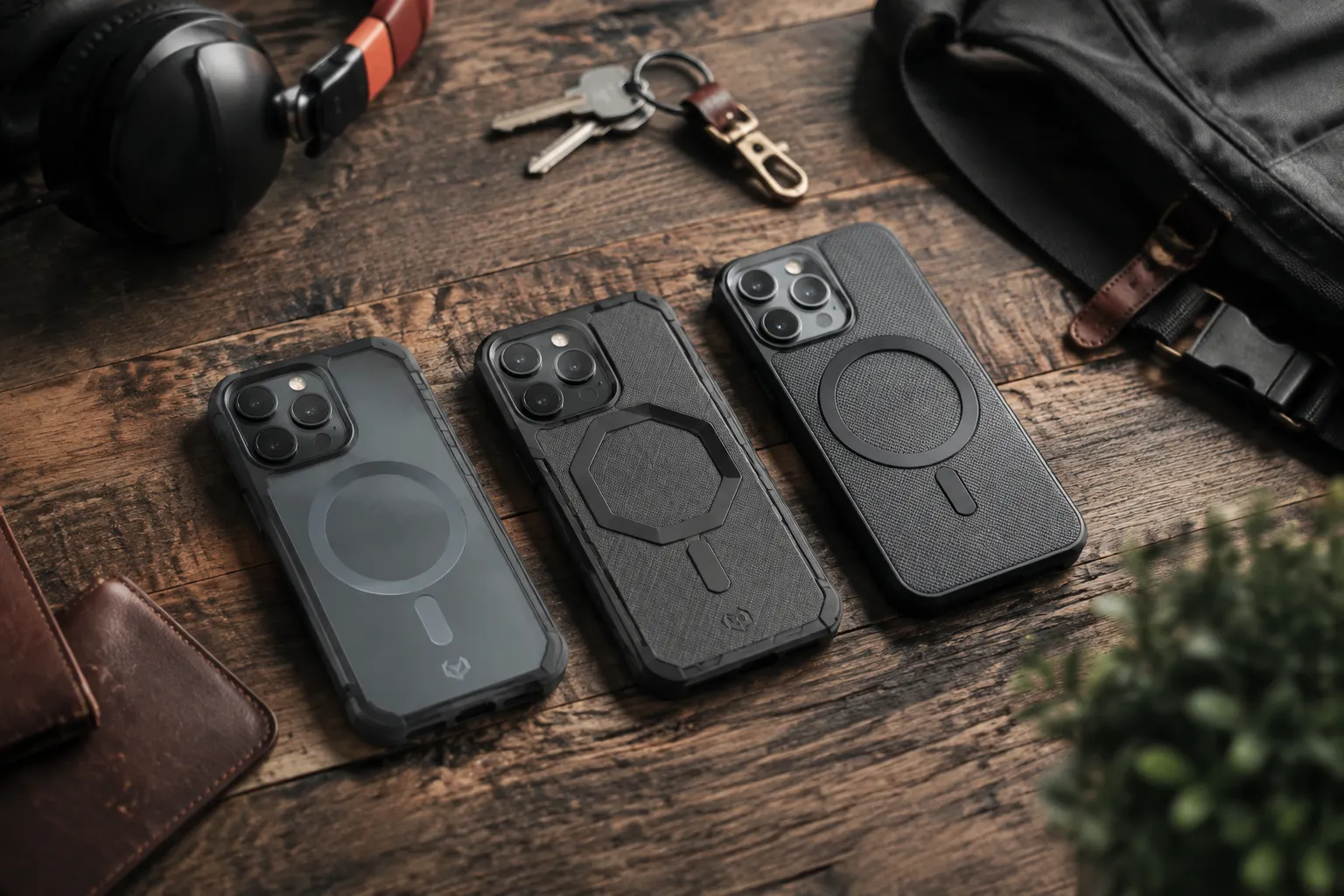
Pitaka makes the MagEZ Case Pro for the 15 Pro, and it is the clearest example of what aramid fiber can do when a manufacturer commits to it fully. The case measures 1.4 millimeters at its thinnest point and weighs around 19 grams. That puts it lighter than Apple's silicone offering by a full 10 grams, and it is noticeably stronger than any plastic shell at the same thickness.
The MagEZ Case Pro uses a 600D aramid weave on the back and a flexible TPU bumper around the edges. That combination matters. The aramid back resists bending and handles drops with a hard surface that distributes impact, while the softer bumper catches the corners where phones actually hit the ground. The case also has a built-in magnet ring that sits nearly flush with the back surface, which keeps the distance between the phone and any MagSafe accessory minimal.
The texture is worth describing. Aramid fiber cases have a dry, woven feel that is nothing like the sticky silicone of an Apple case or the cold plastic of a cheap clear shell. It grips the hand without grabbing fabric, and it does not show fingerprints. The 600D weave is visible under light, giving the case a technical look that some people love and others find too industrial.
Pitaka offers two versions of this case. The standard MagEZ Case Pro has open sides around the buttons, which makes it thinner but leaves the titanium frame partially exposed. The MagEZ Case Pro 4 has full side coverage and a stronger magnet array. The trade-off is about 0.3 millimeters of extra thickness on the sides. For most people, the 4 is the better buy because it protects the frame where drops actually scratch it.
The Caudabe Sheath runs a different play
Caudabe makes the Sheath, which is the closest thing to an anti-arramid case. It is made entirely of a soft-touch polymer called ShockLite, and it measures 1.5 millimeters thick across the back. The company does not publish a weight figure, but holding it next to the Pitaka reveals the difference. The Sheath is noticeably denser, heavier, and more substantial in the hand.
The Sheath does not look like a slim case. It looks like a standard rugged case that somehow got compressed. The texture is a matte, almost rubberized finish that feels dry and grippy, similar to the surface of a new basketball. Drops are absorbed by a combination of the polymer's shock-absorbing properties and a raised lip around the camera lens that sits 1.2 millimeters above the glass.
MagSafe performance on the Sheath is surprisingly good for a case that is not primarily designed around magnets. Caudabe embeds a magnet ring that sits close to the surface, and a PopSocket grip or an Apple wallet locks on with a satisfying snap. The case does not use any metal in its construction, which means the magnets are not boosted, but they are also not blocked. The hold is solid enough for everyday use, though not quite as strong as the Pitaka's built-in ring.
The Sheath's real strength is its drop protection. The side buttons are covered with a firm rubber that requires deliberate presses, and the corners have a slightly thicker section of polymer that acts like a crumple zone. This is the case for someone who drops a phone once a week and cannot afford a cracked screen. It is not the thinnest case here, but it is the one that feels most like it could survive a throw across a parking lot.
Apple's own case is the baseline to beat
The Apple silicone case with MagSafe costs $59 and weighs about 29 grams. It is 2.4 millimeters thick at the back, which puts it in the middle of the pack. The silicone finish is pleasant for about two weeks, after which it starts collecting lint from pockets and developing a shiny wear pattern in the corners where fingers grip.
Its magnetic strength is excellent. Apple designs its own cases to work perfectly with its own accessories, and the wallet and battery pack snap on with full force. The case also has a microfiber lining inside that protects the titanium frame from scratches. But the drop protection is merely adequate. Silicone absorbs some impact, but the material is soft enough that a hard drop can transfer force directly to the phone's corners.
The bigger issue with Apple's case is the bottom edge. It leaves the entire bottom of the phone exposed, including the speaker grille and the charging port. That open design helps with gesture navigation and makes it easier to swipe up from the bottom edge, but it also means a drop on the bottom corner offers almost no protection. Several aftermarket cases from smaller brands have closed that gap while keeping the same slim profile.
The MagSafe test that separates the good from the bad
There is a simple field test for any MagSafe case. Attach an Apple MagSafe wallet to the back, hold the phone by the top edge, and shake it gently. If the wallet slides or shifts, the case has too much material between the phone and the magnet. If the wallet stays locked, the case passes.
This test matters because the Apple wallet is one of the lightest MagSafe accessories. A battery pack or a car mount is heavier and puts more strain on the magnetic connection. A case that barely holds a wallet will fail entirely with a battery pack attached, which turns a supposedly magnetic phone into a device that needs two hands to pick up its accessories.
Cases with metal plates embedded in the back, often sold as "magnetic cases" on Amazon, tend to fail this test in a different way. The metal plate does not boost the phone's magnets. It creates an independent magnetic field that can interfere with the phone's compass and the precise alignment needed for some car mounts. These cases often advertise "stronger magnets" but deliver a confusing experience where accessories stick but the phone's internal sensors behave oddly.
Brands like Spigen and ESR have moved away from metal plates and now use a dedicated magnet ring that aligns with the phone's internal magnets. This is the right approach, and both companies make cases that pass the shake test. The Spigen Ultra Hybrid MagFit, which is a clear case with a rigid back and a reinforced magnet ring, is a solid budget option at around $25. It is not in the same class as the Pitaka or Caudabe for material quality, but it offers 90 percent of the functionality at half the price.
The camera bump is where cases get greedy
Every case manufacturer faces the same problem with the 15 Pro's camera module. The three lenses protrude about 1.5 millimeters from the back of the phone, and they need protection without adding so much material that the phone rocks when placed on a table. The common solution is a raised lip around the entire module, but the height of that lip varies wildly between brands.
The Pitaka case has a lip that sits flush with the lens rings, which means the camera glass is protected from scratches but not from a direct impact on a sharp surface. The Caudabe Sheath raises its lip to 1.2 millimeters, which clears the lens glass entirely and provides a small buffer zone. Apple's silicone case splits the difference, with a lip that sits just above the lens but is soft enough to compress under pressure.
For anyone who places the phone face-up on hard surfaces, the camera lip matters more than any other dimension. A case with a low lip will allow the phone to wobble slightly when the screen is tapped, which is annoying during use. The Caudabe and the Spigen clear case are the most stable here. The Pitaka is the least stable, but its low profile makes it the best choice for pocket carry.
Buttons and the feel of a precise cut
The 15 Pro has an Action button on the left edge, replacing the mute switch that iPhones used for sixteen years. This button is programmable, which means people press it for different reasons. Some use it for the camera shutter, others for a shortcut to open an app, and some just leave it on silent mode. The case needs to make this button accessible without being so bulky that it gets pressed accidentally.
Caudabe covers the Action button with a firm rubber nub that requires a deliberate press. This is good for accidental presses but slightly annoying for people who use the button frequently. Pitaka leaves the Action button exposed in its standard MagEZ case, which makes it easy to press but leaves that section of the titanium frame unprotected. The MagEZ Case Pro 4 covers it with a thin layer of aramid that balances both concerns.
The volume and power buttons are a separate matter. Cases that use flexible rubber around these buttons tend to feel mushy, while cases with cutouts feel precise but expose the frame. The best designs, like the one on the Caudabe Sheath, use individual rubber covers that match the button's travel distance. A person should not have to press harder through a case to change the volume. If the button requires extra force, the case is too thick at the edges.
The final choice is about daily friction
After handling all of these cases, the decision comes down to what annoys a person less. The Pitaka MagEZ Case Pro 4 is the best slim case for someone who keeps the phone in a pocket, uses a MagSafe wallet, and wants the phone to feel nearly naked. The Caudabe Sheath is the best strong case for someone who drops phones, uses a car mount, and does not mind an extra 10 grams in exchange for corner protection. Apple's silicone case remains the default for people who want zero risk of compatibility issues and do not mind replacing the case every year when the silicone degrades.
The Spigen Ultra Hybrid MagFit deserves a mention for a specific buyer. It is the case to recommend to anyone who wants to see the titanium frame, which is one of the 15 Pro's main visual features, while still getting reasonable drop protection and a working magnet. Clear cases yellow over time, and Spigen's material is no exception, but at $25, replacing it every year is cheaper than replacing a screen.
What none of these cases do is solve the fundamental tension. A phone that weighs 187 grams with a titanium frame and flat edges is already a heavy, angular object. Adding a case, even a good one, changes how it feels in the hand. The Pitaka makes the phone feel like a well-made tool. The Caudabe makes it feel like a rugged instrument. Apple's case makes it feel like a slightly softer version of itself. Each of those feelings is valid for a different kind of owner, and each case costs about the same as a nice dinner for two.
The strongest recommendation goes to the Caudabe Sheath for most people, because it commits fully to protection without abandoning the MagSafe system. It is not the thinnest case, and it is not the lightest. But it is the case that a person can buy, attach an Apple wallet, drop the phone on concrete, and never think about the case again. That kind of quiet reliability is what a strong case is actually for.