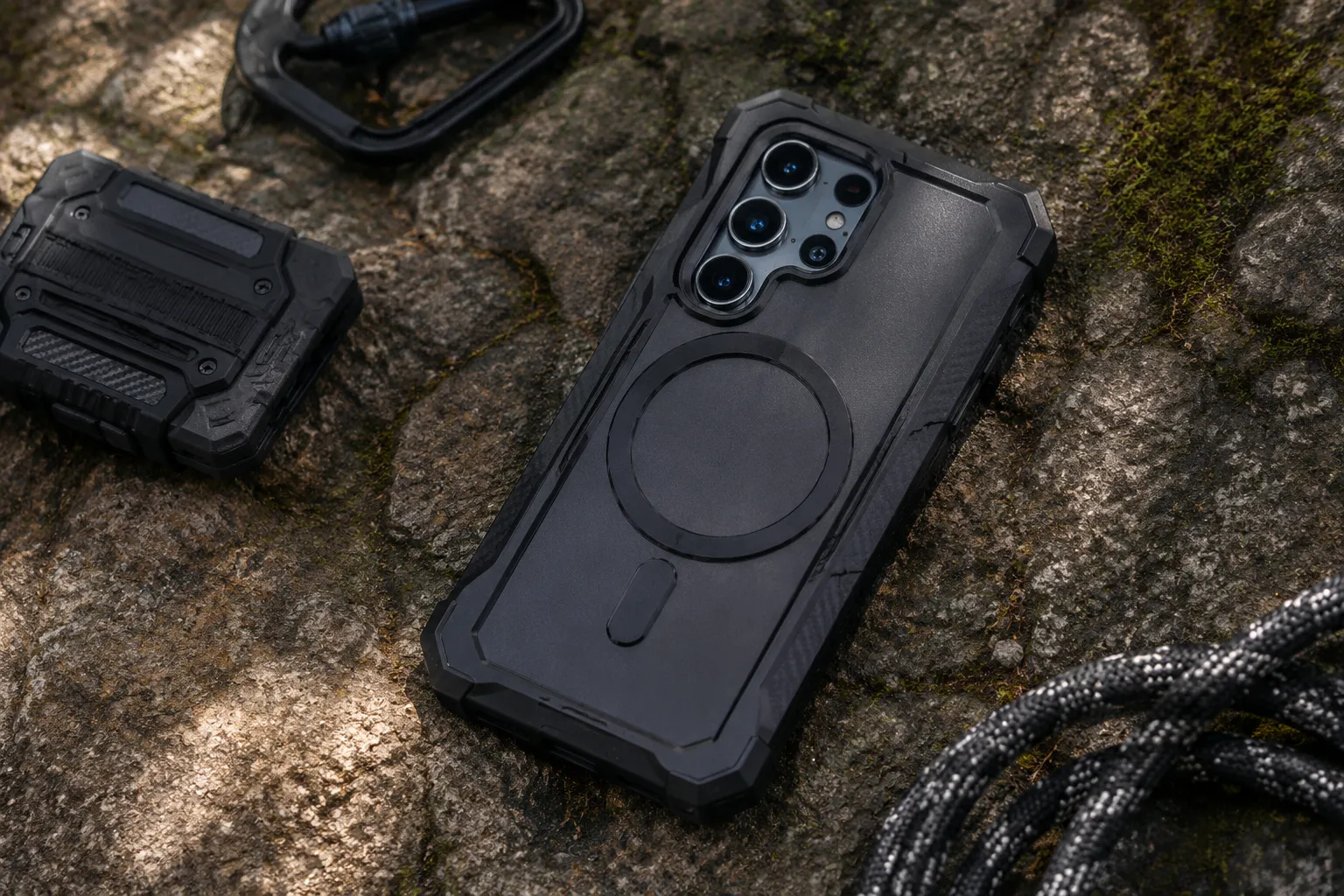
The magnetic ring inside a phone case looks simple, but it is a small feat of engineering. It has to sit at the exact right height so the phone's internal magnets align with it. It has to be strong enough to hold a battery pack or a car mount through a layer of shock-absorbing material. And it has to survive drops, which means it cannot just be glued to the back plate. On the Galaxy S25 Ultra, this gets trickier because the camera module is enormous and the back of the phone is flat glass. Case makers have to work around that geometry, and the ones that want to sell a rugged case have to work even harder.
The result is a category that looked like a compromise for years. A person could buy a tank of a case and lose wireless charging, or buy a slim case with perfect MagSafe alignment and watch it crack on the first drop. The S25 Ultra generation has changed that equation. Several manufacturers are now shipping armor-grade cases with magnets strong enough to hold the phone sideways on a magnetic mount. It took them a while to get here.
The first thing to understand is that the S25 Ultra already has magnets inside the chassis. Samsung put a magnetic array in the phone itself, similar to what Apple has done since the iPhone 12. That means any case, even a plain plastic shell, can theoretically pass magnetic force through to accessories. But "theoretically" does not survive contact with a drop. A thin case lets the magnets work perfectly. A thick case with corner bumpers and a raised lip puts distance between the accessory and the phone's internal magnets. The stronger the magnetic ring in the case, the more forgiving that distance becomes.
The Magnet Strength Problem No One Talks About
Most rugged cases list their magnet count. Eighteen magnets, twenty magnets, sometimes twenty-four. That number matters less than the material and the spacing. A case maker can pack in more magnets, but if they are weak ceramic ones, the holding force will still disappoint. The better cases use N52 neodymium magnets, which are the strong kind, and they arrange them in a ring that matches the phone's internal layout.
There is a practical test that matters more than any spec sheet. A person can attach a MagSafe battery pack to the case, hold the phone by the battery pack, and give it a firm shake. If the phone stays put, the magnets are doing their job. If it slides even a little, the case will fail on a bumpy road or a jogging stroller mount. The best S25 Ultra cases pass that shake test with room to spare. The mediocre ones pass it when the phone is new, then lose grip after a few weeks as the adhesive behind the magnet ring softens from heat.
Heat is the silent killer of magnetic cases. A phone in a rugged case runs warmer because the thick material traps heat. That warmth reaches the adhesive holding the magnet ring in place. Over months, the ring can shift a millimeter or two. That does not sound like much, but a shifted ring breaks the alignment with the phone's internal magnets. The accessory still attaches, but it sits slightly off-center, and the holding force drops noticeably.
Spigen's Tough Armor and the ArcRing Reset
Spigen solved this in an interesting way. The Tough Armor case for the S25 Ultra uses what the company calls ArcRing, a magnet array that is not a single ring but a segmented arc. The design spreads the magnetic force across a wider footprint, which does two things. It makes the case less sensitive to minor misalignment, and it reduces the stress on any single adhesive point.
The Tough Armor is not the most protective case Spigen makes. That title belongs to the Rugged Armor, which trades the kickstand for a slimmer profile. But the Tough Armor has a 56 percent recycled content build, a built-in kickstand, and an air-cushion corner design that has been Spigen's signature for years. The kickstand is the part that makes it a daily driver. A person can prop the phone up on a desk for video calls or on a nightstand for alarm duty, and the kickstand holds the weight without flexing.
The S25 Ultra is a heavy phone. At over 200 grams, it pulls hard on any kickstand or magnetic mount. The Tough Armor's kickstand is reinforced at the hinge, which addresses the weak point that plagued earlier Spigen designs. The magnet ring sits inside a recessed channel that keeps it flush with the back panel, so wireless charging pads make contact without an air gap.
The OtterBox Defender's Second Act
OtterBox has a reputation problem. The Defender series has been the gold standard for drop protection since the early smartphone days, but it has also been thick, boxy, and hard to pocket. The S25 Ultra version keeps the protective DNA but changes the feel. The rubber outer layer is softer, the plastic inner shell has smoother edges, and the whole assembly is noticeably less bulky than previous generations.
The Defender still includes the holster clip, which is a love-it-or-hate-it accessory. The clip functions as a belt mount, a kickstand, and a hand grip, but it also adds width. A person who wants a rugged case that slips into a slim jeans pocket should look elsewhere. A person who works outdoors or carries the phone on a tool belt will find the clip indispensable.
OtterBox added MagSafe compatibility to the Defender without making it a headline feature. The magnets are integrated into the inner plastic layer rather than the outer rubber, which keeps them closer to the phone. This design choice means the case does not need an oversized magnet ring to compensate for material thickness. The trade-off is that the magnets are not quite as strong as those in the Spigen or the Supcase, but they hold well enough for most car mounts and desk stands.
Meet the Supcase Unicorn Beetle Pro
The Supcase Unicorn Beetle Pro is the case that most people do not know about but should. It has a built-in screen protector, a polycarbonate back plate, and a thermoplastic polyurethane bumper that wraps around every edge. The S25 Ultra version includes a magnetic ring that Supcase rates at a holding force of 18 newtons. In real terms, that is enough to hold the phone vertically on a magnetic mount over moderate bumps.
The Unicorn Beetle Pro also solves the camera protection problem better than most competitors. The S25 Ultra has a camera bump that sticks out several millimeters. Many cases leave that bump exposed, trusting the raised lip around it to do the work. Supcase covers the entire camera module with a clear polycarbonate window. That window adds a bit of thickness, but it means the camera lenses never touch a surface directly, even when the case is face-down on a table.
There is one issue with the built-in screen protector. It is a thin plastic film that sits over the display, and it collects fingerprints and smudges more readily than the phone's own Gorilla Glass. Some users peel it off and rely on the raised lip of the case for screen protection. That works, but it voids the case's dust-proofing claim. The screen protector is the only real compromise in an otherwise excellent design.
The Slim Rugged Middle Ground
Not every person who wants a rugged case needs to survive a construction site. Some people just need a case that can handle a drop from a bicycle handlebar or a fumble at a concert. For that group, the premium slim cases offer a middle ground. The Pitaka MagEZ Case and the Mous Limitless 6.0 both fit this category, and both handle MagSafe accessories with more precision than the bulkier options.
Pitaka uses aramid fiber, a material that is best known for bulletproof vests. The MagEZ Case is thin, about 1.4 millimeters, and it has a surprisingly high grip for such a smooth material. The aramid fiber does not add much drop protection on its own. The case relies on a raised lip around the screen and a reinforced camera ring to absorb impact. This is a case for someone who wants the phone to feel almost naked while gaining scratch protection and a secure grip.
The Mous Limitless 6.0 uses a different approach. It has a rigid polycarbonate core with a soft-touch back panel and air pockets in the corners. Mous claims the case can survive drops from 10 meters, which is hard to verify but plausible given the construction. The Limitless 6.0 has the strongest magnets of any case in this group. The company's magnetic array uses a patented interlocking design that physically locks the accessory to the case, rather than relying purely on magnetic attraction.
What Actually Happens When a Rugged Case Meets a Wireless Charger
Wireless charging through a rugged case has always been a gamble. The thick material can interfere with the charging coil, and the magnet ring can create eddy currents that generate heat. The S25 Ultra supports fast wireless charging at 15 watts with compatible chargers. Most rugged cases do not lower that speed, but some do, and the difference is noticeable only when a person tracks charging times.
The common test is a nightstand charger. A phone in a thin case charges from empty to full in about two hours. The same phone in a thick rugged case might take an extra twenty to thirty minutes. That is not a dealbreaker for overnight charging, but it matters for a person who relies on a wireless car mount during a daily commute. The case that charges slowest in this group is the OtterBox Defender, because the outer rubber layer adds distance between the charging coil and the phone.
The Supcase and the Spigen both charge at near-full speed. The Mous Limitless charges at full speed, which is remarkable given its protective build. The Pitaka charges at full speed too, but that is expected because the case is so thin it barely qualifies as a barrier. A person who wants fast wireless charging with serious protection should look at the Mous or the Spigen first.
The MagSafe Mount Reality Check
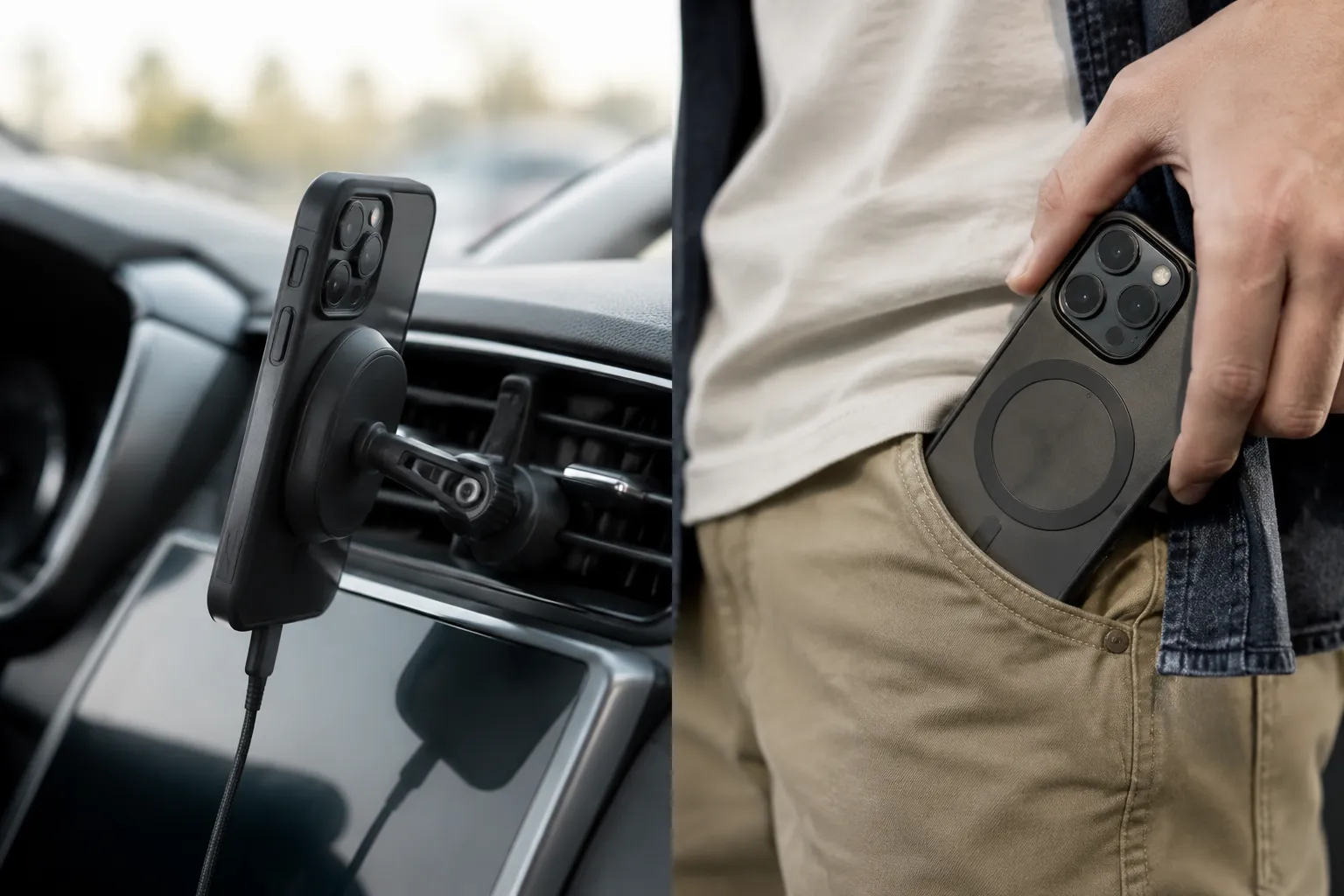
A magnetic phone mount in a car is the most common reason people care about MagSafe in a rugged case. The phone sits on a vent mount or a dashboard mount, and the driver expects it to stay put through turns, potholes, and the occasional hard brake. The S25 Ultra's size works against this. The phone is tall and heavy, which creates leverage that can pull it off a mount during sudden stops.
The best rugged cases for car mounts have a recessed magnet ring that sits flush with the back panel. A raised ring creates a gap between the phone and the mount, which weakens the connection. The Spigen Tough Armor and the Mous Limitless both have flush rings. The OtterBox Defender has a slightly recessed magnetic area, which works better than a raised ring but still adds a small gap.
There is also the question of mount compatibility. Some car mounts are designed for bare phones and have a strong magnetic puck that expects to sit directly against the phone's own magnets. Those mounts will struggle with any case, regardless of the case's magnet quality. A person with a magnetic car mount should test it with the case on before assuming the case is the problem.
Buttons, Grips, and the Feel Factor
A rugged case can have perfect magnets and still fail on the basics. The S25 Ultra has a side button that also functions as a fingerprint sensor. If a case makes that button stiff or hard to press, the phone becomes frustrating to unlock. The Spigen Tough Armor uses covered buttons with a textured surface. The OtterBox Defender does the same. The Supcase has exposed buttons, which some people prefer because they feel more direct.
The grip on the sides matters just as much. The S25 Ultra is a wide phone, and a smooth case makes it harder to hold securely. The Supcase has deep ridges along the sides that provide a confident grip. The Spigen has a subtle texture that improves grip without feeling rough. The OtterBox has the grippiest rubber of the group, but it also attracts lint and dust from pockets. The Mous has a soft-touch finish that feels premium but becomes slippery when hands are slightly sweaty.
The fingerprint sensor is a specific pain point. Some rugged cases make the side button so stiff that the sensor registers presses inconsistently. The OtterBox Defender has historically had this issue, and the S25 Ultra version is better but not perfect. The Spigen and the Mous both handle the button well, providing tactile feedback without requiring excessive force.
The Case for a Screen Protector With a Lip
Every rugged case claims drop protection, but the screen is the most vulnerable part of the S25 Ultra. The phone has a flat display with minimal bezels, which means a case needs a pronounced lip to keep the glass off flat surfaces. The Supcase has the tallest lip in this group, rising about 2.5 millimeters above the screen. The OtterBox has a slightly shorter lip but compensates with a thicker top and bottom edge.
There is a tension between the lip height and the gesture navigation. The S25 Ultra uses swipe gestures from the bottom edge, and a tall lip can interfere with the upward swipe that returns to the home screen. The Supcase's tall lip requires a deliberate swipe that takes a few days to get used to. The Mous has a slimmer lip that allows natural gestures but offers less screen protection.
The Spigen Tough Armor splits the difference. Its lip is tall enough to protect the screen from face-down drops, but it is beveled on the inside, so the thumb can still swipe up from the bottom without snagging. This seems like a small detail, but it is the difference between a case a person lives with happily and a case that gets traded out after two weeks.
Picking the Right Kind of Rugged
The S25 Ultra generation finally closes the gap between protection and magnetic functionality. A person no longer has to choose between a case that survives drops and a case that holds an accessory. The five cases covered here all hit that baseline. The real decision comes down to where a person plans to use the phone.
The Spigen Tough Armor is the best overall for most people. It balances drop protection, magnetic strength, and daily usability better than any other option. The kickstand is genuinely useful, the magnet holds a battery pack securely, and the case does not turn the S25 Ultra into a brick. For a person who wants the phone to remain pocketable while gaining serious protection, this is the one.
The Supcase Unicorn Beetle Pro is the choice for anyone who works outdoors or drops phones regularly. The built-in screen protector and camera window make it the most complete protection package, even if the feel is less refined. The Mous Limitless 6.0 is the pick for someone who wants premium materials and the strongest magnet grip, with the understanding that the drop protection relies on engineering rather than sheer bulk.
The OtterBox Defender remains the option for people who have always bought the Defender and see no reason to change. It is better than previous versions, but it is still the bulkiest and most specialized case in this group. The Pitaka MagEZ Case is not for a clumsy person. It is for someone who wants a light case with magnetic function and understands that no thin aramid fiber case can match a thick polycarbonate and TPU build.
The real question a buyer should ask is not which case has the best drop rating, but which case they will actually keep on the phone. A case that feels too bulky gets removed. A case with a poor grip gets swapped. A case that interferes with the fingerprint sensor gets returned. The rugged case market for the S25 Ultra has matured to the point where the magnets are no longer an afterthought. The remaining differences are about how a person holds, charges, and carries the phone, not about whether the case can survive a fall.