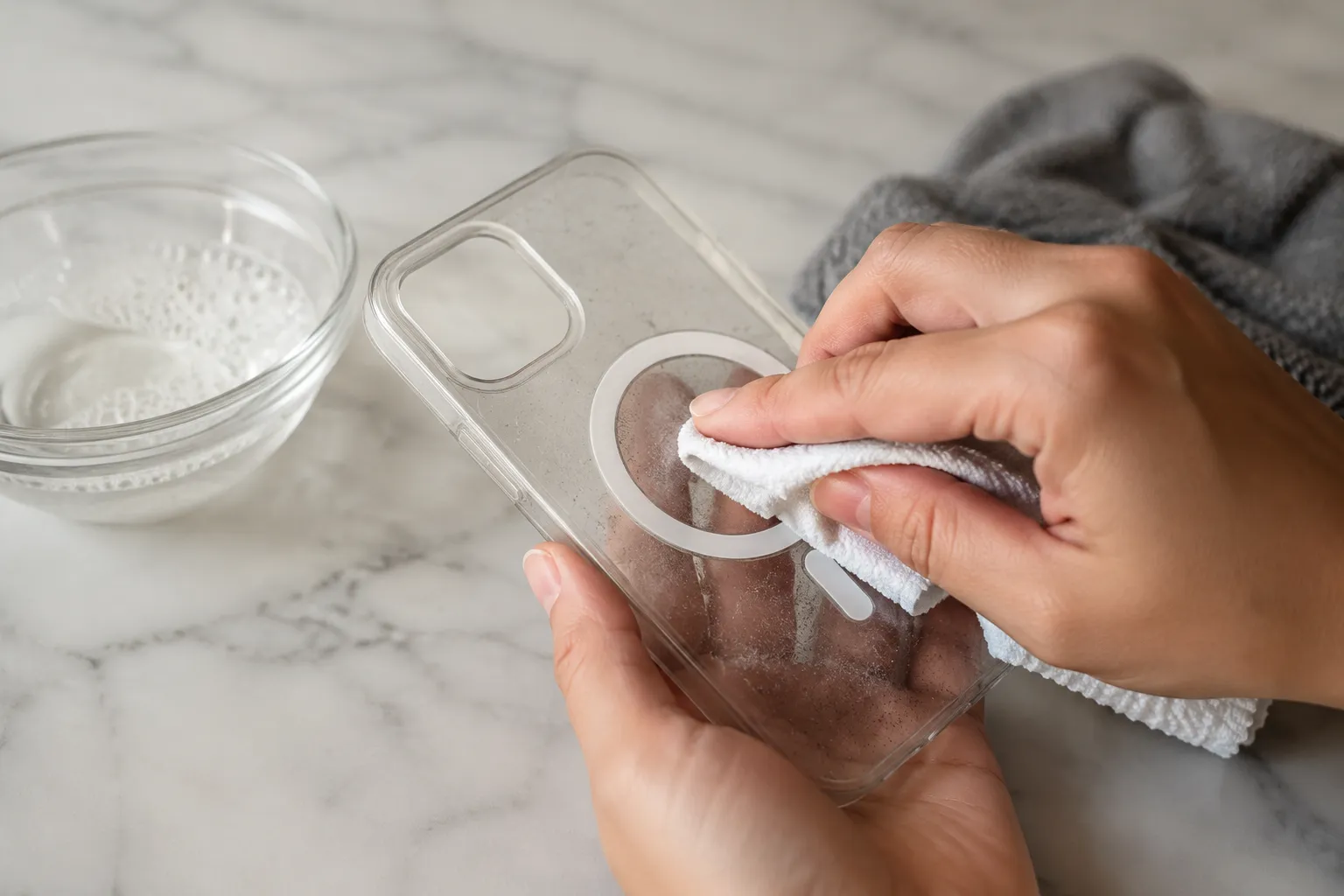
The first time the ring died, it was on a Tuesday, and there was no dramatic moment. No drop onto pavement, no slide across a parking lot. A person simply picked up the phone, and the MagSafe charger clicked on, and the phone slid off sideways like a bar of soap in a wet hand. The magnet had faded to maybe a third of its original pull, and the only suspect was the cleaning routine itself. Soft cloths, mild soap, warm water, nothing aggressive, and still the ring had quietly surrendered. The culprit was not abrasion. It was time, and water, and the thin film of skin oil that worked its way under the case edge and sat against the metal.
Cleaning a MagSafe case is a maintenance task that sounds trivial until the case costs 50 dollars and the replacement cycle is measured in months. The standard advice, wipe with a damp cloth and mild soap, is not wrong, but it is incomplete. That advice treats the case as a single object with uniform needs. It is not. A modern MagSafe case is a laminate of materials with different tolerances: a soft silicone or polycarbonate shell, a microfiber or suede lining on the inside, and a circular band of magnets or magnetic steel embedded between them. All three layers need cleaning, and all three respond differently to the same treatment.
The magnet ring is the part that gets destroyed, and it gets destroyed by the very thing that keeps the case clean: moisture.
What the Ring Actually Is
Apple's own cases, and most decent third-party ones, do not embed a single solid ring of magnetic material. The structure is a band of individual magnets, usually 18 to 26 small segments arranged in a circle, held in place by adhesive and a thin layer of plastic or fabric. Each segment is a rare-earth magnet, typically neodymium, plated with nickel and sometimes a thin passivation layer. That plating is what keeps the magnet from rusting, and it is thinner than most people assume. A nickel layer of a few microns is enough to keep moisture out for a while, but it is not armor. Once that plating is scratched, or once water sits against it for hours, corrosion starts underneath and lifts the plating like a blister.
The adhesive that holds the magnets in place is equally vulnerable. Most case manufacturers use a pressure-sensitive acrylic adhesive that degrades slowly in the presence of water and heat. A phone that lives in a pocket, gets warm from wireless charging, and is wiped down with a damp cloth every few days creates a perfect cycle: heat opens the adhesive's grip, moisture seeps into the gap, and the magnet shifts a fraction of a millimeter. Over months, the ring does not fail all at once. It fails by degrees, and the first symptom is not a dead magnet but a weak one. The phone still attaches, but it wobbles, or it slides when nudged, or it loses connection on a bumpy car mount.
This is why the cleaning method matters more than the frequency. A person could clean a case every day for a year with the right technique and never damage the ring. The same person could clean it once a month with the wrong technique and kill it in four cleanings.
The Two Failure Modes in Order of Likelihood
Water intrusion ranks first. Not because a damp cloth is catastrophic, but because people tend to oversaturate. The common habit is to run a cloth under the tap, wring it out, and wipe the case down, leaving a film of water on the surface that then evaporates slowly. During that slow evaporation, water sits in the seam between the case body and the inner lining, and capillary action pulls it along the adhesive layer toward the magnets. A person cannot see this happen. The outside of the case looks dry in twenty minutes. The inside stays damp for hours.
The second failure mode is chemical. Many people reach for alcohol wipes, disinfecting sprays, or screen-cleaning solutions that are perfectly safe for glass and plastic but harsh on the magnet plating and the adhesive. Isopropyl alcohol in particular is a solvent for some acrylic adhesives, and it accelerates the breakdown of the thin nickel plating. The irony is that alcohol dries fast, so it feels safer, when it is actually more aggressive on the case's internal structure than plain water.
Abrasion is a distant third. The ring itself rarely gets scratched during normal cleaning because it sits under a layer of material. The damage comes from the back of the phone. When a person slides the case off and wipes the inside, the cloth rubs against the exposed magnets or the thin cover over them. A microfiber cloth will not hurt them. A paper towel can, because paper towel fibers are not soft at a microscopic level; they are stiff cellulose shards that can score a soft nickel plating over time. The same goes for the gritty dirt that gets trapped between the phone and the case. Wiping that dirt back and forth without first lifting it away drags abrasive particles across the ring surface.
A Cleaning Routine That Respects the Layers
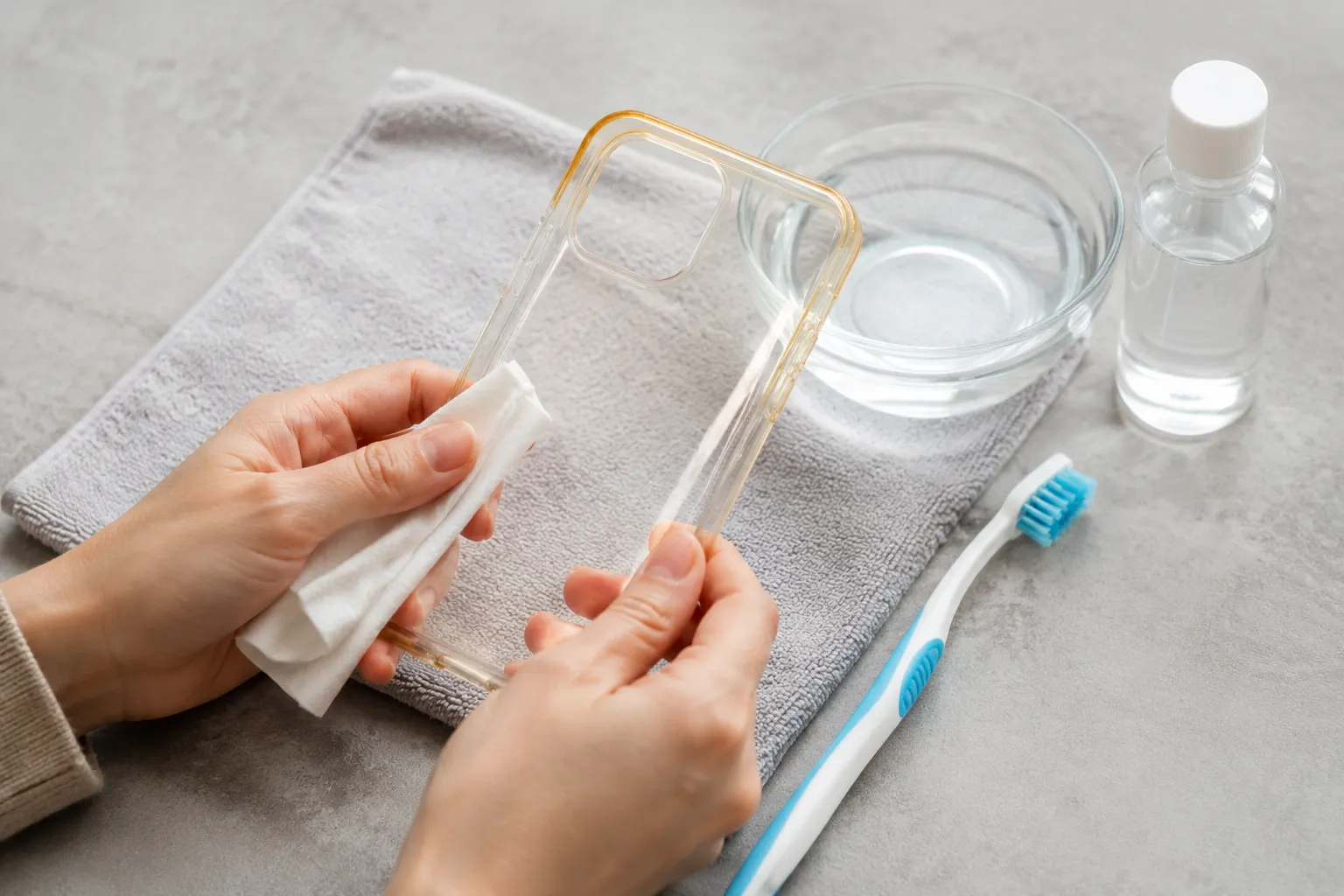
The method that works starts with the case on the phone, not off it. Leaving the case in place during the outer wipe protects the inner magnet ring from the cloth entirely. A person should use a barely damp microfiber cloth, the kind sold for eyeglasses or camera lenses, and wring it until no water can be squeezed out. The cloth should feel dry to the touch with only a slight coolness. Wipe the exterior in straight lines, not circles, and pay attention to the corners where oil collects. Then dry immediately with a second, completely dry microfiber cloth. The entire outer wipe should take less than ninety seconds.
For the inside, the case has to come off, but the phone should be cleaned separately. The inside of the case is where most of the grime lives, a mix of skin oils, lint, and the fine dust that sneaks past the outer edge. A dry microfiber cloth will lift most of it. For the stubborn residue along the edges, a cotton swab barely dipped in warm water, then pressed against a paper towel until it is just damp, works better than any spray. The swab can reach into the seam without flooding the adhesive. The rule is to touch, not soak. Each dab should lift grime, not deposit water.
The magnet ring itself should never be wiped directly with anything wet. If visible grime sits on the ring, which happens mostly on cases with an exposed magnetic band rather than a covered one, the safe method is a dry microfiber cloth and gentle pressure, nothing more. If that fails, a second pass with a dry cotton swab can lift what the cloth missed. Water on an exposed magnet ring is a gamble, and the house always wins eventually.
Why Disassembly Is a Trap
Somewhere on the internet, a person has posted a tutorial that shows removing the inner lining of a MagSafe case to clean underneath it. That person is selling a repair that creates a bigger problem. The lining is not designed to be removed. It is glued down with the same acrylic adhesive that holds the magnets, and peeling it away stretches the fabric and breaks the adhesive bond permanently. Even a careful removal leaves the surface uneven, and the lining never sits flush again. Worse, the act of peeling can shift the magnet segments, breaking the precise circular alignment that the phone's internal magnet array expects. The phone will still attach, but the alignment will be off by a degree or two, which is enough to weaken the connection and slow wireless charging.
If debris has somehow worked its way under the lining, which is rare and usually a sign of a failed case or a manufacturing defect, the correct response is to buy a new case. The cost of a mid-range MagSafe case is lower than the frustration of a magnet ring that no longer holds.
The Soap Question
Mild soap gets mentioned in most cleaning guides, but the word mild does most of the work. Dish soap in the standard kitchen bottle is not mild. It is a degreaser formulated to cut through cooked-on fat, and it will strip the oleophobic coating on a case's exterior and accelerate the breakdown of the adhesive over time. A better choice is a tiny amount of hand soap or a dedicated plastic cleaner, and even then, soap should only be used when plain water fails. Soap is for the greasy buildup that a damp cloth cannot lift, not for routine maintenance. Most cases never need it. The cases that do, the ones that live in pockets next to sweaty skin or spend hours against a face during calls, need it no more than once every few weeks.
When soap is necessary, the process is the same as with water, just slower. A drop of soap on a damp microfiber cloth, worked into a light lather, then the case wiped down, then a second pass with a clean damp cloth to remove the soap residue, then a dry cloth to finish. The final dry pass matters more than any other step because it shortens the time moisture sits against the seams.
What the Charging Habits Do
The cleaning routine matters, but it runs a distant second to what happens during wireless charging. A MagSafe charger generates heat, and a case sandwiched between the phone and the charger traps that heat. Over months, the repeated thermal cycling softens the adhesive that holds the magnet ring in place. This is not speculation; it is visible in the way old cases develop a slight bubble or ripple along the ring line. The heat alone will not kill the magnets, but it makes them movable, and movable magnets wear out their alignment over time. The ring does not lose its magnetic strength so much as it loses its position, and a misaligned ring is functionally weaker.
This means that the best cleaning routine is one that minimizes the need to clean in the first place. A person who wipes the case down before charging, removing the day's oils and grit while the case is still cool, prevents the heat from baking that grime into the surface. A person who charges overnight on a hot pad is asking for a case that needs deep cleaning every few weeks. The two habits are linked: frequent light maintenance reduces the need for occasional heavy cleaning, and heavy cleaning is what damages the ring.
A Quick Word on Third-Party Cases
Apple's own silicone case treats the magnet ring with a thin fabric lining that protects it well. Many third-party cases, especially the clear polycarbonate ones, leave the magnets closer to the surface, sometimes separated by only a fraction of a millimeter of plastic. These cases are more vulnerable to water intrusion because the plastic layer is thin and can flex, creating micro-gaps around the magnet segments. The cleaning routine for a clear case should be even drier than for a silicone one. A person should never use a wet cloth on a clear case's interior, because the risk of water seeping around the magnet segments is higher.
The other category worth attention is the rugged case, the ones with a built-in kickstand or a textured back. These cases accumulate grime in their crevices faster than smooth ones, and people tend to scrub harder to reach it. Scrubbing harder is exactly the wrong response. The crevices should be cleaned with a dry toothbrush, one with soft bristles, which lifts dirt without wetting the internal layers. A person can use a damp cloth on the exterior, but the brush should stay dry.
The Final Dry Is the Whole Game
Every cleaning method comes down to one variable: how long moisture remains in contact with the case's internal structure. A person could use a more aggressive cleaner, or a wetter cloth, and still avoid damage if the case is dried thoroughly within a minute. The reverse is also true. The gentlest cleaner in the world, applied and then left to air dry, can deposit a thin film of moisture that sits against the adhesive for an hour. Air drying is the enemy. Air drying is what allows water to find the seams and work its way toward the magnets.
The discipline is simple: wet, wipe, dry, and never set the case down to finish drying on its own. The case should be dry before it returns to the phone, and the phone should be dry before it returns to the case. A case that goes back on a damp phone traps moisture in the one place it can do the most damage, directly against the fabric lining and the magnet ring beneath it.
None of this is difficult, and none of it requires specialty products. A microfiber cloth, a dry cotton swab, and a willingness to spend ninety seconds instead of thirty. The reward is a case that holds its magnetic grip for two years instead of eight months, and a phone that does not slide off the charger at 6:40 in the morning, landing face down on a tile floor, because the ring was killed by kindness.