The commuter backpack with a USB port is a solution to a problem that barely existed fifteen years ago, and the way most brands build one shows how little they understand the problem they are trying to solve. The average person carries a phone, a portable battery, a laptop, a water bottle, and a handful of cables, and the backpack industry decided that the correct response was to sew a hole in the fabric and run a wire through it. The result is a category flooded with bags that charge devices at glacial speed, leak power into the void when unplugged, and place the entire charging apparatus in the least convenient spot possible. The good news is that a small number of manufacturers treat the USB port as an engineering challenge rather than a marketing checkbox, and those bags are worth finding.
The core issue is that a USB port on a backpack is not a feature. It is a promise about how a person's day flows. A commuter leaves home with a phone at eighty percent, arrives at work with it at forty, and needs to leave the office with it at full charge without sitting next to an outlet for an hour. The backpack that solves this does not just have a port. It has a dedicated battery pocket that does not crush the battery against a laptop, a cable routing system that does not tangle with the shoulder strap, and an exterior that protects the connection from rain. Most bags fail at least one of these, and many fail all three.
The battery pocket deserves scrutiny before anything else. A surprising number of backpacks include a USB port but no designated space for the power bank itself, which means the battery floats loose in the main compartment. A loose battery in a bag full of books and a laptop is a bad idea for a few reasons. The cable yanks out of the phone when the bag shifts, the battery slides to the bottom where a person has to dig for it, and the charging cable gets bent at sharp angles against the bag's contents. The bags that do this properly have a small elastic or velour pocket near the top of the main compartment, sometimes on the inside of the front panel, with a cable pass-through that keeps the wire from snaking through the entire bag. That pocket placement matters more than the port itself.
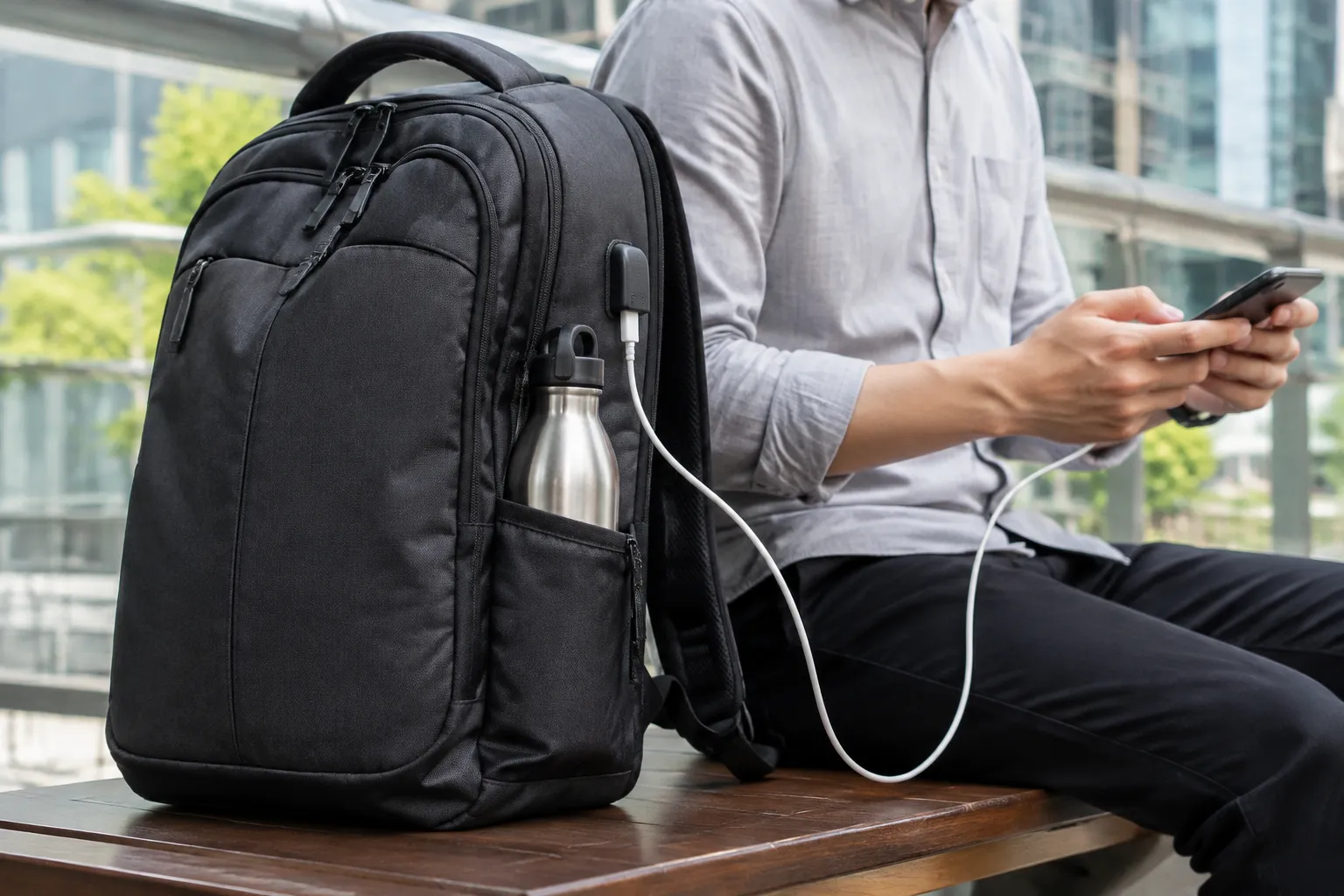
The second issue is the cable routing. Most budget backpacks with USB ports have a port on the side of the bag, near the bottom, which seems logical until a person actually uses it. The phone goes in a pocket, the cable comes out the side, and the cable either drapes across the front of the bag where it catches on doorknobs and subway poles, or it routes through the top where it creates a loop that pulls against the battery every time the bag moves. The best designs route the cable through the shoulder strap itself, with the port located near the top of the strap where a phone can rest in a chest pocket or a jacket pocket. This keeps the cable short, protected, and out of the way. It also means a person can walk with the phone in hand, cable trailing up to the strap, without looking like they are leashed to their own bag.
Bottle holders are where the category splits into two philosophies, and the split is telling. The first philosophy treats the bottle holder as an afterthought: a stretchy mesh pocket sewn onto the side of the bag, sized generically, placed wherever there was room. The second philosophy treats it as a structural element, shaping the bag around the reality that a commuter will carry a bottle every single day. The difference shows up in three places: the depth of the pocket, the tension of the fabric, and the position relative to the bag's center of gravity.
A shallow bottle pocket is a trap. It holds a bottle fine when the bag is full and upright on a desk, but the moment the commuter slings the bag onto one shoulder, the bottle tilts, the weight shifts, and the bottle either falls out or settles into an awkward diagonal that digs into the wearer's back. Deep pockets, those that cover at least half the bottle's height, prevent this. The tradeoff is that deep pockets are harder to access one-handed, especially on a crowded train where a person does not want to swing the bag around. Some manufacturers compromise with an angled pocket that opens toward the front of the bag, allowing a bottle to slide out without a full rotation of the bag. That detail, small as it sounds, is the difference between a bag that works and a bag that merely exists.
The tension of the bottle pocket fabric matters for a different reason. A pocket that is too loose lets the bottle rattle and shift, which is annoying on a walk and dangerous on a bike. A pocket that is too tight requires two hands and a firm tug to extract the bottle, which is worse. The right tension holds a 500 ml bottle firmly enough that it does not move when the bag is inverted, but allows a person to slide the bottle out with thumb pressure on the base. This is a hard thing to judge from product photos, and it is the main reason buying a commuter backpack online is a gamble. The bag that works perfectly in the product renderings may have a bottle pocket that is either limp or rigid in person.
Positioning of the bottle holder relative to the bag's center of gravity is the detail that most reviewers miss. A bottle weighs somewhere between half a kilo and a full kilo when filled, and where that weight sits affects how the bag feels over a two-hour commute. Bottle pockets on the very edges of the bag, flush with the sides, create an asymmetric load that pulls the bag to one side. A person compensates by tightening one shoulder strap more than the other, which leads to back pain over time. Bags that place the bottle pocket slightly toward the rear of the bag, closer to the wearer's back, or that balance two pockets on opposite sides, distribute the weight more evenly. The best commuter bags from a load perspective have the bottle pocket nested partially into the main compartment, so the bottle's weight sits close to the spine rather than far out to the side.
What the USB Port Actually Delivers
The electrical reality of these ports is less glamorous than the marketing suggests. A standard USB-A port on a backpack, wired directly to a power bank inside, delivers whatever the power bank delivers. Most power banks output 10 to 18 watts through a single USB-A port, which charges a modern phone at a rate somewhere between slow and acceptable. A phone with a 4,000 mAh battery, drawing 10 watts, gains roughly 20 to 25 percent charge per hour. That is not fast charging, but it is enough to keep a phone alive through a long commute and a lunch break. The more expensive backpacks that integrate USB-C Power Delivery ports can push 20 to 30 watts, which meaningfully changes the math, cutting charge time nearly in half.
The catch is that a backpack USB port is only as good as the cable between the port and the battery inside. Some manufacturers run thin, low-gauge wire through the bag's lining, which introduces resistance and slows the charge further. Others use connectors that come loose after months of flexing. The buyer has no way to inspect this before purchase, so the practical advice is to buy from a brand that has been making bags with integrated electronics for several years, rather than a brand that added a USB port to a catalog of otherwise ordinary bags. The former has iterated on the failure modes. The latter is still on version one, learning the hard lessons that a person does not want to pay to learn for them.
There is also the question of whether the port is even necessary. A person who carries a power bank in a jacket pocket and a short cable can achieve the same result as a bag with a USB port, with less equipment and fewer points of failure. The bag's advantage is convenience: the battery lives in the bag, always charged, always available, and the phone can be tucked into a pocket without a tangle of cable. For a commuter who takes the same route every day, the bag is the better system. For someone who travels sporadically or carries a different bag depending on the day, a standalone power bank is simpler. The audience for the USB backpack is narrower than the marketing suggests, and that is fine, because the people in that audience use the thing every single day.
The Rain Problem Nobody Mentions
Water is the silent killer of the USB backpack. A port on the exterior of a bag is an opening, and openings invite moisture. Most manufacturers place a small rubber flap over the port, which works fine in a light drizzle but fails in a proper downpour. The flap pops open when the bag is jostled, or the port sits at an angle that channels water into the opening. The result is a corroded connector and a dead port within months. The bags that handle rain well use a recessed port, one that sits in a small cavity protected by an overlapping flap, so that water must travel upward to reach the connector. That design is rare, and it is worth paying extra for.
The other rain issue is the battery compartment inside. A bag that is not itself waterproof will let water seep through the fabric at the seams, and if that water reaches the battery, the charging system is done. Some manufacturers put the battery pocket in the bottom of the bag, where water pools when the bag sits on a wet floor. Others place it higher, near the top of the back panel, where it stays dry even if the bottom of the bag gets damp. The latter placement is objectively better, and it is the one that most budget bags skip.
The Laptop Compartment Question
A commuter backpack is a laptop backpack first and a charging system second. The laptop compartment design determines whether the bag is usable, regardless of the USB port or bottle holder. The current standard is a suspended compartment, one that holds the laptop off the bottom of the bag by an inch or two, so that a hard drop does not transfer the full impact to the machine. Bags without this feature, where the laptop rests directly on the bottom seam, are a gamble. A daily commute involves setting the bag down on platforms, floors, and seats, and the cumulative impact of those taps is small, but the one time the bag slips off a hook and hits the floor hard is the time a non-suspended compartment fails.
The laptop compartment also needs to fit a specific range of sizes without being so loose that the laptop slides around. A 14-inch laptop in a compartment designed for a 16-inch machine will shift during a walk, and the corners of the laptop will wear against the bag's interior. The best compartments have a velcro or elastic strap inside that secures the laptop vertically, holding it against the back panel. This is a small detail that most product descriptions omit, but it is the difference between a laptop that arrives at work undamaged and one that has developed a slow, mysterious rattle.
Strap Comfort and the Weight Transfer Problem
The shoulder straps of a commuter backpack receive less attention than they deserve, given that they carry the entire load for hours each day. Thin, unpadded straps dig into the shoulders, especially when the bag carries a laptop, a bottle, and a battery. Wide, padded straps distribute the weight but can feel bulky under a jacket. The middle ground is a strap that is padded in the center but tapers at the ends, so it sits comfortably on the shoulder without bunching under the arm. The strap attachment point also matters: straps that attach to the bag at the very top create a gap between the bag and the wearer's back, which shifts the center of gravity backward. Straps that attach slightly lower, curving around the shoulders, pull the bag closer to the spine and make the load feel lighter.
The chest strap and the sternum strap are not extras. A commuter who walks a mile or more each way will feel the difference between a bag that swings with each stride and one that stays fixed. The sternum strap prevents lateral movement, and the load lifters, small straps at the top of the shoulder straps, transfer weight from the shoulders to the hips. Bags that lack these features are fine for a short walk from a parking garage to an office, but they are the wrong tool for a genuinely long commute.
Three Bags That Get It Right
Rather than list every bag in the category, it is more useful to describe the three approaches that actually work, because each solves the problem differently. The first is the minimalist commuter bag, typically 18 to 22 liters, with a suspended laptop sleeve, a dedicated battery pocket on the inside of the front panel, a USB-A and USB-C port recessed on the side, and a single deep bottle pocket on the left side that sits close to the back panel. The design is clean, the materials are a mix of ballistic nylon and a waterproof base, and the whole thing weighs under two pounds empty. This bag works for the person who carries the minimum: laptop, phone, battery, bottle, and a light jacket.
The second approach is the expandable commuter bag, 22 to 28 liters, which adds a roll-top closure or an expandable gusset to accommodate the days when a person needs to carry gym clothes or groceries. These bags tend to have better strap systems because they are designed to handle heavier loads. The bottle holder on these bags is often a dual-pocket system, with one shallow pocket on the left and one deep pocket on the right, allowing a person to carry a bottle and a thermos without the load becoming too asymmetric. The USB port on these bags is usually mounted on the shoulder strap, which is the better location, and the battery pocket sits in a dedicated compartment at the top of the bag, accessible without opening the main compartment.
The third approach is the commuter-daypack hybrid, which borrows from hiking bag design. These bags have a frame sheet, a padded hip belt that can be hidden when not in use, and a hydration reservoir compartment that doubles as a laptop sleeve. The bottle holders on these bags are the best in the category, because they are designed to hold bottles while a person is in motion, and they use a combination of a rigid base and an elastic top that grips the bottle without requiring deep insertion. The USB port on these bags is often an afterthought, tucked into the shoulder strap with a modest cable, but the bag's overall comfort and durability make up for the less polished electronics.
The price range for these three approaches spans from roughly 80 to 200 dollars. The cheaper end of that range gets a person a bag that works for a year or two, with the bottle holder pocket loosening and the USB port degrading. The upper end buys materials and construction that last five years or more. The difference is not in the features listed on the product page, but in the stitching, the zipper quality, and the gauge of the wire running from the battery pocket to the port.
The Zipper and Fabric Details That Decide Longevity
A commuter bag fails most often at the zippers. The main compartment zipper is opened and closed between four and ten times a day, which means over a year, that single zipper cycles two to three thousand times. A cheap zipper with small teeth will start to skip and snag within months. A YKK zipper with a robust slider will last years. The difference is visible: the cheap zipper has thin metal or plastic teeth that catch on fabric, while the quality zipper has a smooth, positive action. The same applies to the bottle pocket zipper, which is often the first to fail because it is strained laterally every time a bottle is pushed in or pulled out.
The fabric choice affects both weight and weather resistance. Cordura nylon, typically 500 to 1000 denier, is the standard for commuter bags because it resists abrasion and sheds light rain. A bag made of lighter fabric, around 300 denier, is easier to carry but will show wear at the corners within a year. A bag with a thermoplastic polyurethane (TPU) coating on the base adds water resistance without adding much weight, and that coating is the difference between a bag that protects its contents in a downpour and one that leaves the laptop damp. The tradeoff is that TPU-coated fabric feels slightly sticky and less breathable, which is fine for a commuter bag that spends most of its time on a person's back or under a desk.
The stitching quality is unglamorous but decisive. Look at the seams where the shoulder straps attach to the bag. This is the highest-stress point, and a bag with a single line of stitching here will fail within months. A bag with bar-tacking, a dense zigzag stitch, at the stress points will hold for years. This detail is invisible in product photos and is the main reason that buying a cheap commuter backpack online is a lottery. The bag might last a season or it might last a decade, and the buyer has no way to know until the seam splits under the weight of a full load.
The final consideration is the port itself, the small piece of plastic that the entire category is named after. The cheapest ports are a single piece of molded plastic with a rubber cover that is glued rather than sewn in. These ports fail in one of three ways: the cover tears off, the USB connector loosens inside the housing, or the entire port assembly detaches from the bag fabric. Better ports are mounted in a rigid frame that is sewn into the bag, with the cable connected via a detachable plug so that a damaged cable can be replaced without replacing the whole bag. A person should check whether the port assembly is replaceable before buying. It is the single best predictor of whether the bag's headline feature will still work in year three.
What this all adds up to is that the category is full of bags that look similar in a product listing and perform completely differently in daily use. The bag that charges a phone reliably, holds a bottle without spilling, survives a rainy commute, and does not dig into a shoulder after a two-hour walk is a genuinely engineered product. The bag that has the same features listed in the specifications but was designed by a team that never carried a loaded bag more than fifty meters is a document of good intentions and nothing else. The difference is not visible in a photo, but it is tangible within the first week, and it compounds over the first year.
A person who commutes by car, parks close to the office, and walks less than ten minutes each way does not need most of what has been described here. A simple bag with a laptop sleeve and a bottle holder is enough. But a person who walks a mile, takes a train, transfers once, and walks another half mile will feel every single design decision in their shoulders and their phone battery by the end of the week. That person is the one who should care about the depth of the bottle pocket, the placement of the battery compartment, the gauge of the internal cable, and the quality of the zipper on the main compartment. That person is the reason this category exists at all, and they deserve a bag that treats their commute as a sequence of real moments, not as a marketing render.