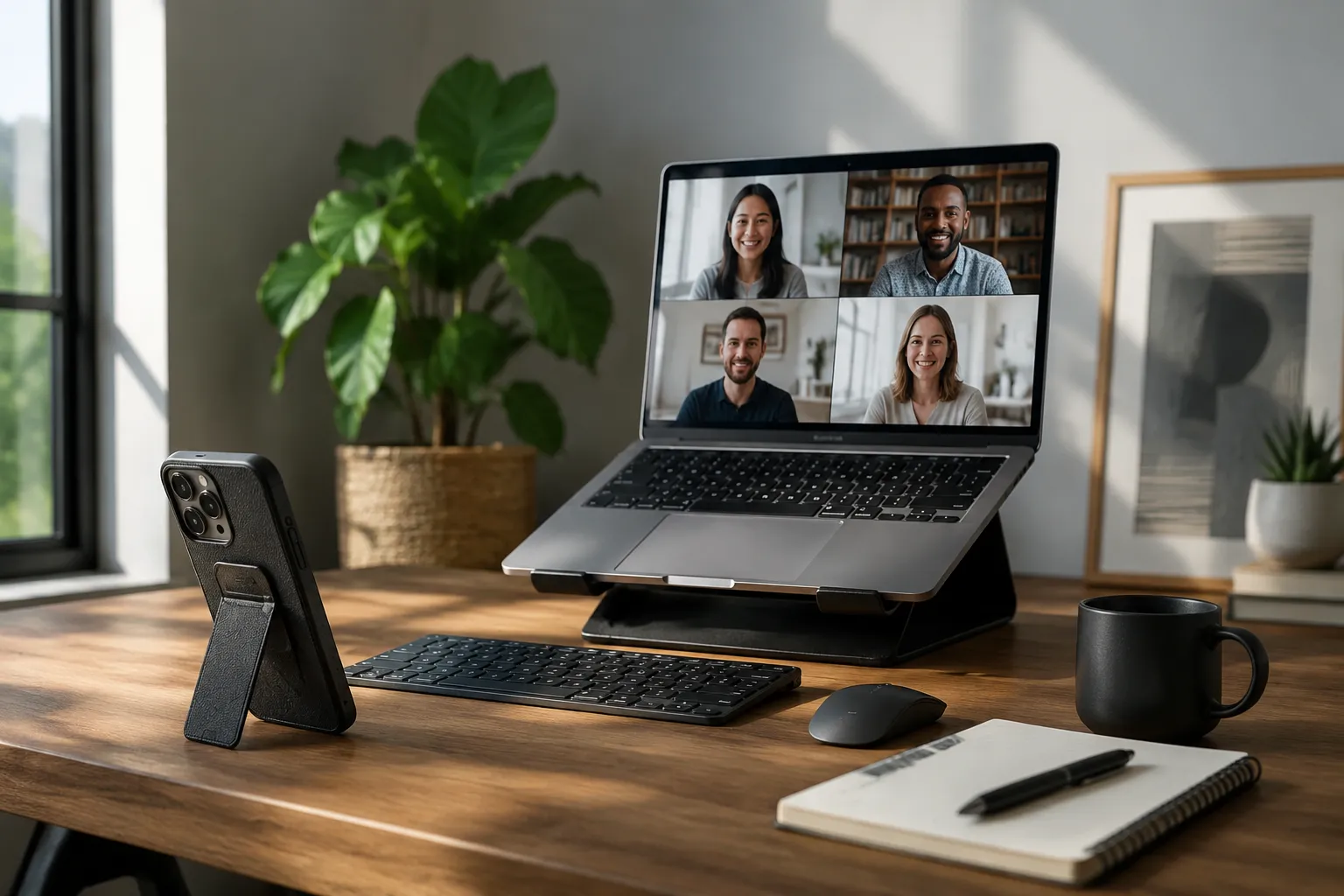
The default posture for a laptop video call is a confession. The camera sits below eye level, aimed up the nose and at the ceiling light, while the screen's own weight forces the lid back to a shaky 100 degrees. Every participant in a Zoom meeting becomes a penitent staring into a bright judgment. A phone perched against a coffee mug does a little better, but only until the mug slides or the notification chime rattles the whole assembly. Neither setup deserves to be called a studio. It is just a person hoping the other end of the call has low standards.
The five stands below fix that specific geometry problem. They raise the camera to eye level or above, lock the device at a stable angle, and give a person back the ability to gesture, lean forward, or stand up without dropping out of frame. Each one comes at the problem from a different physical direction, and the differences matter more than the brand names attached to them.
What separates a useful stand from a desk ornament is not build quality alone. It is the range of angles the hinge allows, the footprint the base leaves on a desk, and whether the device stays put when a person types. A stand that wobbles during a keystroke is worse than no stand at all, because the motion reads on camera as nervous energy.
The Nulaxy C3: The Budget Standard That Earned Its Reputation
The Nulaxy C3 has become the default recommendation on every office-supply listicle for a reason that has nothing to do with marketing. It is a six-point adjustable aluminum frame with silicone pads at every contact surface, and it folds flat enough to slip into a backpack side pocket. The hinge holds firm at any height from a flat 15 degrees to a near-vertical 60, which means it can lift a 16-inch laptop until the webcam sits level with a standing person's eyes.
Its real strength is the open base. Unlike clamshell stands that cradle the laptop from underneath, the C3 leaves the rear edge exposed, so airflow keeps the machine cool during a two-hour call. The open design also means a person can reach under the laptop to adjust cables without moving the whole rig. The silicone strips grip a polished desk hard enough that a firm typing session does not walk the stand forward.
The tradeoff is material honesty. The aluminum is thin, and the hinge mechanism, while functional, develops a slight creak after about a year of daily folding and unfolding. For someone who moves between a home office and a co-working space several times a week, that wear is acceptable at the price point. For a permanent desk setup, a heavier stand makes more sense.
The Roost Stand: A Different Kind of Geometry
The Roost Stand does not look like it should work. It is a single piece of folded nylon composite, shaped vaguely like a wishbone, with a pair of rubber-tipped prongs that grip the laptop's front edge. The laptop leans back against a lower lip, and the whole assembly rises to a height that puts the screen at a standing person's eye level. There is no hinge, no adjustment knob, and no locking mechanism. The angle comes from a series of notches that the support arm clicks into.
That simplicity makes it the lightest serious stand on the market. At 4.7 ounces, it disappears into a bag in a way that the Nulaxy cannot match. The tradeoff is a narrower range of usable angles. The Roost works best with the screen nearly vertical, which is ideal for a person typing on an external keyboard while looking straight ahead. It does not accommodate the shallow, laid-back angle that some people prefer when they want to see the keyboard while they type.
A person who takes calls in coffee shops, airports, and borrowed conference rooms will find the Roost indispensable. A person who works in one room all day will find its single-purpose geometry limiting. The Roost is a travel tool first and a desk stand second.
The Rain Design mStand: The Desk Anchor
The Rain Design mStand takes the opposite approach from the Roost. It is a single slab of aluminum, milled into a gentle ramp with a ventilated back panel and a raised lip at the front. There is no folding mechanism, no portable pretension. It sits on a desk like a piece of furniture and weighs just over two pounds. The mStand does not adjust height, does not collapse, and does not pretend to travel. It simply holds a laptop at a fixed, ergonomic angle with the screen raised about six inches off the desk surface.
That fixed angle is a genuine asset for video calls. The mStand tilts the screen back slightly, which means the webcam points down at the face from a flattering angle rather than up the nostrils. The aluminum body also acts as a passive heat sink, pulling warmth away from the laptop's underside during long calls. The front lip prevents the laptop from sliding forward, even when a person leans in to adjust the microphone or take a note.
The limitation is ergonomic, not mechanical. At six inches of lift, the mStand does not bring the webcam to eye level for most people. It is a height that works well for a person who already uses an external monitor and wants the laptop open as a secondary display, or who sits tall and wants the camera just above the chin line. For a true eye-level camera, the mStand needs to sit on top of a stack of books or a monitor riser, which undermines its clean design.
The Soundance Laptop Stand: When Adjustability Becomes a Feature
The Soundance stand is the tallest of the five, and it is the only one that genuinely reaches standing-desk height. Its aluminum arm extends from a flat base to a top platform that can sit anywhere from six to twenty inches above the desk. The adjustment happens through a pair of wing nuts that loosen and tighten the arm's angle, which means the stand can hold a laptop at any height from a shallow recline to a fully vertical position with the screen at a tall person's eye level.
For video calls, that range matters. A person who stands during calls can place the screen at standing eye height without hunching. A person who sits in an adjustable chair can match the camera to their own sight line. The base is wide and heavy enough that the whole assembly stays planted even when the arm is at full extension, though a hard knock sends it wobbling for a second before the weight settles it.
The downside is that the Soundance looks like a piece of gym equipment. Its exposed aluminum arm, visible bolts, and utilitarian black base do not blend into a decorated office. It is a tool, not a furnishing. That is an acceptable trade for a person who prioritizes camera height over aesthetics, but it is a real aesthetic cost.
The MOFT Z: The Hybrid That Refuses to Pick a Lane
The MOFT Z occupies the strange middle ground between a phone stand and a full laptop stand. It folds from a flat sheet of bonded leather and fiberglass into a triangular prism, and it holds a laptop at two preset heights. The lower setting tilts the screen back at a shallow angle, while the higher setting raises it to roughly eye level for a seated person. The whole thing weighs less than a pound and sticks to the back of a laptop with a peel-and-stick adhesive mount.
That adhesive mount is the MOFT Z's defining characteristic, and it changes how the stand behaves. Because the stand attaches to the laptop itself, it moves with the machine. There is no separate base to align, no folding and unfolding ritual at the start of a call. A person just lifts the laptop, snaps the stand into its triangular shape, and sets it down. The camera angle is identical every time, because the stand's geometry is fixed relative to the laptop rather than relative to the desk.
The tradeoff is stability under load. The MOFT Z holds a laptop firmly when a person is typing lightly or gesturing during a call, but it flexes noticeably when a person types hard or rests a palm on the keyboard deck. The adhesive mount also leaves a permanent patch on the laptop's back panel, which matters for someone who swaps the stand between devices or resells their laptop later. The MOFT Z is a compromise for the person who wants the portability of the Roost and the eye-level reach of the Soundance, and who is willing to accept a bit of give in exchange for never having to adjust anything.
What the Camera Actually Sees
The measurable difference between these stands is not the height range or the weight or the material. It is where the webcam ends up relative to the eyes. A laptop sitting flat on a desk puts the camera roughly 12 inches below the average person's eye line, which produces the dreaded up-the-nose angle and a double chin that has nothing to do with weight. Raising the screen by six inches, the mStand's approximate lift, cuts that deficit roughly in half. Raising it by twelve or more inches, as the Soundance can, puts the camera at or slightly above eye level, which flattens the face and opens the eyes.
That single change does more for a video call than any lighting kit or 4K webcam. A camera at eye level makes a person look attentive and direct. A camera below eye level makes the same person look submissive and slightly uncomfortable, even when they are speaking with complete confidence. The stand is not an accessory. It is the difference between a person performing for a camera and a person having a conversation.
The second thing the camera sees is background movement. A stand that lets the laptop shift, even by a quarter inch, introduces a micro-jitter that reads as instability. The Nulaxy and the mStand both eliminate that jitter through sheer friction, while the MOFT Z's flex and the Roost's lightweight construction can transmit a desk vibration that shows up as a subtle shiver along the edges of the frame.
The Setup That Finally Works
A person who takes calls seriously will end up with two stands: a permanent one for the home desk and a portable one for travel. The mStand earns the permanent slot for its mass and heat dissipation, paired with a small monitor riser underneath to reach true eye level. The Roost earns the travel slot for its weight and its vanishing footprint in a bag. The Nulaxy serves the person who wants one stand that does both jobs acceptably. The Soundance serves the standing desk. The MOFT Z serves the person who moves their laptop between rooms throughout the day and refuses to carry a separate accessory.
The best test for any of them is not specification comparison. It is a recording. Set up the stand, start a recording on the laptop's built-in camera, and then talk for ninety seconds while gesturing naturally. Watch the playback and look at where the eyes land in the frame, whether the shoulders stay in shot when leaning forward, and whether the background trembles during a normal typing rhythm. The stand that passes that test is the right one, regardless of its price tag or its brand reputation. The stand that fails it, no matter how nicely it folds or how premium the aluminum feels, is just a prop for a worse version of the same call.