Every so often, a piece of workwear gear jumps the fence and lands squarely in the outdoor recreation market without changing a single stitch of its design. The carabiner carry case is having that moment right now. These are the pouches, sheaths, and holders built with a metal loop or a reinforced webbing pass-through on the back, meant to clip onto a D-ring, a belt loop, or the ladder lock of a tool belt. For decades, they were the quiet workhorses of construction sites, utility trucks, and warehouse floors. Now the same objects are showing up on hiking packs, climbing harnesses, and fishing vests.
What is happening here is not a marketing pivot. Brands are not repackaging the same product with a leaf logo and a 30 percent price increase, at least not most of them. The crossover is genuine because the requirements of a job site and the requirements of a trailhead overlap more than most people realize. Both environments punish gear that swings, snags, or falls. Both demand that a frequently used tool be reachable with one hand while the other hand is busy holding a rail, a rope, or a map. Both reward a case that stays put.
The Carabiner Was Always the Point
A pocket is a fine place for a multitool until the moment a person kneels down to torque a bolt and the tool jabs into a thigh. A pack is fine until the moment rain forces a person to dig through three layers of clothing to find a headlamp. The carabiner carry case answers both failures by keeping the object on the outside of the body, clipped to a point that is always in reach and always visible.
The cases themselves have a simple anatomy. A rigid or semi-rigid body holds the tool. A flap, a snap, or a tension strap secures the opening. On the back, a carabiner or a gate clip attaches to whatever anchor point is available. The best ones share a few traits: the clip is rated for real weight, the body does not flop around when the wearer walks, and the tool slides out without requiring a second hand to stabilize the case.
That last point matters more than the marketing photos suggest. A case that requires two hands to open is a case that forces a person to set down whatever they are holding. On a roof, that means balancing a nail gun on a shingle. On a trail, that means dropping a trekking pole. The design goal is single-handed access, and the cases that achieve it use a firm grip on the tool so the case stays attached to the belt while the hand pulls upward.
From Framing Crews to Fishing Vests
The classic example is the tape measure holder. A carpenter on a framing crew clips a leather or nylon sleeve to a belt, and the tape measure lives there, ready for a quick pull and a one-handed reholster. The same holder works on a hike when a person wants to carry a compact rangefinder, a GPS unit, or a small camera. The dimensions are close enough that the fit is snug. The retention strap that keeps a tape from bouncing out during a ladder climb does the same job for a rangefinder during a scramble over talus.
Another crossover is the screwdriver and bit driver sheath. On a job site, it holds a ratcheting screwdriver with a bit set. On a trail, it holds a lightweight fixed-blade knife or a folding saw. The belt loop on the back does not care what kind of handle is inserted. The material, often a waxed canvas or a heavy nylon, shrugs off the same scrapes whether the wearer is crawling through a crawlspace or pushing through manzanita.
There is also the utility knife holster. Utility knives are the default cutting tool on construction sites because the blades are cheap and instantly replaceable. The holsters that carry them are slim, low-profile, and clip tight to the body. Hikers and campers have started using these same holsters for small fixed-blade knives, because the profile sits flat against a pack waistbelt and does not poke into a rib cage when bending forward.
Why the Work Versions Beat the Outdoor Versions
Outdoor brands have tried to make their own versions of these cases, and the results are usually worse. The outdoor versions tend to use lighter materials, thinner webbing, and smaller clips to save weight. That sounds good on paper, but it produces a case that feels flimsy when a tool is yanked out of it one hundred times a day.
The work versions use heavier materials because they are expected to survive being hit by a falling two-by-four, dragged across concrete, and left in a truck bed overnight in the rain. A person does not need that level of abuse resistance on a weekend hike. But the weight penalty for that durability is often only a few ounces, and the durability is comforting in a way that is hard to quantify. Nobody regrets that their case survived being sat on, stepped on, or dropped into a creek.
Work versions also tend to have better retention. Outdoor gear manufacturers often assume that a case will be used gently, so they use a simple flap and a magnet. Work gear assumes the opposite: that the wearer will bend, crouch, climb, and move fast. The retention systems on work cases, whether a snap strap or a deep friction fit, are designed to keep the tool inside through violent motion. That same retention is what keeps a knife from launching out of a case when a hiker stumbles on loose scree.
The Clip Quality Divide
The carabiner itself is where the quality gap shows up most clearly. Many outdoor-oriented cases come with a lightweight wire gate carabiner that is fine for hanging a water bottle but not much else. The gate bends, the nose gets sticky, and after a season of use the clip fails to close cleanly. That is a nuisance on a pack. It is a hazard on a job site.
Work-grade cases use a locking carabiner or a heavy spring gate made from real steel or a thick aluminum forging. The gate action is positive, the nose seats fully, and the clip can handle a few hundred pounds of static load without deforming. For trail use, that level of clip is overkill in the best possible way. A person clips a case to a pack waistbelt, and the clip does not need to be checked every hour to make sure it is still closed.
There is a middle ground, and a few manufacturers have found it. They use the same heavy case body as their work line but swap the oversized belt loop for a carabiner that works with a pack daisy chain or a belt. The result is a case that costs a few dollars more but performs identically in both settings. Those are the cases worth seeking out, because they skip the compromises that come from designing specifically for one market.
What to Look For in a Crossover Case
The first thing to check is the anchor. A case with a fixed belt loop can be adapted to a pack by threading the loop through the waistbelt, but that is awkward and often impossible with a padded belt. A case with a real carabiner is immediately more versatile, since it can clip to a shoulder strap daisy chain, a belt, a pack loop, or the outside of a climbing harness.
The second thing is the opening. A case that requires two hands to open will not get used. Look for a flap that can be pulled with one thumb, or a snap that releases with a firm tug. The tool should slide out with a smooth pull, not a wrestle.
The third thing is drainage. Job sites are wet, and so are trails. A case with a small drainage hole at the bottom will not collect water when it gets rained on or dunked in a stream crossing. Cases without drainage become foul-smelling pockets of moisture that rust tools and rot stitching.
The fourth thing is the material. Thick nylon webbing and heavy canvas are the two standards. Waxed canvas has a classic look and breaks in nicely, but it absorbs water and takes a long time to dry. Ballistic nylon is uglier but sheds water and dries fast. For a case that will live outside a pack in variable weather, nylon is the more practical choice.
The fifth thing is the fit. Most cases are sized for a specific class of tool, but within that class there is variation. A tape measure holder sized for a 25-foot tape may not fit a 35-foot tape with a wider body. A knife sheath sized for a slim drop-point blade will be loose on a thicker blade. The best approach is to bring the actual tool to the store, or order from a retailer with a forgiving return policy.
A Few Specific Cases Done Right
Occidental Leather makes a tape measure holder that has been the standard on framing crews for decades. It uses a heavy leather body, a steel riveted belt loop, and a tension spring that grips the tape so it does not slide out when the wearer bends over. The same holder fits a compact binocular or a GPS unit with a similar form factor, and the leather develops a patina that looks better with age.
Husky and Klein Tools make nylon utility knife holsters that cost under ten dollars and clip securely to a belt or waistband. The nylon is stiff enough that the holster keeps its shape even when empty, so reholstering a knife is a one-handed push. The same holster works for a small folder or a multi-tool, and the low profile means it disappears under a pack hipbelt.
Diamondback, known primarily for tactical and law enforcement gear, makes a series of molle-compatible pouches that clip to webbing. These are overbuilt for trail use, but they excel when the task is technical: carrying a headlamp on a climbing harness approach, or keeping a satellite communicator accessible on a long ridge walk. The zippers are sealed, the fabric is a dense cordura, and the attachment system has no weak points.
The Climbing Harness Connection
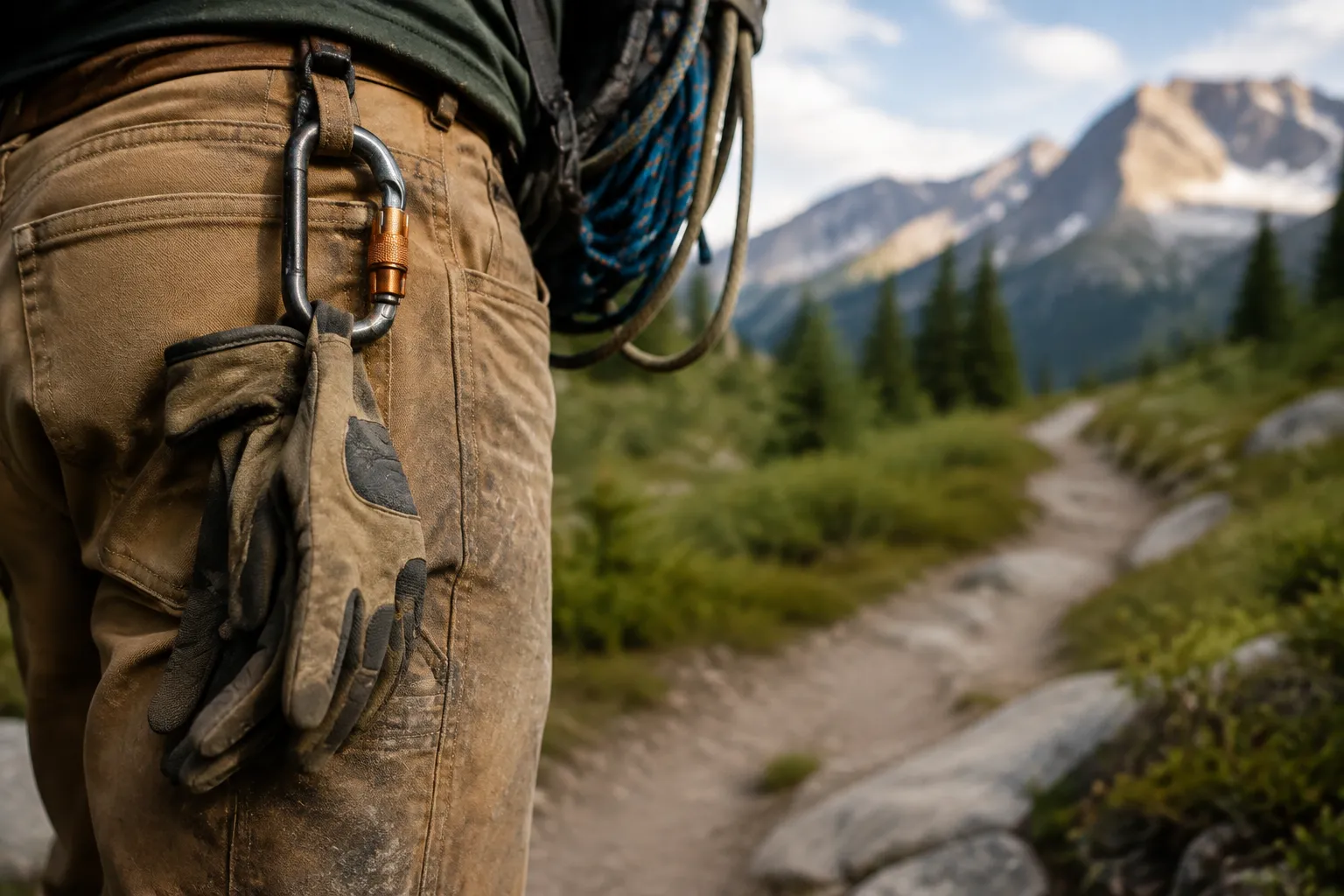
One crossover that deserves special mention is the use of work cases on climbing harnesses. Most climbing harnesses have gear loops made from a stiff webbing, and those loops accept the clip of a work case perfectly. Trad climbers already hang cams and nuts from those loops, but a small case clipped to a rear gear loop makes an excellent home for a multitool, a headlamp, or a stick of lip balm.
The advantage over a pack is that the case stays accessible while the climber is on the wall. A multitool clipped to a harness can be deployed one-handed while hanging from a rope, which matters when a piece of gear needs a quick turn of a screw or a loose bolt on an anchor needs to be checked. The work-grade retention strap keeps the tool from swinging out and hitting the rock during a lead fall.
This use case is not what the manufacturers had in mind, and it does not matter. The design constraints of the work site, namely that gear must stay put through violent motion and remain accessible without looking, turn out to be exactly the constraints of a climbing wall.
When a Pants Pocket Is Still Better
Not every tool belongs in a carabiner case. Something that gets used once a day, like a small folding knife for opening food packages, lives fine in a pants pocket or a pack pocket. The case adds bulk and a dangling point that can catch on brush. Something that never needs to be accessed quickly, like a repair kit that stays in the bottom of a pack, does not need an external mount.
The carabiner case earns its place when the tool is used frequently, when both hands are often busy, and when the wearer is moving through terrain that makes pocket access impractical. On a trail, that describes a camera. On a job site, that describes a tape measure. On a climbing approach, that describes a headlamp that might be needed as the light fades.
A final consideration is how the case rides. A case clipped to a belt on the side of the hip sits close to the body and moves with the wearer. A case clipped to a shoulder strap hangs lower and swings with each step. The right position depends on the tool and the task, but the general rule is to keep the case on the side of the body that does not carry the heaviest load.
The cases that bridge the gap between job site and trailhead are not a new product category. They are an old product category that happens to be right twice. A person who needs a knife at hand while walking a ridge and a person who needs a knife at hand while walking a roof have the same requirement, and the same piece of gear is the honest answer for both.