The pocket and the dashboard are having a turf war, and the phone is caught in the middle. For years, the carry debate was simple: front pocket or back pocket, screen in or screen out. Then the magnetic mount arrived on the scene and turned the car's air vent into a docking station. Now the question is not where the phone rides during the day, but where it lives during the commute, and the answer says more about a person's relationship with their device than any spec sheet ever could.
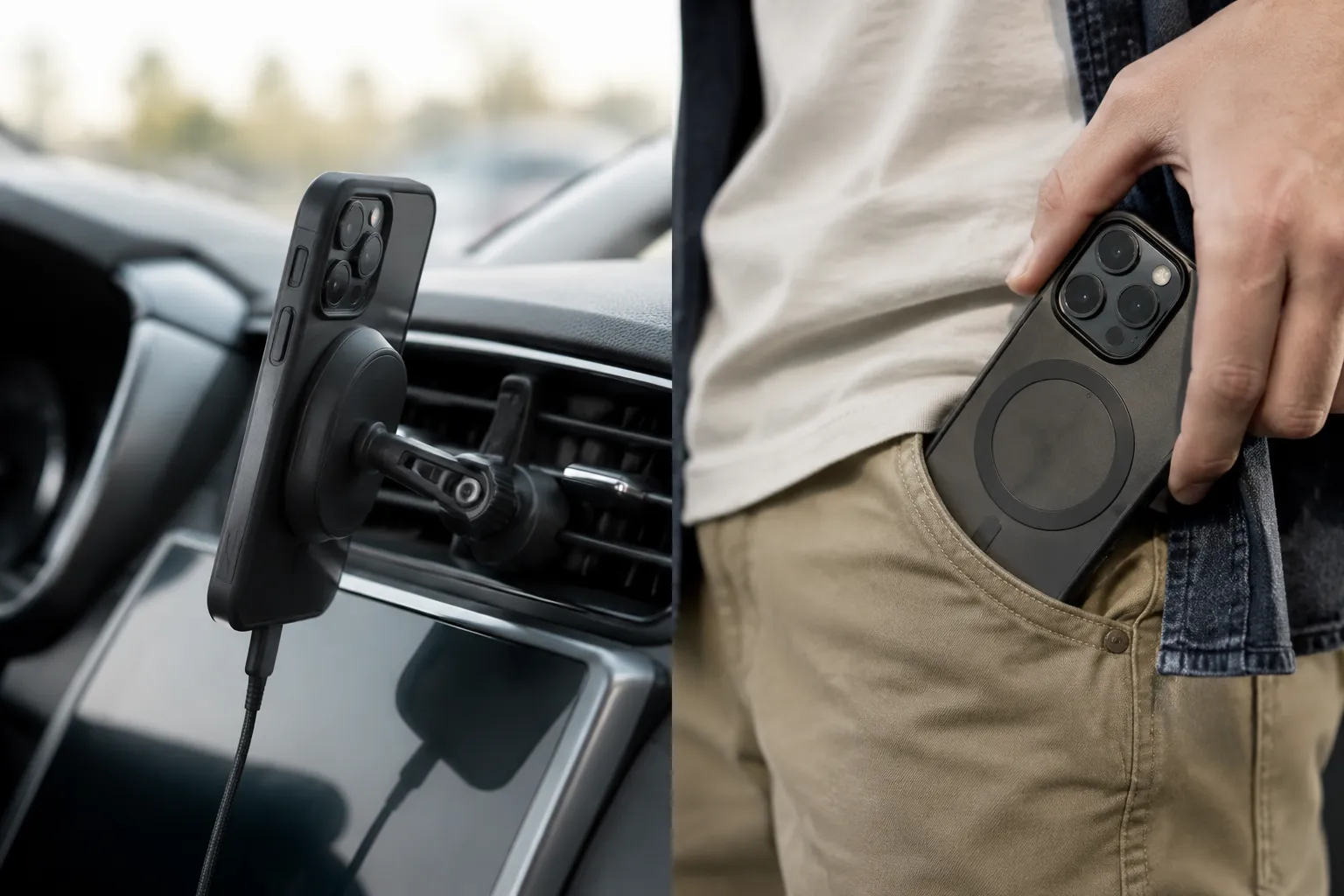
The MagSafe car mount solved a problem that most people did not know they had until they tried one. The old dashboard cradle required two hands, a plastic claw, and the patience of a person assembling flat-pack furniture at 7:45 in the morning. The magnetic mount needs one hand and a second of proximity. The phone snaps into place like it belongs there, which is precisely the illusion that makes the thing so seductive. It feels less like mounting a device and more like returning it to its natural habitat.
But the mount has a shadow, and that shadow is the pocket. The same person who loves the magnetic snap in the car will slide the phone into a jeans pocket and feel the difference immediately. The pocket does not care about alignment. The pocket does not offer a satisfying click. The pocket simply holds the device in place with the quiet dignity of a fabric envelope, and it asks nothing in return except that the phone not be absurdly large.
The Commute Test
Run the comparison through an actual morning. A person walks out the door at 8:15 with a phone in the pocket, keys in the other pocket, and a coffee in one hand. The car is parked on the street. The phone comes out of the pocket, the coffee gets wedged between the knees, and the magnetic mount does its thing with a satisfying snap. The phone is now at eye level, angled toward the driver, ready for navigation or a podcast or the inevitable text that arrives at a red light.
The pocket version of this same commute looks different. The phone stays in the pocket until the car is started and the seatbelt is buckled. Then it comes out, gets plugged into a cable, and lies flat in the center console or the passenger seat. Glancing at it requires taking eyes off the road and looking down, which is exactly the wrong direction. For navigation, the pocket carry driver either rigs the phone against the dashboard with questionable physics or just listens to the turn-by-turn audio and hopes the voice is telling the truth.
This is where the mount wins, and it wins by a lot. A magnetic car mount turns a phone into a heads-up display. The glance to check a map or a song title is a fraction of a second, and the eye path is roughly the same as checking the rearview mirror. That is not a convenience feature. That is a safety feature dressed up as a convenience feature.
What the Mount Steals From the Wearer
The mount gives the phone a permanent home in the car, but it also anchors the device to the vehicle in a way that has consequences. Every time the phone snaps onto the mount, it is visible. Every notification lights up the cabin. Every text message preview becomes a glowing invitation to glance at something that is not the road. The phone that sits in a pocket or a bag has a natural barrier between the person and the ping. The mounted phone has no such barrier. It is out in the open, demanding attention with every vibration and chime.
There is also the matter of the phone leaving the car. A person who uses a magnetic mount gets accustomed to the snap, and then gets out of the car and walks into a store with the phone in hand because the pocket feels like an afterthought. The device that was safely docked thirty seconds ago is now in a bare hand, vulnerable to drops and awkward juggling. The mount trains the user to hold the phone more, which seems like a minor behavioral shift until the phone slips out of a hand that was never meant to carry it.
The mount also demands a phone case that plays nice with magnets. A thick protective case, the kind with a built-in kickstand or a card slot, can weaken the magnetic connection to the point where the phone rattles loose on rough roads. This forces a choice: switch to a slim MagSafe-compatible case or deal with the occasional tumble into the footwell. The pocket never asks such questions. A pocket accommodates any case, any thickness, any accessory. It is the most forgiving carry option ever designed, and it does not require a firmware update.
The Pocket's Quiet Strengths
The pocket is not glamorous, but it is reliable. It holds the phone with no battery drain, no alignment issues, and no dashboard clutter. The phone in the pocket is invisible to passersby, which matters in a city where a phone mounted on a windshield is an advertisement for a smash-and-grab. The pocket carry person walks through a parking garage without broadcasting their electronics to anyone with a crowbar.
Pocket carry also preserves the phone's battery in a way that a mount does not. The mounted phone sits in the car, often connected to power, often running navigation, often cooking in direct sunlight through the windshield. Heat is the silent killer of lithium-ion batteries, and a dashboard mount in summer turns the phone into a small oven. The pocket keeps the phone at body temperature, shaded, unplugged, and perfectly content. A person who carries in the pocket arrives at the destination with a phone that is cool to the touch and ready for the next task.
There is a tactile argument for the pocket as well. The phone in the pocket is a physical presence, a weight against the thigh that reminds the owner it exists. That may sound obvious, but consider the alternative. The phone on the mount is out of sight and out of mind until a glance is needed. The pocket phone is felt with every step. For people who lose their phone multiple times a day, the pocket offers a constant, grounding reminder that the device is exactly where it should be.
The Middle Path Nobody Discusses
The most honest answer to the mount-versus-pocket question is that a person should not have to choose permanently. The two options serve different phases of the day, and treating them as rivals ignores the obvious rhythm of a modern schedule. The phone lives in the pocket during the walk, the meeting, the errand. The phone moves to the mount when the car starts. The phone returns to the pocket when the destination arrives. This is not a compromise. This is a system.
The system works because each option covers the other's weakness. The mount handles the moments when hands are busy and eyes need to stay forward. The pocket handles the moments when the phone should be felt but not seen. The transition between the two takes two seconds, and the magnetic snap that makes the mount satisfying is the same snap that makes the pocket return feel final. The phone clicks home into the mount, and later it slides into the pocket with a sense of completion.
The people who struggle with this decision are usually the ones who try to pick a single carry style for all occasions. They commit to the mount and suffer the exposed phone in every parking lot. They commit to the pocket and fumble with navigation on unfamiliar highways. The better approach treats the carry style as situational, adapting to the environment rather than forcing one method to handle every scenario.
Magnetic Cases Change the Math
The hardware landscape shifted when phone cases started shipping with magnets built in. A person who used to carry a naked phone can now add a MagSafe-compatible case and get the best of both worlds. The case adds negligible bulk, maintains the magnetic connection, and still slides into a pocket without catching on the fabric. The old objection that a mount requires a case compromise has largely evaporated.
But the magnetic case introduces its own quirk. The phone with a magnetic case will stick to any metal surface. A steel desk, a refrigerator, a gym locker, a friend's metal water bottle. The phone becomes a small magnet that collects ferrous debris and occasionally attaches itself to surfaces at awkward angles. The pocket does not care about metal surfaces. The pocket is made of cotton or denim or wool, and it holds the phone without any magnetic theatrics.
The case also scratches the phone's back if the user is not careful. The magnetic ring inside the case can pick up tiny metal particles that grind against the glass or aluminum back, leaving hairline marks over months of use. The solution is a case with a smooth interior lining, but not every case bothers with that detail. The pocket, again, avoids the issue entirely because the fabric lining of a good pair of trousers is softer than any phone case material.
The Car's Design Decides
Not every car interior welcomes a magnetic mount. The air vent mount requires vent slats that are horizontal and sturdy. Some luxury cars have vents that are too narrow, too wide, or too flimsy to hold a phone steady. The dashboard mount requires a flat surface and adhesive that survives temperature swings from freezing winter mornings to baking summer afternoons. A person who owns a car with awkward interior geometry may find that the mount option is simply not viable, regardless of preference.
The pocket, by contrast, works in every car ever made. It does not care about vent design. It does not require adhesive or a clip. It does not rattle on rough pavement or slide off the mount during a hard turn. The pocket is the universal car mount, present in every vehicle since the first pair of trousers hit the road. The only requirement is a lap or a center console for the phone to rest in during the drive, and even that is optional because the phone can simply stay in the pocket for the whole trip.
For drivers who use their phone primarily for music and hands-free calls, the pocket is enough. The audio connects via Bluetooth, the phone stays tucked away, and the driver never touches the screen. For drivers who rely on visual navigation in unfamiliar territory, the mount is close to essential. The difference is not about preference. It is about the task at hand, and honest drivers know which category they fall into.
The Walking Factor
A phone on a magnetic mount is a stationary object. It belongs to the car. A phone in a pocket is a mobile object, ready to accompany its owner through every doorway and down every sidewalk. The distinction matters more than most people realize because the phone is not just a navigation device. It is a camera, a wallet, a ticket, a flashlight, a communication tool. The moment the phone is left on the mount, the driver loses access to all of those functions.
The habit of leaving the phone on the mount is a real phenomenon. People get out of the car, walk toward the store, and realize halfway across the parking lot that the phone is still attached to the dashboard. The walk back is annoying. The alternative is developing a routine where the phone leaves the mount the moment the engine turns off. That routine takes discipline, and discipline is exactly the thing that fails at the end of a long day.
The pocket carry person never has this problem. The phone is already with them, always, because it never left. The trade-off is that the pocket carry person must reach into a pocket while driving to retrieve the phone, which is a distraction in its own right. But a person can pull over to grab the phone. A person cannot pull over to retrieve a phone that is sitting on the kitchen counter because the mount made it feel optional.
The Verdict on the Vent
After hundreds of commutes and countless snap-and-go transitions, the mount earns its place for anyone who drives in unfamiliar areas or relies on navigation. The pocket earns its place for everyone else, and for the moments when the phone needs to disappear. The two are not enemies. They are different tools for different phases of a life that involves both driving and walking.
The real question is not whether a mount is better than a pocket. The real question is whether the phone should be visible or invisible during the drive. A mount makes the phone a co-pilot, an active participant in the journey. A pocket makes the phone a passenger, present but quiet, ready when needed but not demanding attention. Most people need both roles at different times, and the people who enjoy their commutes the most are the ones who know which role they need on any given day.
The magnetic snap is satisfying, but so is the quiet slide of a phone into a well-worn pocket. One announces itself. The other simply works. The best carry style is the one that gets forgotten entirely, because the phone becomes an extension of the day rather than an object of constant negotiation. Whether that happens on a vent mount or against a thigh is a matter of roads, routines, and the small honest calculation of where the phone needs to be when the car stops moving.