The rolling suitcase is one of the most settled pieces of technology most people own. The design has barely wavered in decades: a hard or soft shell, two wheels or four, a telescoping handle that clicks into place. It works. And yet there is a specific, nagging failure point that frequent travelers know well, the moment when the telescoping handle is not enough. A person is wearing a backpack over one shoulder, carrying a coffee in one hand, and trying to drag a second bag by its top handle with the other. The rolling suitcase demands a free hand for steering. The moment that hand is occupied, the suitcase becomes dead weight.
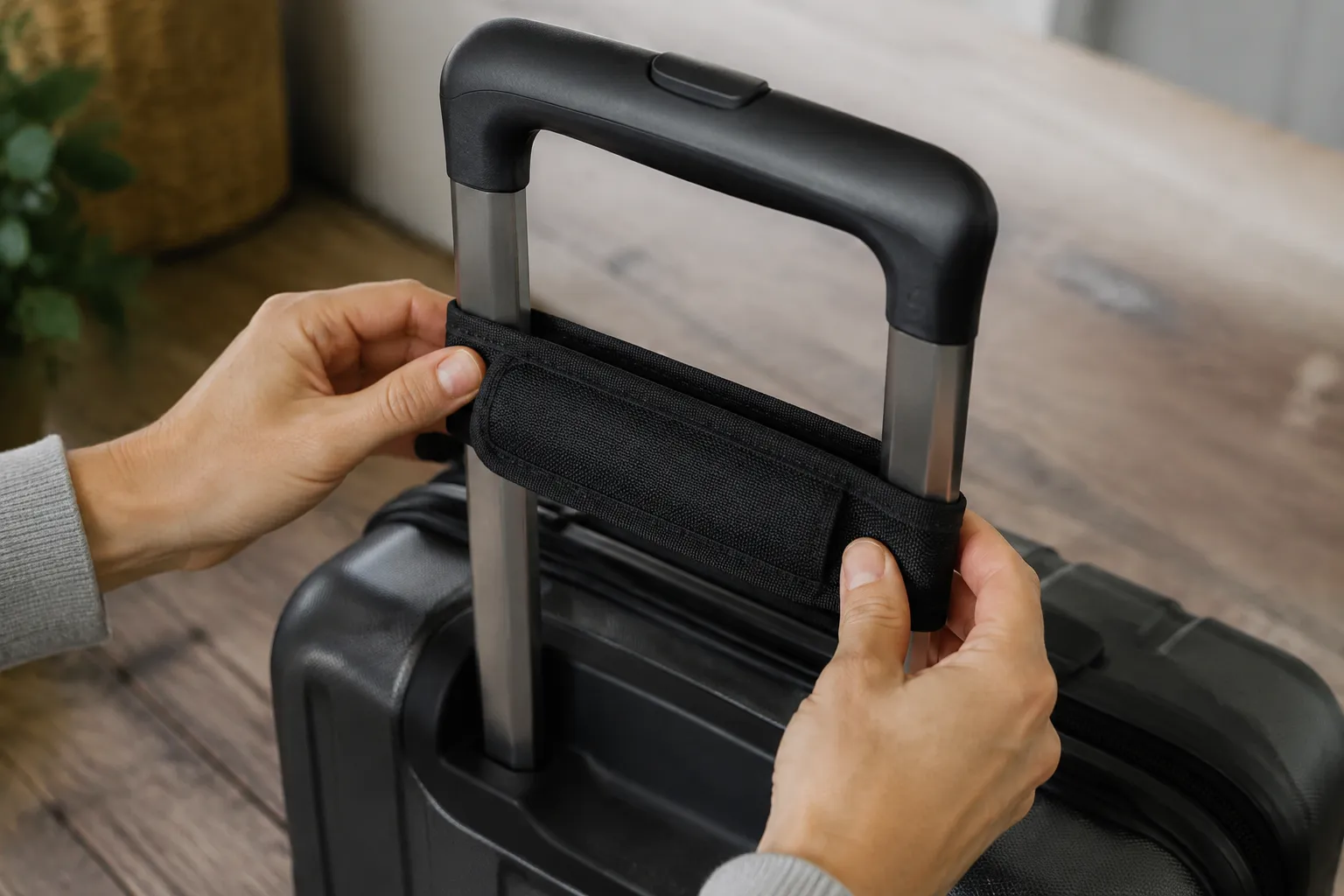
That is where the handle sleeve enters the picture. It is a simple accessory, essentially a padded wrap that fits around the telescoping handle of a rolling bag, with a slim sleeve or strap on the outside. The idea is to let a second bag, usually a duffel or a backpack, slide down over the handle and rest on top of the rolling suitcase. The traveler then pushes the whole stack with one hand. It sounds almost too simple to matter. In practice, it changes the entire calculus of how a person moves through an airport, a train station, or a city street.
The Physics of the Stack
Anyone who has ever tried to balance a backpack on top of a rolling suitcase without a sleeve knows the problem. The backpack slides off at the first bump. The suitcase tips forward because the weight sits too far back. The traveler ends up walking with one hand on the suitcase handle and the other arm wrapped awkwardly around the backpack, which is a posture that looks uncomfortable because it is.
A handle sleeve solves this by giving the top bag something to grip. The sleeve wraps around the vertical handle posts, and the second bag's own handle slides into the sleeve's pocket. The weight of the top bag now presses down directly on the handle, which is exactly where the suitcase is designed to carry load. The center of gravity stays low because the top bag rests on the suitcase body, not floating in the air behind it. The whole assembly rolls as one unit.
The key detail is the sleeve's fit. A good sleeve is snug around the handle posts, not loose. If the sleeve can rotate around the handle, the top bag will wobble with every turn. The best designs use a hook-and-loop closure that pulls tight, plus a non-slip interior lining that grips the metal or plastic of the handle. The sleeve should also sit low enough that the top bag's handle can fully seat inside the pocket. A shallow pocket means the bag sits high and precarious. A deep pocket, around 8 to 10 inches of usable space, locks the bag in place.
There is a weight limit to all of this, and it is lower than most people expect. A rolling suitcase handle is built to be pushed and pulled, not to support a 40-pound duffel pressing straight down for hours. The internal mechanism, the locking pins and the sliding tubes, will eventually fatigue. A reasonable ceiling is around 15 to 20 pounds for the top bag. That covers a personal item, a work backpack, or a small weekender. It does not cover a fully loaded checked bag.
What It Does Not Fix
It is worth being honest about the limits before praising the thing too much. A handle sleeve does nothing for a bag that lacks a sturdy top handle. Many modern backpacks have only a thin loop of webbing at the top, which is fine for hanging the bag on a hook but useless for sliding over a suitcase handle. The bag's handle has to be rigid enough, or at least structured enough, to stay open when the sleeve slides over it. A floppy fabric loop will just collapse.
The sleeve also does not fix the sideways problem. If the top bag is wider than the suitcase footprint, it will catch on door frames, armrests, and the shoulders of strangers in a crowded aisle. The stack is only as stable as its narrowest point. A suitcase with a 14-inch width paired with a 18-inch-wide duffel will require constant vigilance when navigating a narrow train corridor. The passenger will learn to angle the whole assembly sideways, which puts the top bag's weight off-center and makes the suitcase want to tip.
And then there is the matter of the suitcase itself. A two-wheeled suitcase, the kind that rolls on two wheels with the body tilted back like a cart, is a perfect host for a handle sleeve. The wheels sit at one end, and the handle is at the other, so the traveler tips the whole thing back and drags. Adding a top bag keeps the balance roughly neutral. A four-wheeled suitcase, a spinner, is a different animal. The traveler usually pushes it upright, and the handle is vertical. A top bag sitting on that vertical handle shifts the center of gravity backward, making the spinner want to fall over on its heels. The sleeve works, but the traveler must be more deliberate about keeping the stack tilted slightly forward to compensate.
The Material Question
Handle sleeves are sold in two broad camps. The first is the thin, unpadded sleeve, often made of a single layer of nylon or polyester with a stitched pocket. It weighs almost nothing, packs flat, and costs very little. It does the basic job of keeping a top bag from sliding off, but it offers zero comfort. The hard metal of the suitcase handle presses through the sleeve into the traveler's palm. On a long walk from a remote gate to baggage claim, that pressure point turns into a sore spot.
The second camp is the padded sleeve, which wraps the handle in a layer of foam or neoprene before the exterior pocket is added. This is the version worth owning. The padding does two things. It softens the grip for the hand, and it damps the vibration of the wheels. A rolling suitcase on hard airport tile transmits every wheel seam and crack up through the handle. The padded sleeve absorbs a meaningful portion of that chatter. The difference is noticeable within the first 50 yards of walking.
The material of the sleeve's outer face matters more than the padding. A slick nylon face will let the top bag slide off sideways when the traveler leans into a turn. A textured or rubberized face gives the top bag's own handle something to bite into. Some sleeves add a small elastic strap that loops over the top bag's handle to secure it further. That strap is not a gimmick. It is the difference between a bag that stays put on a straightaway and a bag that survives a sudden stop at a security checkpoint without sliding forward off the sleeve.
Packing Order Changes Everything
Using a handle sleeve forces a traveler to think about packing order in a way that a single-bag trip never does. The top bag, the one that rides on the sleeve, must contain everything needed between security and the hotel. That means the laptop, the tablet, the book, the travel documents, the snacks, and the light jacket all go in the backpack or duffel that rides on top. The rolling suitcase underneath holds the bulk, the clothes, the shoes, the toiletries, the things that can stay packed until arrival.
This reverses the instinct of many travelers, who pack the heavy, valuable items into the rolling suitcase and then stuff the backpack with the overflow. The result is a setup where the top bag is light and empty, which sounds fine until the traveler realizes that the light bag bounces on the sleeve with every wheel rotation. A light bag needs the constant downward pressure of the traveler's hand to stay put. A reasonably loaded bag, around 10 to 15 pounds, sits heavy enough to stay stable on its own.
The sleeve also changes how a person boards an aircraft. Most airlines allow one carry-on and one personal item. The two-bag setup, with the personal item riding on the carry-on's handle, is exactly the configuration the sleeve is built for. At the gate, the traveler lifts the whole stack by the rolling suitcase's top handle, which is now sheathed in the sleeve, and walks down the jet bridge with one hand free. The free hand is the real prize. It holds the phone, the passport, the coffee, or the handrail on a set of stairs.
A Concrete Look at the Stairs
The staircase is where a handle sleeve earns its keep or reveals its weakness. Consider a typical subway exit with no elevator and 30 steps. The traveler without a sleeve has two options: carry the backpack and drag the suitcase up with one hand, which is a back-twisting strain, or try to carry both at once, which is impossible for most people. The traveler with a sleeve grabs the rolling suitcase's top handle with both hands, lifts the entire stack, and climbs. The top bag stays put because it is locked onto the sleeve. The whole stack goes up as one piece.
The catch is that the lifted stack is now taller and heavier than a single suitcase. A person of average height lifting a 25-pound suitcase plus a 12-pound backpack up a flight of stairs is handling 37 pounds of awkward, shifting load. The sleeve keeps the bags together, but it does not make them lighter. The traveler must be honest about upper body strength. For some people, this is an easy lift. For others, the smarter move is to unclip the top bag, carry it separately up the stairs, then come back for the suitcase. The sleeve's value on stairs is that it makes that choice a deliberate one, not a forced compromise.
One more detail on stairs: the sleeve's padding protects the handle from the concrete edge of a step if the traveler sets the stack down for a rest. An unpadded handle will get scuffed and dinged. A padded sleeve takes the impact. It is a small thing, but it keeps a nice suitcase looking decent through years of travel.
Choosing the Right Sleeve for the Bag
The single biggest mistake in buying a handle sleeve is choosing one that matches the suitcase but not the top bag. The sleeve has to fit two objects: the handle it wraps around and the handle of the bag that slides into it. A sleeve designed for a thick, padded suitcase handle will flap loosely around a slim aluminum one. A sleeve with a narrow pocket will refuse to accept a duffel with a wide, flat handle.
The fix is to measure both handles before buying. The suitcase handle posts are usually between 0.5 and 1 inch in diameter and spaced 6 to 8 inches apart. The sleeve's wrap width should match that spacing. The pocket opening should be at least 2 inches wide to accept most bag handles, and the pocket depth should be checked against the bag's handle length. A handle that is too short will not reach the bottom of the pocket, leaving the bag sitting on top of the sleeve instead of inside it.
There is also the question of whether the sleeve stays permanently on the suitcase or gets packed away when not in use. A permanently attached sleeve adds a layer of bulk to the handle, which means the handle may no longer slide smoothly into its recessed position on some suitcases. Many spinner suitcases have a handle that retracts flush into the bag's back panel. A sleeve wrapped around it will prevent that flush fit. Travelers with this kind of suitcase should treat the sleeve as a travel accessory that goes on at the start of the trip and comes off at the destination, not as a permanent fixture.
The One-Handed Commute
The real test of a handle sleeve is not the occasional airport trip. It is the weekly commute, the person who takes a train into a city with a rolling bag and a backpack every Monday morning and does it again on Friday evening. That person learns quickly which handle sleeves are worth the money. The cheap unpadded sleeve will wear through at the seams within a few months of weekly use. The stitching at the pocket corners is the first to go, since that is where the top bag's handle exerts the most stress.
A better-made sleeve uses bar-tack stitching at stress points and a reinforced binding around the pocket opening. The hook-and-loop closure should be the heavy-duty variety, not the flimsy kind found on cheap cable organizers. The padding should be closed-cell foam, which does not absorb water and does not compress permanently after a few trips. A sleeve that meets these standards costs more, often twice as much as the basic version, but it will outlast the suitcase it is attached to.
The long-term benefit of the sleeve shows up in a specific way. A person who travels with a rolling suitcase and a backpack every week accumulates wear on the body, the shoulders from carrying the backpack, the wrists from gripping the suitcase handle at an awkward angle. The sleeve transfers the load to the rolling suitcase's wheels, which are designed to carry it. The traveler walks upright, with the stack rolling smoothly in one hand, and the other hand free. The posture is better, the strain is lower, and the commute stops being a daily wrestling match.
None of this makes the handle sleeve an exciting purchase. It is a piece of fabric with some foam and a pocket. But it is the kind of accessory that a traveler notices only in its absence, the trip where the backpack keeps sliding off, where the wrist aches from gripping bare metal, where the stairs require three separate trips. The sleeve is a small piece of kit that quietly eliminates a recurring annoyance. For the traveler who rolls through the world with more than one bag, that is a meaningful upgrade.