Phone cases occupy a strange corner of the accessory market. People will spend a thousand dollars on a device and then protect it with a two-dollar sleeve of molded thermoplastic polyurethane, or they will bolt on a slab of aerospace-grade composite that doubles the phone's weight and makes it look like tactical gear. The two approaches speak to different anxieties. One camp fears scratches and the way a bare phone slides off an armrest. The other camp fears the drop onto concrete that shatters a glass back into spiderwebs. Both fears are legitimate. The question is which one deserves to win, and the answer depends less on the phone itself than on how the phone lives.
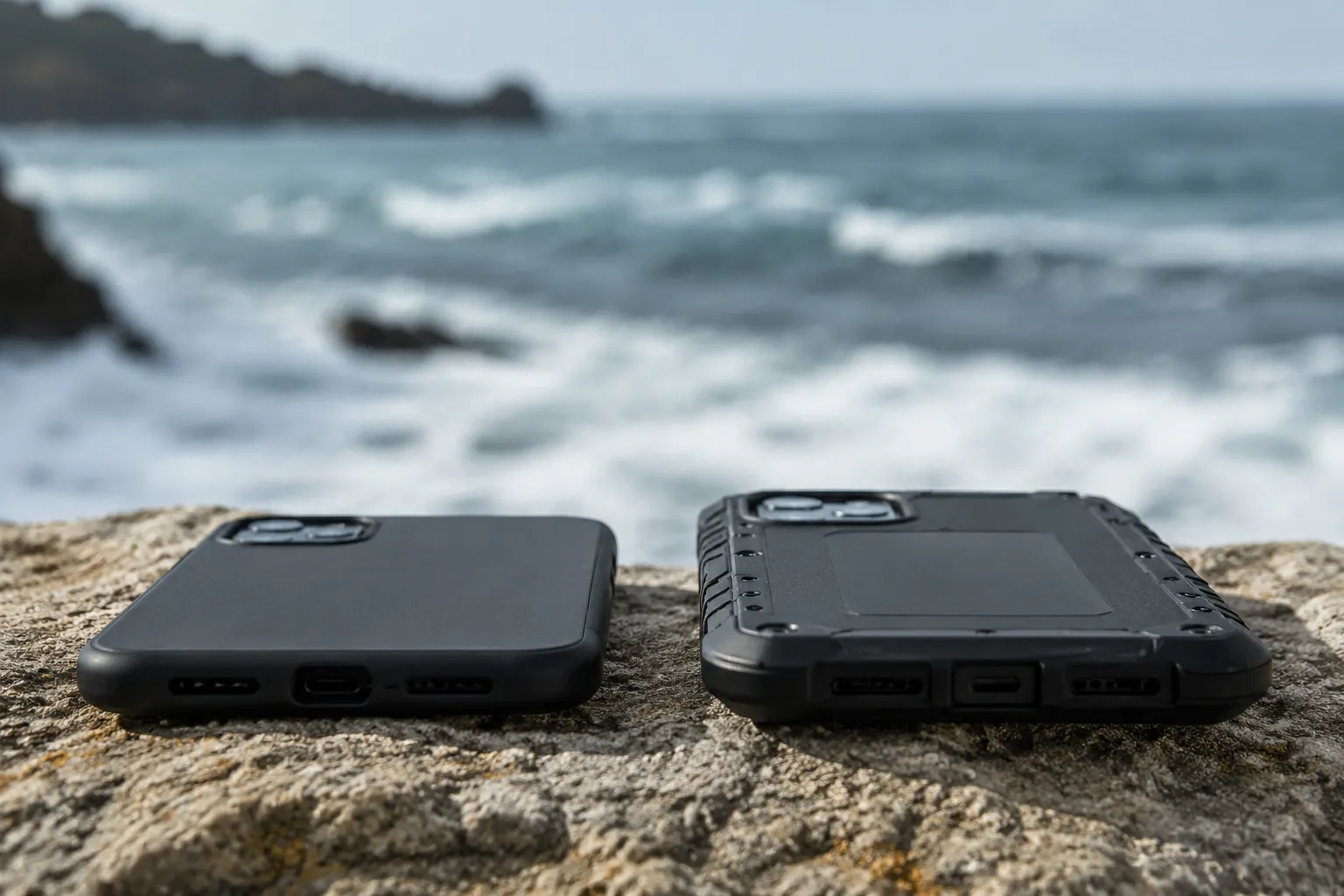
The slim case market has been lying to buyers for years. Manufacturers advertise 0.3-inch profiles and "barely there" feel, and the products mostly deliver on that promise. What they do not advertise is the compromise hiding in the materials. A case that thin has no room for an air cushion, no depth for a raised lip around the camera module, and no structure to absorb a corner impact. It is a scratch guard with delusions of grandeur. The marketing photos show a phone dropping onto pavement and bouncing cheerfully, but physics does not cooperate with a millimeter of polycarbonate. The case cracks, the phone absorbs the energy, and the screen becomes a collection of radial fractures.
Rugged cases tell the opposite lie. They promise military-grade protection, and they deliver it, but they omit the daily cost of that protection. A phone in a rugged case no longer fits in a pocket without a visible bulge. It no longer slides into a car mount designed for standard dimensions. The wireless charging coil sits farther from the pad, which means slower charging or no charging depending on the pad's strength. The buttons, buried under thick rubber, require a deliberate press that feels like operating machinery. Every interaction with the phone becomes slightly more effortful, and over two years of daily use, that friction adds up to a real tax on the relationship between person and device.
The middle ground exists, but it requires honesty about what a case actually does. A case protects against three distinct threats: scratches and abrasion, drops from hand or pocket height, and the rare falls from greater distances like a bike mount or a balcony railing. No single product handles all three equally well. The person who needs protection from a two-story drop should buy a rugged case and accept the bulk. The person who mostly worries about setting the phone on a granite countertop should buy a slim case and accept the drop risk. The problem emerges when buyers expect one product to cover all three scenarios and then blame the case when it fails at the one job it never claimed to do.
The real decision point is drop frequency, not drop severity. A person who works outdoors, moves between job sites, or carries the phone in a bag with tools and keys will drop it more often. That person needs impact protection and should choose a rugged case with reinforced corners. A person who works at a desk, commutes by car, and handles the phone mostly indoors will drop it rarely, and when it does fall, it will likely fall onto carpet or office flooring. That person can wear a slim case and accept the modest risk because the probability of a damaging drop is low. The mistake is buying for the worst case scenario when the actual usage pattern suggests a much gentler life.
Grip deserves more attention than the specs sheets suggest. Most drops happen during the first few seconds of handling, when the phone slips from a hand that was not ready. A bare phone made of glass and aluminum is dangerously slick, especially after hand cream or in humid weather. A slim case with a matte or textured back solves this problem completely. A rugged case with a rubberized surface solves it too, but at the cost of pocketability. The texture matters more than the thickness. A well-textured slim case at 1.5 millimeters will prevent more drops than a smooth rugged case at 4 millimeters, because the slim case simply stays in the hand longer.
Camera protection has quietly become the deciding factor in recent years. Smartphone camera modules now protrude several millimeters from the back of the device, and that glass lens array is the most expensive single component to replace. A drop that lands on the camera corner can shatter the lens cover even when the rest of the phone survives. Slim cases often leave the camera rim exposed or provide only a token lip that barely clears the glass. Rugged cases typically surround the entire module with a deep bezel that keeps the lenses completely recessed. For anyone who uses the phone as a primary camera, this single feature may justify the extra bulk of a rugged case. The trade-off is not between weight and protection. It is between protecting the screen and protecting the lenses.
Screen protection follows a similar logic. A case with a raised front lip keeps the glass off the table when the phone lands face-down, and that lip height is directly proportional to case thickness. Rugged cases offer substantial lips, often 2 millimeters or more, which means the screen rarely touches any surface. Slim cases offer a token lip that clears the glass by fractions of a millimeter, enough for a flat drop but not enough for a drop onto gravel or uneven pavement. Anyone who has ever picked up a phone from a sidewalk and found a single point of impact on the screen understands the value of that extra millimeter. The screen protector market exists precisely because slim cases cannot solve this problem alone.
Heat is the overlooked variable. A phone in a rugged case runs measurably hotter during sustained use because the thick materials insulate the chassis and trap the heat generated by the processor. Navigation in a car mount with the screen at full brightness will push a rugged-cased phone into thermal throttling much faster than a bare or slim-cased phone. The display dims, the processor slows, and the user wonders why the phone feels sluggish. The slim case, by contrast, adds negligible thermal resistance. For anyone who uses the phone for extended GPS sessions, video recording, or mobile gaming, the slim case is the better thermal choice. A hot phone is a slow phone, and no amount of drop protection compensates for a device that cannot sustain peak performance.
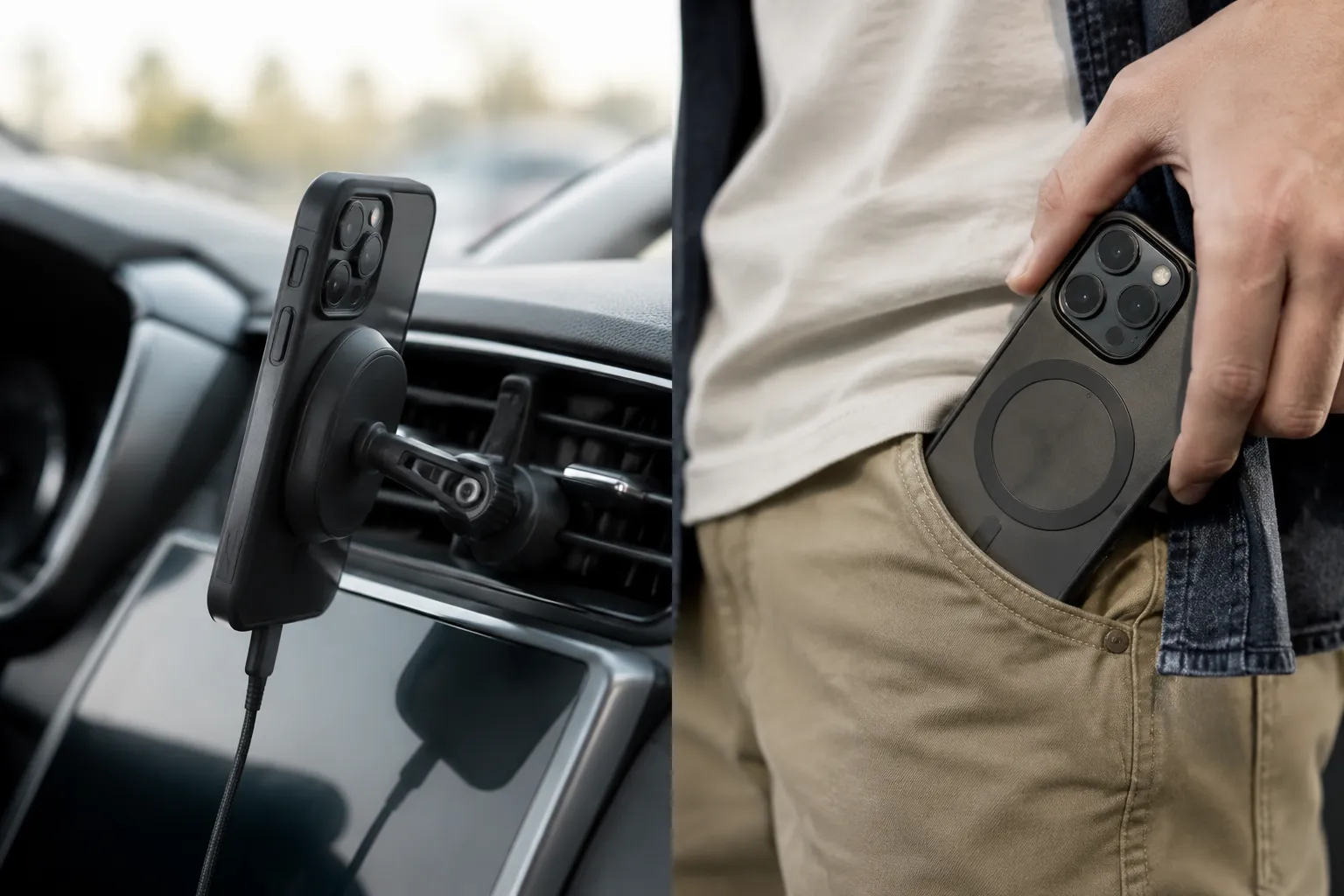
MagSafe and wireless charging add another layer of complication. The magnetic alignment rings in recent phones need the case to be thin enough for the magnetic field to pass through. Most slim cases work fine. Many rugged cases interfere, either because the material thickness blocks the field or because the case includes metal components that disrupt alignment. The result is a phone that charges slowly or fails to attach to magnetic car mounts and wallets. Some rugged cases have adapted with built-in magnet rings, but these add cost and still require the phone to sit at a precise distance from the charging pad. The slim case wins this category decisively, and for anyone who has built a life around wireless charging, that advantage is difficult to surrender.
Pocket fit shapes the daily experience more than any spec sheet measurement. A phone at 7.9 millimeters thick in a slim case reaches about 9.5 millimeters, which fits comfortably in most front pockets. The same phone in a rugged case reaches 13 to 15 millimeters, and the difference is immediately noticeable when sitting down. The case catches on the pocket seam, creates a visible outline through the fabric, and presses against the thigh. Women's pockets, already shallower and often narrower, make rugged cases nearly unusable without a bag. This is not a minor comfort issue. It is the difference between carrying the phone without thinking about it and constantly adjusting the device every time the wearer stands or sits.
The durability of the case itself matters too, though it rarely appears in reviews. Slim cases wear out. The TPU edges yellow after a few months of sun exposure, the matte coating rubs off at the corners, and the case eventually develops a permanent looseness that lets dust and grit work their way between the case and the phone. A rugged case, built from harder composites and thicker rubber, will look nearly identical after two years of abuse. The slim case user replaces the case every six to twelve months, which means the slim case is not actually cheaper over the life of the phone. The rugged case is a one-time purchase that outlasts the device itself. This calculus rarely appears on the product page, but it should.
There is also the question of what the case signals. A rugged case in a boardroom or a client meeting reads as either practical or clumsy depending on the industry. A slim case made of leather or aramid fiber reads as deliberate and polished. These are superficial concerns, but phones are visible objects carried into every meeting, every dinner, every commute. The case says something about how the owner relates to the device, and for some people, that message matters. The person who treats the phone as a tool will choose differently from the person who treats it as an extension of their personal style. Neither choice is wrong, but pretending the choice does not exist is a kind of denial.
The hybrid option deserves consideration for the chronically undecided. Several manufacturers now produce cases with a slim back panel and removable bumper corners, or a two-piece design that allows the user to strip off the outer armor layer when the phone stays indoors. These products add complexity and often cost more than either a slim or rugged case alone, but they solve the central dilemma by letting the protection level match the context. The phone wears the full armor on a hiking trip and sheds it for an evening out. The compromise is real: hybrid cases are rarely as slim as dedicated slim cases or as protective as dedicated rugged cases. They split the difference, and for many people, that is exactly where they want to live.
The honest recommendation depends on the phone's actual life, not the life the owner imagines. A phone that stays in a purse or a jacket pocket, emerges for calls and messages, and sleeps on a nightstand every night needs only a slim case and a screen protector. A phone that rides in a backpack with keys, gets dropped onto warehouse floors, and survives rain and dust needs the rugged case without apology. The middle path, a slim case with textured grip and a slightly raised camera lip, covers the majority of urban and office users who treat their phones carefully but not preciously.
The last consideration is replacement cost versus inconvenience cost. A shattered screen on a flagship phone costs anywhere from 200 to 400 dollars to replace, depending on the model and whether the repair voids the warranty. A rugged case costs 40 to 60 dollars upfront. The math seems to favor the rugged case, but the inconvenience of living with a brick in the pocket for two years has no line item. Conversely, a slim case at 20 dollars offers negligible protection but preserves the phone's original feel and handling. The person who drops phones once every few years should take the slim case and pay the repair cost if the drop ever happens. The person who drops phones monthly should take the rugged case and never think about it again. The choice is a bet on personal clumsiness, and most people know which side of that bet they fall on.