Somewhere around the third time a tablet slid off a café table and nearly cracked on the tile, the hunt for a proper everyday carry bag stopped being about aesthetics and started being about physics. The problem is not that the market lacks options. The problem is that most options commit to a single identity. A camera bag looks like a camera bag, with its Velcro dividers and tactical webbing, and it screams "valuable electronics inside" to anyone within twenty feet. A tablet sleeve protects the device and nothing else, leaving the charger, the field notes, and the lens cap to rattle around loose. The interesting question is whether a single sling can credibly do both jobs without compromising either.
The bag in question here is the Bellroy Venture Sling, in the 10-liter size. It arrived in a muted gray-green that photographs as almost charcoal, with hardware that looks brushed rather than painted. First impressions matter in this category, and the immediate feeling is that the materials are serious. The outer fabric is a recycled ripstop with a matte finish that does not feel like it will pill or scuff in the first week. The zippers are chunky, waterproofed, and they move smoothly even when the bag is stuffed. None of this is revolutionary, but it sets a baseline of quality that cheaper slings fail to reach within a month of daily abuse.
The tablet fit is the real test
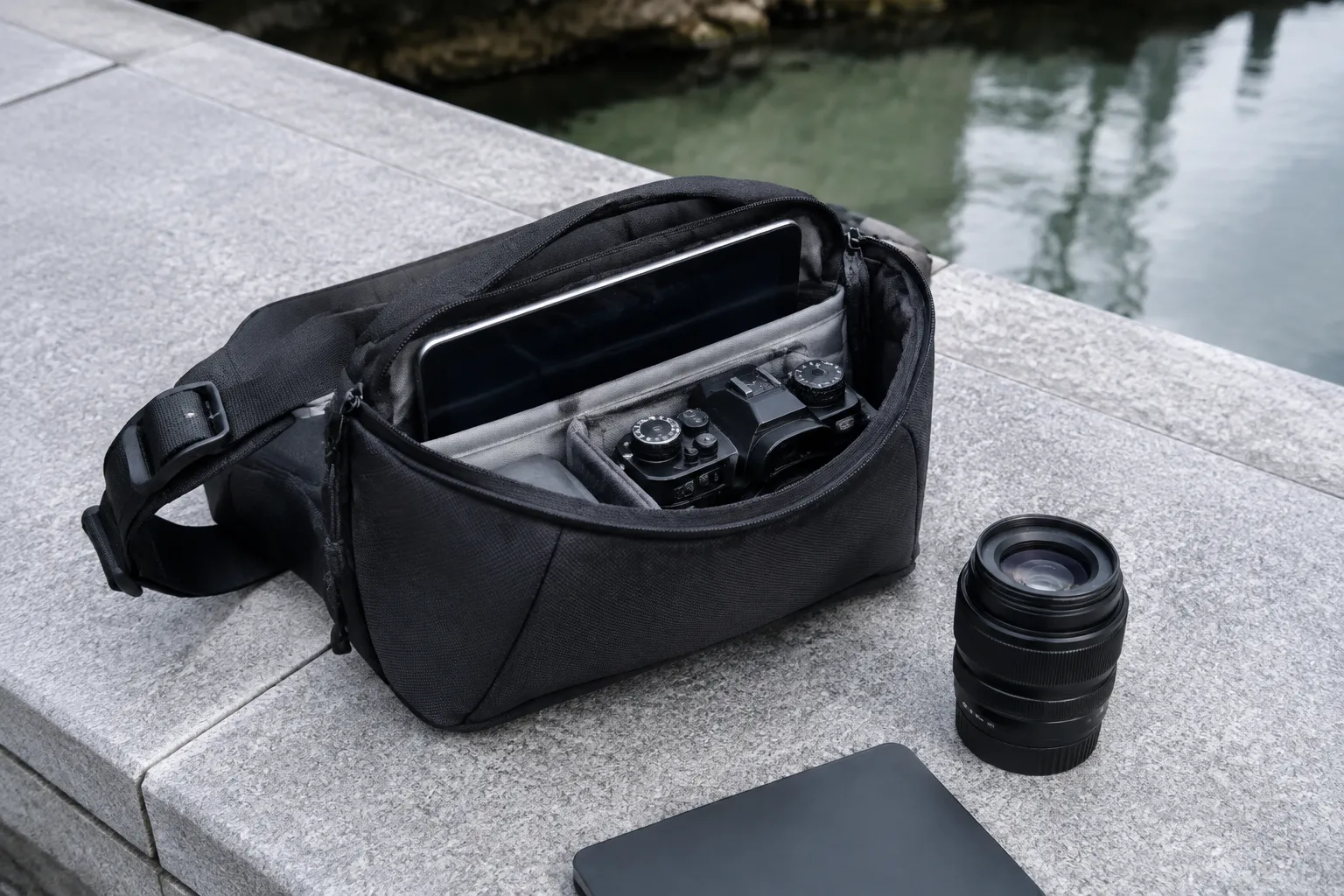
Most slings in this size class claim to hold a tablet, but the claim usually means "a small iPad Mini slides into the main compartment at a diagonal, scraping the zipper on the way in." The Venture Sling is different. An 11-inch iPad Pro fits flat against the back panel, inside a dedicated fleece-lined sleeve that is genuinely protective. The sleeve has enough structure that a person can slide the tablet in and out one-handed while walking, which matters more than it sounds. Fumbling with a bag at a security checkpoint or in a crowded train aisle is how tablets get dropped.
The sleeve is positioned against the back of the bag, which is where it belongs. That placement keeps the tablet close to the body, reducing the pendulum effect that makes loaded slings swing and bang against the hip. It also means the tablet is not pressing against the front panel, where a knock from a doorframe or a crowded escalator would transfer force directly to the screen. The design logic is sound, and it is the first sign that the bag was actually drawn around the devices rather than designed as a generic pouch with a tablet slot added as an afterthought.
For camera duty, the main compartment opens flat like a clamshell, which is the correct choice for gear access. A person can unzip the full length and see everything at once, no digging required. The interior is lined with a soft gray fabric that does not feel like it will scratch a lens barrel or a screen. There is a single padded divider that can be repositioned via Velcro, and it is enough to separate a body with a lens attached from a second lens or a small audio recorder. This is not a dedicated camera insert, and anyone expecting the modular grid of a Peak Design field pouch will be disappointed. The Venture Sling works best with a compact mirrorless setup: one body with a prime lens, one additional lens, and a small accessories pouch for batteries and cards.
How it carries when actually loaded
The weight distribution is the make-or-break detail for any sling, and the Venture Sling gets it mostly right. The strap is wide enough, at roughly 50 mm, to spread load across the shoulder without digging in. The strap also has a slight texture that keeps it from sliding off a jacket or a cotton t-shirt. A loaded bag stays where it was placed, which is a minor miracle for a category where bags constantly migrate from the shoulder to the elbow to the hand over the course of a walk.
The bag sits high against the upper back when worn across the body, which is the correct position for urban use. It does not hang at the hip like a messenger bag, and it does not swing forward when the wearer bends down to tie a shoe. The 10-liter size is compact enough that it does not interfere with a backpack worn simultaneously, which is a use case the designers clearly considered. A person can wear a full hiking pack and use the sling as a front-mounted day bag for quick access to a phone, a passport, or a camera. In that configuration, the bag becomes a chest rig, and it performs admirably.
The downsides of the high carry position become apparent in one specific scenario: reaching for the main compartment while the bag is worn on the back. The zipper pulls are accessible, but the clamshell opening requires swinging the bag to the front, which is a two-handed operation. There is no quick-access side pocket for a phone, and the front pocket, while useful for keys and a wallet, is not large enough for a phone with a thick case. A person who wants to grab a phone without taking the bag off will have to unclip the sternum strap and rotate the whole thing. It takes about four seconds, and after a week it becomes second nature. But it is a friction point that does not exist on smaller sling designs with dedicated phone pockets.
The pocket layout rewards planning
Inside the main compartment, a pair of mesh pockets line the front panel. They are deep enough to hold a passport, a small notebook, or a pack of cards, and the mesh is transparent enough to see contents at a glance. The back wall of the main compartment has the tablet sleeve, and there is a small organizational panel with a key clip and a few card slots. Everything has a place, which is good, because the bag does not have a lot of wasted volume. Every cubic centimeter is accounted for.
The front pocket is the one design decision that deserves criticism. It is a shallow, flat pocket that sits against the front panel, and it has a separate zipper. It works for flat items: a phone, a slim wallet, a pair of reading glasses in a hard case. It does not work for anything bulky. A set of keys with a car fob creates a lump that presses into the main compartment and eats into the space reserved for the camera or tablet. The pocket is also positioned on the outside curve of the bag, so when the bag is full and worn on the back, a person cannot see into it without taking the bag off. It is a minor frustration, but it is the kind of detail that accumulates over months of daily use.
The water bottle situation is the other notable gap. The Venture Sling has no external bottle holder, and a standard 500 ml bottle will not fit inside the main compartment when a tablet and camera are loaded. This is not a flaw so much as a trade-off. Adding an external bottle pocket would ruin the clean silhouette and add bulk. But it is worth stating plainly: this is a bag for gear, not for hydration. A person who wants to carry a bottle will need to hold it, clip it to the strap, or wear a separate backpack.
Weather resistance without a rain cover
The fabric and zippers are the least flashy but most important part of the daily-carry equation. The Venture Sling uses waterproof zippers throughout, and the outer fabric has a DWR coating that beads water on contact. In a light rain, the contents stay dry without any cover. In a proper downpour, the bag will eventually wet out, but the inner liner and the tablet sleeve provide a meaningful second layer of defense. The tablet sleeve itself is padded and fleece-lined, and it adds enough protection that a person would feel comfortable putting a device inside even if the outer shell got soaked.
There is no included rain cover, and that is fine. Rain covers for slings are fiddly things that get lost or left at home, and the whole point of a bag in this category is that it should not need one for normal use. A person caught in an unexpected storm can tuck the bag under a jacket and move on. The zippers will not leak from the top, which is the most common failure point on cheaper bags. This is an area where the price premium becomes visible. A thirty-dollar sling will soak through in a drizzle; this one shrugs off a proper rain shower.
What the strap and buckles actually do
The strap system deserves a closer look because it is where the bag's personality lives. The strap is not removable, which is a deliberate design choice. A removable strap is a common failure point, and it adds a buckle that can break or slide loose at the worst moment. The fixed strap is stitched through the back panel and anchored at both corners, and it feels like part of the bag rather than an attachment. The adjustment buckle is smooth and holds its position securely, but it is also easy to adjust on the fly. A person can loosen the strap to swing the bag around or tighten it for a run without stopping to fuss.
The sternum strap is a simple magnetic buckle that clips across the chest. It is a quiet but welcome addition. Without it, a loaded sling shifts and bounces during any activity more vigorous than walking. With it, the bag stays planted against the upper back. The magnetic buckle is easy to release one-handed, which matters when a person needs to shed the bag quickly to grab a camera shot. The only gripe is that the sternum strap is not adjustable in length, so it works best for average torso widths. A broader-shouldered person will find it pulls across the chest at an angle that is not quite natural.
A full day on the streets with both devices
The practical test was a full day that involved a morning ferry ride, a walk through a crowded market, a stop at a café for two hours of writing, and an afternoon of shooting street photography. The bag started the day with the iPad in the sleeve, a Fujifilm X-T5 with a 35 mm lens mounted in the main compartment, a spare battery and a card holder in the mesh pocket, and a phone in the front pocket.
The ferry ride was the first revelation. The bag sat on the lap without sliding off, and the tablet came out for reading without disturbing the camera setup underneath. That separation of access is the core value proposition, and it worked exactly as designed. In the market, the bag rotated to the front for a camera grab without needing to unclip the sternum strap first, because the strap was already loose enough for the rotation. The shot was captured in under ten seconds from decision to shutter, which is the whole reason to carry a sling instead of a backpack.
At the café, the bag hung from the chair back, and the tablet came out one-handed while the other hand held a coffee. The front pocket held the phone, and the flat profile of the bag meant it did not push the chair away from the table. During the afternoon walk, the weight was noticeable but not annoying. A loaded 10-liter sling is not a feather, and at roughly 1.5 kg with gear, it is a presence on the body. But the strap geometry kept the weight close to the spine, and by the end of the day there was no shoulder soreness and no need to switch sides.
The verdict hides in the details
The Bellroy Venture Sling 10-liter is not a perfect bag, and the shortcomings are worth naming. The front pocket is too shallow for anything useful. The lack of a bottle holder is a real constraint for warm-weather use. The sternum strap does not adjust for wider torsos. And the price, which lands north of 150 dollars, is hard to justify for someone who only carries a tablet and a phone on a commute.
But the core question, whether one sling can credibly handle both tablet and camera duty, is answered with a qualified yes. The qualification is that the gear must be compact. A full-frame body with a 24-70 mm zoom and an iPad Pro will not fit together comfortably. A mirrorless body with a prime lens and a tablet fits with room to spare. The bag is not a bottomless pit, and it rewards a person who edits their kit before leaving the house. That discipline is not a drawback. It is the difference between a bag that gets used and a bag that gets left at home because it is too heavy or too full to be convenient.
The real achievement is the tablet sleeve. Every other sling in this class treats the tablet as an afterthought, an item that can be slid into a padded slot if the camera gear is removed first. The Venture Sling integrates the sleeve into the structure of the bag, so the tablet is always protected and always accessible. That single design decision justifies the price for anyone who actually carries both devices daily. The bag disappears into a routine, which is the highest compliment a piece of carry gear can earn. It stops being an object and becomes simply the way a person moves through the city with the tools of their work in reach.