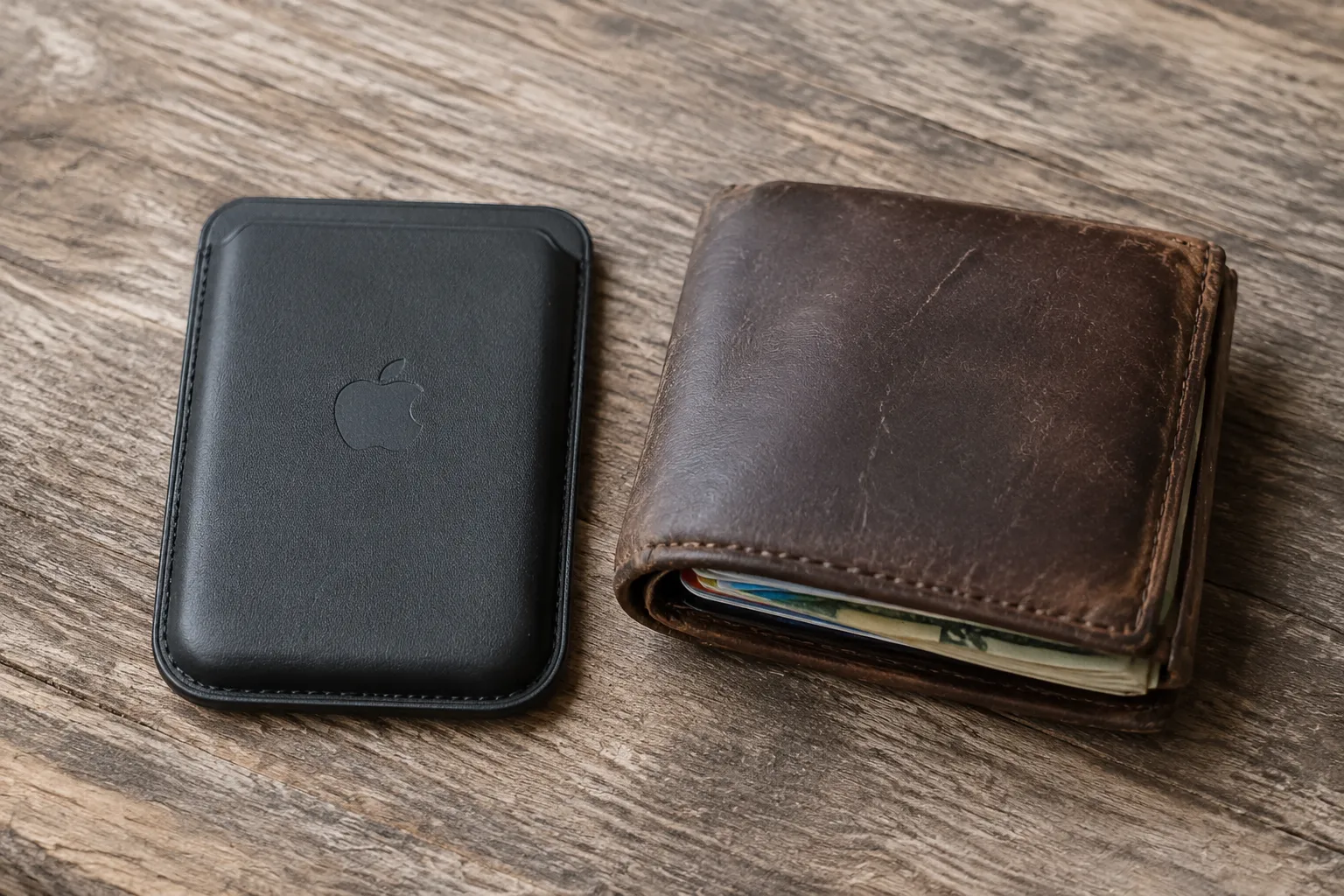
The leather bifold in a back pocket has been a quiet piece of infrastructure for a century. It carried cards, cash, receipts, and the occasional photograph, and it slowly reshaped the spine of whoever sat on it. The MagSafe wallet is younger than most smartphones still in use. Apple introduced the thing in 2020 alongside the iPhone 12, a slim pouch that clicks to the back of a phone with magnets. Comparing the two sounds like comparing a toolbox to a single screwdriver, but the comparison is worth making because the two objects answer the same question: how should a person carry the few plastic rectangles that prove they are who they say they are?
Most people do not carry a wallet because they love the leather. They carry one because the alternative, stuffing cards into separate pockets, ends in a frantic pat-down at a subway gate. The real question is what a person is willing to trade. The MagSafe wallet trades capacity and cash handling for a profound reduction in bulk. The traditional wallet trades pocket real estate for the ability to hold coins, folded bills, and a decade of accumulated loyalty cards. One of them is a tool. The other is a small archive.
The physics of the back pocket
A traditional wallet lives in the back pocket, and the back pocket is a terrible place for a spine. Sitting on a folded stack of leather and plastic tilts the pelvis and puts uneven pressure on the sciatic nerve. Chiropractors have made a quiet living off this habit for decades. The MagSafe wallet, by contrast, rides on the back of a phone, which means it ends up in a front pocket or a bag, never under a seated person's weight. For anyone who spends eight hours a day in a chair, that alone is a medical argument.
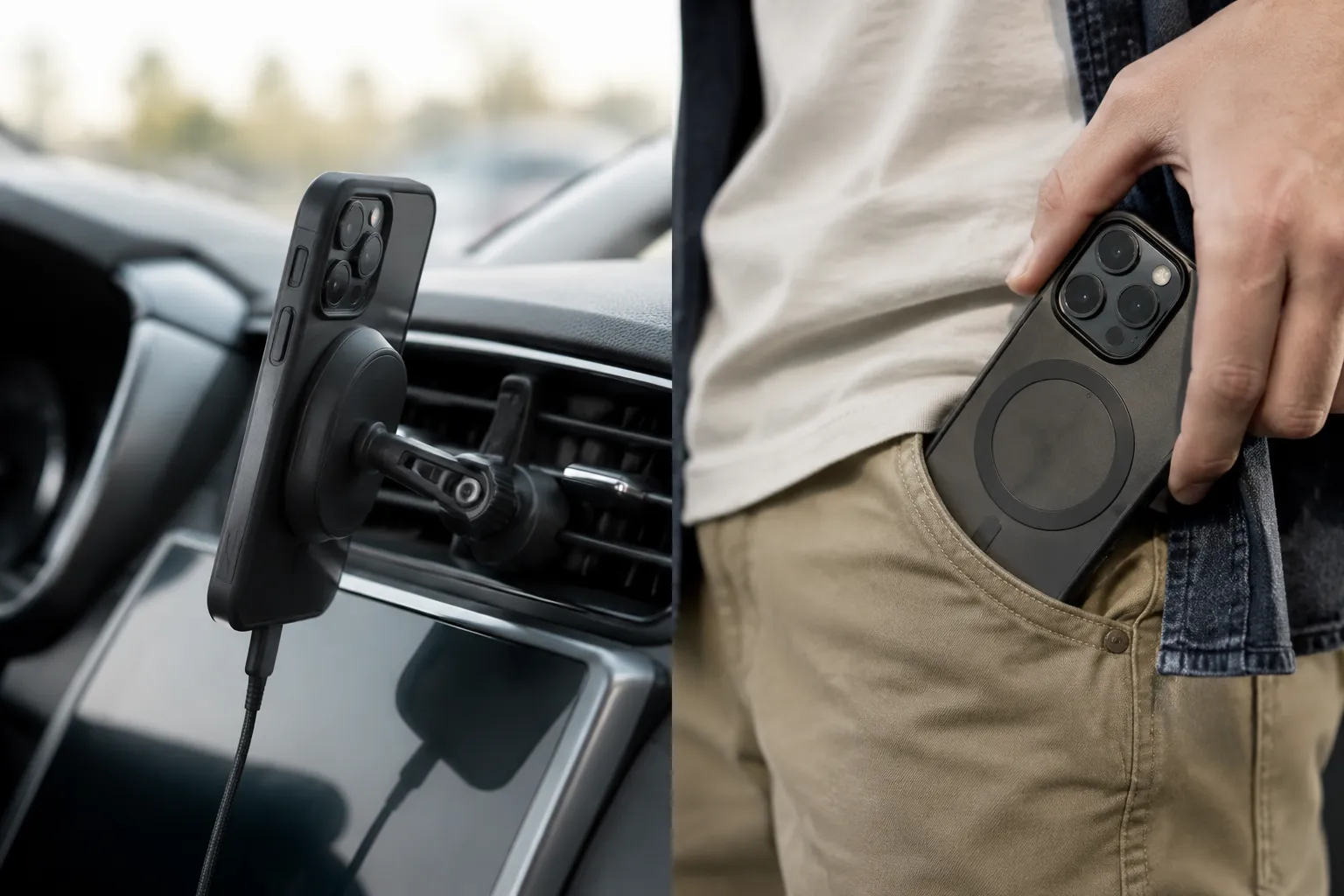
But the front pocket has its own physics. A phone with a MagSafe wallet attached is roughly the thickness of two smartphones stacked. In slim-cut trousers, that creates a bulge that reads as a minor medical condition. The phone becomes heavier, too. An iPhone 15 Pro with an attached wallet weighs about as much as a small deck of cards added to the hand, and after an hour of walking, the asymmetry in one pocket starts to annoy. The traditional wallet in the back pocket is at least symmetrical with nothing else back there.
The counterpoint is the pickpocket. A back pocket wallet is the easiest target in public transit history. A front pocket phone with a magnetically attached wallet is harder to lift silently; the owner feels the tug on the phone itself. Street crime is rarer than most people fear, but the asymmetry matters to commuters in crowded cities. The MagSafe wallet makes a person less attractive as a target, which is a real, if unglamorous, point in its favor.
What actually fits in the thing
Apple's own MagSafe wallet holds two or three cards, and third-party versions stretch to four. That sounds useless until a person itemizes what they actually use in a week. A transit card, a debit card, a driver's license. Many people rotate through exactly three cards daily. The rest of the contents of a traditional wallet, the reward cards, the insurance ID, the backup credit card, the folded emergency cash, sit untouched for months.
The moment the MagSafe wallet fails is the cash transaction. A person at a farmers market or a food truck who needs to hand over a five-dollar bill finds the MagSafe wallet has no slot for paper money. Some versions have a thin pocket that holds a single folded bill, but the fit is tight and the bill emerges creased and softened. The traditional wallet handles cash effortlessly, which is why it remains the default for anyone who lives in a city with a strong cash economy, or anyone over a certain age who remembers when a card machine failure meant finding an ATM.
Then there is the card count creep. A traditional wallet expands to fit a person's life: a new insurance card, a library card, a spare SIM card, a photo of a dog. The MagSafe wallet punishes expansion. Adding a fourth card makes the magnetic attachment weaker and the whole unit harder to pull off the phone. The limit is enforced by physics, not by choice. For people who like constraints, this is a feature. For everyone else, it is a ceiling.
The magnetic attachment as a daily gamble
The core engineering bet of the MagSafe wallet is that magnets strong enough to hold a wallet through a day of movement are also strong enough to be annoying. The attachment is rated to hold the wallet against a firm shake, but real life involves softer failures. A phone slipped into a bag next to a water bottle, and the wallet catches on the bottle's sleeve and peels off. A phone dropped on a sidewalk, and the wallet skids away separately, scattering cards across the concrete. The traditional wallet never falls off its owner. It stays in a pocket until removed.
Apple added Find My support to its wallet so a lost unit can be located, which quietly admits the failure mode exists. The tracking helps a person find the wallet after it detaches, but it does not help with the moment of panic in a checkout line when the hand reaches back and finds nothing there. A person pats the phone, feels the smooth back where the wallet should be, and runs through the last hour of movement to guess where it dropped.
The attachment also fails in the other direction. A person who wants to use the phone one-handed has to peel the wallet off first, and that motion, a deliberate tug against magnets, becomes part of every interaction. The traditional wallet never interferes with the phone because it lives in a different pocket entirely. The MagSafe wallet turns the phone into a two-part system that must be assembled and disassembled dozens of times a day.
The slim profile is a lifestyle claim
Fashion writers have spent years telling men to slim down their wallets, and the advice mostly failed because the leather bifold is also a status object. A worn, thick wallet signals a busy life, full of receipts and folded notes. The MagSafe wallet signals something different: that a person has reduced their financial life to the bare minimum and trusts the cloud for everything else. It is a minimalist's badge, worn on the back of a phone where others can see it.
That visibility cuts both ways. The MagSafe wallet on a phone is a public statement about income and lifestyle in a way a wallet in a pocket is not. A person who carries a traditional wallet reveals nothing until they open it. A person with a MagSafe wallet announces, in every coffee shop and elevator, that they own a recent iPhone and have pared their life down to a few cards. For some, that is a clean aesthetic. For others, it reads as a little precious.
The real cost difference is worth naming. A decent traditional leather wallet costs 30 to 60 dollars and lasts five to ten years. Apple's MagSafe wallet costs around 60 dollars, third-party versions less, and the materials wear out faster because the wallet rubs against pockets, desks, and bags constantly. The magnets weaken over time, and the leather or silicone surface scuffs noticeably within a year. A person who replaces a MagSafe wallet every couple of years spends more than a person who buys one good bifold and forgets it.
The backup card problem and the lost phone problem
A traditional wallet and a phone are independent failure domains. If a person loses the phone, the wallet still has the cards. If a person loses the wallet, the phone still has mobile payment. The MagSafe wallet merges the two failure domains into one. A person who loses the phone loses the payment method too, and the panic of a lost phone multiplies when the cards are attached to it. The Find My network can locate the phone, but a thief who turns it off immediately leaves the owner with no cards and no phone and no wallet.
This is the argument that keeps the traditional wallet alive, and it is a strong one. The separation of phone and wallet is a form of redundancy that costs nothing. A person who carries both spreads the risk across two pockets. A person who attaches the wallet to the phone concentrates the risk into one object that is also the most stolen item in modern life.
The counterpoint is that a lost phone can be wiped remotely, and the cards in a MagSafe wallet are still physical cards that can be frozen with one phone call. But the phone call requires a phone, which the person just lost. The traditional wallet owner who loses the wallet still has the phone to call the bank. The MagSafe wallet owner who loses the phone has no fast path to freeze anything.
A day in two pockets
Picture a commuter with a traditional wallet. The morning involves a subway swipe, which means pulling the wallet out, sliding the transit card out of its slot, swiping, and sliding the card back. The wallet is thick enough that the card sits snug, so the motion takes two hands. Lunch is a cash purchase at a deli, and the wallet handles the exchange smoothly. The afternoon involves a dentist appointment, and the insurance card lives in a clear window pocket, easy to find. Nothing about the day is elegant, but nothing fails either.
Now picture the same commuter with a MagSafe wallet. The subway swipe is faster; the transit card pops out of the wallet with a thumb, and the phone stays in the other hand. Lunch at a food truck requires pulling the wallet off the phone, discovering the single folded bill is too creased to hand over cleanly, and using the phone's payment app instead. The dentist's office asks for an insurance card, and the commuter realizes it is in the glovebox, left behind because only three cards fit in the wallet. The day is smoother in small moments and worse in the moments that require something beyond the three-card minimum.
The two days are not a verdict. They are a description of trade-offs. The MagSafe wallet optimizes for the daily commute and the coffee shop, the repetitive motions of a city worker who pays by phone. The traditional wallet optimizes for the errand day, the Saturday that involves a hardware store, a pharmacy, and a visit to a relative who pays in cash. Most people have both kinds of days, which is why the honest answer is not one wallet or the other.
The honest compromise nobody advertises
The people who actually solve this carry both. A slim card holder in the front pocket for the daily three, and a traditional wallet in a bag or desk drawer for the errand-heavy weekends. The MagSafe wallet works best as a commuter's daily driver, not as a person's only wallet. The traditional wallet works best as the archive, the place where the full set of cards and cash lives until needed.
This is the point the marketing misses. Apple sells the MagSafe wallet as a replacement for a wallet, a sleek minimal upgrade to a clunky habit. But the people who love it most treat it as a subset. They keep the full wallet at home or in the car and carry the magnetic pouch for the specific slice of the day that requires only a transit pass and a debit card. The traditional wallet never dies because the need for a full archive never dies. It just stops being a daily companion.
The real distinction between the two is not capacity or cash handling or spine health. It is whether a person wants their carried identity to be the complete record or the daily summary. The traditional wallet says everything about a person's financial life is on their body. The MagSafe wallet says the rest is somewhere else, reachable by phone, stored in a drawer, or simply not carried. One is a biography. The other is a business card. Most people need a biography sometimes, and a business card other times, and the person who pretends one is enough is the person who ends up standing at a farmers market with a phone that cannot pay and a wallet that cannot hold a five-dollar bill.