Apple's own MagSafe documentation and the physics of small permanent magnets suggest that stacking accessories is a game of diminishing returns, and the returns diminish faster than most people expect. The iPhone 12 through the iPhone 16 generation all share the same basic magnetic array hidden behind the glass back, a ring of 18 magnets designed to hold one accessory flush against the surface. The moment a second accessory goes on top of the first, that clean design assumption breaks, and the whole stack starts behaving like a wobbly tower of fridge magnets rather than a precision attachment system.
The core issue is pull strength and the distance over which it operates. A MagSafe charger or battery pack has a specified holding force measured against a bare iPhone back. Add a thin silicone card holder between the phone and the battery, and the gap grows by a few millimeters. Magnetic force falls off with the square of the distance, so those millimeters cost real holding power. The battery that felt firmly parked on a naked phone now shifts with a firm bump against a door frame. The card holder that stayed put on its own now slides down the back of the phone when the stack gets knocked in a bag.
Then there is the question of what Apple actually sells and supports. The company sells a MagSafe charger, a MagSafe battery pack (discontinued but still floating around), and a wallet. It does not sell a MagSafe charging battery wallet, because the engineering trade-offs make that product bad. Third-party manufacturers have tried combination units, and the good ones are thick. The bad ones are thick and weak. When a person builds the stack themselves from separate pieces, they are assembling a product that no engineer ever tested as a unit.
Where the alignment tolerances break down
The hidden detail in every MagSafe accessory is the alignment ring. The 18 magnets in the iPhone are arranged so that the accessory snaps into one exact position, centered on the charging coil. That precision matters for wireless charging, because the coil in the accessory has to line up with the coil in the phone to transfer power efficiently. Off by a few millimeters and the charger still works, but it runs hotter and charges slower as the handshake negotiates a weaker link.
Stacking accessories multiplies the alignment problem. Each layer adds its own magnet ring, and each ring is manufactured with its own tolerance. Two accessories from the same brand might align perfectly with each other. A wallet from one company on top of a battery from another company might sit slightly off-center, and that misalignment cascades down the stack. The phone thinks it is charging at 15 watts while the actual transfer rate has dropped to 7.5 or even 5 watts. The phone gets warmer than it should, and the battery charges slower than the indicator suggests.
Heat is the quiet killer in this equation. Wireless charging already generates more heat than a cable, and inductive charging loses efficiency with distance. Every extra layer of plastic, metal, or leather between the charger and the phone is another obstacle for the magnetic field to push through. The phone's own thermal management will throttle charging speed to protect the battery chemistry, but the heat still cooks the phone and the accessory over time. A battery pack stacked underneath a phone in a car mount, charging while navigating, can get genuinely hot to the touch. That heat ages lithium cells faster, and it can warp the adhesive holding a card wallet together.
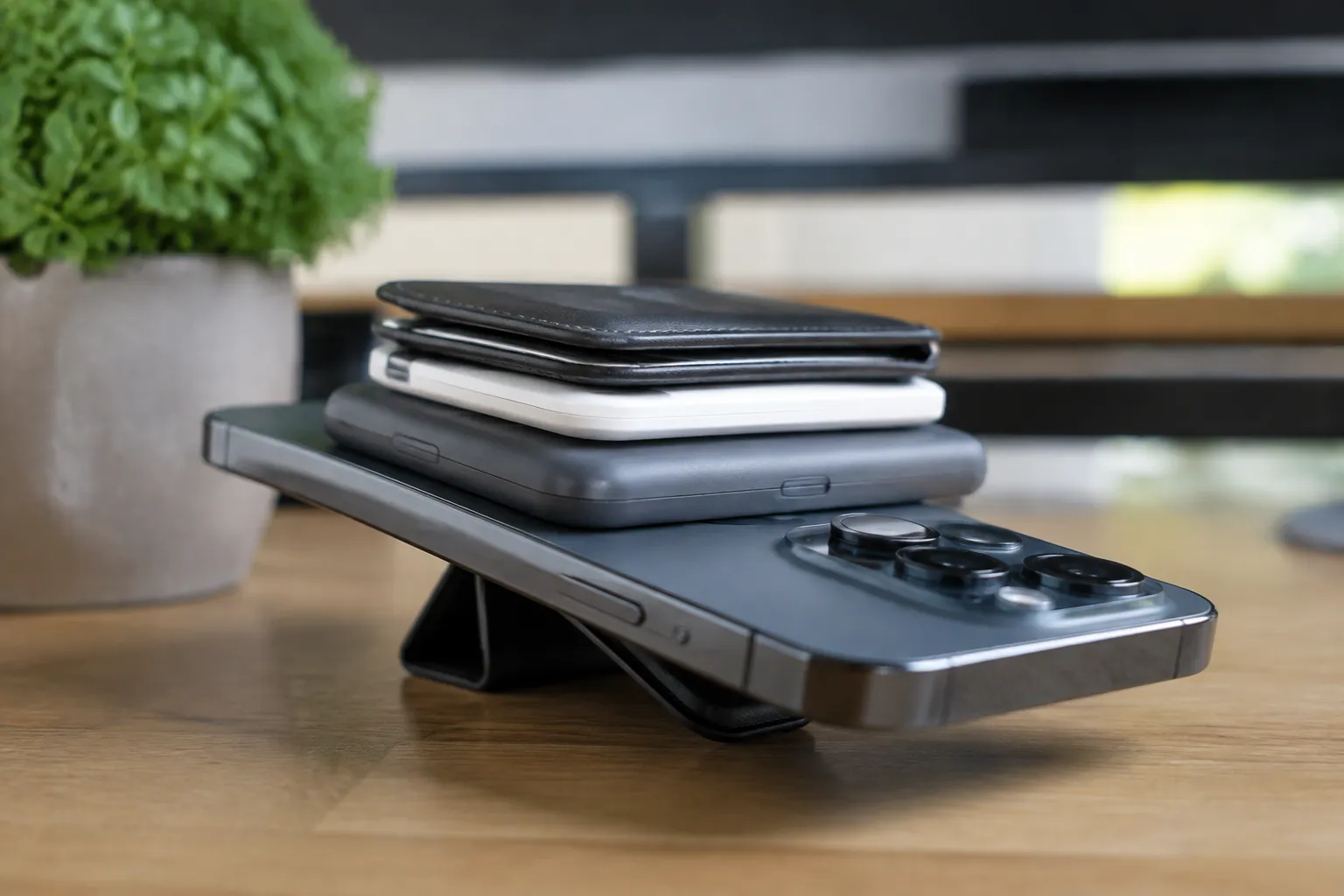
The physical thickness compounds the issue. A typical MagSafe wallet adds about 8 to 10 millimeters of bulk. A battery pack adds another 10 to 15. Stacked together, the phone becomes nearly two and a half times as thick, and the center of gravity moves away from the phone's back. That changes how the phone sits in a hand, how it balances on a desk, and how it behaves in a pocket. The stack is no longer a phone with an accessory. It is a brick with a screen.
The magnetic strength math nobody does at the store
Apple rates the holding force of the standard MagSafe connection at roughly 1.2 kilograms of pull force when attached to a bare iPhone. That figure is enough to hold the phone on a magnetic mount over mildly rough roads, but it was never designed to carry a chain of accessories. Each additional layer relies on the magnet ring directly beneath it, and that ring has to hold the combined weight of everything above it plus the leverage created by the distance from the phone's back.
Consider a typical stack: a 50-gram wallet, a 90-gram battery pack, and a phone that weighs around 200 grams. The phone's own magnet array is asked to hold roughly 140 grams of accessories, which sounds easy until the stack is in motion. A phone in a pocket experiences lateral forces and rotation as a person walks, sits, and stands. A phone dropped into a bag gets jostled against keys and cables. The leverage from a thick stack multiplies these forces, and the accessory that held firm on a bench in the store slides off in real use.
Two layers is usually survivable. A wallet on the phone with a charger on the desk, or a battery pack on the phone with a popsocket-style grip on top of that, will generally hold for daily use. Three layers is where things get dicey, especially if any of them are off-brand. The cheapest accessories on Amazon use weaker magnets to save money, and they advertise compatibility without matching the pull strength of the genuine article. A person who buys a $12 magnetic card holder from a brand they have never heard of is stacking an unknown magnetic rating on top of another unknown rating.
The failure mode is rarely a sudden drop. It is a slow creep. The stack holds for a week, then a card gets removed from the wallet, which changes the weight distribution. The battery pack starts to sit a hair off-center. The phone gets warmer during charging, which slightly demagnetizes the accessory over time, and one day the whole stack detaches when the phone is pulled out of a pocket. That is the real risk: not breaking the phone, but losing it, or losing the accessories, at the worst possible moment.
Charging behavior with a sandwich of accessories
Charging through a stack is the most common use case, and it is also the one where the hidden inefficiencies pile up. The iPhone's MagSafe charger negotiates power delivery with the accessory through a handshake protocol. When a third-party battery pack sits on top of a MagSafe charger, the charger has no way to know what is actually on the other side of the interface. It sees a compatible magnetic field, assumes the coil is aligned, and pushes power. If the stack is off-center or the intermediary accessory has a weak magnet ring, the power transfer becomes less efficient without any error message.
The practical result is a phone that says it is charging but gains battery percentage more slowly than expected. A person might leave the stack on a nightstand for eight hours and wake up to a phone at 80 percent instead of full. The phone's battery health indicator will eventually reflect the strain, showing a faster degradation curve than a phone charged exclusively by cable. This is not an emergency. It is a slow tax on the battery's longevity, paid in fractions of a percent per charge cycle.
Some stacking configurations simply refuse to charge at all. A metal plate or a thick magnetic mount in the middle of the stack can interrupt the field entirely. Apple's own guidelines warn against placing credit cards with RFID chips directly against the charging surface, because the magnetic field can damage the chip. That warning gets more complicated when a wallet is stacked between the phone and the charger, because the field has to pass through the cards to reach the phone. Most modern hotel key cards and contactless payment cards will survive a few charging sessions, but repeated exposure is a gamble that no card manufacturer recommends.
The case layer changes everything
A phone case adds another variable that most stacking advice ignores. Apple states that MagSafe works through cases up to a certain thickness, roughly 2 to 3 millimeters of non-metallic material. But a case changes the magnetic behavior in two ways. It adds distance between the phone's magnets and the accessory, weakening the hold, and it introduces its own materials that can shield or distort the field. A leather case with a metal rivet, a wallet case with a magnetic clasp, or a rugged case with a built-in stand all interfere differently.
The common advice to use a MagSafe-compatible case does not solve the stacking problem. A MagSafe-compatible case has its own ring of magnets embedded in the back, designed to align with the phone's magnets. But that ring is a separate component with its own tolerances. When a wallet goes on the case and a battery goes on the wallet, the stack now has three separate magnet rings that all need to align. Each one is manufactured to its own spec, and the tolerances add up. A stack that clicks together perfectly on a flat table can feel loose and sloppy when held at an angle.
Cases also change the thermal picture. A thick silicone case traps heat, and a stack generating excess heat from inefficient charging will cook inside that insulation. The phone's temperature management will slow charging to protect itself, but the accessory battery on the outside of the stack gets no such protection. Third-party battery packs have their own thermal sensors, but those sensors read the battery's internal temperature, not the ambient heat from the charging field passing through the case.
What actually works in daily use
After all the warnings, there are configurations that function well enough for daily life. The key is respecting the limits of the system rather than fighting them. One accessory on the phone is always safe. Two is acceptable if the innermost layer is thin and the outermost layer is light. A card wallet directly on the phone with a MagSafe charger on a desk mounted to it will hold fine, because the charger is stationary and gravity is doing most of the work. The same wallet with a heavy battery pack on top of it, carried in a pocket, will eventually fail.
The better approach is to separate functions. A MagSafe wallet works well when it is the only thing on the back of the phone. A MagSafe battery pack works well when it is the only thing on the back of the phone. The moment they are stacked together, the phone takes on the bulk of both without getting the convenience of either. The wallet is buried under the battery, requiring the whole stack to be removed to pay for coffee. The battery is fighting gravity and the wallet's weight every time the phone is picked up.
People who genuinely need both a wallet and extra battery during a day out are better served by a battery case or a phone that simply has better battery life. The iPhone Pro Max models, with their larger cells, often eliminate the need for a battery pack entirely for a normal workday. The standard models may need a midday top-up, but that charge can happen at a desk where the phone lies flat on a charger with the wallet removed. The convenience of stacking is real, but it is a convenience that comes with a reliability tax.
The pop socket exception and other light top layers
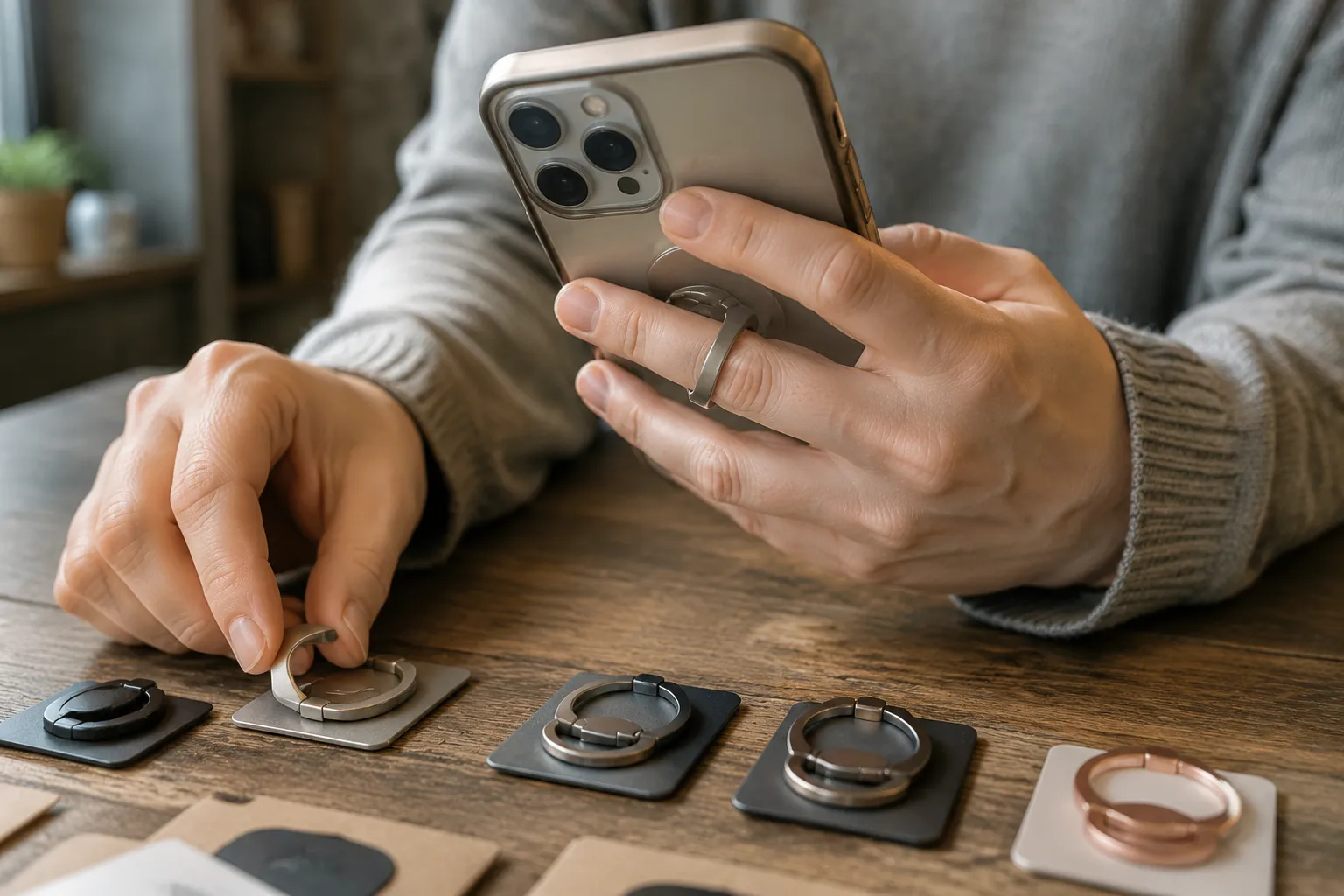
Not all stacks are created equal. A MagSafe pop socket or a thin magnetic finger grip on top of a battery pack is a different animal from a wallet. These items weigh almost nothing, often under 20 grams, and they do not introduce a charging coil or a thickness that shifts the center of gravity dramatically. A grip on top of a battery pack is a stack that works, because the grip is not trying to hold anything but the user's finger, and the battery's magnet ring is strong enough to hold that negligible load.
The distinction matters. A stack fails when the load exceeds the holding force or when the geometry makes the load unstable. A light grip is a stable load. A wallet containing three embossed credit cards is a heavy, rigid, uneven load that shifts every time a card is removed. A battery pack is a heavy load with its own internal weight distribution that changes as the cells drain and the device warms up. The failure threshold is not about the number of layers. It is about the weakest magnet ring in the stack and the leverage applied to it.
The real risk is attention, not hardware damage
Nothing in this article describes a scenario where a stacked phone catches fire or shatters from magnetic stress. The actual damage is more mundane. A phone dropped because a stack shifted at the wrong moment. A card demagnetized after weeks of charging proximity. A battery pack that stopped holding a charge after repeated overheating. These are slow failures, the kind that get blamed on the phone rather than on the accessory arrangement.
There is also the everyday cost of fiddling. A person with a three-layer stack spends seconds every time they pick up the phone checking whether everything is still seated. They avoid putting the phone in a tight pocket because the stack catches on the fabric. They hesitate before dropping the phone into a bag because the lateral forces will pop the wallet off. These micro-frictions add up to a constant low-grade anxiety about the device that should be an afterthought.
The hardware itself is resilient. An iPhone back glass can survive a drop from pocket height onto carpet. A MagSafe accessory that pops off onto a sidewalk might scuff but will usually keep working. The loss is rarely catastrophic. What is lost is the trust in the system. Once a stack drops a phone once, the owner starts treating the magnetic attachment as provisional. They grip the phone tighter, check the back before lifting it, and stop using the stack in situations where a drop would matter, which defeats the purpose of the accessories in the first place.
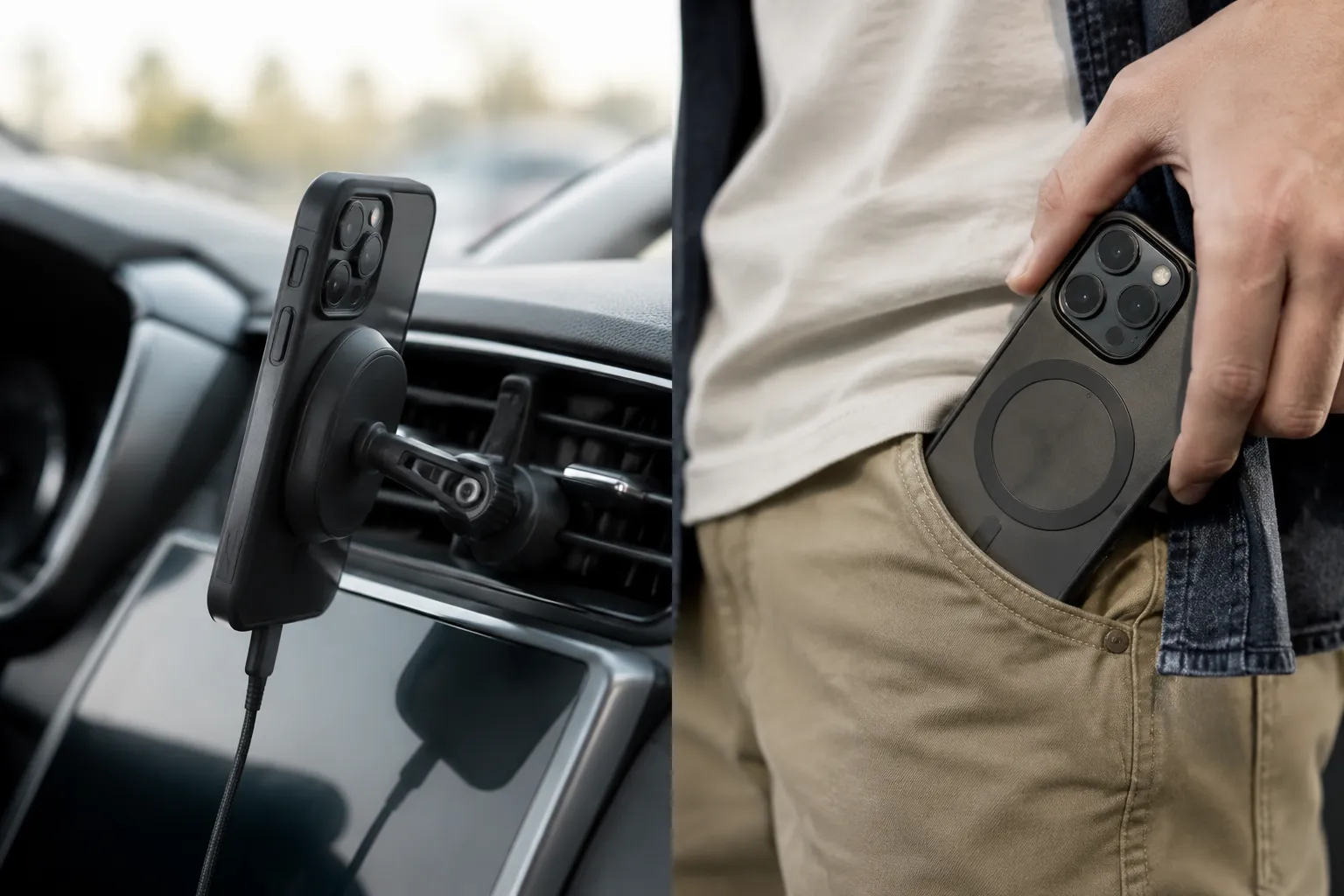
The practical rule, learned through trial and error across dozens of accessory combinations, is simple: two layers maximum, with the innermost layer as thin as possible, and never carry the stack in a way that allows it to swing freely. A phone in a front pocket with a wallet and a grip on top is fine. A phone thrown into a tote bag with a wallet and a battery pack on top is a phone that will eventually hit the floor of a parking garage. The magnetic array in the iPhone is a precise tool. Treating it as a general-purpose stacking system ignores the engineering that makes it work in the first place.