The price of a realistic everyday carry sling kit is almost never the price people quote. Forums light up with $40 bag recommendations and $200 "grail" setups, and both numbers miss what most people actually end up carrying. A person who buys a $40 sling and stuffs it with the first pocket items they grab has built a kit that costs more than they think and does less than they want. The useful number, the one that survives contact with a daily commute, a weekend hike, and a crowded airport, sits somewhere else entirely.
The honest breakdown starts with a confession: a sling kit is a collection of compromises held together by a strap. The bag itself matters less than the system inside it, and the system fails when a person tries to make one bag do everything. A sling that carries a tablet, a water bottle, a full camera, and a first aid kit is no longer a sling. It is a badly designed backpack that happens to hang off one shoulder, and it will hurt. The realistic kit accepts limits from the start.
What the bag really costs per year of use
A decent sling, the kind with real stitching, a weather-resistant shell, and straps that do not dig in, runs between $60 and $120. The cheap ones at $25 fail in specific ways: the zipper pulls separate from the tape, the shoulder pad slides down the strap, and the whole thing flaps against the ribs with every stride. The expensive ones past $200 add materials that feel nice in a store but do nothing measurable for a person standing in a bus queue at 7:40 in the morning.
The value calculation changes when the bag is divided by actual use. A $90 sling carried five days a week for two years costs about 17 cents per carry. That same sling, bought at $25 and replaced three times in the same period because the stitching let go, costs more in dollars and far more in annoyance. The realistic buyer skips both extremes and lands on the $70 to $100 band, where brands like Chrome, Topo Designs, and Aer fight for attention with genuinely different layouts.
The layout argument matters more than the brand name. A sling that opens like a clamshell makes everything visible at once, which suits a person who carries a camera and needs to grab it fast. A sling with a main compartment plus an external quick pocket suits the person who reaches for hand sanitizer or earbuds twenty times a day. Neither layout is wrong. The wrong choice is buying the clamshell when the daily routine is quick grabs, or the quick pocket bag when the daily routine is hauling a tablet to a coffee shop.
The load-bearing layer: what goes inside every single day
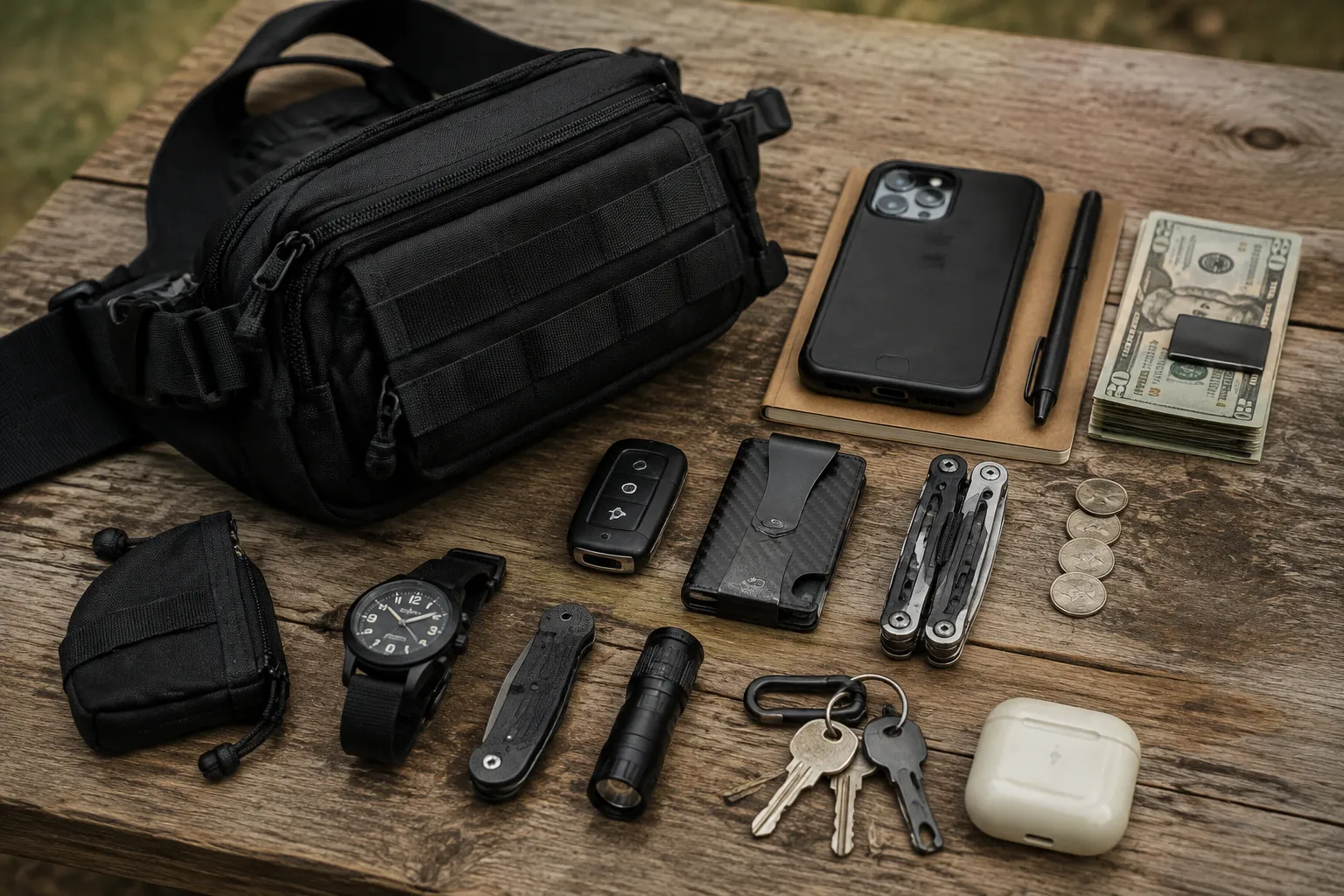
Before any specialist gear gets considered, the daily core has a fixed cost. A wallet, keys, a phone, and a pair of sunglasses form the baseline, and most people already own these. The sling simply relocates them from pockets to a strap. The relocation costs nothing new, but it forces a decision about organization. A sling with one big empty space swallows a phone and a wallet into the same dark pit, and the person ends up digging with two fingers while the bus doors close.
The fix is a set of small organizers, and this is where the line item gets real. A slim tech pouch, roughly the size of a paperback, holds a charging cable, a wall plug, earbuds, and a power bank. A decent one from Maxpedition or Bellroy runs $25 to $60. A separate card sleeve or mini wallet for the sling's quick pocket costs another $15 to $30. These are not luxury add-ons. They are the difference between a bag that works and a bag that becomes a jumble of receipts and loose change by Wednesday.
The power bank deserves special attention because it is the item most people buy twice. The first purchase is a cheap, high-capacity brick from an unfamiliar brand, and it works for a month before it stops holding a charge or refuses to fast charge a modern phone. The second purchase is a name-brand unit from Anker or similar, and it costs $30 to $50 for something that actually delivers the advertised wattage. The realistic kit budgets for the second purchase and skips the first.
Cables add a quiet tax. A person needs at least one USB-C cable that reaches from the power bank to the phone while the phone stays in a hand, which means a cable of about three feet. Quality braided cables run $10 to $20 each. The realistic kit carries two: one for the phone, one for earbuds or a second device. That is $20 to $40 in cables alone, and it feels absurd until the moment the hotel room has no compatible charger and the phone sits at 14 percent.
The daily tool kit: a knife, a light, and the argument over both
The pocket knife and the flashlight are the first items that make a sling feel like a kit rather than a purse. A folding knife in the $30 to $70 range from a brand like Civivi, QSP, or Ontario Knife covers 95 percent of daily cutting tasks: opening boxes, cutting loose threads, slicing an apple at a desk. The knife does not need to be a $200 custom piece. It needs a blade that takes an edge, a lock that does not fail, and a clip or pocket that keeps it from rattling against the bag's other contents.
A small flashlight in the $25 to $50 range, something like a Thrunite or a Skilhunt, covers the other daily emergencies: finding a dropped key under a car seat, walking a dark stairwell, checking the back of a closet. The mistake people make here is scale. A full-size tactical light with a strike bezel and 2,000 lumens belongs in a car or a duty belt, not in a sling that is supposed to weigh less than three pounds. A light the size of a thumb with 300 to 500 lumens and a pocket clip is the right tool, and it costs $30.
Some people skip both tools entirely. A phone has a flashlight app, and a credit card can open a taped box. That position is defensible until the phone battery dies at the exact moment the box needs opening in a dark hallway. The tools are cheap insurance, and their total cost, roughly $60 to $110, is less than the cost of replacing a single lost phone or a broken zipper on a bag stuffed with overpacked items.
The medical and repair layer nobody budgets for
The first aid and repair items are the ones people skip, and the skip is understandable because these items sit unused for months. Then a blister forms on a long walk, or a bag strap buckle snaps in a foreign city, and the cost of being unprepared is measured in ruined socks and a flapping bag. The realistic kit carries a small, flat first aid pouch, about the size of a passport, with a few adhesive bandages, two antiseptic wipes, one roll of medical tape, and a single dose of an over-the-counter pain reliever.
That pouch costs $15 to $30, depending on whether a person assembles it from loose supplies or buys a prefilled kit and swaps out the useless pieces. The prefilled kits from Adventure Medical Kits are a reasonable starting point, but most need editing: the kits include too many butterfly closures and not enough blister treatment. A dedicated small roll of leukotape, the gold standard for blister prevention, costs $8 and takes up almost no room.
The repair layer is even less glamorous. A tiny sewing kit with two needles and a few yards of strong thread costs $5. A single cable zip tie, the kind used for emergency strap repair or shoe lace replacement, costs pennies. A small tube of super glue costs $3. Together these items weigh less than two ounces and cost under $15. They are the difference between a broken kit and a functional one, and they are almost always the first items removed when a person tries to lighten the load. That removal is a mistake.
Specialist additions that change the total
The daily core, the tech pouch, the tools, and the medical layer total roughly $250 to $400 for the whole kit, bag included. That range already covers the realistic needs of most people. The total climbs when a person adds specialist gear, and the additions need to be evaluated on whether they serve a specific, recurring need or just fill a compartment.
A writing instrument is a common addition. A solid ballpoint or a compact pen in the $20 to $50 range, something like a Fisher Space Pen or a Zebra, writes on receipts and forms that reject cheap plastic pens. The cost is small and the utility is real for anyone who signs delivery packages or fills out paperwork on the go. A pocket notebook adds another $5 to $15, and it earns its place only for people who actually take notes. The person who buys a notebook and never writes in it has added dead weight.
A small camera, a compact point-and-shoot or an action camera, adds $200 to $500 and changes the bag's entire weight profile. The realistic sling kit accommodates a camera only if the camera was the reason for the bag in the first place. Adding a camera to a bag that was built for commuting creates a conflict: the camera needs a padded insert or a dedicated compartment, and that insert eats space meant for the tech pouch or the daily tools. The kit then has to shed items, and the shedding is where the system falls apart.
The same logic applies to a tablet. A mini tablet, roughly the size of a phone, fits in the main compartment without issue. A full-size tablet does not fit without making the sling bulge and pull. The realistic answer is to choose one primary device per bag. The sling carries either the camera or the tablet, not both, and the choice comes down to the day's actual plan rather than the theoretical possibility of needing both.
The weight budget and the discipline of removal
Weight is the silent killer of the sling kit. A bag that feels featherlight in a store gains mass with every addition, and a loaded sling carries differently than a loaded backpack. The weight sits on one shoulder, pulling the trapezius muscle into a knot by the end of a long day. The realistic total weight for a daily sling kit, bag included, is between two and a half and four pounds. Anything above that becomes a source of chronic discomfort, and the person stops carrying it.
A person can weigh the components at home with a kitchen scale. The bag is roughly one to one and a half pounds. The tech pouch with a power bank and cables adds about a pound. The knife and light together add another half pound. The medical and repair layer is four to six ounces. The phone, wallet, and keys add whatever they add. The math gets tight quickly, and the discipline of removal becomes the core skill of maintaining the kit.
Removal means taking out the items that have not been used in two weeks. The spare charging cable for a device that died last month goes. The multi-tool with seventeen functions, carried for three years and used twice, goes back to the drawer. The second power bank, the one bought for a trip that never happened, goes to the desk. This is not minimalism as an aesthetic. It is weight management as a physical necessity. A sling that hurts to carry gets left at home, and a bag left at home protects nothing.
The true cost of the rebuilt kit
The realistic total lands at roughly $350 to $500 for a complete, functional kit that covers daily life without specialist gear. That number includes the bag at around $80, the organizers at $50, the power and cable layer at $70, the knife and light at $80, and the medical and repair layer at $25. The specialist additions, a camera or a tablet setup, push the total past $700 only when a person genuinely needs those devices every day.
That $350 to $500 figure sounds steep against a $40 bag from a discount retailer. The comparison misses the replacement cycle. The cheap bag fails in a year. The cheap power bank fails in six months. The cheap knife fails the first time a real cutting task appears. The rebuilt kit, the second set of purchases, costs exactly as much as the quality kit would have cost from the start, with the added tax of having owned and discarded the failures.
The other cost is less visible. A kit assembled without a plan weighs more, digs into the shoulder harder, and gets abandoned faster. The person who abandons the sling and goes back to stuffing pockets has paid for the whole experiment and received nothing from it. The kit that works, the one within the weight and price budget, is the one that gets worn on the Tuesday morning commute and the Saturday afternoon errand run. It is worn because it is comfortable, and it is comfortable because it was built with limits. The price of a realistic kit is the price of those limits, and it is worth every cent of the difference.