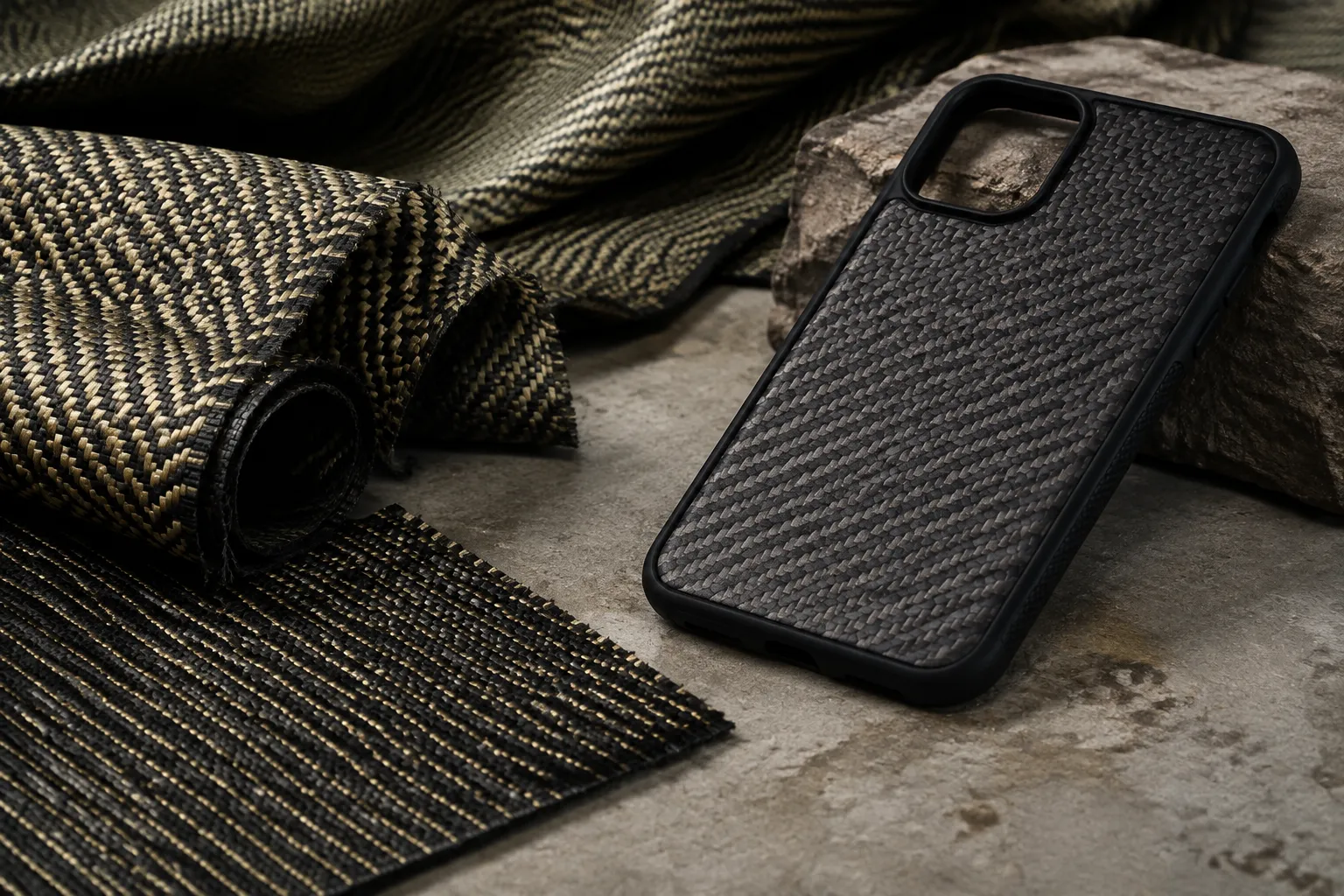
Carbon fiber got the fame, but aramid fiber got the jobs that actually involve getting hit. Kevlar, the best-known aramid, stopped bullets and shrapnel for decades before it ever wrapped a phone. Twaron, its Dutch cousin, does the same work in tires and marine rope. The material has a genuine resume in hard use, which is more than most case materials can claim. So when aramid cases started showing up on flagship phones around 2017, the question was never whether the fiber was tough. The question was whether a thin weave glued around a plastic shell could carry any of that toughness over to the thing people actually drop.
The honest answer is complicated, and most marketing departments would prefer that nobody ask too hard.
What Aramid Actually Does Inside a Case
Aramid fiber is a synthetic polymer with a rigid molecular structure that stacks into sheets. Those sheets resist stretching and tearing far better than steel on a pound-for-pound basis. That property makes it exceptional at stopping a knife point or spreading the energy of a bullet across a vest panel. The fiber itself does not shatter like carbon fiber does on impact. It flexes, it absorbs, it holds together.
Inside a phone case, that translates to one specific job: preventing the case from cracking or splitting open on a hard drop. A polycarbonate shell can do that too, but aramid layers add stiffness without much thickness. A typical aramid case measures between 0.8 and 1.5 millimeters thick. A comparable hard plastic case often runs 2 to 3 millimeters. The difference in hand feel is immediate, and it is the real reason people buy these cases in the first place.
The weave pattern matters more than the fiber type. The tightness of the twill, the resin used to bind the layers, and the number of plies all change the final product. A single layer of 600-denier aramid weave is a decorative fabric. Three layers laminated with epoxy resin form a rigid composite that can actually absorb an impact. Some manufacturers are transparent about their layup. Most are not.
The Drop Test Gap Between Marketing and Reality
Here is where things get uncomfortable. Aramid cases perform well in manufacturer-touted drop tests, but those tests usually involve a smooth fall onto a flat surface from a controlled height. Real drops happen onto gravel, onto the edge of a curb, onto a sidewalk seam. Aramid handles the first kind beautifully. The rigid composite spreads the impact and the phone survives. The second kind is a gamble for every case material on the market.
What aramid does not do is provide much of a cushion. Its strength is in stiffness and tear resistance, not in compression. Drop a phone onto a corner and the force transfers through the rigid case into the frame. A thick silicone bumper would absorb some of that energy by deforming. Aramid holds firm, which is excellent for preventing penetration but mediocre for isolating the phone from a sharp impact point.
The brands that do this well know it. They pair the aramid backplate with a raised lip around the screen and a softer inner liner that sits between the fiber and the phone. The brands that do this poorly sell a thin, single-layer wrap that looks premium and protects like a sticker.
The Weight Argument Carries More Weight Than Expected
Modern phones are heavy. The Pro Max models and their Android equivalents push past 220 grams without a case. Add a rugged case and the pocket burden becomes genuinely rude. Aramid cases solve this problem with a mathematical certainty that no amount of marketing spin can distort. A typical aramid case weighs between 15 and 30 grams. A comparable dual-layer armor case weighs 60 to 80 grams. That difference, 40 or 50 grams, is the difference between noticing the phone in a pocket and forgetting it is there.
People who carry phones in tight jeans or tailored trousers feel this every single day. The aramid case is not just lighter. It is thin enough that the phone does not become a brick-shaped doorstop. The profile stays close to what the manufacturer intended, which matters for wireless charging alignment and for the simple pleasure of holding a device that was designed to feel good in a hand.
That thinness demands a trade, and buyers should make it with open eyes. A 1.1-millimeter case offers essentially no drop protection beyond a scuff guard. A 1.4-millimeter case with a decent layup starts to feel meaningful. A 1.8-millimeter case approaches the protection of a basic polycarbonate shell while still beating it on weight. The millimeter difference is invisible in product photos and extremely visible in a drop on concrete.
Grip and Texture Are the Quiet Differentiators
Aramid weave looks distinctive because the twill pattern plays with light at different angles. That visual texture comes with a physical one. The surface has a slight tooth, a dry friction that plastic and glass lack. A phone wrapped in aramid sits more willingly in a hand and resists sliding off a sloped armrest or a car seat.
This matters more than the spec sheet suggests. The most common cause of a dropped phone is not a sudden jolt. It is a slow slide off a surface or a fumble during a one-handed reach. A backplate with a little grip prevents more damage in a week than a thick bumper prevents in a year.
The catch is that manufacturers coat the weave with a resin to make it rigid, and that coating can be glossy or matte depending on the formula. Matte coatings preserve the dry feel. Glossy coatings turn the surface into something closer to polished plastic, which defeats the purpose. Reading the fine print of reviews helps here, because product photos rarely convey the difference.
Over time, the coating wears at the corners and edges, exposing the raw fiber. This does not compromise the case's structure if the layup is sound, but it changes the look. Aramid cases show wear honestly. They develop a soft, brushed appearance at the points of contact rather than the spiderweb cracks of a carbon fiber case or the shiny scuffs of a plastic one. Some owners find this charming. Others find it a reason to buy a new case every year.
The Price Premium Is a Material Reality
Aramid fabric costs more than polycarbonate pellets. The weaving process is slow, the resin systems are specialized, and the cutting and edge-sealing steps require precision. A well-made aramid case sells for 50 to 90 dollars. A comparable plastic case sells for 20 to 40 dollars. The gap is real, and it is not pure margin gouging.
What stings is that the price does not guarantee quality. The market has filled with cases that use a thin cosmetic layer of aramid over a cheap plastic frame. These products look right in photos and fail in the hand. The weave feels flimsy, the edges fray, and the case offers less impact protection than a basic silicone sleeve.
The reliable way to judge is to flex the case. A good aramid case has a certain rigidity, a resistance to twisting, that a cosmetic layer lacks. It also has a cleanly finished edge, not a raw cut that shows loose fibers. And it has a consistent pattern density. If the weave looks uneven or the resin has pooled in patches, the manufacturing quality is suspect.
MagSafe and the Metal Ring Problem
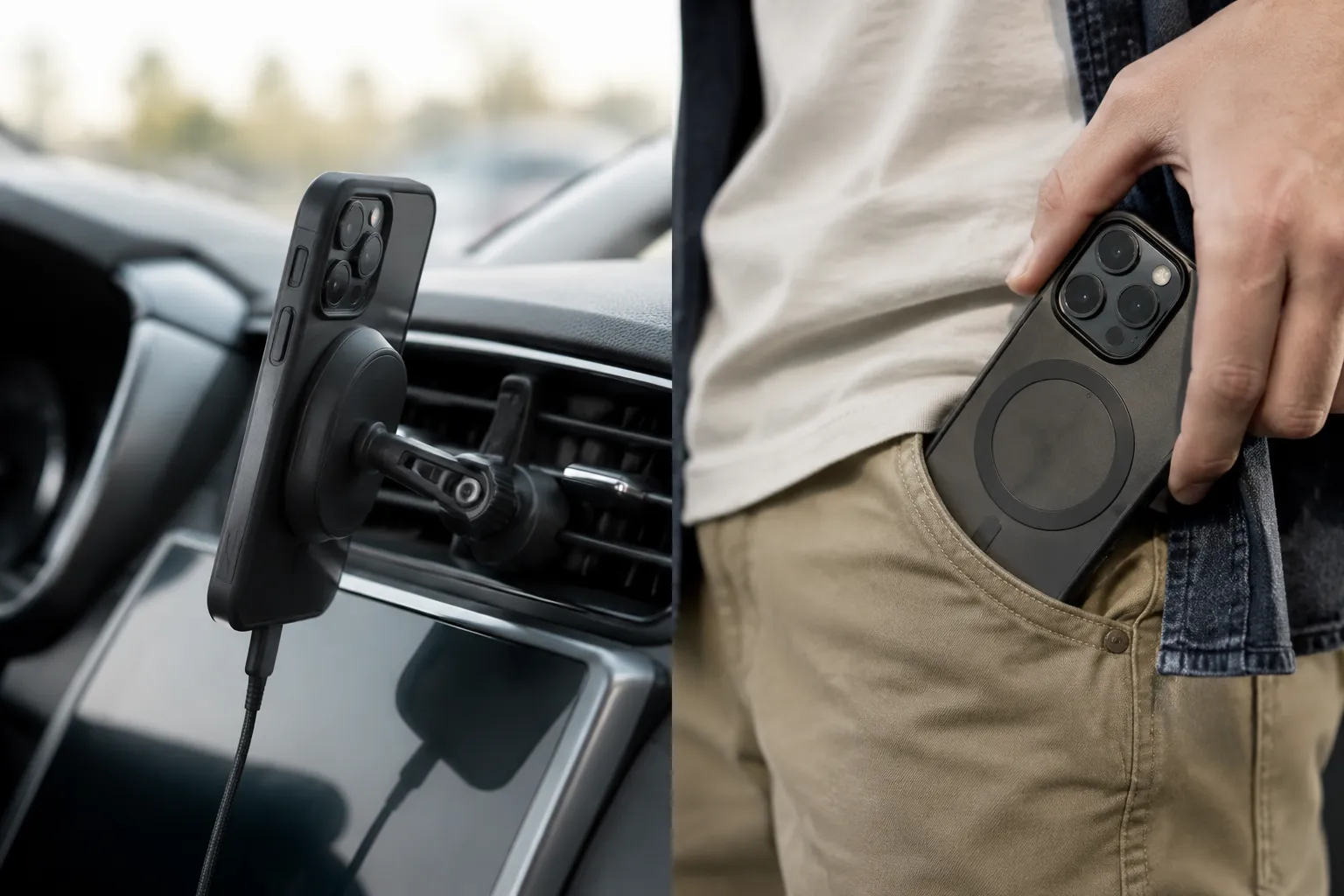
Aramid is transparent to magnetic fields, which makes it an ideal material for cases that need to work with MagSafe and its Android equivalents. The fiber does not interfere with the alignment magnets or the charging coil. In theory, this makes aramid the perfect companion to a wireless charging ecosystem.
In practice, the magnet ring inside the case creates a visible circular bump or a pattern change on the backplate. Manufacturers hide this with a darker finish or by recessing the ring slightly, but a careful eye can spot it. The ring also adds a few grams, which eats into the weight advantage. Some brands skip the ring entirely and rely on friction to hold accessories, which works poorly with car mounts that expect a firm magnetic grip.
The metal ring introduces one more issue: heat. Wireless charging generates warmth, and the ring sits directly under the coil. Aramid conducts heat poorly, so the case can run noticeably warmer than a bare phone during a charging session. This is rarely dangerous, but it slows charging and makes the phone uncomfortable to hold right after a top-up.
Comparing Aramid to Its Actual Competitors
Carbon fiber cases look similar to aramid cases at a glance, but the materials behave differently. Carbon fiber is stiffer and lighter, yet it shatters on sharp impacts. A hard carbon case can crack into splinters that scratch the phone frame. Aramid flexes and survives the same impact. For daily carry, aramid is the more forgiving material.
Leather cases offer a different kind of appeal, with a patina that ages gracefully and a grip that improves as the material softens. But leather absorbs moisture, adds bulk, and offers minimal drop protection unless it wraps a thick plastic core. The weight difference between a good leather case and an aramid case is usually 20 to 30 grams, which is enough to feel in a shirt pocket.
Plain polycarbonate cases remain the value champion. They protect well, they come in every color, and they cost a fraction of what aramid commands. What they lack is thinness and feel. A 2.5-millimeter polycarbonate shell with a matte finish protects a phone admirably but makes it feel like a brick wrapped in a shell. The trade is honest and clear.
The Longevity Question Nobody Answers
Every case material ages poorly in its own way. Plastic yellows and becomes brittle. Leather dries and cracks. Silicone gets tacky and attracts lint. Aramid's failure mode is quieter. The resin coating that gives the case its rigidity slowly wears down at the edges, and once the fibers start to fray at a corner, the case begins to lose its structural integrity.
A well-made aramid case lasts two to three years of daily use before the corners show significant wear. That is an honest lifespan for a premium accessory, roughly matching the upgrade cycle of most buyers. The cases that fail faster are the ones with thin single-layer construction, and they fail by losing shape at the corners within six months.
The fiber itself does not degrade from sunlight or sweat the way some materials do. Aramid is chemically stable and resists UV damage reasonably well. The resin is the weak link. Cheaper resins yellow and get brittle. Better formulations, usually epoxy-based, hold their clarity and flexibility for years. Again, the spec sheet rarely says which resin a manufacturer used, which turns the purchase into a small act of faith.
Aramid Is a Feel Decision, Not a Spec Decision
The buyers who love aramid cases tend to describe them the same way: they forget the case is there. That is the entire pitch. The case adds negligible bulk, negligible weight, and a grip that keeps the phone in place. It does not scream for attention or require a ritual of installation. It simply becomes the surface of the phone.
The buyers who return aramid cases tend to describe them the same way too: they paid 70 dollars and the phone broke anyway. A drop on a sharp edge at the wrong angle defeats every case under 3 millimeters thick. Aramid does not perform miracles. It performs a narrow job well, and that job is weighing almost nothing while surviving the scrape-and-tumble drops that make up the majority of real-world accidents.
A person who drops a phone from a second-story balcony needs a rugged case with air cushions and a raised bezel that could anchor a boat. A person who drops a phone from hand height onto floors and sidewalks, which is the actual use case for most owners, can trust aramid to handle the fall more often than not. The distinction is not academic. It is the difference between buying armor and buying a tailored jacket that happens to resist a scuff.
The weave is pretty. The weight is undeniably right. But the material earns its place only when a buyer understands the limits of thinness. Featherweight armor protects against the threats that actually arrive, not the ones that appear in slow-motion marketing videos. For the pocket, for the hand, for the daily routine of a phone that gets picked up and put down forty times a day, that is usually enough.