The iPhone accessory market has a curious habit of solving problems that barely exist, then charging a premium for the privilege. Few categories illustrate this better than the two competing ways to carry cards and cash alongside a phone: the wallet case and the MagSafe wallet. Both claim to free a person from the pocket bulge, yet they represent fundamentally different compromises. One is a commitment. The other is an experiment. Understanding the difference comes down to how a person actually moves through a day, not how the accessory looks on a product page.
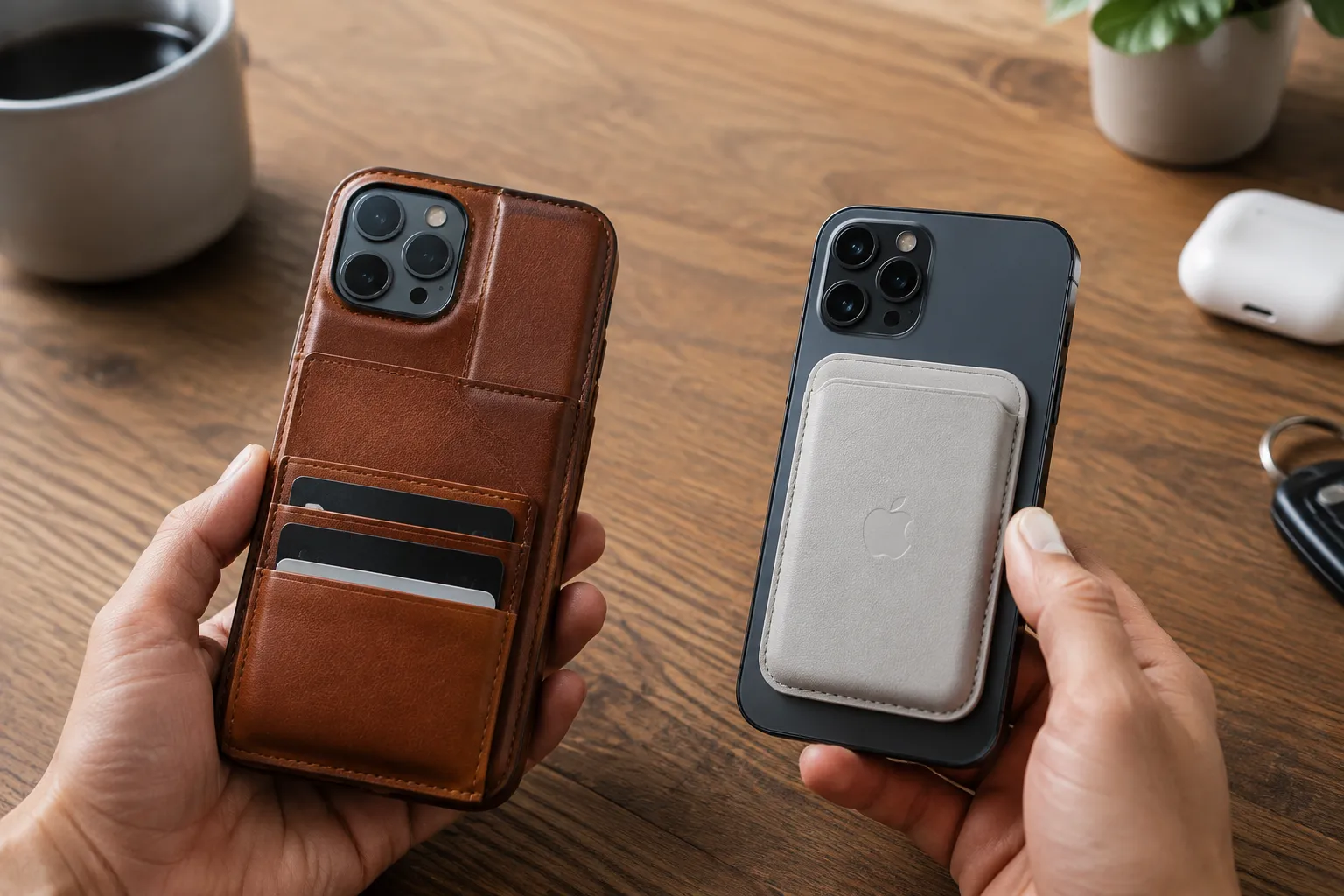
The core tension is physical. A wallet case wraps the phone entirely, adding material on the back and often a flap on the front. It changes the device's weight, its thickness, and the way it sits in a palm. A MagSafe wallet, by contrast, is a slim pouch that snaps to the back of the phone using magnets. It adds negligible bulk, comes off in half a second, and turns the phone into a modular system. The choice between them is really a choice about whether the phone should permanently look and feel like a wallet, or whether the wallet should occasionally behave like an accessory.
That distinction matters most at the moment of pickup. With a wallet case, a person grabs one object and everything is included. Keys, phone, cards, out the door. The mental load of checking for a separate wallet disappears entirely because there is no separate wallet. With a MagSafe wallet, the phone and the card holder are two pieces that must be deliberately joined. People who have used both know the specific dread of arriving somewhere and realizing the magnetic wallet stayed on the desk, still holding the ID needed at the door.
This is the first real fork in the road, and it sorts people quickly. The wallet case suits the forgetful, the rushed, and anyone whose daily carry already resembles a controlled explosion. The MagSafe wallet suits the deliberate, the minimalist, and those who treat their phone as a docked device that sometimes leaves home.
What the Added Thickness Actually Does
Holding a modern smartphone already requires a certain palm span. Add a wallet case, even a slim one, and the phone gains roughly three to five millimeters of depth. That does not sound like much until the phone is shoved into a jeans pocket, where it creates a visible rectangular outline and a slight resistance when sitting down. Many people accept this trade without thinking, then spend months wondering why their pockets feel heavier than the device's weight alone would explain.
The MagSafe wallet adds almost nothing perceptible. The Apple-designed versions and their third-party equivalents hover around two to three millimeters thick when empty, expanding only when stuffed with cards. A phone wearing one still slides into a pocket with the ease of a naked device. The difference is felt immediately, not in the hand but in the thigh. Anyone who has carried a wallet case through a long day of walking, sitting, and standing will recognize the subtle relief that comes from switching to a magnetic system.
There is a cost to that slimness. The magnetic wallet can hold roughly three cards before the flap struggles to close or the magnets start to push back. A wallet case, depending on design, swallows four to six cards and even folded bills with room to spare. For people who carry a driver's license, a debit card, a credit card, a transit card, and the occasional folded twenty, the MagSafe wallet demands ruthless curation. The wallet case simply absorbs the overflow.
That capacity difference explains why the two accessories rarely compete in the same household. The wallet case is often a primary wallet replacement, the only card carrier a person owns. The MagSafe wallet tends to be a companion, a slim secondary that holds the two or three cards needed for a specific outing while the main wallet stays home or in a bag.
The Grip Problem Nobody Mentions in Reviews
Phone reviewers spend paragraphs on camera sensors and refresh rates but almost no time on how an accessory affects grip security. This is a mistake. A wallet case, because it adds thickness and often uses a textured leather or silicone back, generally improves grip. The phone becomes easier to hold, less prone to slipping out of a hand during a one-handed scroll. Some people find the extra width actually makes the device more comfortable to grip for extended periods.
The MagSafe wallet has the opposite effect in one specific scenario. When attached, it sits on the upper or middle back of the phone, creating a raised ridge that the fingers naturally rest against. This can improve stability, acting like a makeshift pop socket. But when the wallet is removed, the phone reverts to its bare, often slippery, glass-and-aluminum finish. And the act of removing it, a thumb pushing against a magnetically secured pouch, requires a grip adjustment that has caused more than one phone to take a dive toward a hard floor.
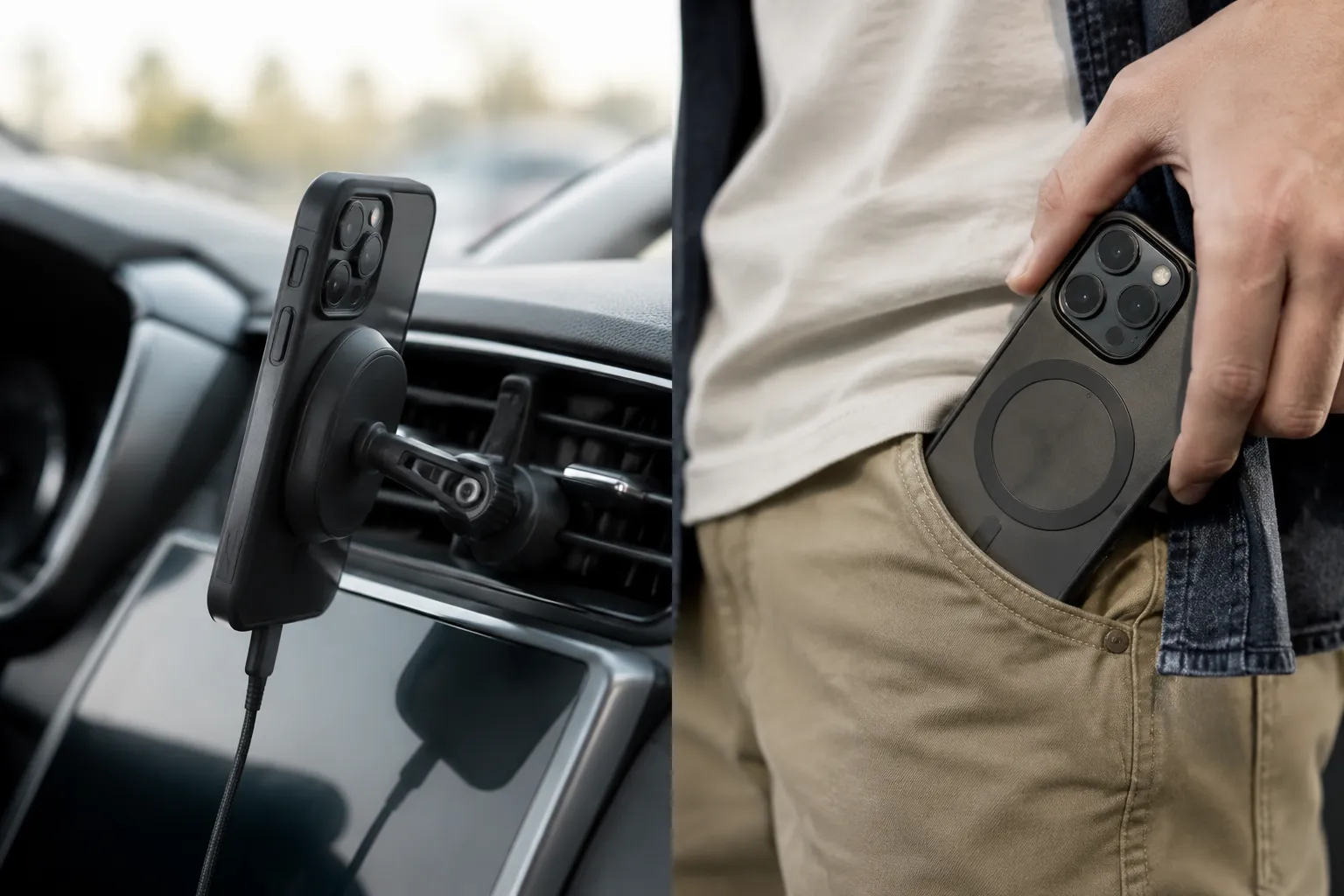
Wireless charging introduces another subtle difference. A wallet case usually stays on the phone permanently, which means it sits between the device and any charging pad. Most wallet cases either block wireless charging entirely or require the user to remove the phone from the case. The MagSafe wallet is designed to come off. A person sets the phone on a charger, snaps the wallet away, and both charge independently if the wallet itself supports it. For anyone who charges wirelessly every night, this workflow difference becomes a daily ritual, one that feels either like a pleasant routine or an annoying extra step depending on temperament.
The heavier the cards, the more pronounced these differences become. A wallet case with four cards inside changes the phone's center of gravity, making it feel denser and more secure in the hand, almost like a small notebook. A MagSafe wallet with three cards adds a concentrated weight near the phone's upper back, which can make the device feel slightly top-heavy when held by the lower half. Neither is a dealbreaker, but both are felt.
The Security Theater of Cards on the Back
Nobody talks enough about what happens when a phone is set down face-up on a restaurant table. A wallet case, with its front flap or card slots on the back, offers some visual privacy for what is inside. A MagSafe wallet displays its contents to anyone walking past. The cards sit in a neat stack against the phone's back, usually visible from the side if they protrude even slightly. Anyone who keeps their phone face-up, which is most people, has essentially laid their ID and bank card on the table for casual observation.
This is not a theft risk so much as a privacy leak. The person across the table can read the name on a driver's license if the cards sit slightly proud of the phone's edge. The same is true for a wallet case, of course, if the phone is placed face-down. But the wallet case's front flap, when closed, protects the screen and covers the cards. The MagSafe wallet offers nothing when the phone is face-up. The phone becomes a display case for its own contents.
There is also the matter of radio-frequency identification skimming, an overhyped concern but a real one. A wallet case, depending on material, provides a thin barrier between cards and the outside world. A MagSafe wallet exposes the cards on the outer face of the phone, which is the side facing up and away from the body when the device rests in a pocket. The risk is minimal in practice, but the geometry is worth noting for anyone who spends time in crowded transit or dense street markets.
How Each Option Survives a Real Day
Consider a commute involving a train, a coffee stop, and an office building with a badge reader. The wallet case user grabs the phone, taps the badge reader, pays for coffee by holding the phone near the terminal, and never once thinks about cards. The entire transaction flow is one object. The MagSafe wallet user goes through the same motions but must remember to keep the wallet attached. If the wallet came off the night before for charging, it sits on the kitchen counter. This is the single most common failure mode of the magnetic system, and it is not a design flaw, it is a habit flaw.
People who charge their phone on a bedside stand every night develop the routine of snapping the wallet back on in the morning. People who charge their phone in the car, or on a desk at work, or anywhere else, tend to forget. The wallet case eliminates this entire category of error. There is nothing to reattach because nothing was removed.
The counterpoint comes at the gym or the bar. A person who wants to carry only a phone and a single card, maybe an ID, finds the full wallet case absurd. The MagSafe wallet shines in these scenarios because it scales down to the bare minimum. The phone plus one card becomes a genuinely light carry that fits in a small pocket or a wristband pouch. A wallet case cannot shrink. It is always the full case, with its full bulk, regardless of how little is inside.
That difference in adaptability is why many people end up owning both. The wallet case for daily work carry, the MagSafe wallet for weekends and short errands. It is an expensive dual setup, but it reflects the reality that daily carry is rarely one size fits all.
The Long-Term Wear Patterns
Leather wallet cases age in a way that some owners genuinely love. The material darkens, develops a patina, and takes on the specific creases of its owner's grip. After a year of use, a good leather wallet case looks like a personal object, not a factory product. The same is true for leather MagSafe wallets, but there is a catch. The magnet inside the wallet can create a faint raised ring on the leather's surface where it presses against the phone. Some users find this ugly, others consider it a natural mark of use.
Non-leather options wear differently. Silicone and polycarbonate wallet cases tend to collect pocket lint around their edges and show scratches on the back. The MagSafe wallet's fabric exteriors, especially the ones made of microtwill or nylon, attract dust and pills over time. None of this is a functional failure, but it matters to anyone who looks at their phone dozens of times per day.
The more significant long-term issue is the wallet case's effect on the phone's resale value. Because it is the primary case, the phone inside stays pristine, protected from drops and scratches. When the time comes to trade in, a phone that lived in a wallet case typically earns the full credit. A phone that spent its life naked with a MagSafe wallet, by contrast, carries every scratch and scuff the environment offered. The magnetic wallet protects nothing. It only carries.
This is the quiet argument in favor of the wallet case that almost no review mentions. It is not just a wallet, it is armor. The MagSafe wallet, for all its elegance, leaves the phone exposed to exactly the kind of damage a case is designed to prevent. A dropped phone with a MagSafe wallet attached lands on its screen or its aluminum frame. A dropped phone in a wallet case usually survives with a scuff on the case itself.
The Find My Consideration Favoring the Magnet
The one feature that tilts the entire debate toward the MagSafe wallet is item tracking. Apple's official MagSafe wallet integrates with the Find My network, meaning the wallet pings the phone's location when separated. A person who leaves a magnetic wallet on a café table can check the phone and see exactly where the wallet was left. The same is not true for a wallet case. A wallet case is physically attached to the phone, so it cannot be lost independently. But it also cannot be located if the phone itself is lost.
The practical consequence is narrow but real. A MagSafe wallet separation is an annoying but recoverable error, as long as the owner realizes the separation happened within a reasonable window. The Find My integration sends a notification when the wallet detaches from the phone, which catches most forgetful moments instantly. Third-party MagSafe wallets without Find My offer no such safety net, which makes the Apple version the only one that meaningfully solves the detachment problem.
Wallet case users never need this feature. Their wallet cannot be forgotten because it is bolted to the device in their hand. But their phone, if misplaced, takes the wallet with it. A person who loses a phone with a wallet case loses both identity and payment method simultaneously. A person who loses a naked phone with a detached MagSafe wallet at home loses only the phone. The wallet stays safely in the drawer or on the desk.
This asymmetry in loss scenarios is worth more consideration than it usually gets. The wallet case concentrates risk into a single point of failure. The MagSafe wallet, when it is not attached, distributes the risk across two objects that can fail independently. For some people, that separation is a liability. For others, it is a safeguard.
Deciding by Personality Rather Than Specs
Strip away the materials, the magnet strength, and the card capacity, and the decision reduces to a simple question about behavioral tendencies. Does this person lose things, or does this person forget things? The distinction matters. A person who loses a wallet every few months, leaving it at restaurants, in rideshares, or on office desks, should never choose a MagSafe wallet. The detachable design invites that exact failure. The wallet case keeps everything married to the phone, which is the object most people hold at the moment of leaving any location.
A person who forgets to bring the wallet along entirely, who walks out the door without cards because they were left in a different jacket, needs the MagSafe wallet. Because it snaps to the phone, attaching it becomes part of the phone pickup ritual. The wallet is less likely to be left behind if it lives on the phone itself during the day.
The phone size matters too. A wallet case on a Pro Max model creates a brick that pushes the limits of pocket comfort and one-handed use. A MagSafe wallet on the same phone adds negligible thickness and keeps the device manageable. On a smaller phone, the wallet case's added bulk is less punishing, but the MagSafe wallet still wins on pure ergonomics.
People who use their phone as a primary camera should also think twice. The wallet case adds weight to every photo taken, every video recorded, every stabilizer mount attached. The MagSafe wallet comes off cleanly, leaving the phone in its intended shooting configuration. There is a reason professional mobile photographers rarely use wallet cases, though they often keep a magnetic card holder in their bag for the walk to the shoot.
Both solutions work. Both have dedicated fans who will argue until the battery dies. The only wrong choice is the one that fights a person's natural habits rather than supporting them. A person who is honest about their own tendencies will pick the right system in about five minutes of thought. The rest of the decision is just shopping.