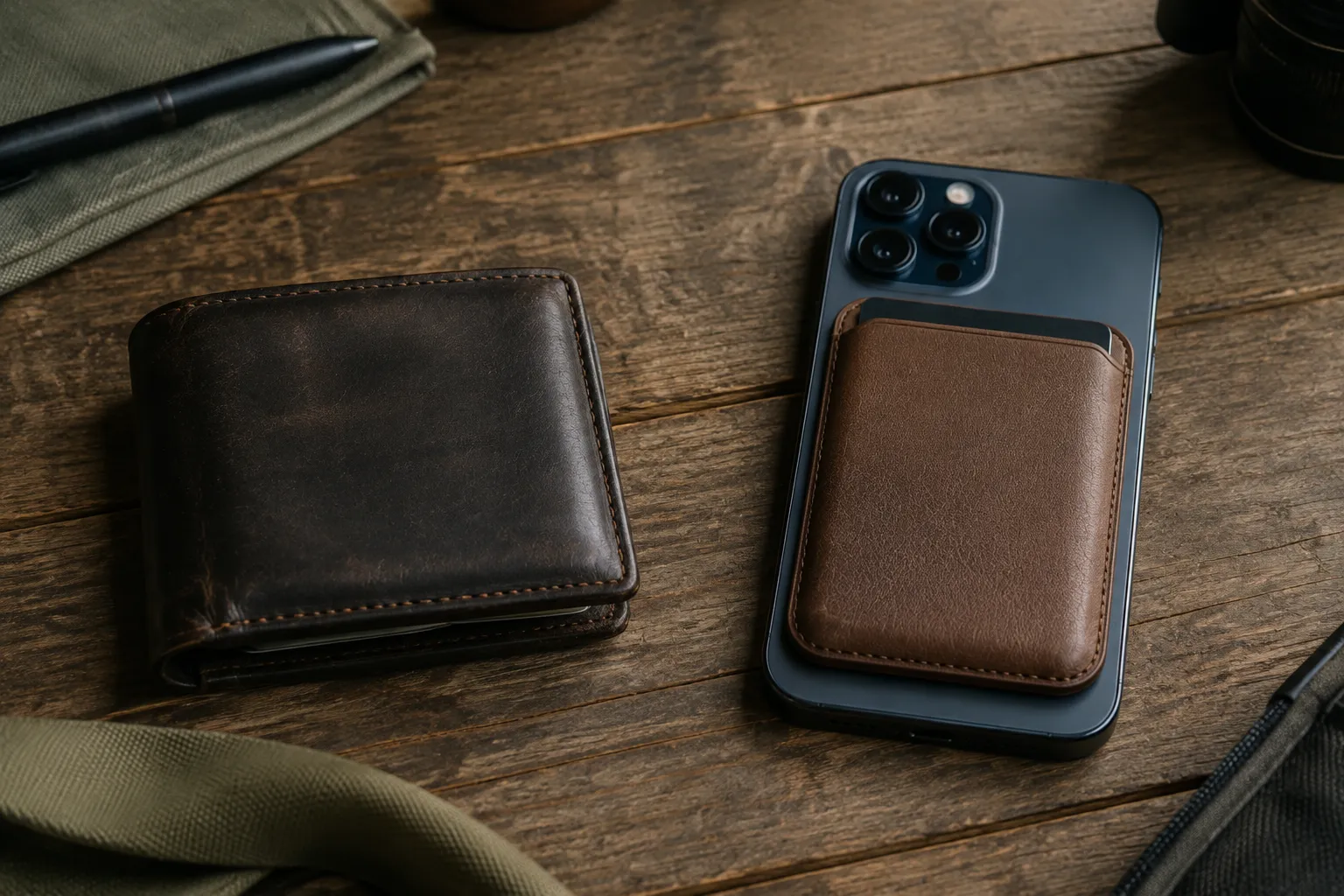
The brown leather bifold has been riding in back pockets since long before anyone called a phone a "daily carry," and it is not going anywhere. Yet the MagSafe wallet, a slab of aluminum and rare earth magnets that costs as much as a good dinner, keeps selling out. The interesting question is not which one is better. The interesting question is what each one actually does to the way a person moves through a day.
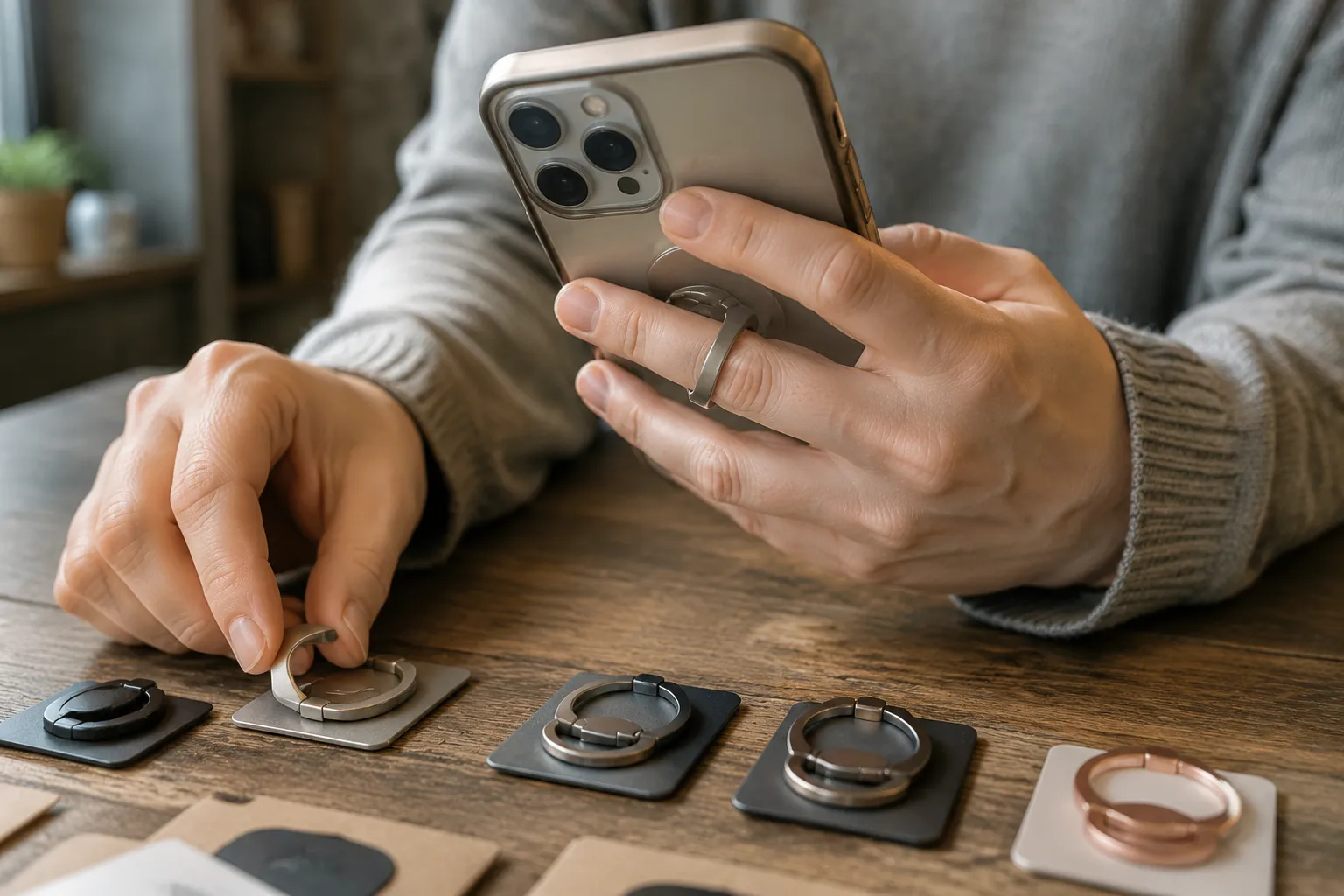
For the last eleven months, both have lived in rotation. The leather bifold holds a license, two credit cards, a transit card, a folded emergency twenty, and a decade of wear that has shaped the thing into the exact curve of a back thigh. The MagSafe wallet holds three cards and sticks to the back of a phone. Every few weeks, the swap happens. The reasons for switching are never about storage capacity. They are about physics, posture, and the quiet social choreography of paying for things.
The Physics of a Back Pocket
Sitting on a bifold is a slow act of self-harm. A person who carries one knows the particular fidget: the wallet gets pulled out before getting into a car, set on the passenger seat, forgotten, retrieved with a sheepish lean across the center console. Chiropractors have built entire practices on the resulting lumbar asymmetry. The spine does not appreciate a 12-millimeter lift on one side of the pelvis.
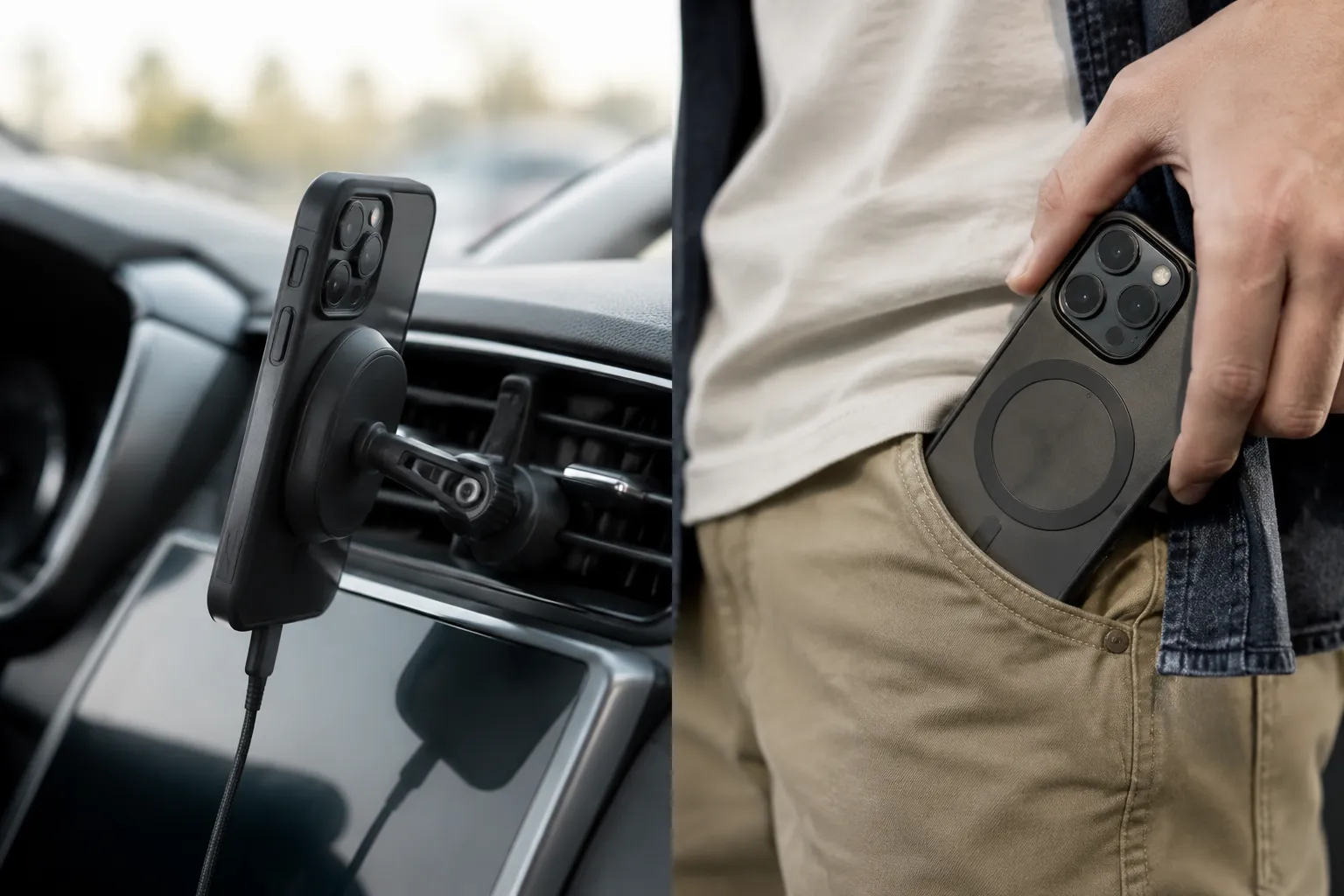
The MagSafe wallet eliminates that entirely. The phone rides in a front pocket or a jacket, and when a person sits down, nothing digs into the sciatic nerve. There is a real, measurable relief in that. The body stops compensating. The back pocket stays flat. It is a small freedom that becomes obvious only after it has been lost again.
But the front pocket has its own physics. A phone with an attached wallet is a brick. In slim-cut trousers, the silhouette goes from clean to bulging. The magnetic wallet adds roughly 30 grams, which sounds negligible until it is attached to a phone that already weighs 240 grams. The combined unit pulls at the seam of a pocket. It swings when a person walks. It makes sitting down with a phone in the front pocket an exercise in strategic adjustment.
The Card Capacity Reality
The bifold holds everything. Inside the aged leather there is room for a folded receipt, a spare house key in a pinch, a health insurance card, a photograph that has been there so long the corners have worn soft. That flexibility is the leather wallet's oldest argument. It is a mobile filing cabinet that never needs charging and never fails to open.
The MagSafe wallet holds three cards, and that limit is not a suggestion. Forcing a fourth card in stretches the sides and weakens the magnetic shield that protects the strip from demagnetization. The card that gets left behind becomes a decision made in the morning. A person must choose: driver's license and two cards, or license, one card, and the transit pass. The debit card gets swapped in and out based on the day's errands.
This sounds like a limitation. It functions as one, and it also functions as a filter. The act of deciding what belongs in the magnetic wallet means the thing never carries a single useless item. No ancient loyalty cards. No forgotten gift certificates. No receipts that turn to confetti in the washing machine. The three-card limit imposes a discipline that the capacious bifold never demands.
The Fumbling Index
At a checkout counter, the two devices produce completely different choreography. The leather wallet comes out of the back pocket, gets opened like a book, and the right card is slid out from under the thumb. The whole operation takes two seconds and requires no surface. The card is handed over, the wallet snapped shut, the back pocket resumed. It is a smooth, practiced motion that has been refined over decades.
The MagSafe wallet requires a surface. The phone comes out, the thumb pushes against the top edge of the wallet, and the whole assembly separates with a click that is genuinely satisfying. But the wallet needs somewhere to go. It cannot stay in the hand while the phone taps the reader. It gets tucked under an arm, set on the counter, or held between the knees. In a crowded coffeeshop, this becomes a small ballet of awkwardness.
Worse is the moment when the phone is passed to someone else. A person hands over the phone to show a photo, and the wallet goes with it. The recipient feels the unexpected weight, looks down, and an unspoken negotiation begins about whether the wallet should be detached. It is a small social friction that never happens with a bifold.
The Losing Game
The magnetic wallet has one catastrophic flaw, and it is the same feature that makes it convenient. The magnets are strong enough to hold through a jeans pocket, rated at roughly 900 gauss of pull force. They are not strong enough to survive a crowded subway car. Every person who has carried one for more than a month has a story about the moment the hand slips, the phone stays, and the wallet clatters to the floor or, worse, stays wedged between two people on a packed train while its owner watches it disappear.
Apple's Find My integration helps. The newer versions ping the phone when the wallet separates beyond a certain distance. But the detection is not instant. It takes about a minute of separation before the alert fires, and by then, a wallet dropped in a busy intersection has already been kicked, picked up, or pocketed.
Leather wallets get lost too. But they get lost as a distinct object, something a person notices missing the moment the back pocket feels light. The magnetic wallet gets lost as an attachment. It slides off silently, and the phone still works, and the person walks three blocks before checking a notification and realizing the wallet is gone.
The Texture of Daily Life
There is something to be said for the sensory experience of the bifold. The leather warms to body temperature. The edges soften. The smell becomes familiar in a way that registers as comfort rather than scent. The act of pulling it out is a tactile ritual that anchors a transaction in physical reality.
The MagSafe wallet is cold aluminum and hard edges at first. It warms quickly but never feels alive. The thumb pushes the cards out through a cutout in the back, and that motion has a mechanical precision that is efficient and entirely without warmth. The whole experience is optimized for speed, not for feel.
This is where the choice stops being about utility and starts being about temperament. A person who likes tools that show their history will always choose the leather. A person who likes tools that disappear into the task will choose the magnet. Both are legitimate. They are simply different philosophies about what an everyday object should be.
The Summer Problem and the Winter Solution
Season changes the calculus. In summer, the back pocket holds a wallet and the front pocket holds a phone, and both create sweat patches and awkward bulges in light chinos. The magnetic wallet turns one pocket into a single unit, freeing the other entirely. A person can carry a phone with a wallet attached and nothing else. Keys go in the other pocket. The result is a remarkably clean carry.
In winter, the leather wallet wins. A coat has interior pockets, and the bifold slides into a breast pocket where it rides safely and accessibly. The phone goes in a different pocket, and the separation is natural. The magnetic wallet, attached to the phone, ends up buried under layers. Every payment requires unzipping, reaching, and fumbling through a coat sleeve.
The Invisible Cost of Convenience
The MagSafe wallet costs around 60 dollars. The leather bifold was 45 dollars nine years ago and has never needed replacement. On a pure cost-per-year basis, the leather wins by an enormous margin. But the calculation ignores what the magnetic wallet does not require: the phone case.
A person who carries a bifold still needs a phone case. A person who carries a MagSafe wallet needs a specific kind of case, one with the magnet array embedded, and those cases cost more than the basic rubber ones. The total system cost for the magnetic route is roughly double what the leather route demands. The trade-off is that the phone case with the magnet array also enables a dozen other accessories: magnetic car mounts, battery packs, desk stands. The wallet is not a purchase. It is a gateway into an ecosystem.
A Wallet Is a Commitment Device
The real difference between these two objects is what they say about the person carrying them. The bifold is a commitment to permanence. It says that the contents matter enough to be carried at all times, that the owner believes in being prepared for a transaction that has not yet been imagined. It is why the bifold still beats the magnetic wallet for travel. A passport, a boarding pass, a backup card, cash for a country where cards do not work. The magnetic wallet cannot do that.
The magnetic wallet is a commitment to the present moment. It says that the only things worth carrying are the things needed today, right now, and that anything else is clutter. It is a minimalist philosophy enforced by physics. The three-card limit is not a bug. It is the whole point.
Neither is correct. But the choice reveals something. The person who carries the bifold is planning for the unexpected. The person who carries the magnetic wallet is planning for the immediate. Both will get through the day. They will simply have different experiences of what the day required.
The Shared Table Test
The final test is the restaurant table. The leather wallet comes out, gets placed next to the plate, and sits there like a trusted companion. It takes up space. It asserts its presence. When the check arrives, the card comes out of its familiar slot and the wallet goes back to the pocket, mission complete.
The magnetic wallet stays in the pocket during the meal. The phone stays in the pocket too, because the wallet makes the phone heavy and awkward on a table. When the check arrives, the phone comes out, the wallet separates with a click, and the card is extracted through the cutout. The wallet sits on the table, a small slab of metal reflecting the restaurant lights, looking like a prop from a science fiction film set in a minimalism cult.
A person reaches for whichever object has been in daily rotation that week, and the hand knows the motion before the brain decides. That is the real verdict. The best wallet is the one the hand has learned. The body adapts to either, and after a week, the alternative feels foreign. The bifold feels bulky after a month of magnets. The magnetic wallet feels insubstantial after a month of leather. There is no winner that stays won.