The wireless charging world has a dirty little secret that accessory makers have been banking on for years: most people do not actually know what their phone contains. Apple sold the MagSafe feature as a defining iPhone trait starting in 2020, so the assumption became that every iPhone from the iPhone 12 onward has a magnet array glued inside the back glass. That assumption is wrong in a way that matters the moment a person goes shopping for a Qi2 car mount. The iPhone SE line, which Apple kept quietly updating through 2022, never received the magnets. Neither did the second and third generation iPhone SE models that millions of people still carry daily. Those phones charge wirelessly through the same Qi protocol, but they have no magnetic alignment ring to click into a mount.
This gap between what people believe and what their device actually does has produced a market of accessories that are technically compatible with Qi2 and practically useless for a large slice of the iPhone population. A Qi2 car mount without magnets is not a paradox. It is a necessary category that few brands bother to make well, because engineering a mount that works without magnetic attachment is harder than stamping out another MagSafe clone.
Why Qi2 assumed the magnets were always there
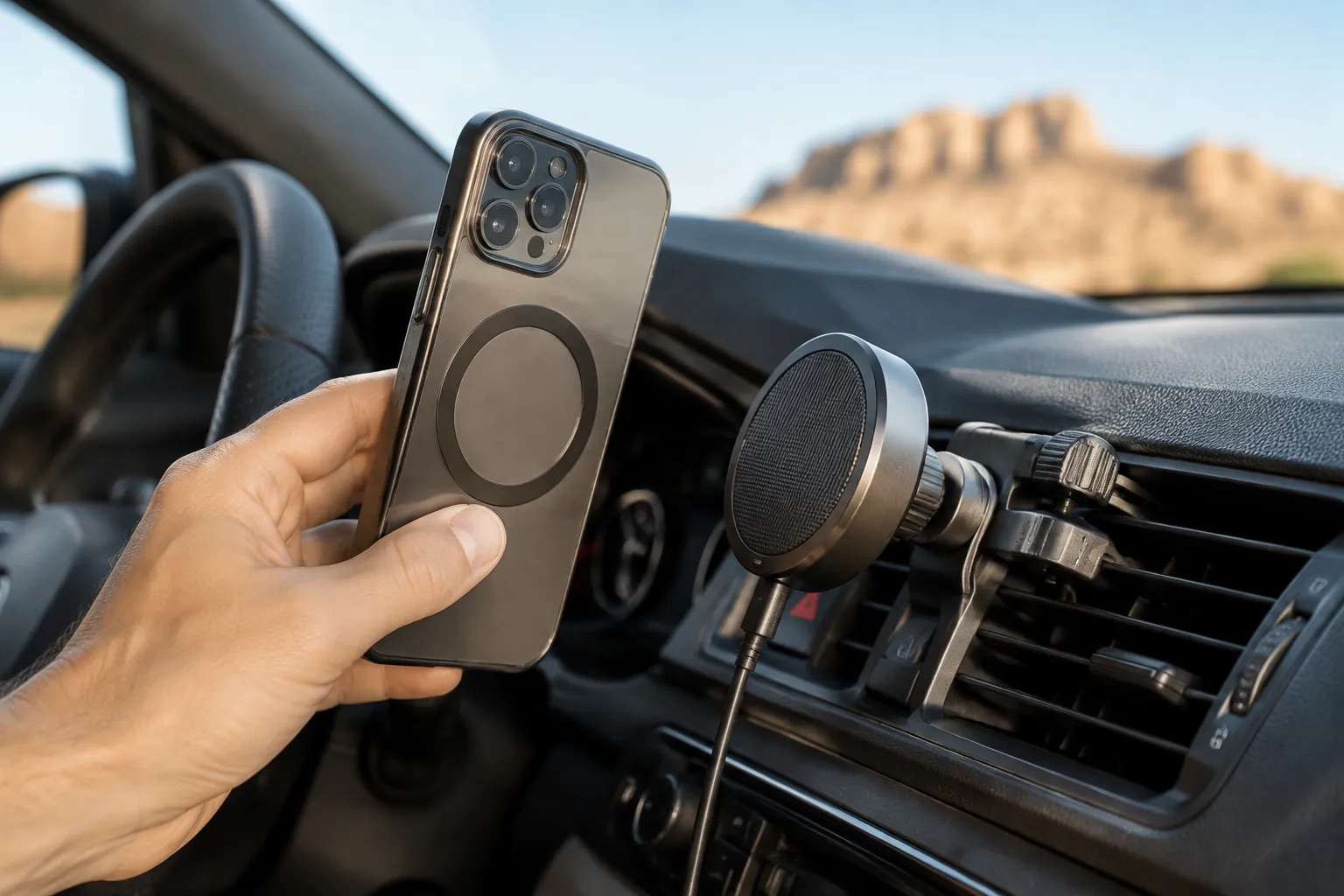
The Qi2 standard itself is built on the bones of MagSafe. The Wireless Power Consortium took Apple's magnetic alignment architecture, made it an open standard, and called it the Magnetic Power Profile. For a device to be Qi2 certified, it needs that ring of magnets positioned around the charging coil so the accessory snaps into perfect alignment. This is genuinely better engineering than the old Qi standard, which left a phone floating in space on a charging pad and required the user to hunt for the sweet spot. Qi2 solved that problem by borrowing Apple's homework.
But the phone itself has to contain the magnets for the system to work. The iPhone SE 2022 does not. It charges through Qi, which means it can draw power from a Qi2 charger because Qi2 retains backward compatibility with the older standard. The mount will happily deliver 7.5 watts to an SE. The phone just cannot hold onto the mount by itself. Gravity wins the argument in a moving car.
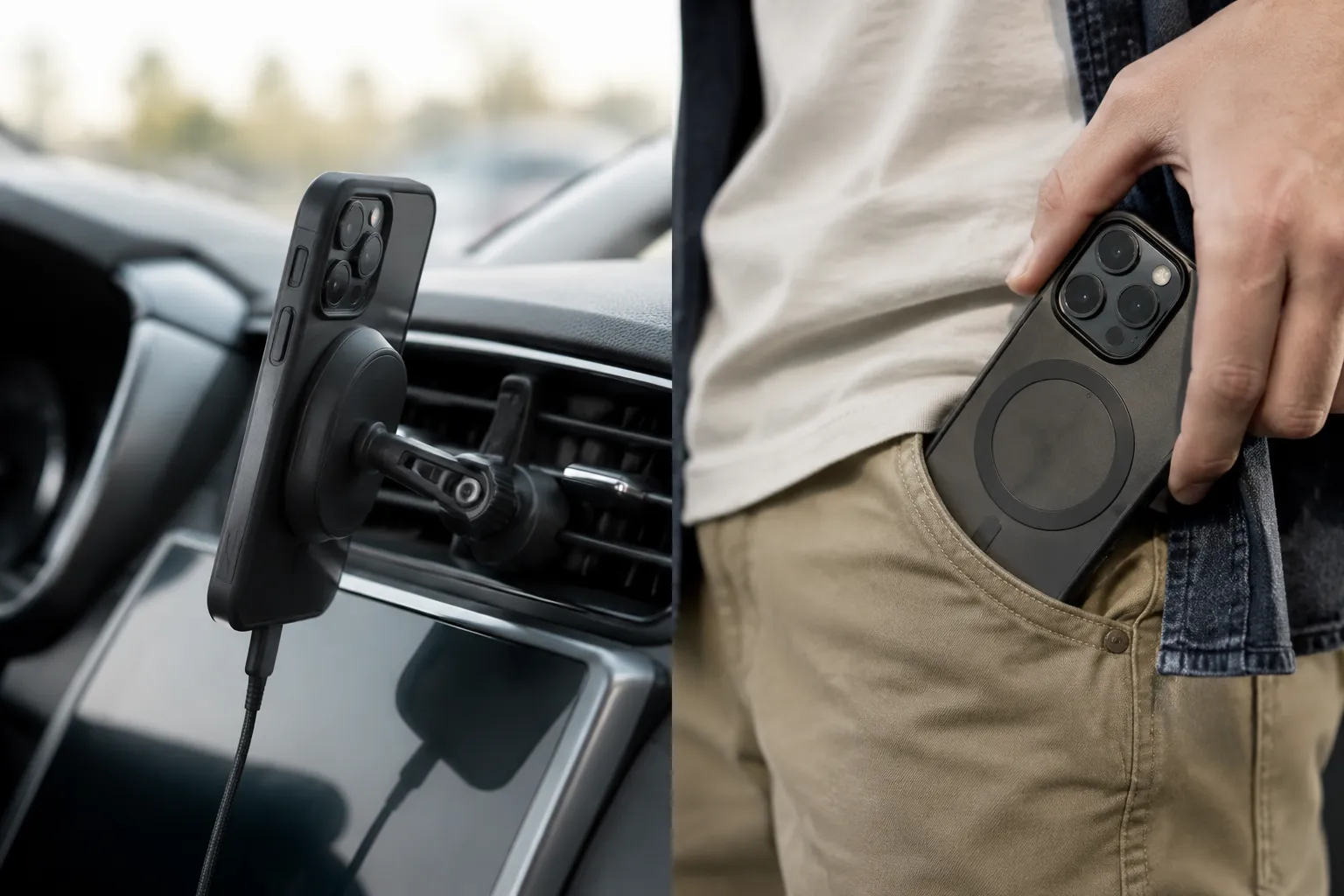
This creates a strange market position. Qi2 car mounts are designed, marketed, and photographed with magnet-equipped iPhones. Their sales pages show a phone snapping into place, one hand on the wheel, no clips or grips anywhere. A person with an older phone looks at those photos and thinks the mount does not work for their device. Technically that is correct. The mount does not work without either an add-on adapter or a mount design that does not rely on the phone's internal magnets in the first place.
The three ways a mount can work without phone magnets
There are exactly three routes to making a Qi2 mount function with a case-less, magnet-less iPhone, and each has trade-offs worth understanding before spending money. The first is a metal plate adapter that sticks to the phone or slides inside a case. The second is a mount that uses spring-loaded mechanical arms to hold the phone, which then happens to also charge it wirelessly. The third is a cradle design with a lip or ledge that the phone rests against while the charging coil pushes from behind.
Each of these solutions changes the experience in real ways. The metal plate route is the most popular because it is cheap and it makes a magnet-less phone behave exactly like a MagSafe phone. But it requires the user to be okay with a visible disc on the back of the phone or a case with a built-in plate, and it interferes with other wireless charging if the plate is poorly positioned. Some plates are adhesive rings that only cover the center, some are full discs that block the coil, and some are tiny rectangles meant for the lower half of the phone. Getting this wrong means a mount that either does not hold or does not charge.
Mechanical arms are the second route and the one that feels most like a return to the pre-magnetic era. These mounts grab the phone with spring tension and hold it firmly, then align a charging coil behind the center of the device. The phone does not need to snap into place because the arms do the work. The trade-off is ergonomic. Removing a phone from a grip mount requires two hands and a deliberate squeeze, which is a worse daily experience than the one-handed drop of a magnetic mount. But it works with literally any phone, including ones with thick cases, and it never loses grip on a bumpy road.
The cradle approach is the least common and often the most elegant when done right. These are closed-bottom mounts shaped like a shallow bowl. A phone slides down into the cradle until its bottom edge rests on a ledge, and the charging coil sits against the back. Gravity secures the phone downward, the ledge stops the slide, and pressure from the coil keeps the back in contact. Pulling the phone out takes one hand and an upward tug. This design has no moving parts to wear out and no adhesive to fail, but it tends to work only in portrait orientation and it can block access to the charging port depending on the cradle's depth.
What the actual Qi2 certified mounts are doing
The certified Qi2 mount market has mostly ignored this problem. A search through the major accessory brands shows a wall of magnetic products, each one assuming the phone has its own ring. Belkin, Anker, and Spigen all sell Qi2 car mounts that are magnet-first designs. They perform beautifully with iPhone 15 or iPhone 16 models and with Android phones that adopted the Qi2 spec. None of them ship with a workable solution for a magnet-less iPhone beyond a vague mention that a separately sold adapter ring might help.
The situation is not identical across brands. Some mounts place the charging coil in a puck that sits off a vent clip or a CD slot arm, and those designs can hold a phone via friction even without magnets, but the coil alignment drifts with every bump. Others have a flat backing plate with no grip at all, which means a magnet-less phone is simply falling off the moment the car turns. The honest assessment is that most Qi2 car mounts on the market in 2025 are designed for phones that already have magnets, and the rest of the market is an afterthought.
This is where the buyer with an iPhone SE or an older iPhone faces a genuine information gap. Online listings do not state clearly that the mount requires the phone to have built-in magnets. The listing says "MagSafe compatible" and the consumer reads it as "my phone works with this." Product photos show a phone with no visible case, snapped to the mount, and the visual language implies universality. The fine print often buries the requirement in a compatibility chart that lists iPhone models and omits the SE entirely.
The adapter ring is the pragmatic fix, until it is not
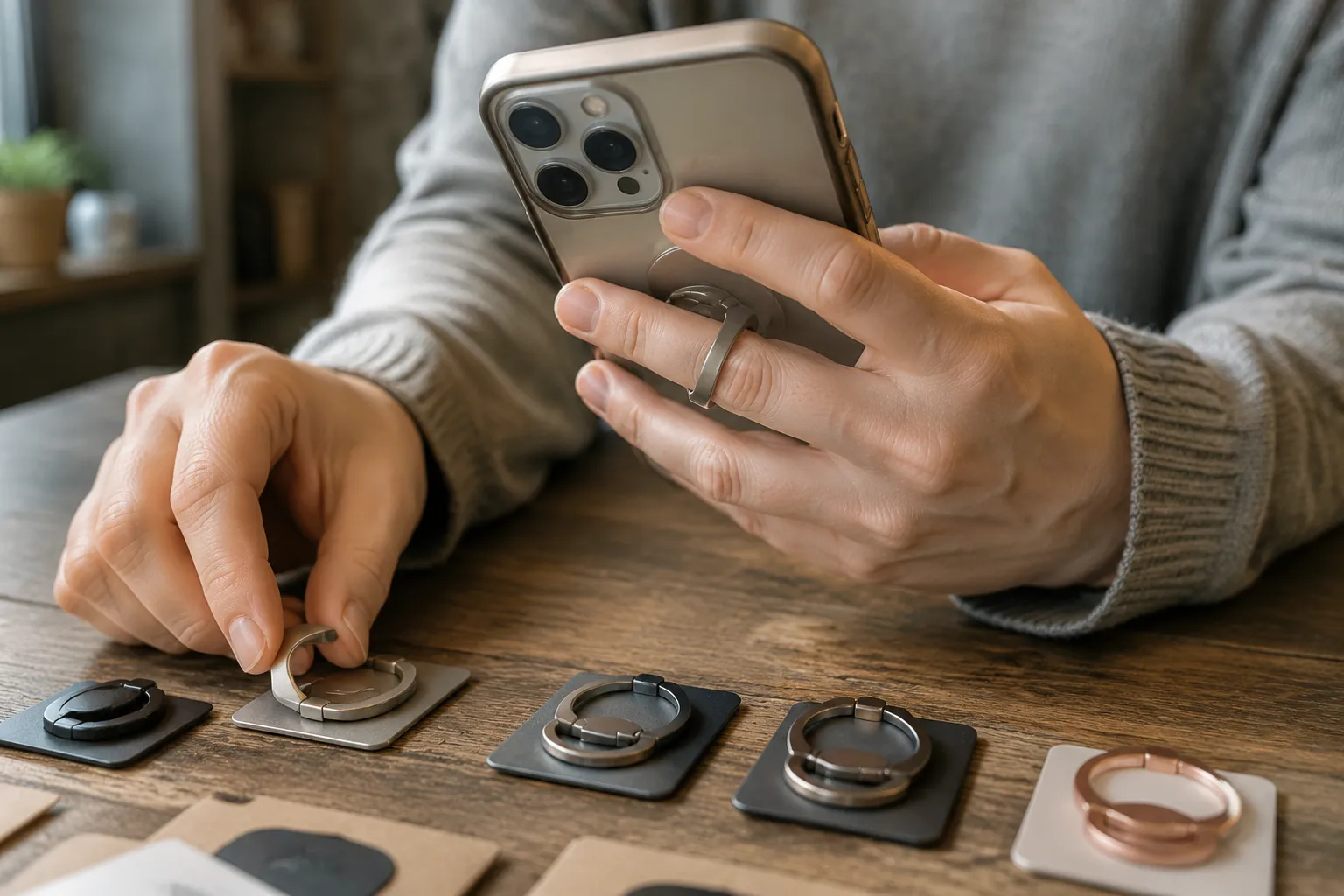
The most common solution people actually land on is a magnetic adapter ring. These are thin metal discs, usually around 58 millimeters in diameter, with a 3M adhesive backing. A person sticks the ring to the back of the phone, or to the inside of a clear case, and suddenly the phone has the magnetic profile of a MagSafe device. Qi2 mounts snap to the ring exactly as they would to a built-in array. Charging alignment becomes consistent because the ring's position is fixed at the center of the device.
This fix works, and for a lot of people it is the right answer. The ring costs less than ten dollars. It adds minimal thickness. It allows the full Qi2 charging speed and a secure magnetic hold. The problems emerge only over time. The adhesive degrades in a hot car, and dashboard temperatures in summer can easily reach 160 degrees Fahrenheit, which softens the glue and lets the ring shift or detach. A phone that suddenly stops holding to a mount at highway speed is an event a person remembers. The ring also sits proud of the back glass, which means the phone no longer lays flat on a table without rocking, and it collects dust around the edge.
Quality varies wildly between rings. The cheap ones use a weaker adhesive and a thinner metal that flexes under the pull of the magnets. The better ones, often sold by the same brands that make the mounts, use a firmer foam adhesive ring that fills the gap created by a camera bump and bonds more aggressively. The difference is not visible in a product photo. It is only visible after a month of parking in the sun.
The case that hides the problem
A person with an iPhone SE has another option that avoids sticking anything directly to the phone. Several case manufacturers make cases with the magnetic ring built into the case itself. The phone slides into the case, the case carries the magnets, and the mount snaps to the case. This is the cleanest solution in terms of daily use. The phone stays protected, no adhesive meets the glass, and the case can be swapped out when the magnets weaken.
The trade-off is that these cases are not common for the SE line. The iPhone SE uses the chassis of the iPhone 8, a design Apple stopped updating in 2022, so case makers have moved on to newer models. Finding a magnetic case for an SE requires digging through third-party brands that still manufacture for older devices, and the quality is inconsistent. Some of these cases place the magnet ring off-center, which is a death sentence for charging alignment. Others use such a thin metal that the connection feels weak even with a strong mount. The search is doable, but it is not a one-click purchase.
For the broader iPhone population, those with an iPhone 12 through iPhone 15, the case approach is effortless because every major brand sells a magnetic case in every color. The SE owner gets leftovers and compromises. This is a small market, and the accessory industry has voted with its production lines.
The rare mount that does not need the ring at all
A handful of Qi2 mounts have been designed with the understanding that not every phone has magnets. These are the mechanical grip mounts that include a Qi2 charging coil. They look like the old Scosche and iOttie grip mounts from the pre-MagSafe era, but they add a charging pad behind the phone. The phone is held by clamping arms, and the coil sits behind the center of the device. Because the arms force alignment, the coil reaches the phone's internal receiver regardless of whether magnets exist.
These mounts are the only Qi2 products that work out of the box with every phone that supports Qi charging. They also solve the heat problem that plagues magnetic mounts, because the phone is not pressed against a flat charging pad by magnetic force. The coil sits close enough to charge, but the design leaves a small air gap that helps with airflow. The downside is that they are genuinely rare. The big accessory brands mostly stopped making mechanical grip mounts once the magnetic standard took off, and the ones that remain are older Qi models that charge at a slower 7.5 watts instead of the full Qi2 speed.
Finding a Qi2 rated mechanical grip mount requires looking at smaller companies. Some of the newer adjustable car mounts from Chinese accessory brands combine a powered or manual clamp with a Qi2 coil, and they fill a real niche. The quality control is less predictable than with a Belkin product, but the core functionality is sound. These mounts also have a pragmatic advantage for households with mixed devices. A car shared by a person with an iPhone 15 and a person with an iPhone SE can use one mount for both without any adapters.
Why the vent mount changes the math
The mounting location in the car affects which solution makes sense. A dashboard mount or a windshield mount has the phone sitting at a steep angle, and gravity pulls the phone downward along the face of the mount. Magnetic hold has to fight that shear force. A vent mount, by contrast, holds the phone roughly vertical or with a slight backward tilt, which reduces the gravitational pull on the magnetic connection. A weaker adapter ring can hold a phone on a vent mount for months and fail within a week on a dashboard mount.
This is why the recommendation between adapter rings and mechanical grips should always come with a location caveat. A person who drives a car with prominent dashboard vents and who only needs the phone for navigation might be perfectly served by a cheap adapter ring and a magnetic vent mount. A person who needs the phone mounted high on the dash, out of the way of the vents, is better off with a mechanical grip or a cradle mount that does not rely on magnetic shear strength. The same phone, the same ring, two completely different outcomes.
The charging speed reality for older iPhones
An iPhone SE from 2022 charges wirelessly at a maximum of 7.5 watts. That is the ceiling of the Qi standard it uses. A Qi2 mount can deliver up to 15 watts, but the phone will only draw what its receiver allows. This means a person with an older phone spends extra money for a Qi2 mount and receives no faster charging than they would get from a five year old Qi pad. The benefit of Qi2 for these users is not speed. The benefit is only the magnetic alignment, which they still do not have without an adapter.
This reality undermines the upgrade logic. If charging speed stays at 7.5 watts regardless, and if the phone has no magnets, then a Qi2 mount is functionally identical to a standard Qi mount, except for the price premium. A person could buy an old Qi vent mount with mechanical arms for a fraction of the cost and get the exact same charging performance. The only reason to choose Qi2 is future-proofing, the assumption that the next phone will have magnets and will use the full 15 watts, or that a second phone in the household already does.
For a household with one older iPhone and one newer iPhone, the math changes. A Qi2 mount with a magnetic adapter ring on the older phone works for both devices at their respective speeds. The newer phone gets 15 watts and a secure snap. The older phone gets 7.5 watts and a secure snap via the ring. The combined cost of a Qi2 mount and a ring is still less than buying two dedicated mounts, and the charging experience in the car is unified.
The metal plate problem nobody mentions
Every article about making a phone magnetic warns about metal plates interfering with NFC and Apple Pay, and that warning is accurate. A solid metal plate placed between the phone and a payment terminal can block the NFC field entirely. The workaround is to position the plate low on the phone, away from the NFC antenna that sits near the top of the device. This works for mounting, but it creates a charging problem. The Qi charging coil in the iPhone SE sits in the center of the device. A plate placed low enough to avoid NFC is also out of alignment with the charging coil.
The adapter ring solves this by being an open circle, not a solid plate. The center of the ring is empty, so the Qi charging field passes through the hole. The magnetic pull comes from the ring's circumference, and the charging coil sits inside it. This is why the ring, and not the older full plate, is the correct accessory for anyone who wants both a magnetic mount and wireless charging. The distinction is lost on a lot of buyers who search for "magnetic car mount iPhone SE" and land on a product listing for a metal plate that blocks the very feature they want to use.
The ring also has to be correctly sized. A ring designed for MagSafe is 58 millimeters across, and that size matches the Qi2 charging coil. A smaller magnetic sticker, the kind sold for holding a phone to a magnetic vent mount by its corners, will not align with the coil at the center. The phone will hold to the mount, but it will not charge, because the magnets sit off to the side and the coil has no clear path. The two functions require different hardware.
Choosing by the phone that comes next
The decision process changes when a person considers the lifespan of the phone they currently own. An iPhone SE from 2022 has maybe two or three years of software support left. Buying a high end Qi2 mount and a careful adapter ring solution for a phone that will be replaced soon is a different calculation than buying the same setup for a phone that will be in service for another four years. The mount is a multi-phone investment. The adapter ring is a consumable that sticks to one device.
For a person planning to replace their SE with an iPhone 16 or 17, the sensible path is to buy the Qi2 mount now, use a cheap adapter ring in the interim, and remove the ring when the new phone arrives. The mount stays in the car and the ring goes in the trash. This spreads the cost of the mount across multiple phones and keeps the daily experience consistent. The alternative, buying a cheap Qi mechanical mount now and a separate Qi2 mount later, costs more in total and produces two car mounts with nowhere to go.
The other path is for the person who plans to keep the SE until it dies. For them, the mechanical grip Qi2 mount is the better investment, because it does not depend on an adhesive ring that will fail in a hot car eventually. The grip mount holds the phone regardless of temperature, case, or ring condition, and it will still work when the phone is replaced, because the grips adjust to any size. The only sacrifice is the one-handed release that magnetic mounts provide.
There is no universal answer because the market is fragmented by phone vintage. The honest recommendation is a conditional one. If the phone has magnets, buy any Qi2 mount and stop thinking about it. If the phone does not have magnets and the user expects to replace it within two years, buy a magnetic Qi2 mount and an adapter ring, and put the ring on carefully with the phone in a case. If the phone does not have magnets and will be kept until it dies, buy the mechanical grip Qi2 mount and skip the ring entirely. The last option is the only one that treats the magnet-less iPhone as a permanent condition rather than a temporary inconvenience.
The Qi2 car mount market will eventually solve this on its own. As the iPhone SE line either disappears or finally gains magnets, the population of magnet-less iPhones will shrink to zero, and the accessory makers can safely ignore the problem. Until that day, the person holding an older iPhone has to be the one who reads the fine print, checks the phone model against the compatibility chart, and decides whether they are buying for the phone they have or the phone they will have next. The mount industry has made its choice. The buyer has to make theirs.