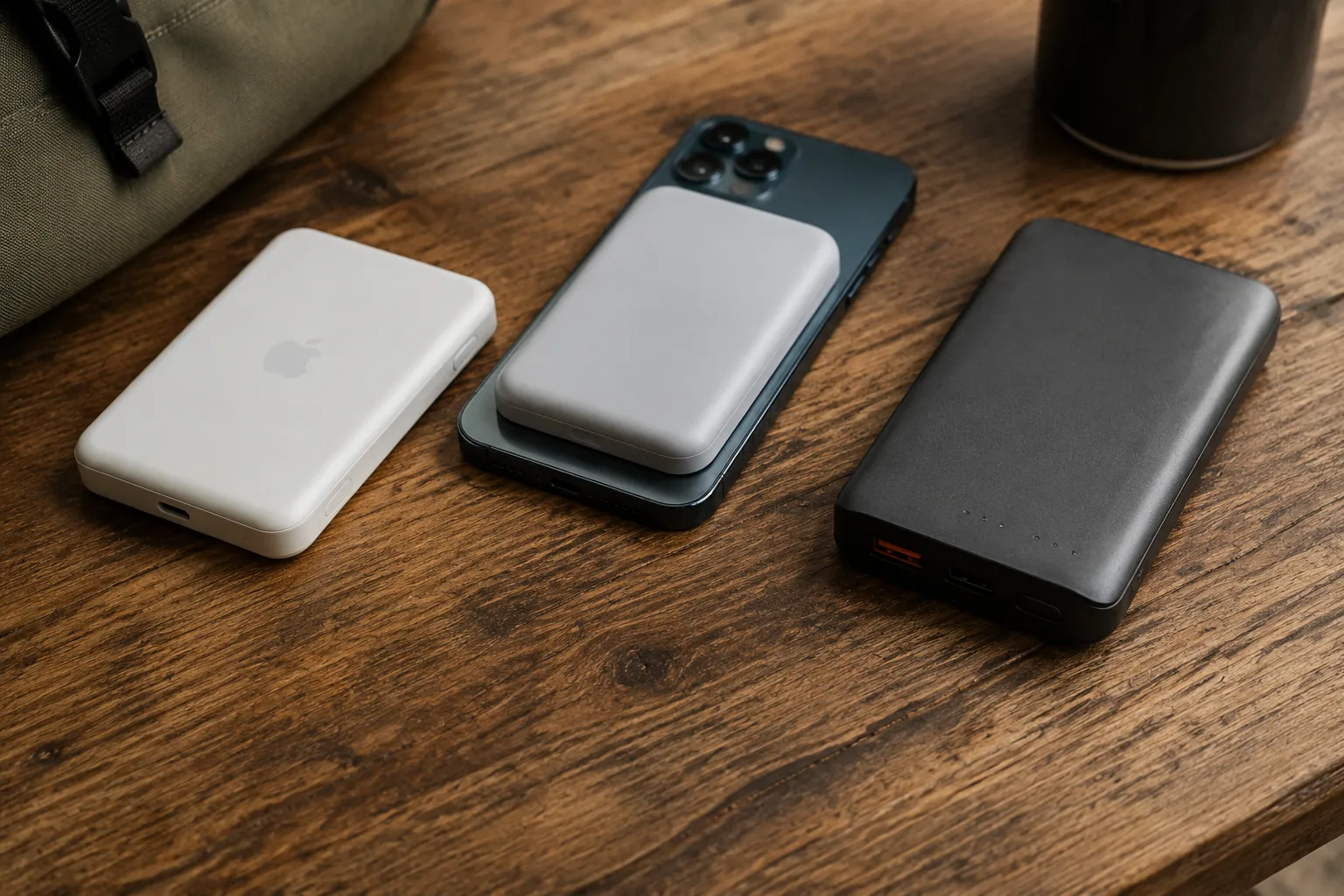
The battery pack in a pocket is a lie most people have told themselves at least once. A traditional 10,000 mAh power bank weighs roughly 200 grams, roughly the heft of a small can of soup, and its cable adds another tangle of failure. Yet the MagSafe Battery Pack, Apple's own 1,460 mAh accessory that costs around $99, disappears into a palm and does almost nothing on its own. The gap between what these two devices promise and what they actually deliver on a normal Tuesday is wider than the spec sheets suggest.
The core question is not which one charges faster, because the answer is obvious and boring. The traditional brick wins on raw output every single time. The question is which device a person will actually carry, attach, and use without resentment. Charging hardware that stays in a drawer is worthless at any wattage.
The 1,460 mAh Reality Check
Apple's MagSafe Battery Pack holds 1,460 mAh at 7.62 volts, which translates to roughly 11.1 watt-hours. A modern iPhone Pro Max carries a battery near 4,500 mAh at around 3.8 volts, about 17 watt-hours. Simple division shows the pack holds roughly 60 percent of the phone's capacity, but wireless charging loses energy to heat and the pack refuses to fully drain itself the way a wired brick does.
The practical result is that the MagSafe pack delivers somewhere between a 40 and 50 percent top-up to a depleted Pro Max. That is enough to turn a dead phone into a phone with dinner-time legs. It is not enough for a weekend away. Anyone expecting a full recharge has misread the product name as a promise rather than a convenience.
The traditional 10,000 mAh pack, by contrast, delivers roughly two full charges to the same phone, accounting for conversion losses. The math is not close. The brick wins on raw capacity by a factor of four. Carrying one means never thinking about percentages again.
But raw capacity misses the point of why the MagSafe pack exists. The device is not a reservoir. It is a life raft that happens to stick to the back of a phone.
Where the Cable Becomes the Enemy
A traditional power bank demands a choreography that no one admits until they have lived it. The phone goes in one pocket, the brick in another, and the cable connects them at an awkward angle that catches on door handles. Walking with a phone charging from a pocket brick bends the Lightning or USB-C connector in ways that wear out ports. Sitting down with both devices in the same pocket creates a lump that digs into a thigh.
People solve this by holding the phone and brick together in one hand, which turns a simple walk into a two-handed operation. The free hand becomes the charging hand. Texting with one thumb while the other hand grips a tethered brick is a posture designed by someone who never tried it.
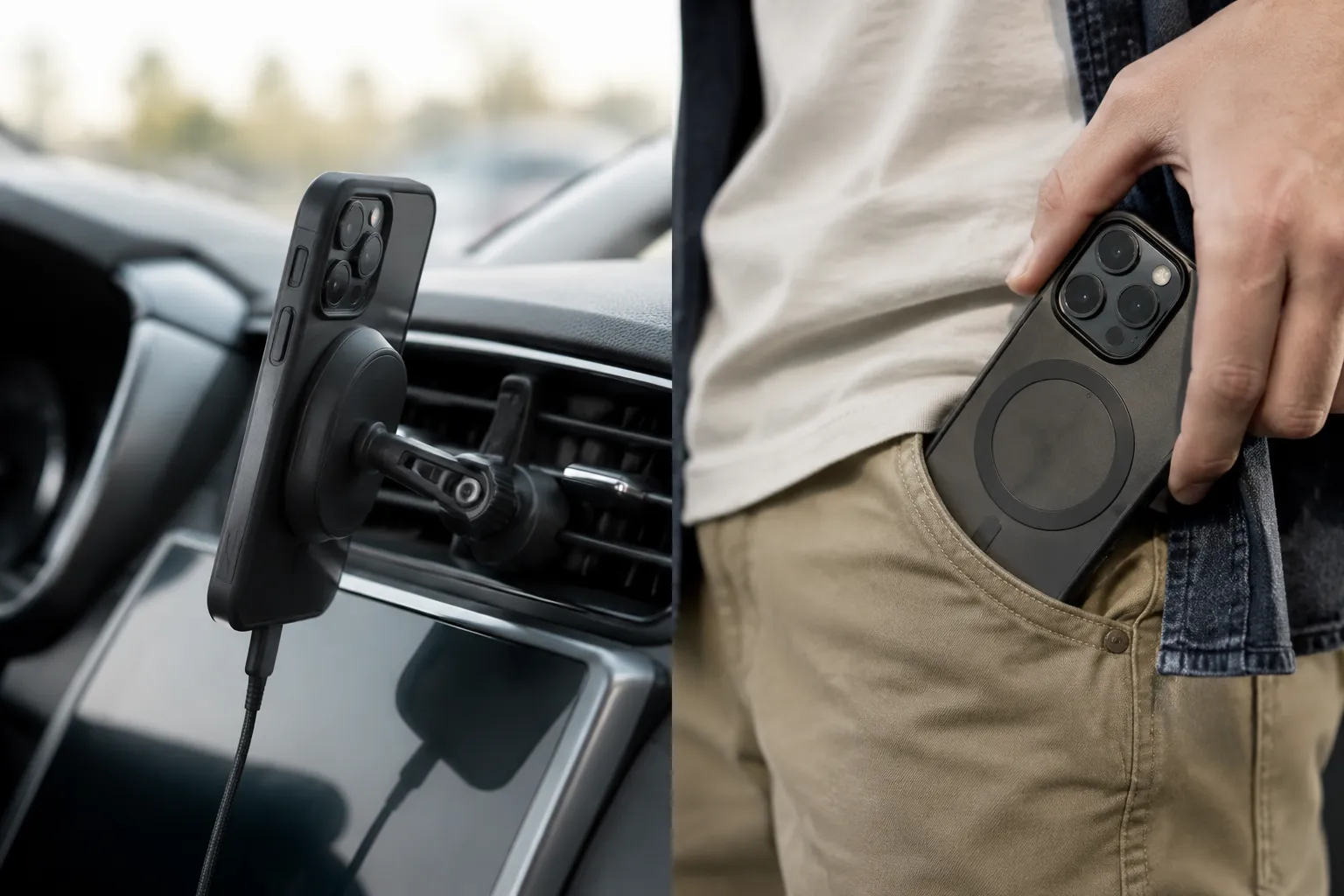
The MagSafe pack eliminates that entire sequence. The phone and the pack become one object, slightly thicker and heavier but still a single unit. A person can scroll, photograph, and pocket the combination without thinking about cables. The pack's charging speed of 5 watts when used in this untethered pass-through mode is slow, but the phone still gains charge during normal use. The difference between draining 10 percent an hour and gaining 5 percent an hour while using the phone is the difference between arriving home dead and arriving home with 30 percent.
That pass-through behavior is the pack's hidden strength. It does not need to be the fastest charger. It needs to be the charger that a person forgets is attached until the phone stops losing power.
The Physics of the Bump
Traditional power banks come in two shapes, and both fail at pocket ergonomics in different ways. The slim credit-card style packs, usually 5,000 mAh, slide into a pocket but slide around inside it, rotating against keys and creating a shifting rectangle that never sits still. The larger brick style packs, 10,000 mAh and up, are shaped like a thick candy bar with rounded ends, and they sit in a pocket like a deliberate choice to carry a second device.
Every traditional pack introduces a cable loop somewhere. Coiled cables unravel. Loose cables snag. The act of charging from a brick in a bag while using the phone means the cable runs up from the bag, which puts tension on the phone connector at precisely the angle that weakens it over months of use.
The MagSafe pack changes the phone's center of gravity. A Pro Max with the pack attached becomes a heavier object, roughly 280 grams combined. The pack protrudes from the back by about 12 millimeters, which makes the phone sit awkwardly on flat surfaces. Typing on a desk with the pack attached leaves the phone rocking on its camera bump and pack edge, a wobble that annoys some users enough to remove the pack at their desk.
But in a pocket, the combined unit feels like a thick phone, not like a phone plus a separate object. The difference is subtle and decisive. A person can forget the pack is there until the battery icon stops dropping.
The Reverse Charging Question That Nobody Asks
One behavior separates these two devices more than any spec comparison, and it is the reverse charge trick. The MagSafe Battery Pack, when plugged into a Lightning cable itself, can charge the phone while the pack sits on a table, effectively becoming a wireless charging stand. The pack tops up first, then passes power to the phone. This turns the pack into a two-in-one device that many owners discover months after purchase.
The traditional power bank has no equivalent party trick. It charges the phone or it does not. There is no configuration where the brick becomes a desk accessory with a secondary function.
This reverse charging mode also solves the MagSafe pack's biggest weakness. On a nightstand, the pack plugged into a wall charger becomes a wireless charger that keeps the phone at 100 percent while the pack itself recharges. In the morning, the person grabs the phone and the fully charged pack together and leaves. The workflow has no cable untangling and no separate charging session for two devices.
The downside is that this requires owning a Lightning cable and a wall adapter, and the pack charges itself slowly at roughly 8 watts. A full recharge of the pack takes over an hour and a half. The traditional brick with USB-C Power Delivery charges itself at 18 to 30 watts, reaching full in under two hours for most 10,000 mAh units.
The Heat Problem That Changes Real-World Speeds
Wireless charging generates heat, and heat is the enemy of battery health. The MagSafe pack, when attached to a phone that is actively navigating with the screen on full brightness, will sometimes stop charging entirely to protect both batteries. The phone temperature sensor triggers a pause, the battery percentage freezes, and the pack keeps the phone from draining rather than actively charging it.
The traditional power bank avoids this problem entirely. A wired connection generates negligible heat by comparison. A phone plugged into a brick while running navigation will charge at full speed, or close to it, because the heat from the charging circuit dissipates through the cable rather than building up between two flat surfaces pressed together.
This is the MagSafe pack's most frustrating behavior in practice. Attaching it to a hot phone during a summer day of GPS use can result in no charging at all. The pack becomes a passive weight that merely prevents further drain. A person expecting a top-up during a long drive will look down to find the percentage frozen at 18 percent for an hour.
The traditional brick never has this failure mode. It charges or it is broken. There is no thermal negotiation happening between two sealed devices pressed together.
The Carry Decision That Matters More Than Specs
The real distinction between these devices is not technical. It is behavioral. People carry the MagSafe pack more often because it attaches to the thing they already carry, and it vanishes into the same pocket as the phone. People carry traditional power banks only when they know they will need them, which means the brick stays home on the days the phone dies unexpectedly.
A 10,000 mAh brick in a backpack is a different proposition than one in a pocket. In a bag, the weight is irrelevant and the cable can stay coiled until needed. The brick becomes an emergency reserve, not a daily companion. This is the correct use case for traditional power banks. They belong in bags, cars, and desk drawers, waiting for the day a phone is truly dead and there is time to sit still for an hour.
The MagSafe pack belongs in a pocket or nowhere. Its small capacity makes it useless as a bag reserve, since a person reaching into a bag after a long day will find the pack has already bled its charge passively or was never charged in the first place. The pack only works when it travels with the phone constantly, attached whenever the percentage drops below a comfort threshold.
People who buy the MagSafe pack and try to use it like a traditional power bank, pulling it out of a bag only when the phone is at 5 percent, will be disappointed every time. The pack needs to be on the phone early, at 40 percent, to provide meaningful runtime extension. Waiting until the phone is nearly dead gives the pack too little time to transfer its limited energy.
The 5,000 mAh Third Option That Splits the Difference
The market has responded to this divide with magnetic wireless power banks that attach like the MagSafe pack but hold 5,000 mAh, roughly triple the capacity. Anker, Belkin, and others sell these in the 30 to 50 dollar range. They stick to the back of a phone, charge at 7.5 to 15 watts, and provide a more meaningful top-up. A 5,000 mAh magnetic pack can deliver nearly two full charges to a standard iPhone or a full charge to a Pro Max, depending on efficiency losses.
These third-party packs are heavier than Apple's version, often 130 to 150 grams, and they protrude more. But they cost less than half of Apple's pack and hold more than three times the energy. The tradeoff is a thicker combined device and the same heat limitations that plague all wireless charging.
For most people, this third option is the rational purchase. The Apple pack is a beautifully engineered object with a premium price and a capacity that feels almost insulting next to a 20 dollar Anker brick. The third-party magnetic packs ask whether a person wants the attachment convenience or the capacity, and they mostly deliver both.
None of these magnetic options replaces a traditional power bank for travel. A person flying cross-country with a dead phone and a layover needs 10,000 mAh or more. The magnetic pack is a daily driver, not a survival tool.
What the Wallet Actually Pays For
The price difference between these categories is not a spec sheet gap. Apple sells the MagSafe Battery Pack for 99 dollars. A comparable traditional 10,000 mAh brick from Anker or RavPower costs 25 to 35 dollars. The fourfold price difference buys a smaller capacity and a slower charge. On paper, this is a terrible deal.
What the price actually buys is the removal of friction. The MagSafe pack turns charging from a conscious decision into an automatic behavior. A person who never remembers to charge a brick will reflexively slap the pack on the phone when leaving the house, because the pack lives on the nightstand next to the phone and is always charged. The habit loop is shorter. The object is always in sight and always ready.
For a person who already leaves the house with a brick in a bag, the MagSafe pack is a redundant luxury. For a person who has never once remembered to bring a brick, the pack changes behavior in a way that a spec sheet cannot measure. The purchase is not about watts or milliamp-hours. It is about whether the device integrates into an existing routine or demands a new one.
The traditional brick demands a routine. It must be charged, packed, and remembered. The MagSafe pack only asks to be attached, and even that happens because the phone and the pack sit next to each other during the charging ritual at night.
A person should buy the MagSafe pack only if the phone is already their primary computing device and the pocket is their primary bag. Everyone else should buy the cheap brick and leave it in a bag, where it will wait patiently for the day it is actually needed. The pack is a lifestyle accessory wearing the costume of a utility tool, and it excels only when a person commits to that lifestyle completely.