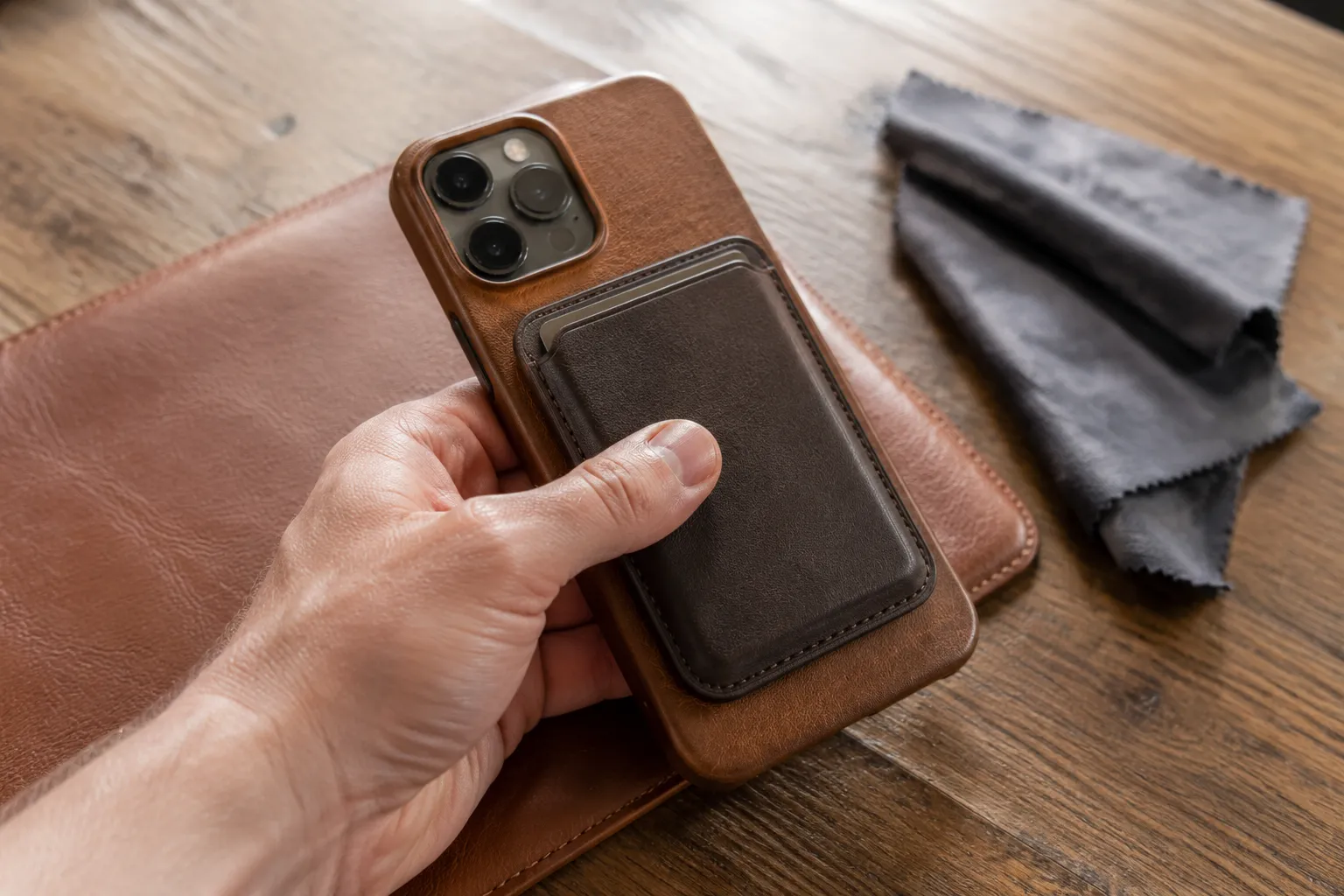
The leather case on a phone is a commitment to a certain kind of aging. It starts stiff, almost brittle, with a factory finish that feels more like coated cardboard than hide. Over weeks of pocket warmth and hand oil, it softens, darkens, and develops a map of small dents and scuffs that belong to one person only. That process is the entire reason to buy leather in the first place. Then a rectangular slab of plastic and magnets goes on the back, and six months later, when the wallet comes off, the leather underneath looks like a ghost of itself. The color has not faded evenly. There is a clean rectangle of untouched dye surrounded by the patina of daily use. It is not a stain. It is a tan line, and it is permanent.
MagSafe wallets are useful enough that plenty of people accept this trade. They slide on and off with a satisfying click, hold a couple of cards, and keep a phone单手able in a way a traditional bifold never can. The problem is not the wallet. The problem is that most leather cases are dyed through a process that leaves the surface vulnerable to exactly this kind of differential wear. The fix is not complicated, but it requires understanding what is actually happening at the surface of the leather, and it requires a small amount of preparation before the wallet ever goes on.
Why the Mark Appears in the First Place
The most common assumption is that the MagSafe wallet rubs against the case and abrades the finish. Friction plays a role, but it is not the main culprit. The main culprit is light, specifically ultraviolet light, and the absence of it. Leather dye, even good quality aniline dye, is not colorfast. It oxidizes and fades when exposed to sunlight over months of use. The rest of the case gets that exposure constantly. The area under the wallet does not. When the wallet comes off, the contrast between the faded, aged leather and the protected rectangle is stark.
The second factor is pressure and heat. A phone sits in a pocket or a bag with the wallet pressed against it. Body heat softens the leather's natural oils, and the wallet's flat back acts like a miniature press, flattening the grain structure in that one spot. The leather under the wallet stays smoother and shinier, while the exposed edges develop the dull, slightly pebbled look of normal wear. The combination of uneven fading and uneven texture makes the outline look even worse than a simple color difference would.
There is also the matter of the case's own finish. Many leather phone cases, especially those in the mid-price range, use a pigmented topcoat rather than a pure aniline dye. That topcoat is what gives the case its uniform color out of the box. It is also what yellows, chips, and wears away over time. Under the wallet, the topcoat remains pristine. Everywhere else, it degrades. The mark is not the wallet damaging the leather. The mark is the wallet preserving a snapshot of the case as it looked on day one.
Understanding that changes the approach. The goal is not to protect the leather from the wallet. The goal is to make the area under the wallet age at the same rate as the rest of the case, or to create a barrier that prevents the wallet from leaving a clean edge.
The Prep That Prevents the Rectangle
The single most effective step is to treat the entire back of the case with a leather conditioner or cream before attaching the wallet. This sounds counterintuitive. A conditioned surface is softer, more supple, and arguably more susceptible to pressure marks. But the conditioner serves a different purpose here. It saturates the leather fibers with oils and waxes, which slows the oxidation process and evens out the way the leather reacts to light and pressure.
An untreated case fades fast in the sun and stays dark under the wallet. A conditioned case fades slower overall, because the oils buffer the dye from UV damage. The difference between the exposed area and the covered area becomes much less pronounced. The conditioner does not eliminate the tan line. It compresses the timeline, so the contrast builds over years instead of months. For most people, that is enough.
The type of conditioner matters. A heavy wax-based product, like the kind used on work boots, leaves a residue that can feel sticky and attract pocket lint. A lighter cream, the sort meant for dress shoes or fine leather goods, absorbs more completely and leaves a drier finish. A person should apply it sparingly, rub it in with a soft cloth in small circles, and let the case sit for an hour before attaching anything. The leather should feel slightly hydrated, not greasy.
Do this once when the case is new, and again every few weeks while the wallet is in use. The second and third applications matter more than the first. The leather is absorbing oils unevenly as it wears, and regular conditioning keeps the whole surface closer to a single saturation point.
A Thin Barrier Changes Everything
Conditioning slows the contrast, but it does not stop the pressure artifact. The leather under the wallet will still be flatter, smoother, and shinier than the surrounding area. For people who notice that texture difference, a physical barrier between the wallet and the case is the better answer.
The obvious choice is a skin or film, the kind sold for protecting phone backs from scratches. A clear, matte-finish skin adheres to the leather and sits between it and the wallet. It does two things. It distributes the pressure of the wallet across a wider area, so the leather does not get compressed in one clean rectangle. And it creates a sacrificial layer that takes the wear instead of the hide underneath.
The trick is finding a skin that does not damage the leather when it is removed. Many adhesive films use a strong acrylic glue that can pull at the leather's topcoat or leave a sticky residue. Look for a skin labeled as removable or repositionable, ideally one using a silicone-based adhesive. These stick well enough to stay put under the daily friction of a MagSafe wallet but peel off cleanly without leaving residue or lifting dye.
Cutting a custom piece is cheaper than buying a phone-specific skin. A sheet of adhesive-backed matte vinyl, cut to the approximate footprint of the wallet, works just as well. Round the corners slightly with scissors so the edges do not catch and peel up. The film does not need to match the wallet's exact shape. It needs to be slightly larger, so the wallet sits entirely on the film and never touches bare leather at the edges.
The aesthetic trade-off is real. A clear film over leather is barely visible at arm's length, but up close, under direct light, the edge of the film is detectable. People who bought a leather case for its tactile quality may not love the feeling of plastic over the hide. But the film is a compromise that preserves the leather's color and grain completely. When the wallet eventually comes off for good, the case underneath looks exactly like the rest of the phone's back.
What the Wearers of Patina Actually Do
There is a school of thought that rejects all of this as fussing. Some leather enthusiasts argue that the tan line is not a defect but a record of use, the same way a well-worn wallet develops a crease where it bends, or a belt darkens at the buckle. They attach the MagSafe wallet on day one and never take it off, letting the case age as one unit. When the wallet finally comes off, the contrast is stark, but it is also a document of how that specific object was carried. There is an honesty to that approach.
For those people, the better question is not how to prevent the mark but how to make the mark look intentional. The answer is to expose the leather to light before the wallet goes on. A new case left on a sunny windowsill for a few days, or under a UV lamp for a few hours, will darken and fade slightly. This pre-aging means the leather under the wallet starts from a darker baseline. When the wallet is removed months later, the contrast is still there, but it reads as a natural variation in tone rather than a pristine rectangle on a faded background.
There is also the option of moving the wallet periodically. Rotating its position on the back of the case, even by a few millimeters, breaks up the clean edge of the protected area. The result is not a single rectangle but a slightly smeared, softer transition zone. Anyone who uses a wallet with a kickstand or a grip has likely noticed this by accident. The case develops a faint, hazy patch instead of a hard outline.
Leather Type Changes the Whole Calculation
Not all leather phone cases behave the same way. Full-grain, minimally finished leather darkens and patinas quickly, which means the contrast under a wallet becomes noticeable within a few weeks. It also responds well to conditioning, because the dye sits deeper in the hide and the oils can penetrate more thoroughly. A full-grain case is the best candidate for the conditioner-heavy approach.
Crust leather, which is tanned but not dyed, behaves differently. It absorbs oils and moisture readily, and it darkens wherever it touches skin or sits in a pocket. The area under a MagSafe wallet on a crust leather case darkens more slowly simply because it is not in contact with anything. The mark that appears is lighter than the surrounding leather, the opposite of the tan line on a dyed case. Conditioner helps here too, but the real fix is accepting that crust leather is a living material that records every contact.
At the other end of the spectrum are cases with a thick polyurethane coating, often marketed as "leather feel" or "coated leather." These do not patina at all. The coating is plastic, and it yellows and cracks with age and UV exposure. Under a MagSafe wallet, the coating stays clear and flexible while the exposed areas become brittle and discolored. The result is an even more obvious rectangle, and none of the conditioning or barrier tricks help much, because the problem is in the plastic topcoat, not the hide. For these cases, the only real prevention is a skin barrier, or simply not caring about the mark, because the case will look worn out long before the wallet comes off anyway.
The Removal Moment Nobody Plans For
Most of the advice about preventing marks assumes the wallet is temporary. But the more common scenario is that the wallet stays on for a year or two, and then the user upgrades to a new phone, or drops the wallet and loses a card, or simply gets tired of the extra thickness. At that moment, the case is usually near the end of its life anyway. A year of pocket wear, drops, and sun exposure has already taken its toll. The rectangle under the wallet is often the least damaged part of the entire case.
This reframes the problem. The tan line is not a flaw that appears on an otherwise pristine case. It is a reminder that the case was protected where the wallet sat, and worn everywhere else. The wallet was doing its job, shielding the leather from the abrasion of pockets and the degradation of light. The mark is evidence of protection, not damage.
A person who plans to resell the case, or pass it down, has a legitimate reason to minimize the mark. A person who plans to use the case until it falls apart does not. The leather will age unevenly no matter what, because the wallet covers part of it. The only way to get a perfectly uniform patina is to never attach a MagSafe wallet at all, or to commit to removing it every night and letting the whole back breathe and see light.
Those who do remove the wallet nightly are a small minority. They are also the ones who report the most dramatic tan lines, because the repeated on-and-off cycle creates a tiny amount of friction at the wallet's edges each time, wearing a faint outline into the leather around the protected area. The wallet that comes off every night leaves a sharper mark than the wallet that stays put for a year.
The Honest Cost-Benefit of Each Fix
Conditioning alone is the lowest-effort option and works well enough for most people. It costs a few dollars for a jar of cream that lasts for years, takes five minutes to apply, and reduces the contrast by maybe half. The trade-off is that it softens the leather slightly, which some people do not like on a phone case that needs to feel rigid for grip.
A barrier film is more effective, nearly eliminating the mark entirely, but it adds a layer of plastic between the hand and the leather. The tactile quality that justified buying a leather case in the first place is compromised. The film also adds a tiny bit of thickness, which can affect how snugly the MagSafe wallet snaps on. Some wallets, particularly those with strong magnets and a tight fit, may feel slightly looser over a film.
Pre-aging the leather with sunlight is free and preserves the full leather feel, but it produces a case that looks older before it has earned that look. The color darkens unevenly, and the leather may dry out if left in direct sun too long. It is a gamble that works better on some hides than others.
Doing nothing is also a legitimate strategy. The mark under a MagSafe wallet is rarely visible while the wallet is attached, which is most of the time. By the time the wallet comes off, the case is usually scratched, dented, and faded in a dozen other places. The rectangle under the wallet is just one more story the leather tells.
The real decision comes down to whether the case is an accessory or a tool. Accessories get protected, maintained, and kept pristine. Tools get used, worn, and replaced. A leather phone case with a MagSafe wallet is, for most people, a tool. It carries cards, holds a phone, and absorbs the abuse of daily life. The tan line is the price of that utility. Conditioning slows it. A film stops it. Acceptance makes it irrelevant.