The Galaxy S24 Ultra is a big phone. That is not a complaint, it is a physics lesson. The thing weighs 232 grams, measures 162.3 by 79 millimeters, and has flat titanium edges that make it feel like holding a small tablet. Slap a case on it and the weight climbs toward a quarter kilo. MagSafe accessories promise to make this slab easier to live with, but the real trick is finding a case that adds grip without adding a second chin. Most of the options out there fail at this specific task. They either slide out of a hand like a wet bar of soap or they bulk up the frame so much that the phone stops fitting in a car mount.
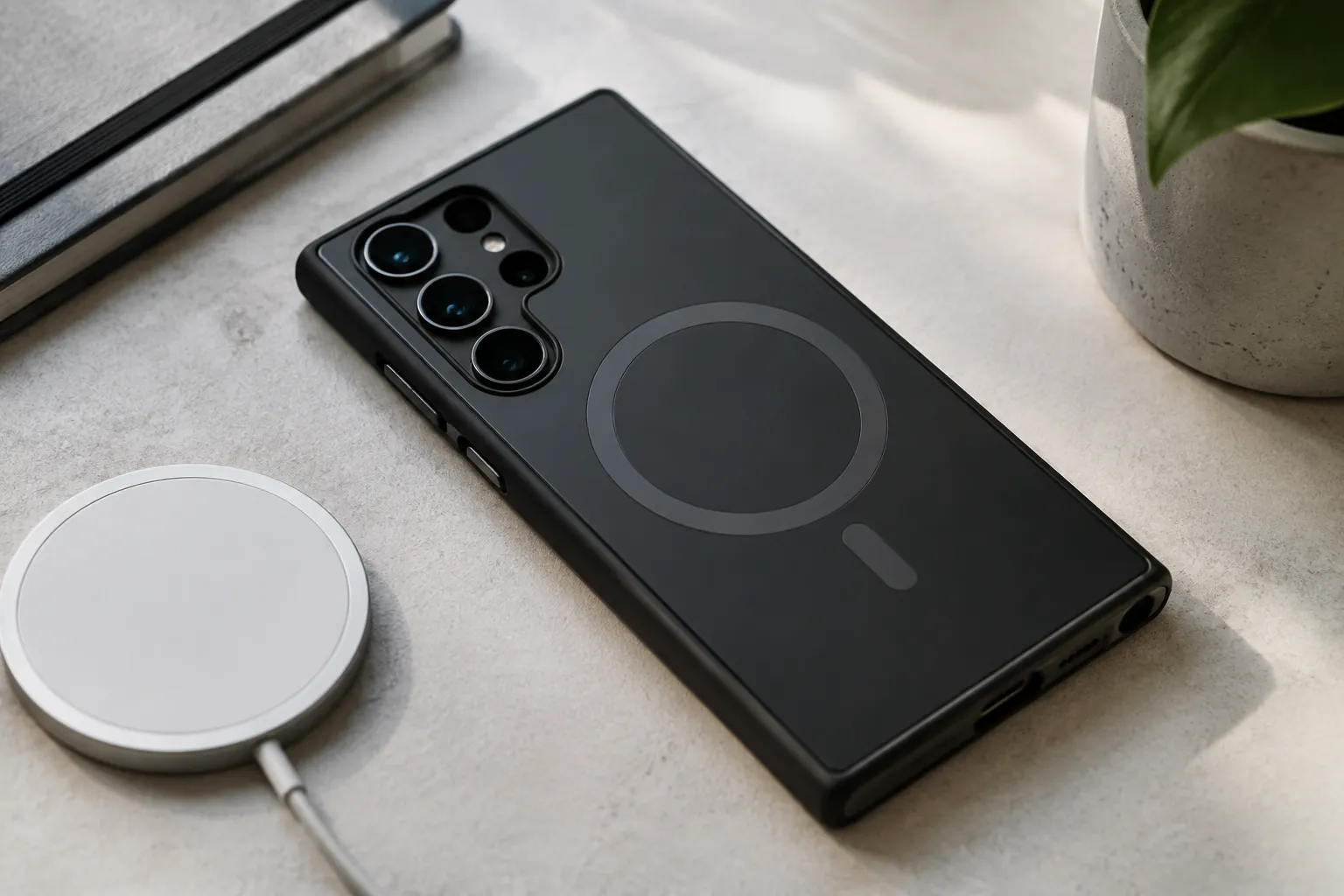
The fundamental problem with the S24 Ultra is that Samsung refuses to build magnets into the frame. Apple owns the MagSafe ecosystem, and Samsung has its own proprietary wireless charging standard that never caught on with accessory makers. That leaves buyers with two choices: a magnetic ring stuck to the back of a naked phone, which looks terrible and interferes with the S Pen, or a case with embedded magnets. This roundup covers the second path. The shortlist includes a few obvious names and one unexpected contender that manages to be both slim and genuinely sticky.
Why grip matters more on a 232 gram phone
Every phone case review talks about grip like it is a luxury feature. On the S24 Ultra, grip is a safety requirement. The phone is tall enough that the center of gravity sits high in the hand, and the flat sides mean there is no curved back to hook a pinky finger onto. A person reaching across a desk or pulling the phone out of a pocket is one bad grip away from dropping a $1,300 device onto concrete. The stock Samsung case, the one with the kickstand, is slippery in a way that borders on negligent.
The cases that solve this problem do it with surface texture, not with material thickness. Soft-touch silicone feels grippy in a store but turns glossy after a few weeks of pocket wear. Textured polycarbonate with a matte finish holds up better. The best options use a combination: a hard shell for structure and a softer TPU bumper with some kind of pattern or ribbing on the edges. That edge texture is where grip actually lives, because that is where a hand wraps around the device.
The other factor is width. A case that adds 2 millimeters to each side makes the phone harder to hold, not easier. The S24 Ultra is already at the edge of comfortable single-hand use. Every millimeter of added girth pushes it past that edge. Slim cases are not an aesthetic preference here. They are a functional requirement for anyone who does not want to use two hands for every text message.
The ultra-slim category has one real winner
Pitaka makes the MagEZ Case Pro 4 for the S24 Ultra, and it is the thinnest magnetic case that does not feel like a compromise. The construction uses aramid fiber, which is the same material used in ballistic vests and high-end racing helmets. It is thin, it is light, and it has a texture that is hard to describe until it is felt. The surface is not rubbery and not slick. It sits somewhere in between, like a finely woven fabric that has been compressed into a solid shell.
At 1.5 millimeters thick and 31 grams, the Pitaka disappears on the phone. There is no lip protecting the camera lenses, which is a real concern for anyone who sets the phone down on rough surfaces. The bottom cutout is open, exposing the USB-C port and speaker grille. That open bottom means the case does not protect the lower corners from a drop. This is not a rugged case. It is a case for someone who wants the phone to feel naked while still having magnet functionality.
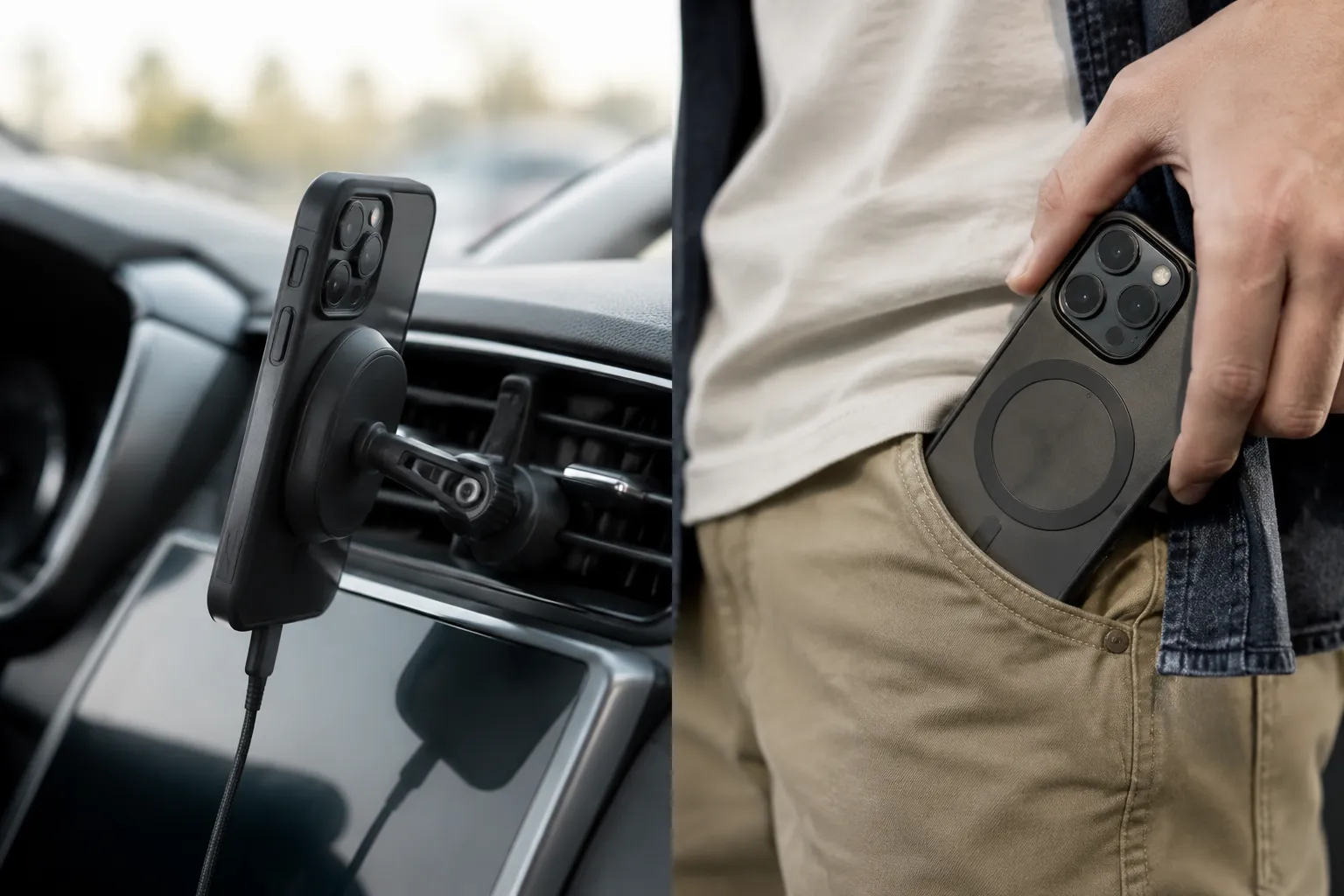
The magnets in the Pitaka are strong. A MagSafe wallet sticks to the back and stays put through normal use. The alignment is precise, so wireless charging works at full speed with compatible chargers. The aramid fiber does not interfere with the magnetic field at all. The one major drawback, beyond the lack of drop protection, is the price. Pitaka charges a premium for the material and the brand. For someone who mostly keeps a phone in a pocket and uses a magnetic car mount, the cost is justified.
The sticky middle ground: Spigen's magnetic refresh
Spigen released a MagSafe-compatible version of its classic Thin Fit case for the S24 Ultra, and it is the best value option in this category. The case uses a two-piece design: a hard polycarbonate back and a TPU bumper. The bumper has a matte finish with tiny horizontal ridges along the sides. Those ridges are subtle enough to go unnoticed visually but aggressive enough to keep the phone from sliding when a hand gets sweaty.
The Thin Fit MagSafe measures about 2.5 millimeters thick on the back and adds roughly 1.5 millimeters to each side. It is not as thin as the Pitaka, but it offers real drop protection. The corners have air cushion technology, which is Spigen's term for hollowed-out corner pockets that absorb impact. The camera cutout is a precise circle with a raised lip that keeps the lenses off flat surfaces.
This case costs about a third of what the Pitaka costs, which makes it the sensible recommendation for most people. The magnets are not quite as strong as the Pitaka's, but they hold a wallet or a car mount securely. The texture on the sides is the standout feature. It provides the kind of grip that makes a person feel confident holding the phone one-handed while walking down a busy street. The tradeoff is the back panel, which is smooth and a little prone to fingerprints. The black version hides this better than the clear one.
When a case needs to be a tank: the rugged pick
For people who drop phones regularly, the UAG Pathfinder with MagSafe is the honest answer. UAG cases are not slim and they are not pretty. They are built like tactical equipment, with a hard outer shell, reinforced corners, and a hexagonal pattern on the back that looks like it belongs on a military drone. The Pathfinder adds about 4 millimeters to the thickness and pushes the total weight past 280 grams with the phone installed.
Holding the UAG case feels different from holding any other case in this roundup. There is no slippery surface anywhere. The sides have a deep texture that feels like sandpaper with a cloth backing. The back has a rubberized section near the camera that provides tactile feedback. This case will not slide off a car dashboard. It will not slide out of a hand. It will not let go of anything it touches.
The magnet array in the Pathfinder is substantially stronger than the Spigen's. UAG embeds a full ring of magnets rather than a segmented set. A MagSafe battery pack snaps on with an audible click and stays attached even when swinging the phone around by the pack. The downside, beyond the bulk, is that the raised rubber bezel around the screen makes edge swipes less fluid. Gesture navigation requires a slightly more deliberate motion to get over the lip.
This is the case to buy for someone who works outdoors, carries the phone on a belt, or has a habit of resting it on car roofs before driving away. It sacrifices the slim profile entirely in exchange for confidence. That trade is worth making for the right person, but it is the wrong choice for anyone who values pocket comfort.
The clear case problem and one partial fix
Clear cases with MagSafe are everywhere, and almost all of them yellow within six weeks. The ones that do not yellow are made from polycarbonate backs with TPU bumpers, which means the back stays clear but the edges turn an ugly amber color. The only clear case worth considering for the S24 Ultra is the Ringke Fusion Magnetic, and it has a specific trick: the bumper is detachable from the hard back.
The Ringke case allows a person to replace just the yellowed bumper when it eventually discolors. Ringke sells the bumper separately for a few dollars. This is not a permanent solution, but it extends the life of the case significantly. The back of the case has a matte anti-fingerprint coating that actually works. Smudges are visible but wipe away easily.
The grip on the Ringke is adequate but not exceptional. The TPU bumper has a smooth matte finish without any texture pattern. It is less slippery than bare polycarbonate but not as sticky as the Spigen's ridged sides. The magnets are placed in a visible circle on the back, which looks fine on the black version and slightly odd on the clear version, since the metal ring interrupts the view of the phone's back panel. For someone who specifically wants to show off the titanium finish, this is the best clear option. For someone who prioritizes grip, the Spigen remains the better buy.
The dark horse: a case that rethinks the kickstand
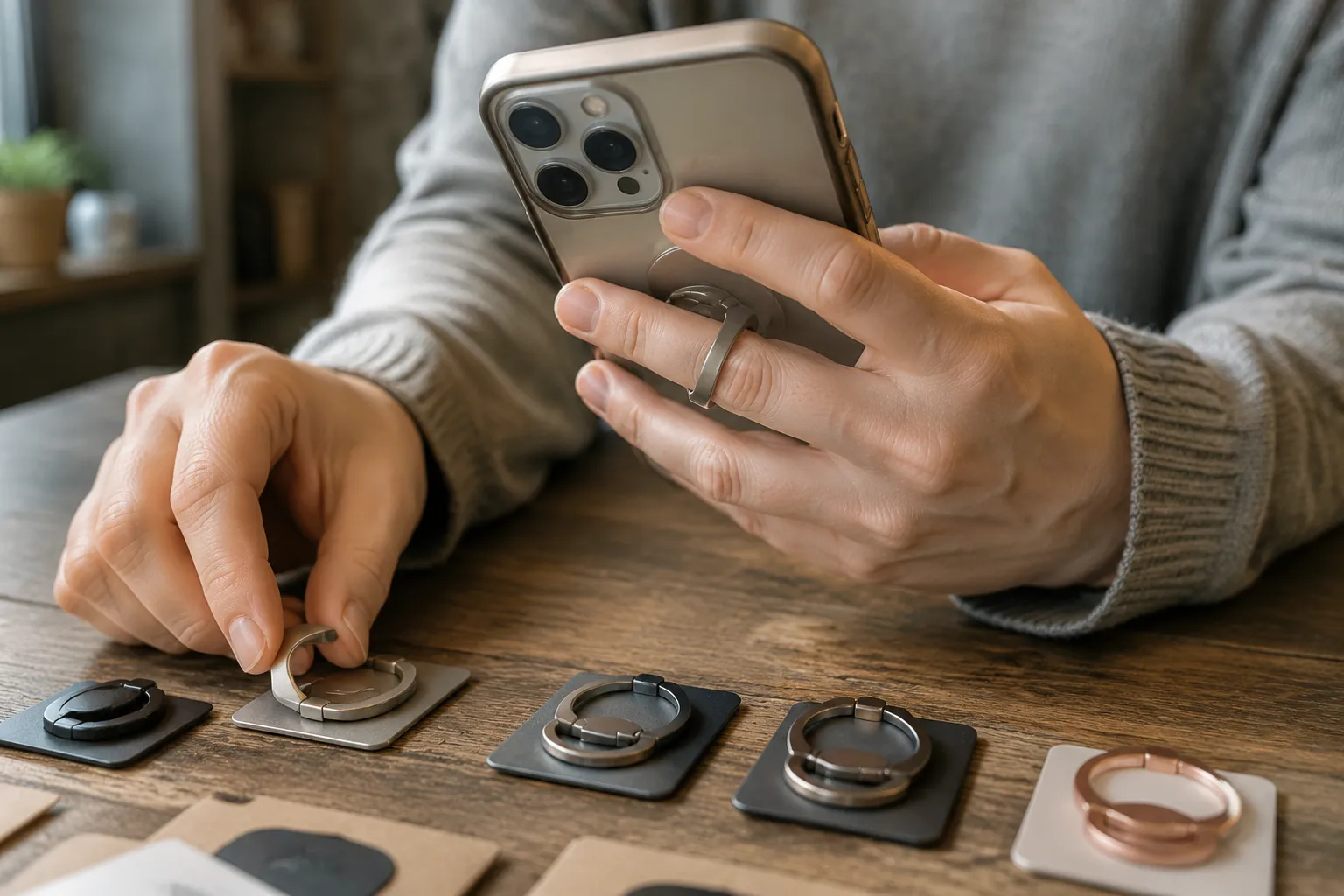
The ESR MagSafe Case with a built-in stand deserves attention for a reason unrelated to grip. ESR solved the kickstand problem by making the stand out of the magnet ring itself. The back of the case has a metal loop that folds flat against the surface or flips up to act as a finger ring or a desk stand. This loop is also the magnet array, so there is no extra bulk added for the stand function.
Using the ESR case feels like handling a different kind of object. The metal loop on the back provides a place to hook a finger, which changes the entire ergonomics of holding a large phone. A finger through the loop allows the hand to relax while the weight of the phone rests on that finger. This dramatically reduces the grip effort required, especially when using the phone with one hand for extended periods like reading or watching video.
The case itself is about 2 millimeters thick with a soft-touch back coating that has a slight rubbery feel. The edges are smooth and do not offer much texture, but the finger loop compensates for that. The kickstand function works in both landscape and portrait orientations, which is rare. The magnets are strong enough for car mounts but the metal loop means some flat magnetic mounts will not sit flush. The loop has to be folded down first, which adds an extra step when docking the phone.
This is the case for someone who uses the phone as a primary media device. The S24 Ultra has one of the best screens on the market, and propping it up on a desk or holding it with one finger while lying on a couch is a legitimate use case. The ESR case enables both without the bulk of a folio or a separate grip accessory.
What actually matters with the magnet strength
MagSafe cases for Android phones vary wildly in magnet strength, and the difference is not visible in product photos. The official Apple spec calls for a pull force of about 1 kilogram for a direct attachment. Some cheap cases on Amazon deliver a fraction of that. A weak magnet array means a wallet slides off in a pocket or a car mount drops the phone on a bumpy road.
The cases in this roundup all exceed the minimum threshold, but they are not equal. The UAG Pathfinder has the strongest hold, followed closely by the Pitaka. The Spigen and Ringke are adequate for stationary use but will let a heavy battery pack wobble. The ESR case falls in the middle. For a person who plans to use a magnetic wallet daily, magnet strength should be the deciding factor between the Pitaka and the UAG. For someone who only needs the case to charge wirelessly and occasionally snap onto a tripod mount, the Spigen is more than enough.
One additional consideration is heat. Wireless charging generates heat, and a case adds insulation. The thinnest case in this roundup, the Pitaka, allows the most heat dissipation. The UAG, with its thick rubber layers, retains more heat. This matters for the S24 Ultra because fast wireless charging at 15 watts will slow down if the phone gets too warm. A person who charges wirelessly every night should lean toward a thinner case for consistent charging speeds.
A note on the S Pen and magnet interference
The S Pen in the S24 Ultra uses electromagnetic resonance technology. Strong magnetic fields can interfere with the digitizer layer beneath the screen. This is a real concern with MagSafe cases, since they introduce magnets directly behind the phone. The cases tested here all keep the magnet array positioned below the area where the S Pen digitizer is most active, which is the upper center of the screen.
In practice, writing near the edges of the screen with any of these cases installed produces occasional jitter or skipped strokes. The effect is most noticeable in the bottom corners of the display, near where the magnets sit. The Pitaka, being the thinnest, shows the least interference. The UAG, with its stronger magnet array, shows slightly more. None of these cases make the S Pen unusable, but a person who does heavy note-taking with the S Pen should be aware that a magnetic case will introduce some minor artifacts. Samsung's own non-magnetic cases do not have this issue.
Removing the case and using the S Pen bare eliminates the problem entirely. For most users, the occasional jitter when writing in the extreme corners is an acceptable trade for having magnetic accessory support. For digital artists or students who take handwritten notes all day, the trade might not be worth it. That person should buy a magnetic case for daily use and keep a slim non-magnetic case for dedicated S Pen sessions.
The final call depends on daily habits
The right case is the one that matches a specific daily routine. A person who commutes by car and relies on a magnetic vent mount will want the Pitaka for its thin profile and reliable hold. A person who walks through a city and takes photos on the move will want the Spigen for its side grip and balanced drop protection. A person who watches videos in bed and holds the phone above their face will want the ESR for the finger loop that removes the fear of dropping the phone on their nose.
The UAG exists for the person who has cracked a previous phone or who works in an environment where drops are not a possibility but a certainty. It is heavy and ugly, but it turns the S24 Ultra into a device that survives contact with concrete. That specific kind of confidence has a price, and for some users, no slim case can match it.
What none of these cases do is make the S24 Ultra feel small. That is not a failure of design but a property of the device itself. The phone is large, and a case can only manage that size, not erase it. The best any case can do is make the size manageable, which means adding grip where a hand touches, keeping bulk where a pocket does not, and providing magnetic functionality without compromising the structural integrity of the package. Each case in this roundup accomplishes that goal in a different way, and the differences are significant enough that choosing based on price alone would be a mistake.