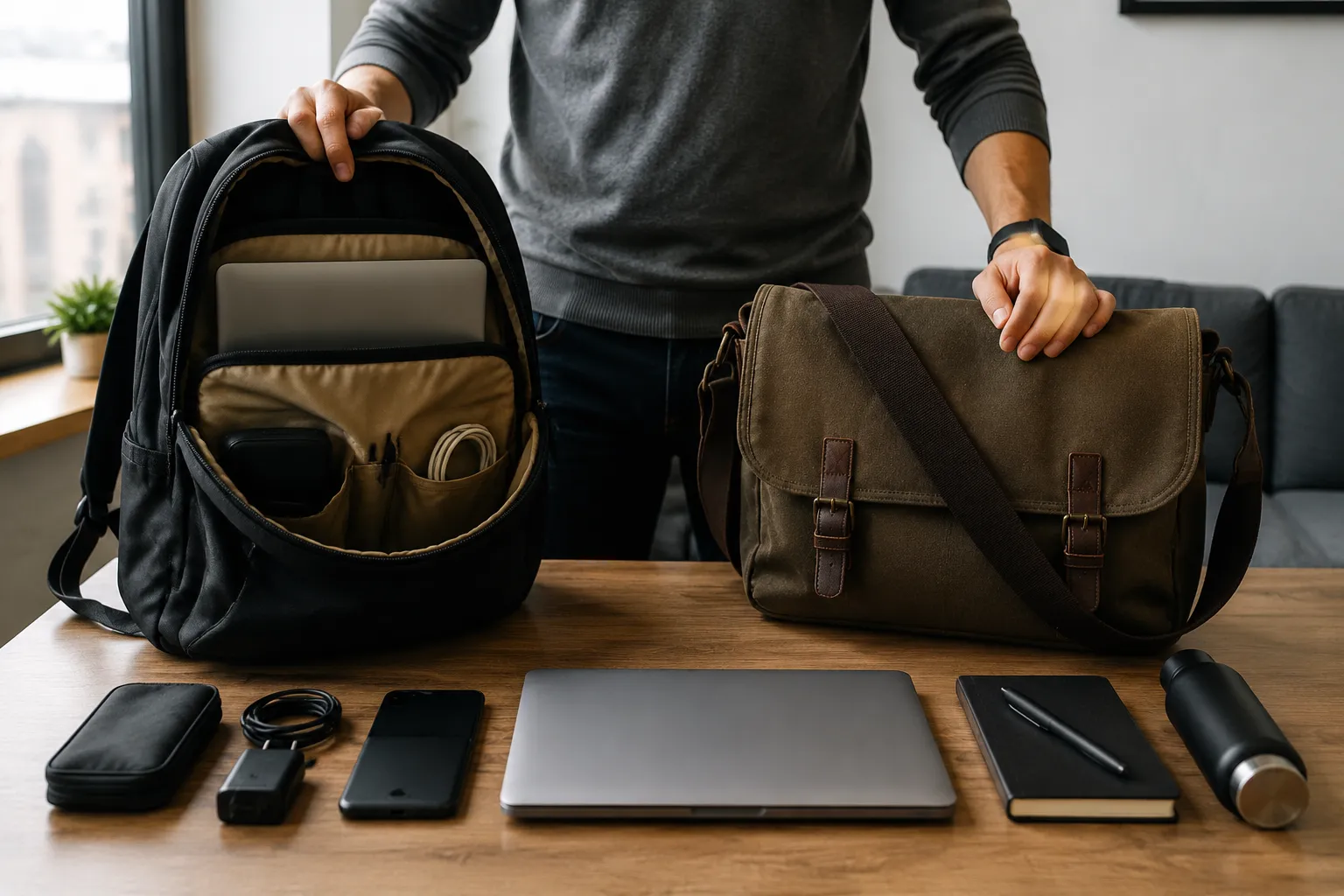
The default assumption holds that a backpack is the responsible choice and a messenger bag is the stylish compromise. The backpack wins on ergonomics, the messenger wins on access, and most buying guides leave the decision there. That framing misses the actual problem. The right carry depends less on the bag itself and more on what the load does to the body over a full day of movement, and on how often the contents actually need to come out.
For a decade of carrying laptops, cameras, and the assorted cables that breed in side pockets, the real distinction has emerged through use. A messenger bag is not a worse backpack. It is a different tool with a different failure mode. The failure mode for a backpack is the heat on the back and the ritual of removing the whole thing to reach a phone. The failure mode for a messenger is the shoulder, and it arrives faster than most people expect.
The Physics of the One-Strap Load
The human shoulder was not designed to carry a diagonal strap under load for hours. A messenger bag distributes weight across the trapezius and the clavicle, and the body responds to that pressure by hitching the shoulder upward. Over a commute of forty minutes, that hitching becomes a habit. By the end of the week, the neck on the strap side feels tight. By the end of the month, the postural shift is visible in a mirror.
None of this surfaces in the first week of ownership. A new messenger bag with a light load feels almost liberating. The quick spin to the front, the silent unzip, the removal of a laptop without setting the bag down. That convenience is real. It is also the trap. The bag encourages the wearer to load it like a backpack, and the body pays a compounding tax that the backpack never asks for.
Weight is the deciding variable. A messenger bag with a load under four kilograms, roughly the weight of a slim laptop, a tablet, a charger, and a notebook, is manageable. Push past six kilograms with a camera body, a couple of lenses, and a hard drive, and the strap digs into the shoulder in a way that no pad can fully solve. Padding helps distribute pressure, but it does not change the fundamental asymmetry of the load.
The counterargument has merit. A well-designed messenger bag, worn high and close to the body, keeps the weight nearer the center of mass than a backpack that sags low on the hips. The bag should sit at the top of the hip bone, not hang at the waist. Most people wear messengers too low, which increases the lever arm and multiplies the strain on the shoulder and the lower back.
Backpack Heat and the Urban Sweat Tax
The backpack's weakness is not the shoulders. It is the back. A padded backpack panel pressed against a shirt in warm weather turns a fifteen-minute walk into a damp ordeal. The back does not ventilate well, even with the mesh channels and airflow ridges that manufacturers claim solve the problem. Those features help at the margins. They do not change the fact that a heat source sits against the spine.
This matters more in some cities than others. A person commuting in a temperate climate, where the morning temperature stays below twenty degrees Celsius for most of the year, will not feel the heat tax as acutely. A person in a city with humid summers will arrive at work with a sweat stain that no fabric technology has fully prevented. The messenger bag, worn off the back, lets air move freely across the shirt.
The tradeoff becomes stark in summer. The backpack keeps the load balanced but cooks the wearer. The messenger keeps the wearer cool but punishes the shoulder. Neither option wins outright, and the choice often comes down to which discomfort the person tolerates better.
There is a third path. The sling bag, worn across the back with a single strap, splits the difference poorly. It carries less than either alternative and still loads one shoulder. The sling works for a tablet and a phone, nothing more. Anyone who needs to carry a full laptop, let alone a laptop plus peripherals, should skip the sling entirely.
Access Frequency Decides More Than Weight
Consider the actual rhythm of the day. A person who takes the laptop out twice, once at the office and once at home, needs access exactly zero times during transit. The backpack's inconvenience, the need to remove it and set it down, never manifests. The bag stays on the back for the entire commute, and the access problem is theoretical.
The messenger earns its keep in a different rhythm. The coworking user who moves between desks, the field technician who pulls a tool from the bag every few minutes, the photographer who swaps lenses while standing on a sidewalk. Each of those people performs a remove-and-replace cycle that a backpack makes awkward. The messenger bag swings to the front, opens, closes, and swings back, all without setting anything down.
The frequency threshold sits around once every fifteen minutes. Below that, the backpack's superior ergonomics win. Above that, the messenger's access advantage outweighs the shoulder strain. A person who checks a phone by reaching into a backpack pocket has already lost the efficiency battle. The phone lives in a pants pocket, not a bag, and anyone who carries a bag primarily for phone access has misdiagnosed the problem.
The Laptop Size Ceiling
Screen size imposes a hard constraint that most discussions ignore. A thirteen-inch laptop fits comfortably in almost any messenger. A fifteen-inch laptop, particularly the heavier workstation models, turns a messenger into a shoulder injury waiting to happen. The bag's proportions change, the weight shifts outward, and the strap geometry becomes less forgiving.
The physical dimensions matter beyond weight. A messenger bag wide enough to hold a fifteen-inch laptop becomes a bulkier object against the hip. It catches on doorframes, bumps into fellow passengers on crowded transit, and generally makes the wearer more aware of its presence. The backpack, worn centered on the back, has a smaller effective footprint in crowded spaces.
Anyone carrying a sixteen-inch or seventeen-inch laptop should not be considering a messenger at all. The form factor simply does not suit loads that large. The industry has responded with oversized messengers that look like collapsed backpacks, and those bags fail at both jobs. They hang awkwardly, they weigh too much empty, and they still load one shoulder with the full weight of a desktop-replacement laptop.
The Style Argument Has Real Teeth
The aesthetic case for the messenger bag deserves more respect than gear reviewers typically give it. A backpack reads as commuter gear, and in many workplaces that is fine. In client-facing roles, in creative fields, or in cities where the visual language of dress matters, a well-made leather messenger projects a different signal. It suggests that the wearer carries only what is necessary.
That signal has a cost. A leather messenger bag that looks good weighs between one and two kilograms empty. Add a laptop and the daily load crosses the discomfort threshold before a single accessory goes inside. The canvas messengers weigh less but read more casual, and the nylon technical options read as gym equipment.
The backpack has closed much of this gap. The modern commuter backpack, built with waxed canvas or minimal leather trim, carries a similar visual weight to a messenger at half the empty weight. The design language has shifted far enough that the old association between backpacks and students has faded. What remains is the silhouette, and some people simply prefer the horizontal line of a messenger against the hip.
The Commute Is the Test
A laboratory comparison of straps and padding misses the variable that matters most: the commute itself. A person who walks ten minutes to a train, stands for twenty minutes, and walks another ten minutes has a different experience than a person who cycles for thirty minutes or drives for an hour.
Cycling eliminates the messenger bag as an option. The diagonal strap shifts during the motion of pedaling, the bag swings with each turn of the handlebars, and the load on one shoulder destabilizes the upper body. A backpack, worn snug against the back, stays put. The cyclist who wears a messenger is fighting the bag for the entire ride.
Standing on a train favors the messenger. The wearer can swing the bag to the front and guard it against pickpockets, a real concern in crowded stations. The backpack on the back is out of sight and, in dense crowds, out of control. The messenger worn in front also doubles as a small table for holding a phone or a book during the ride.
The walking commute favors neither. Walking is the one mode where the body absorbs load symmetrically, and a good backpack distributes weight across both shoulders and the hips if the waist strap is used. The messenger's asymmetric load becomes more noticeable over longer walks, and a thirty-minute walk with a three-kilogram messenger leaves the strap shoulder noticeably more tired than the other.
What the Bag Does When Empty
Most buying advice focuses on the loaded state, but the empty state shapes daily behavior. A backpack that collapses into a shapeless lump when empty invites overpacking. The empty space reads as unused potential, and the wearer fills it with items that have no scheduled use. A messenger bag, with its flatter profile and more structured shape, discourages that behavior.
This is the quiet argument for the messenger. The form factor imposes a discipline that the backpack does not. The messenger holds the laptop, the charger, the notebook, and little else. The backpack holds the laptop, the charger, the notebook, a jacket, a water bottle, a book, a snack, and the accumulated debris of the week.
The wearer who notices this dynamic has already made the decision. The person who carries a bag to be prepared for every possible scenario needs the capacity of a backpack. The person who carries a bag because the pockets of a coat cannot hold a laptop needs the specificity of a messenger. The bag should match the mental model of what belongs in it.
The Hardware That Actually Fails
Beyond the ergonomic debate lies the question of durability, and here the messenger bag has a hidden weakness. The buckle, the clasp, or the magnetic closure that secures the main flap is the component most likely to fail, and it fails at the worst possible moment. A backpack's zipper can fail too, but the load is still contained by the bag's structure. A messenger's flap closure failure spills the contents onto the ground.
Magnetic closures wear out fastest. The rare-earth magnets that snap shut with satisfying force lose their strength over years of use, and the flap starts to pop open under load. The buckle closures, whether plastic side-release or metal ladder-lock, are more reliable but slower to operate. The Velcro closures are the loudest and the least professional, announcing every open and close with a rip that draws attention in a quiet room.
The backpack has no equivalent single point of failure. The main compartment zipper can jam, but the bag still carries the load. The shoulder straps can detach at the anchor points on cheap models, but the stitching gives warning through fraying before a catastrophic failure. The messenger's flap hardware gives no such warning.
A person who buys a messenger should inspect the closure mechanism with the same care applied to the stitching and the strap padding. The closure is the part that will end the bag's life, and it is the part that most reviews ignore.
Water and the Contents Within
Weather resistance flips the conventional wisdom. A backpack worn on the back is protected from rain by the wearer's body and by the angle of the shoulders. The top of the backpack takes the rain, and most commuter backpacks have water-resistant panels or a roll-top closure for exactly that reason. The back panel stays dry because it never faces the sky.
A messenger bag worn across the body exposes its flap to the rain at an angle that encourages runoff toward the seam. The flap's leading edge, the part that meets the body of the bag when closed, becomes a collection point for water. A sudden downpour can push water through that seam and into the main compartment before the wearer has time to find shelter.
The solution, a rain cover or a bag made from waxed canvas or a welded waterproof fabric, adds weight or requires maintenance. Waxed canvas needs periodic rewaxing to maintain its water resistance, and the rewaxing process is messy. A waterproof liner inside the messenger helps, but it adds bulk and reduces the usable interior volume.
For the person who commutes in a city with reliable weather, this distinction is academic. For the person who walks through actual rain, the backpack's structural advantage is decisive. The messenger is a fair-weather bag unless it carries a waterproof specification that most models do not have.
The Two-Bag Household
The most honest conclusion is that the question of backpack versus messenger is a false binary for anyone who can afford two bags. The person who walks to a train in the morning and moves between client sites in the afternoon needs both. The backpack carries the bulk of the load on the way in. The messenger carries the laptop between those client sites, where the bag comes out of the car or off the shoulder multiple times per hour.
This is not a hedge. It is the practical reality of a working day that has multiple phases. The single-bag purist, the person who insists on one carry for every occasion, ends up with a bag that is too large for quick trips and too small for the full load. The compromise bag, the one that tries to be both a backpack and a messenger through convertible straps, performs neither function well. The convertible adds strap hardware that digs into the back in backpack mode and adds bulk that makes the messenger mode feel clumsy.
The two-bag approach also solves the wear problem. The backpack does not get worn every day, so its shoulder straps and back panel last longer. The messenger does not carry the full daily load, so its strap does not fatigue the shoulder. Each bag performs the job it does well, and neither bag is asked to do the job it does poorly.
The cost of this approach is not just the price of the second bag. It is the space to store the bag not in use, and the discipline to actually switch bags when the day's rhythm changes. Most people will not develop that discipline. They will grab the bag that has the laptop charger in it, and that bag will be the one they reach for every day, regardless of the mismatch between the bag's strengths and the day's demands.
For those people, the ones who will only ever own one bag, the decision comes down to the worst hour of the day. The backpack is the choice for the person whose worst hour is the walk home in the rain with a full load. The messenger is the choice for the person whose worst hour is the frantic reach for a laptop in a coffee shop, the bag's flap already open, the contents already accessible before the chair has stopped sliding back. The body will complain either way. The question is which complaint the person is willing to live with.