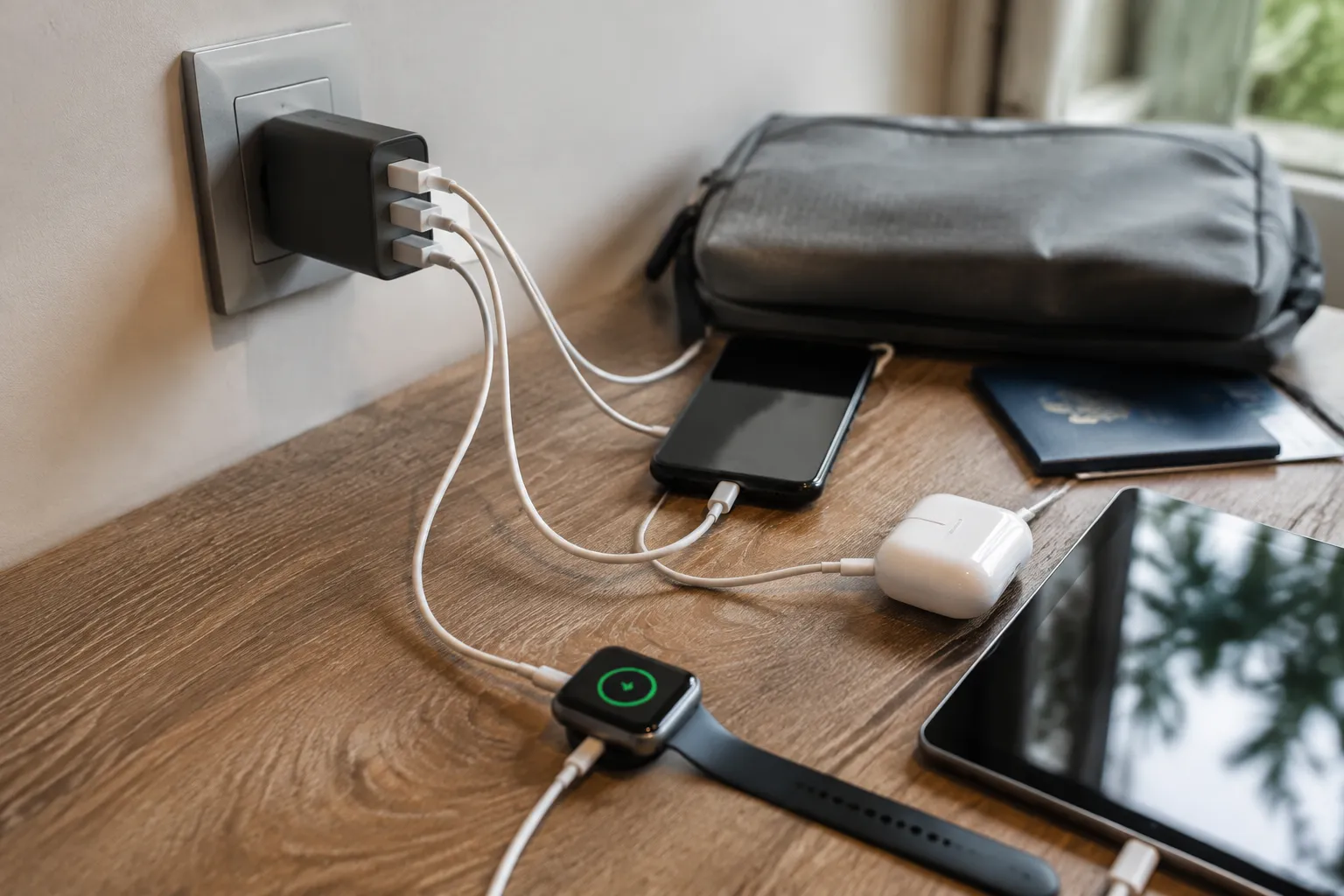
The charging brick is the least loved object in the modern carry rotation. A person will agonize over a titanium pen and then shove a cracked white cube from 2017 into a bag, a cube that manages one device at a glacial pace and sparks anxiety at airport gates. The rest of the everyday carry kit got upgraded. The charger stayed pathetic. This is a test of three chargers that actually try, units designed to refuel a phone, a pair of earbuds, and a tablet or camera battery from a single wall outlet, and the findings are less about raw wattage than about how a brick behaves under real pressure.
The test setup was deliberately unglamorous. A 14-inch laptop at 35 percent battery, a phone drained to single digits, and a set of wireless earbuds with a dead case. Each charger had to bring all three back to functional levels simultaneously, then handle a sequential top-up for the laptop while the other devices stayed plugged in. The wall outlet was a standard household socket, not a lab-grade power source. Temperature was checked by hand after thirty minutes of sustained output, because a brick that throttles or runs hot is a brick that fails at its only job.
The Anker Prime, the heavy favorite with a catch
The Anker Prime 100W arrives with a reputation that precedes it. This is the brick that tech reviewers recommend when they stop pretending budget options are fine. It packs three ports, two USB-C and one USB-A, into a body that is smaller than a deck of cards but noticeably denser. The folding prongs sit flush. The finish is a matte gray that resists fingerprints better than most electronics. It feels like a piece of precision equipment, which is appropriate, because it costs like one.
On pure output, the Prime delivers. The laptop climbed from 35 to 71 percent in an hour while the phone and earbuds charged at full speed on the other ports. The internal power allocation shifted dynamically, and the brick stayed cool enough to hold comfortably. Anker's smart charging circuitry is the best in the business at this price tier, and the Prime demonstrates why. It juggled three devices with different power demands without a single drop in throughput.
The catch is the physical footprint. The Prime is dense in a way that punishes loose bags. It weighs nearly a pound, which sounds absurd for a charger until the hand feels the heft. This is a brick that belongs in a dedicated tech pouch, not a jacket pocket. For the person who wants one charger that lives in a briefcase and never moves, the Prime is the answer. For the person who needs a charger to rotate between a work bag, a weekend backpack, and a car console, the weight becomes a constant negotiation.
The other issue is price. The Prime costs over twice as much as competent alternatives, and the premium buys refinement rather than raw capability. A cheaper charger can hit 100 watts. The Prime hits 100 watts with better heat management, smarter allocation, and a build quality that suggests a decade of use. Whether that refinement justifies the cost depends entirely on how much a person values the absence of fuss.
The Satechi 165W, raw power with a split personality
Satechi's 165W offering is a different animal entirely. This is a charger that seems designed by someone who was told to remove every constraint. It produces enough power to run a small laptop and a tablet simultaneously at full tilt, and it does so through four ports, two USB-C and two USB-A. The wattage figure is not marketing math. The unit genuinely delivers 140 watts through a single USB-C port when a demanding device asks for it.
The testing revealed a split personality. On the desk, plugged into a wall outlet with room to breathe, the Satechi is magnificent. It charged the laptop from 20 percent to full in under two hours while running a phone and earbuds without breaking a sweat. The brick stayed warm, never hot. The power delivery remained stable across all four ports, a feat that many multi-port chargers fail to achieve. This is the charger for the person who docks at a coffee shop for the afternoon and wants every device topped off before leaving.
The problems emerge when the Satechi leaves the desk. The body is long and rectangular, closer to a travel router than a charging brick. The prongs fold, but the weight distribution is awkward, and the unit sags slightly in loose wall outlets. More critically, the Satechi does not play well with other devices on the same circuit. In a hotel room where the air conditioner shares the wall outlet, the charger triggered the breaker twice. That is a niche failure, but it is a memorable one.
The real question for the Satechi is whether a 165-watt charger belongs in an everyday carry rotation at all. The unit is overkill for a phone and earbuds. It makes sense only for the person who routinely carries a power-hungry laptop, a tablet, a camera, and a phone, all dead at the same time. For that person, the Satechi is a revelation. For everyone else, it is a bulky reminder that capability and portability are often opposing forces.
The Nimble 65W, the compact compromise that nearly wins
Nimble took a different approach. The 65W Champ is built around the idea that most people do not need to charge a gaming laptop from a wall brick. They need to charge a phone, earbuds, and a tablet, or a phone and a slim ultrabook. The Champ delivers 65 watts through two USB-C ports and one USB-A port, all packed into a body that is genuinely pocketable. The recycled aluminum shell gives it a texture that is pleasant to hold, and the folding prongs are the sturdiest of the three tested units.
In practice, the Champ handles the three-device scenario with grace. The phone and earbuds charged at their maximum speeds while the laptop pulled 30 watts, a slower rate than the other two chargers but sufficient for a gradual top-up. The brick ran cooler than the Satechi and only slightly warmer than the Prime. The power allocation is fixed rather than dynamic, which means the laptop always gets its share even when the other ports are idle. That is a feature for the person who wants predictable behavior over clever optimization.
The Champ's weakness is its ceiling. When a device demands more than 65 watts, the charger cannot deliver it. A 16-inch MacBook Pro will charge, but slowly. A high-end gaming laptop will drain faster than the Champ can refill it. The unit is also limited to two USB-C ports, which means the person carrying a phone, earbuds, a laptop, and a camera must choose which device goes without. The Champ is honest about its limits, but those limits are real.
What the Champ gets right is the daily reality of most carries. The average person does not need 100 watts. The average person needs a charger that fits in a front pocket, does not tip out of a wall socket, and reliably refuels the devices that actually run low. The Champ does all of that while costing less than half the Prime and a third of the Satechi. It is the charger that most people should buy, even if it is not the one that impresses at a gear meetup.
The wall socket test no spec sheet captures
Chargers are tested on benches and measured with instruments, but they are used in hotel rooms, airport lounges, and the cramped spaces behind nightstands. The wall socket test is where these three units separated most clearly. The Prime and the Champ both feature folding prongs that sit flush against the body. The Satechi does too, but the longer body creates leverage that makes it prone to sagging in outlets that have loosened over years of use.
Loose outlets are the silent killer of travel chargers. A brick that weighs too much or distributes its mass poorly will slowly angle downward until the prongs lose contact. The Prime, despite its density, held firm because its mass is concentrated close to the socket. The Champ held firm for the same reason. The Satechi wobbled in an older outlet in a way that required careful positioning and a prayer that no one bumped the table.
There is also the matter of horizontal clearance. Many power strips and surge protectors place outlets close together, and a wide charger blocks adjacent sockets. The Prime is narrow enough to avoid this problem. The Champ is slightly wider but still fits alongside a standard plug. The Satechi, with its elongated body, effectively kills the socket next to it. In a hotel room with limited outlets, that is a genuine inconvenience.
The cable management question also belongs in this test. None of these units ship with a cable, which is the correct choice, but each behaves differently with the cables a person already owns. The Prime and the Champ both handle thicker, high-wattage cables without strain. The Satechi's port spacing is tight enough that two beefy cables side by side create a small tangle. This matters more than it should, because a charger that looks tidy is a charger that gets packed every morning.
Heat, the enemy that decides longevity
Heat is what kills chargers. Not the dramatic failure of a blown capacitor, but the slow degradation of internal components that happens when a brick runs hot for years. Every charger in this test generates heat under load. The difference is how each one manages that heat and what it sacrifices to keep temperatures down.
The Prime runs the coolest of the three, with a thermal design that spreads heat across the entire aluminum body. After an hour of full load, the surface was warm but not uncomfortable to hold. The Champ ran a few degrees warmer, still acceptable, but the plastic areas near the ports got noticeably hotter than the aluminum shell. The Satechi ran the hottest under sustained load, particularly when all four ports were active. The heat was not dangerous, but it was enough to make a person hesitate before stuffing the unit into a bag immediately after use.
Heat also triggers throttle behavior. When a charger gets too hot, it reduces output to protect itself. The Prime throttled rarely and briefly. The Champ throttled when the ambient temperature was high, reducing the laptop's charge rate by about 15 percent in a warm room. The Satechi throttled more aggressively when all four ports were under load, dropping the laptop from 100 watts to around 65 watts after twenty minutes of sustained output. The numbers recovered once the brick cooled, but the pattern suggests a unit that will age faster than its competition.
For the person who charges overnight, none of this matters. For the person who needs a full laptop charge between meetings, throttle behavior is the difference between making the next appointment and hunting for another outlet. The Prime is the only unit of the three that never compromised its output during the testing window.
The decision comes down to the carry
After several weeks with all three units, the conclusion is not about which charger is objectively best. It is about which charger matches a specific carry style. The Anker Prime is the right choice for the person who treats their tech kit seriously, carries a dedicated pouch, and wants the most reliable charging experience money can buy. The weight is a fair trade for the peace of mind.
The Satechi serves a narrower audience. The person who carries a 16-inch laptop, a tablet, a mirrorless camera, and a phone, and needs all of them charged from one outlet several times a week, will find the 165 watts indispensable. That person must accept the bulk and the occasional sag. The Satechi is not a travel charger in the traditional sense. It is a desktop charger that happens to fold.
The Nimble Champ is the one that earns a permanent spot in a well-traveled backpack. It handles the realistic load of a modern carry, fits in spaces where the others struggle, and costs enough less than the Prime that replacing it in three years is not a financial wound. The Champ does not have the Prime's elegance or the Satechi's raw output. It has something more useful: the right size for the job most people actually have.
The charging brick will never be the object that sparks joy. It will sit in a bag, anonymous and utilitarian, until the moment a phone dies and a flight boards in twenty minutes. In that moment, the grams and the wattage figures and the port arrangements all collapse into a single question. Does this brick deliver when it matters? The Prime does, with authority. The Satechi does, with conditions. The Champ does, with a quiet competence that is easy to underestimate and hard to argue with.