The 6.1-inch phone changed the everyday carry equation more than most people realize. For years, the standard advice was simple: buy a bag that fits the phone. That worked when phones were 5.4 inches or smaller. But the current generation of compact flagships, devices like the iPhone 15 Pro and the Galaxy S24, sit right at the boundary where soft pouches stretch suspiciously and rigid organizers refuse to close. The phone is no longer a trivial addition to a bag. It is the primary object, and the bag has to be chosen around it.
The mistake most people make is measuring the phone diagonally and assuming the bag needs a pocket that matches that number. A 6.1-inch diagonal does not translate to a 6.1-inch pocket. The actual device is roughly 5.8 inches tall and 2.8 inches wide, and it needs clearance on every side. A pocket that fits the phone exactly is a pocket that requires two hands, a precise angle, and a small prayer that the fabric gives way. The real requirement is a pocket that accepts the phone without resistance and releases it without a fight.
The Dimensions Behind the Screen Size
Manufacturers quote the diagonal because it is the largest single measurement, and it sounds impressive in marketing materials. But the diagonal is nearly useless for bag fitting. What matters is the footprint: the height and width of the actual chassis, plus the thickness, plus the case. A person running a slim bumper case adds roughly two millimeters to the width and a few grams of friction. A person running a rugged case adds considerably more.
Take a typical 6.1-inch phone with a standard case. The assembled object measures about 6 inches tall, 3 inches wide, and 0.4 inches thick. That object needs a pocket that is at least 6.5 inches deep and 3.5 inches wide, and ideally a bit more. The extra half inch of depth matters because a phone shoved into a too-shallow pocket sits proud of the opening, and the next time the bag gets tossed onto a seat, the phone slides out.
The thickness is the detail people forget. A 0.4-inch phone fits into a slot that is 0.5 inches wide, but it does not slide in smoothly. It catches. It requires a wiggle. And over time, the repeated wiggling wears out the pocket lining and stretches the opening. A properly sized phone pocket is at least 0.75 inches wide, which means the phone drops in vertically and comes out with a straight pull.
Soft Pouches Versus Structured Organizers
The bag world splits into two camps when it comes to phone storage. The first camp uses soft, unstructured pouches: a simple fabric sleeve sewn into the back panel or the front compartment. These pouches stretch, which is both their strength and their weakness. A soft pouch accepts a 6.1-inch phone easily because the fabric gives way, but it also accepts a 6.4-inch phone, which means the phone shifts around and rubs against whatever else is in the bag.
The second camp uses rigid, molded organizers: the kind with elastic bands, stiff dividers, and precisely cut slots. These look great in product photos and feel terrible in daily use. A rigid slot sized for a 6.1-inch phone leaves no room for a case, no room for a slightly larger phone next year, and no room for the natural variation in how a person grabs the device. The phone goes in at the exact angle the designer intended, or it does not go in at all.
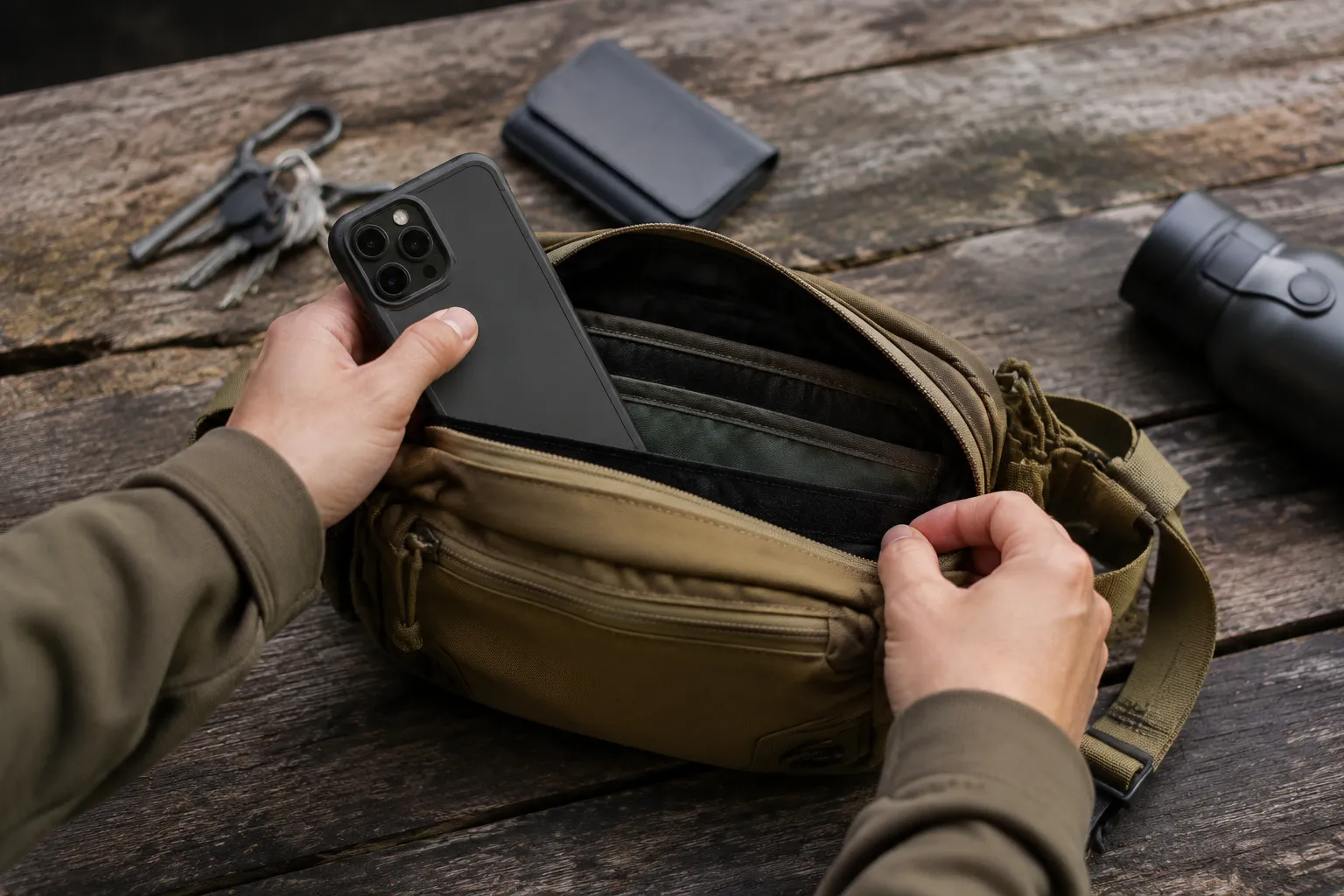
The better approach is a middle ground: a soft pouch with a structured opening. The opening is reinforced with a stiff fabric or a thin piece of plastic, so it holds its shape and accepts the phone without the person needing to hold the bag open with one hand. The interior is soft and slightly oversized, so the phone drops in freely but does not rattle around. This design is rare, and finding it requires reading spec sheets carefully rather than trusting product photos.
Where the Phone Pocket Sits Matters More Than Its Size
A phone pocket on the back panel of a bag, pressed against the wearer's back, stays relatively protected. But a phone pocket on the front panel, near the bottom of the bag, takes the brunt of every table placement, every car seat drop, and every time the bag gets set down harder than intended. The phone absorbs that impact through the bag fabric, and over months, the screen develops micro-stresses that eventually show up as hairline cracks.
The ideal position is high and centered. A pocket located near the top of the main compartment, with the phone oriented horizontally or at a slight angle, keeps the device off the bottom of the bag. This placement also makes the phone accessible without emptying the bag, which matters for people who check their phone constantly throughout the day. A phone buried at the bottom of a 20-liter pack might as well be in a different time zone.
There is also the question of external access. Many bags advertise a "quick access" pocket on the side or the top, designed specifically for a phone. On a 6.1-inch device, these pockets are often too shallow. The phone fits, but only when oriented diagonally, and the diagonal orientation means the corner of the phone presses against the zipper track. Every zip and unzip scrapes that corner. After a few months, the phone case shows wear marks in exactly that spot.
The Case Changes Everything
Bag reviews and spec sheets assume a bare phone. Real people use cases, and cases add bulk that the spec sheet never mentions. A thin polycarbonate shell adds about 1.5 millimeters per side. A silicone case adds closer to 3 millimeters. A rugged case with a built-in screen protector can add 5 millimeters or more, turning a sleek 6.1-inch phone into a device that is effectively 6.3 inches with a significant width increase.
The consequence is that a bag sized for a naked phone becomes a bag that fits a cased phone too tightly. The phone goes in, but it does not go in easily, and it definitely does not come out with one hand. The person ends up using two hands, bracing the bag against their body, and fishing the phone out with a thumb hooked over the edge. This friction happens dozens of times a day, and it grinds on the nerves more than people expect.
Anyone shopping for a bag should measure the phone with its case on and add at least half an inch to every dimension before comparing against a bag's internal pocket measurements. That half inch is the difference between a pocket that works and a pocket that frustrates. And because cases get swapped out seasonally, the measurement should be redone whenever the case changes.
Testing the Fit Before Buying
The only reliable test is to bring the actual phone to the store and try it in the actual bag. Online spec sheets lie, or at least they omit details. A bag listed with a "phone pocket" might have a pocket that fits a 5.5-inch device from 2019, not a modern 6.1-inch slab. The manufacturer measured the pocket diagonally, or they measured the interior at its widest point, which happens to be where the seam curves inward.
In a physical store, the test takes ten seconds. The phone goes into the pocket, and the person checks three things. First, does the phone go in without resistance, meaning it drops to the bottom of the pocket under its own weight? Second, does the phone come out with one hand, without the person needing to grip the bag between their knees? Third, does the pocket have enough depth that the phone is fully covered, with no part of the device protruding above the opening?
When shopping online, the test is harder but not impossible. A person can contact the manufacturer and ask for the internal dimensions of the phone pocket, not the external dimensions of the bag. Many brands will provide this information if asked directly, and the brands that refuse are usually the brands whose pockets do not fit. The answer arrives within a day, and it saves the cost and hassle of returning a bag that looked right but did not fit.
Bags That Get the Phone Fit Right
Certain bag designs handle 6.1-inch phones better than others. The classic messenger bag with a large flap and a single main compartment almost always works, because the phone goes into a soft internal pocket with no structural constraints. The minimalist crossbody with a single external pocket is the opposite: the phone pocket is often the entire bag, and a 6.1-inch phone leaves no room for anything else.
The backpack category shows the widest variation. A commuter backpack with a dedicated laptop compartment and a separate tablet sleeve usually has a phone pocket somewhere in the front panel, and that pocket tends to be sized for smaller devices. A tech-focused backpack with a clamshell opening and a fully configurable interior handles the phone better, because the phone can go into any of several soft pouches rather than being forced into one specific slot.
The sling bag category is where most fit failures happen. A 6.1-inch phone takes up a huge percentage of a 4-liter sling, and the phone pocket on the back panel of the sling, the one that sits against the body, is often too small for anything larger than a 5.8-inch device. A person with a 6.1-inch phone needs a sling of at least 6 liters, and even then, the phone pocket should be verified before purchase.
The Tradeoff Between Access and Protection
Bags that make the phone easiest to grab also make it least protected. A phone in an exterior stretch pocket, the kind on the side of a hiking pack or the front of a urban sling, comes out instantly but takes the full force of any bump or brush. A phone in a deep interior pocket, buried under the weight of a laptop and a water bottle, stays safe but requires a full bag unpack to retrieve.
The 6.1-inch phone forces a decision that smaller phones did not. A 5.4-inch phone fits in an exterior pocket with room to spare and stays reasonably protected because the pocket absorbs some of the impact. A 6.1-inch phone in the same pocket sits proud, the top third of the device exposed, and any lateral pressure bends the phone against the pocket's edge. The larger device needs a deeper pocket, and a deeper pocket means a slower grab.
Some bags solve this with a vertical exterior pocket that accepts the phone top-first. The phone slides in deep, fully covered, and the person grabs the exposed corner to pull it out. This design works, but only when the pocket is genuinely deep enough. Many manufacturers make the pocket look deep in photos by angling the bag, and the actual pocket depth is an inch less than it appears.
Why the Phone Should Be the First Object Placed
The order in which objects go into a bag determines how the bag carries. Most people pack the laptop first, then the accessories, then the phone last, wedging it into whatever space remains. This approach guarantees a bad fit. The phone ends up in a gap between other objects, and it shifts with every movement of the bag, eventually working its way to the bottom where it gets crushed under everything else.
The better sequence starts with the phone. The phone goes into its designated pocket first, and every other object gets placed around it. This approach forces the person to know where the phone lives before they start packing, and it prevents the common situation where the phone has no home and gets dropped into the main compartment loose.
A loose phone in a bag is a hazard. It slides against keys, scratches against the metal zipper pull, and gets sat on when the bag is set down. Even in a bag with soft lining, a loose phone rattles and shifts with every step. The dedicated pocket, sized correctly and positioned thoughtfully, is the only safe home for a 6.1-inch device, and the bag that lacks such a pocket is the wrong bag.
When the Spec Sheet Says One Thing and the Bag Does Another
There is a particular frustration in receiving a bag whose listing promised a phone pocket and finding that the pocket is a cosmetic detail rather than a functional one. The pocket exists, but it is sewn shut at the bottom, or it is angled so the phone cannot enter straight, or it is lined with a material that grips the phone case like Velcro. These bags go back, and the return shipping cost is the price of trusting a spec sheet.
Experienced bag buyers learn to read between the lines of product listings. A listing that gives internal dimensions in millimeters is more trustworthy than one that only gives external dimensions. A listing that shows a photo of a phone actually inside the pocket is more trustworthy than one that shows the pocket empty. A listing that mentions the phone pocket's depth and width, rather than just its presence, is the rarest and most reliable of all.
The 6.1-inch phone has become the standard compact size, and bag manufacturers are slowly catching up. But the catch-up is uneven. Some brands have redesigned their pockets around the new reality, while others still ship bags designed when a phone was small enough to fit in a shirt pocket. The buyer's job is to distinguish between the two, and the only reliable method is to measure, test, and refuse to settle for a bag that treats the phone as an afterthought.